The 53rd edition of the San Francisco International Film Festival (SFIFF) came to a close on May 6, having sold out 92 screenings during its successful 15-day run. While I'm still mulling over the three dozen films I saw during those two weeks—all of which I hope to write about—here's a look back at five of this year's special events.
I've been coming to the SFIFF for a few decades now, and 2010 was only the second time I've attended the opening night festivities. Someday I might grow to feel blasé about the event, but for now I still get caught up in the glamour of it all. My suit came out of the closet for the first time since last year's opening night, and despite a major MUNI snafu I was second in line and able to secure myself a choice, unreserved aisle seat in the Castro Theater. After perusing the contents of my goodie bag—which I placed under my seat and regrettably forgot at evening's end—I spent 90 minutes chatting with friends who were equally amped up for two weeks of movies, movies, movies.
The program started 20 minutes late, presumably to accommodate late arrivals from the aforementioned MUNI delay. Late that afternoon, a man either jumped or fell onto the Castro St. Station subway tracks and was killed, effectively terminating all train service until mid-evening. Finally at 7:20PM, SF Film Society Executive Director Graham Leggat took the stage and welcomed everyone, reminding us that this was his fifth year at the festival's helm—"the best five years of my life." The resounding applause and cheers hopefully told Leggat that the feeling is mutual.
This year's opening night film was Jean-Pierre Jeunet's Micmacs, which the director assured us had nothing to do with Big Macs, and everything to do with his new favorite English word, shenanigans. I've enjoyed all of Jeunet's films, except the one everybody adores (yes, Amelie, I'm talking about you). Reviews for Micmacs have been mixed, but it turned out to be a perfect opening night film—inventive, fast-paced, comical, crowd pleasing. I couldn't remember much about it the next day, but I did recall how much fun I had while watching it. After the screening, the festival's new Director of Programming Rachel Rosen interviewed Jeunet and conducted an audience Q&A. We learned that the director "wanted to put everything I love in this film," which ranged from animator Tex Avery to Mission Impossible, and that he's "not interested in realism." When asked if he might ever work again with Marc Caro (co-director of Delicatessen and The City of Lost Children), Jeunet diplomatically replied, "it's so good to work alone." With the final question, Jeunet got off the best line of the evening in regards to Micmacs poor reception on his home front: "In France they love to hate what they loved before." With that, the ebullient crowd adjourned to the Regency Center for a swinging after-party. The nibbly things I sampled there were delicious, and I washed them down with the beer everyone who frequents Landmark Theaters loves to hate.
I hadn't attended the festival's Founder's Directing Award program since it was given to Arturo Ripstein in 1999 (when it was still known as the Akira Kurosawa Award). In the interim years I've skipped honorees both deserving (Coppola, Leigh, Lee, Herzog, Forman, Altman, Kiarostami) and, imho, questionable (Eastwood, Beatty, Hackford). When I unexpectedly found myself with a free night on April 28, I high-tailed it over to the Sundance Kabuki Cinema for this year's tribute to Brazilian director Walter Salles (Central Station, The Motorcycle Diaries).
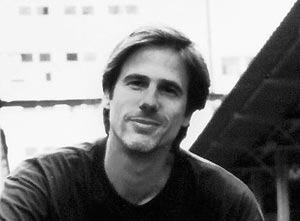
Firstly, I wish someone had clued me in on how handsome this guy is so I could have ogled him from the front row. But from my seat in the Kabuki's large House One it was easy to perceive the man's warmth and self-effacing intelligence. The evening began with introductory remarks by Leggat, followed by a clips reel of career highlights. Then came the on-stage conversation with Mexican director Alejandro González Iñárritu, who started things off by saying, "Let's put the guns down before we start, and talk about the sex life of Mr. Walter Salles." Hear, hear! I loved hearing about Salles' early life as a diplomat's son living atop a Parisian arthouse theater. Twelve-year-old Walter frequented that cinema so often, the ticket seller began letting him in for free. But he longed for Brazil: "I hated the drizzle, the cold, the croissants." During the talk it was also revealed that Salles spent a full year casting the boy in Central Station, that Latin Americans do not make good genre films (i.e., his own remake of Hideo Nakata's Dark Water), and that Argentina currently has the strongest cinema in Latin America (little to argue about there). He also acknowledged that "Antonioni is the director who brought me to cinema," specifically 1975's The Passenger.
Before getting to the evening's main event, Salles shared a short film that had been screened only once before—for the 60th anniversary of the Cannes Film Festival. In it, he addresses his six-month-old son, saying, "If I could choose just one film for you to see before any other, it would be this one." Then we saw an infant entranced by Chaplin dancing with the globe balloon in The Great Dictator. Salles remarked that they screened a DVD projection for the first take, and his son just wasn't interested. For the second take they projected it in 35mm and this time he became fully engaged by Chaplin's antics. What a smart, discerning kid!
As a special treat made exclusively for the SFIFF, Salles next showed us a one-hour work-in-progress documentary about his efforts to film Jack Kerouac's On the Road. It was edited in just one week from 100 hours of mini-DV and super-8 interview and location footage. Salles, who first read the book as a 15-year-old, feared that showing an incomplete film about The Beats in San Francisco might be a "suicidal act," but the festival audience ate it up. In its current state, the film gives an impressionistic overview of Kerouac's work and the times from which it sprang. An off-camera Matt Dillon intermittently reads passages from the book, and contemporary figures ranging from Laurie Anderson to Johnny Depp to David Byrne reflect on its influence. There are terrific interviews with key players who are still with us (Michael McClure, Carolyn Cassady), as well as vintage screen tests by Brendan Fraser, Ashley Judd, Mathew McConaughey and others made for a previous attempt at filming the book. Directors as diverse as D.A. Pennebaker and Jean-Luc Godard have been interested in the project, but based on the evidence presented that night, Salles is clearly the man for the job. Indeed just one week after this event, it was announced that shooting for Salles' On the Road (the narrative feature) will begin in August. The next day at the festival, Salles would conduct a master class, as well as introduce a screening of his 2008 film, Linha de Passe.
On Saturday, May 1st, I must have changed my mind a dozen times. Should I spend the early evening at the Kabuki watching a French orangutan documentary (Nenette) and a Brazilian movie (The Famous and the Dead) before heading over to the Castro for the late-night world premiere of All About Evil? Or should I catch Roger Ebert receiving this year's Mel Novikoff Award at the Castro? I chose the latter and it turned out to be a smart move. The combination of Roger Ebert and Peaches Christ made for one of the most fabulous evenings I've experienced in 35 years of attending this festival.
Ebert and his wife Chaz were brought onstage and seated while four directors delivered heartfelt and hilarious tributes to the man they call "The Thumb." Terry Zwigoff recalled Ebert being the first person in line for a 1985 Telluride screening of Louis Bluie, and later sold him a soundtrack LP in the theater lobby. He also told a great story about a Crumb test screening. The audience survey cards were overwhelming negative—they thought the storyline about brother Charles should be dropped—so Zwigoff "fixed" the cards with the help of Wite-Out and a late-night trip to Kinko's. Ebert would become a steadfast champion of the film, going so far as to record a commentary track for the DVD release (much of which would be used for the text-to-speech software that allows the now "speechless" Ebert to speak through a computer). Next, documentarian Errol Morris called Ebert, "not just a film critic, but a cultural icon." He was followed by Jason Reitman who, commenting upon Ebert's social networking prowess, declared "I know teenage girls who tweet less than Robert Ebert." Reitman would also add that, "It's hard to put Roger Ebert's work into context when it's him who puts us into context."
Last up was Philip Kaufman, who took a seat next to Ebert and Chaz and read a mayoral proclamation declaring May 1, 2010 "Roger Ebert Day" in San Francisco. Then the man himself fired up his laptop and brought the house down with his first sentence, "My little man is standing on his chair and applauding." The rest of Ebert's speech railed against Hollywood's current output of sequels and so-called blockbusters ("The studios are running like lemmings to 3-D") while films like Erick Zonka's Julia, featuring a tour de force performance by Tilda Swinton, gross a measly $65,000 in U.S. release. (Locally, the film ran for one week last summer on the SF Film Society's Kabuki Screen before moving over to the Roxie). The tribute audience then got to see and judge Julia for itself, having been specifically chosen by Ebert to accompany his appearance at the festival. A letter of regret from Swinton was read to the crowd—she had hoped to attend the screening but was stuck filming on the East coast. I was thrilled to watch it a second time, especially on the Castro's big screen. It's a tough little film and there were a few walkouts, but the applause at the end was booming.
I darted out of the Castro and was greeted by the sight of blood-splattered klieg lights clawing the night sky. Then I noticed a dead body flopped across the base of the lights and a ticketholders line already around the block a full two hours before showtime. This could only mean one thing—the world premiere of Peaches Christ's All About Evil! From my vantage point in the press line, I was able to watch the red carpet parade of outlandish costumes and mile-high hairdos, praying that none of those 'dos ended up sitting in front of me. (This was a movie theater, after all, and not a planetarium.) As Peaches would remark at some point in the evening ("Peaches" being the beloved late-night movie hostess alter-ego of one Joshua Grannell), a movie only gets one world premiere. And boy did he/she pull out the stops to ensure All About Evil's would be momentous.
The All About Evil preshow consisted of no less than four musical production numbers, the first one featuring Peaches and a dozen pom-pom shaking monstrosities performing, "I'm a Gore-Gore Girl." Afterwards, she threatened the audience with a three-hour preshow in which she would single-handedly act out the entire movie onstage. Next she brought out All About Evil cast member Mink Stole and the duo croaked out the theme song from John Water's film, Female Trouble. Peaches and Mink go way back, the latter having been the first "celebrity" to appear at Peaches' Midnight Mass film series at San Francisco's Bridge Theater. Waters was also in the house that night and stood for a round of applause. Teen heartthrob and All About Evil co-star Thomas Dekker was next on board, performing the movie's rocking theme song, "Welcome to the Horror Show." Then Natasha Lyonne, who stars as mousy theater-owner turned murderous film director Deborah Tennis (pronounced De-BOR-ah Ten-NIS) wrapped things up with a final number.
After all that hullabaloo, one almost expected the film itself to be anti-climactic. But no, All About Evil delivered the sicko thrills and chills. Two scenes in particular had all 1400 audience members screaming their collective heads off in disbelief, and neither was the film-within-the-film, A Tale of Two Severed Titties. By the time the Q&A wrapped up—with Peaches now out of drag and onstage as plain old Joshua Grannell—it was two in the morning. Everyone was handed a commemorative All About Evil world premiere poster upon exiting the theater, which I'll surely treasure for the rest of my days. It was Saturday night and the Castro Street bars were emptying out—a phenomenon I hadn't witnessed in many years. I was satisfied and spent and had no hope of making it to the next morning's surprise SF Film Society members screening.
If you weren't there that night, here's good news. Come October, Peaches will be presenting the film, complete with a preshow, at San Francisco's Victoria Theater (where All About Evil was actually filmed). She promises a full-on William Castle-like experience—I think her exact words were "we're gonna stab you and chainsaw you." Meanwhile, check out Dennis Harvey's recollection of the evening at SF360, and don't miss The Evening Class' Michael Guillén and his interviews with Grannell, special effects artist Aurora Bergere and five cast members. Now for a special treat, the evening's complete opening number.
I spent the next few days singing, "I'm a gore, I'm a whore, I'm a gore-gore girl" and desperately needed a new earworm. One came in the form of the rousing and repetitive chorus that greeted each new chapter of Stuart Paton's 1916 silent screen adaptation of Jules Verne's 20,000 Leagues Under the Sea. This May 4 Castro Theater screening was also the world premiere of a new score composed and performed by The Magnetic Fields' frontman Stephin Merritt, with help from Daniel Handler on accordion, David Hegarty on the Castro's Mighty Wurlitzer and a gentleman playing tuba and trumpet.
Merritt was clearly having a goof with it, blending his customary old-timey vibe with injections of electronic bleeping and screechy freakouts. Speaking and singing through megaphones, Handler gave voice to the female roles in an abrasive Olive Oyl-y falsetto while Merritt handled the male parts in a low register that was mostly inaudible. The film itself is kind of unremarkable—a flatly directed mash-up of Verne's 20,000 Leagues and The Mysterious Island, with underwater photography that was stunning for its time but is now merely quaint. Merritt exploited the film's campier aspects, such as a sarong-clad "child of nature" who sings a ditty about not wanting to wear pants and who turns out to be Captain Nemo's long lost daughter. I thought it was all good-natured fun and Merritt's legion of fans seemed satisfied, but I know some likened the performance to a bad episode of Mystery Science Theater 3000. I was glad I went, but it paled compared to last year when Dengue Fever blew the dome off the Castro with their score for the stop-motion dinosaur epic, The Lost World.
Cross-published on film-415 and Twitch. Photos by Pamela Gentile and Pat Mazzera courtesy of the San Francisco Film Society and SF360.
"Cinema is, first and foremost, the projection of a cultural identity which comes to life on the screen. It mirrors or should mirror this identity. But that is not all. It should also dream it. Or make it flesh and blood, with all its contradictions."—Walter Salles, The Cinema of Latin America (2003).
Walter Salles received the San Francisco Film Society's Founder's Directing Award at the 53rd San Francisco International Film Festival (SFIFF53). The Founder's Directing Award is presented each year to a master of world cinema and is given in memory of Irving M. Levin, founder of the San Francisco International Film Festival. The award was first bestowed in 1986 on iconic filmmaker Akira Kurosawa, and for many years carried his name. Highly recommended is Margarita Landazurri's tribute essay "Dreaming Identity" for the SFIFF53 catalogue, which provides an insightful overview of the filmmaker's creative shift from documentary work and its influence on his subsequent feature films. She likewise profiles his tireless promotion of Brazilian master works alongside the visions of younger South American filmmakers, many of whose films he has helped produce. Further, Landazurri finesses: "In dreaming and exploring his own cultural identity as a Brazilian, a Latin American and a citizen of the world, Salles has contributed his unique perspective and in so doing significantly enriched international cinema."
To celebrate the honor, SFIFF53 organized three separate programs with Salles in attendance at each. The first was an onstage tribute at the Sundance Kabuki Cinemas, which included a clip reel of career highlights, an onstage interview with Alejandro González Iñárritu, and a special screening of In Search of On the Road (a Work in Progress), an hour-long edit prepared specifically for the Festival of a documentary about Salles's effort to make a documentary about Jack Kerouac, his seminal novel On the Road, and the Beat Generation; the second was a Masters Class in which Salles spoke to young filmmakers; and the third was a screening of Linha de Passe, introduced by Salles before rushing off to accept his award at the benefit awards ceremony. I hope to write about all three events more fully when time warrants, but until then, I offer two brief exchanges with this year's strikingly articulate Walter Salles.
* * *
Michael Guillén: You've spoken of the movement within the visual language of your films, and you've touched upon the intriguing concept of the immersive quality of 3D technology as applied to films; but, I'd like to say that I find the 2D quality of your films to be quite immersive, quite sensual. I was wondering if you could speak to the tactile language of your films? And how it is that you structure your films such that your audiences experientially feel them?
Walter Salles: It's something that is hard to define—the word is not very good—but, even in a Cartesian manner. You achieve that quality when you are on the set and you forget that you are doing a film. Everybody forgets that they're doing a film. What blossoms is something that pertains to that movement, to that moment, and has an integrity of the moment. I don't know if I'm being clear about this; but, every time that you scheme everything that is the veils of acting and pretending, you're approaching something that is quite unique and sensorial. This is why I hate to have a "making of" [camera crew] in a shoot because you're constantly reminded that you are in a shoot, you see? I think that to film is to actually forget that you're doing a film. This is when the ballet of it starts, y'know? When the jazz of it starts. You can actually communicate with the DP just by looking at him and sensing where one should go. The actor feels that. It's something that cannot be expressed by words, but has to do with—I would say—the temperature that you create on the set and the way that you reach that.
So to give you an example: in the case of The Motorcycle Diaries, we arrived in Argentina where the production started and a long time before the shoot. And we collectively did—the word is a little bit grand, but—seminars. A lot of young professors from the University came to talk about the music of the period, about heroism, and about Inca history. At the beginning, Carlos Conti (the production designer) and a group of six or seven people came to listen to that, and at the end the whole crew came. We projected films from the fifties. We brought the period closer to us and we somehow decanted it.
Picasso used to say, "Painting as you should is at the time when you forget painting, as when you were a five-year-old." The process is really about knowing all the possibilities, then forgetting about what you've learned and being inventive on the moment. On the moment, you have to forget that you're doing a film. This is how it acquires a sensorial quality.
Guillén: I'm impressed with your quotesmanship, your knowledge of other filmmakers, and especially your knowledge of other art practices. I'm interested if you can address the value of acknowledging a sibling relationship with the other arts and the value such acknowledgment lends to filmmaking?
Salles: We are part of a generation that was mostly informed about the world through films; but, also through literature, through music. This morning I was writing, for instance, [an acceptance speech for tonight's award ceremony] and it wasn't working. I was feeling too much jet lag and I was thinking, "How can I solve this?" Neil Young helped me. The interconnection between different forms of narration, of art, is something irrefutable. It is what it is.
I tend to believe that you don't need to go to film school to become a filmmaker. I actually didn't go to film school. At one point I studied philosophy, history, economics, it just happened like this and for one reason: there was no film school in Brazil—in Rio at least—at that point. I couldn't study film, you see? So I had to drift a little to find a way to get there; but, above all, the film drifts out of curiosity. Because at the end of the day, it's about storytelling. Storytelling is in the streets, it's in the books that we read, it's in the music that we hear and all of these echoes. There's a general echo that comes from that interest.
With this entry, I wrap up my coverage of the first-ever TCM Classic Film Festival with many thanks to TCM's publicist Sarah Schmitz and Caitlin McGee at L.A.'s mPRm Public Relations. I've already written some on TCM's Road to Hollywood tour, which built up to the TCM Classic Film Festival with a set of five local events. Attended by enthusiastic fans, the pre-festival Road to Hollywood celebrations featured free screenings in New York, Chicago, Boston, San Francisco and Washington, D.C., with appearances by TCM host Robert Osborne, weekend daytime host Ben Mankiewicz, Oscar®-winning actress Eva Marie Saint, filmmaker Peter Bogdanovich, Broadway legend Elaine Stritch and others. Not only was this a conciliatory gesture to offset the hefty price tag for passes at the festival proper (the Road to Hollywood screenings were free to the public); but, each film was chosen as reflective of the city wherein it was screened. What better choice could there be for San Francisco than Orson Welles' 1948 film noir The Lady From Shanghai? And who better to introduce this memorable thriller than filmmaker Peter Bogdanovich (The Last Picture Show), an expert on the films of Orson Welles and a close friend of the director, joined by San Francisco's KRON reporter Jan Wahl?
Asked how Orson Welles might react if he knew that The Lady From Shanghai was being screened at San Francisco's historic Castro Theatre, Bogdanovich asserted Welles would have been thrilled. When Bogdanovich asked Orson Welles how people reacted when The Lady From Shanghai first opened, Welles told him people avoided the subject. If the film was mentioned, people would quickly change the subject. The first American who said anything nice about the film was Truman Capote when Welles met him in Sicily two years after The Lady From Shanghai came out. Capote even quoted lines from the movie. But other than for that, the film was not terribly well received.
Bogdanovich met Welles in 1961 when he was asked to curate the first U.S. Orson Welles retrospective at New York's Museum of Modern Art. He'd been invited to curate the retrospective because he had written a nice program note about Othello (1952), which Bogdanovich hailed as "the best Shakespeare film ever made." Once he agreed to curate the show, Bogdanovich wrote a monograph, which was sent off to Welles in Europe where he was making The Trial (1962). Bogdanovich didn't hear anything at all from Welles for seven years.
He finally received a phone call where Welles announced himself and said, "I can't tell you how long I've been wanting to meet you. I'm staying at the Beverly Hills Hotel. What are you doing at 3:00 tomorrow?" Bogdanovich said, "Nothing. I'll meet you there." Though he was nervous as hell, Bogdanovich met Welles the following day. Welles was dressed in a loose caftan. They spent three hours talking and by the end of that conversation Bogdanovich felt like he'd known Orson Welles all his life. Bogdanovich had brought Welles a copy of the book he had written on John Ford, who he was aware was Orson Welles' favorite director. Leafing through the book Welles insinuated that it was too bad Bogdanovich hadn't written a book on him. Bogdanovich said he would welcome the opportunity to write a book of interviews with him and so their first interview was held on the set of Catch-22 (1970), which urban legend says is where Bogdanovich first met Welles, though that's not entirely accurate; they had met before.
With regard to The Lady From Shanghai, apparently Harry Cohn—who was running Columbia Pictures—was angry at Welles because of his influence on Rita Hayworth, even though their marriage was faltering and they were estranged during the filming of The Lady From Shanghai. Cohn was upset that Welles convinced Hayworth to give up her red tresses, and dye her hair blonde and cut it short. After the shoot was over, Cohn swore he would never make another picture where the director and producer was also the star. "I had nobody to fire," he complained, "I might as well be the janitor."
Though some shooting took place at locations in San Francisco—such as Portsmouth Plaza, the Steinhart Aquarium in Golden Gate Park, and Whitney's Playland Amusement Park on the beach—other scenes were shot on sound stages, in Mexico and on Errol Flynn's yacht Zaca. Evidently, Flynn is even in a couple of scenes, though not so he can be recognized. Under contract to Warners, he wasn't about to give Cohn that pleasure.
The Lady From Shanghai was not fully the picture that Orson Welles wanted; but, then again, he rarely achieved the pictures he envisioned. One major dissatisfaction for him was Heinz Roemheld's score, which he hated and had nothing to do with. For example, the mirror sequence at the end was not supposed to have any score at all and Bogdanovich imagined Welles gnashing his teeth every time he heard it.
At one point, Orson Welles moved in with Bogdanovich and—though he was fun to live with—he moreorless took over his house. "It was a big house too!" Bogdanovich emphasized. Welles had a room, and an anteroom and a bathroom, but pretty soon he was using the dining room table as his writing desk. One of Bogdanovich's happiest memories of that stay was when Orson Welles moved briskly through his office, saying, "Dick Van Dyke is on!" Welles loved watching reruns of The Dick Van Dyke Show.
Another time, Cybill Shepherd—who was also living with Bogdanovich—walked by the part of the house where Orson Welles was staying and she smelled something burning. She knocked on the door and said, "Orson, I smell something burning." He shouted back, "Yes, well I'd like a little privacy, please, that's all. Everything's fine." "But I smell something burning," she insisted. "Privacy is what's requested," he repeated. She didn't mention anything to Bogdanovich and later when both she and Orson were out of the house, Bogdanovich's housekeeper called out to him and said, "Mr. B., I think Mr. Welles had an accident." She had found his white terrycloth robe with a big burn mark in it. It turned out that he had put his lit cigar in the pocket of the robe and it had caught fire. So he had taken it off and thrown it into the bathtub but a part of it had fallen over the edge of the tub and had ignited the carpet. Welles said he would take care of it but he never did. A couple of days later a beautifully-wrapped book arrived for Cybill and when she opened it she found a beautifully-illustrated book about opera—she loved opera—and inside Orson had drawn a picture of a burning house with a ladybug in the foreground looking terrified. Underneath the drawing, Welles had written: "Ladybug, ladybug, fly away home. Your house is on fire and so is your houseguest. Love, Orson."
Orson Welles was also the individual responsible for the rule that there should never be "dead air" on the radio or television because of the way he scared half the country with his Halloween 1938 radio adaptation of War of the Worlds. Staged as a series of simulated news broadcasts—now unlawful— interrupting the normal musical programming, Welles had an eyewitness newscaster describing the alien craft that had allegedly landed in Princeton. The moment that specifically terrified America was when the announcer—who had gone to Princeton—was describing the green monster emerging from the space craft and suddenly let out a scream followed by silence, dead air. People who were in the studio where Welles was directing recount that he wouldn't let them break the silence. He kept gesturing to them to keep the pause going for a long time. The silence is what scared the shit out of everybody.
Welles was also the one who advised Bogdanovich to film The Last Picture Show in black and white. When Bogdanovich asked him why, Welles explained, "Because your script is an actors story. Its an actors picture. And you know what I say about black and white?" "What, Orson?" "It's the actor's friend." "Why do you say that?" "Because every performance is better in black and white."
Along with recognizing Orson Welles' brilliance, Bogdanovich described him as being very funny. Bogdanovich had the honor of working with Welles on The Other Side of the Wind, an unfinished film directed by Welles starring Bogdanovich, John Huston, Dennis Hopper and Oja Kodar. Though Welles was kind to his actors, he could be a bit rough on his crew who were largely composed of volunteers or people who were not getting paid much. One day they had been there since 7:00 in the morning and it was already 3:00 in the afternoon and they hadn't broken for lunch. The assistant director nervously mentioned to Welles, "Uh Orson, the crew hasn't eaten. They've been here since 7:00 and it's already 3:00." "All right," Welles voiced irritably, "if they have to eat, let them go to lunch. I'm not hungry." Bogdanovich was sitting there and he said, "I'm not hungry either, Orson, I'll stay with you." "Fine!" Welles pronounced, "Peter and I will stay here while the crew goes to lunch." So the crew left for lunch and when Bogdanovich and Welles were finally alone, Welles turned and asked, "Are you hungry, Peter?" They went into the kitchen and on top of the refrigerator was an industrial-sized bag of Fritos. Welles picked it up, tore off the top, and poured the bag's contents onto the kitchen table. Welles sat down, took a big fist full of Fritos and shoved them in his mouth and—while crunching on them—said to Peter: "Y'know, you don't gain weight if nobody sees you eating."
Recalling that Bogdanovich had filmed What's Up, Doc? (1972) in San Francisco with Barbra Streisand, Wahl quipped that not too many people who have worked with Streisand have lived to talk about it and asked if Bogdanovich could share a bit of his experience working with her? "I loved working with her," Bogdanovich answered, "she was a lot of fun." She didn't like the script, though she had given up script approval; but, she did like Bogdanovich and he liked her. She would read the script and go, "You think this is funny? This is funny to you?" He would say, "I think it's really funny, Barbra." Then he'd suggest, "Why don't you read that line like this?" She would stop, stare at him, and say, "You're giving me a line reading?" He told her he was merely giving her an indication of how the line could be said. Her agent called him up and said, "You're giving Barbra Streisand line readings?!" Again, he explained he was just offering a suggestion on how the line could be read. Two weeks later she finally said, "Okay, how would you say it?" Then he would tell her and she would do it. Finally, when she was singing "As Time Goes By" for the film, Bogdanovich asked her, "You know that line where you say 'and on that you can rely'?" She said, "Yeah." He said, "Can you hit 'can'?" She retorted, "Now you're giving me line readings on the fucking song?!" But she did it.
Bogdanovich mentioned that—if you listen to the DVD commentary for What's Up, Doc?—Streisand is very funny because she acts like she's never seen the movie. You hear her saying, "Oh, this is funny!" She said, "I don't know what to say about this, all I did was show up and did what he told me." Bogdanovich called her up and said, "I like what you said on the DVD." She said, "It's true, isn't it? I showed up and I did what you told me." But that wasn't exactly true because—when she first began working on the film with Bogdanovich—she told him flat out, "You know, I've never been directed." "Really?" he said, so while the picture was happening he would direct her along and she would protest, "What are you doing?" He said, "I'm directing." She said, "I'd like to take a moment here." He said, "No moment. There'll be no moments for the entire picture." She swore, "Jesus Christ!"
Towards the end of the film Streisand had a scene where she says the in-joke, "Love means never having to say you're sorry." When the time came to rehearse the scene, Bogdanovich told her to say "love means never having to say you're sorry" in one straight phrase and then blink her eyes. "Why?" she wanted to know. He explained he felt it took the heat off the line and made it funny. "Yeah?" she answered, "huh." So from then on in the two weeks left before they shot the scene she went to each and every person on the set and asked, "What's funnier? Love means never having to say you're sorry ... or ... love means never having to say you're sorry?" She went to her co-star Ryan O'Neal, "Ryan, which do you think is funnier?" Ryan said, "I don't know, Barbra. Peter's the director." Finally, the day they were supposed to shoot the scene, she said, "Okay, let's shoot it two ways." She wanted to shoot it with her saying the line the way she wanted to say it and then the way Bogdanovich wanted her to say it. Bogdanovich told her he wasn't going to do that; they were only going to shoot the scene once. "Why?" she wanted to know. "Because if we shoot it both ways," he told her, "from now until forever you'll be saying, 'Use this one. No use this one. No use this one.' " She retorted, "Jesus Christ!" Bogdanovich asserted, "This is called directing, Barbra." With total deadpan, Bogdanovich said, "I loved working with her."
As for working with Cher on Mask (1985), Bogdanovich was quick to opine that he did not love working with her. Directing Cher was like pulling teeth. He had to resort to a lot of close-ups because she couldn't sustain a scene for more than a few moments. She would start a scene one way and end up way over somewhere else and he would have to say, "Cher...." He admitted she was great in close-ups because she had all the suffering of the world in her eyes, "until you found out it was self-pity." The audience howled. He charged on, "The only good thing she had to say about Sonny was when he died. I love Cher."
Wahl related that one of her favorite scenes in all of movies is in Paper Moon (1973) when Madeline Kahn is trying to convince Tatum O'Neal to come down off the hill. There's something so touching about that scene for her. Bogdanovich related that in that scene Kahn as Trixie Delight pleads with Tatum's character Addie to not screw things up for her with Moses Pray (Ryan O'Neal). She cajoles Addie into sitting in the back seat and letting Moses sit up front with her big tits. The first time they read the scene, Kahn said, "I'm not saying that." He said, "You're not going to say that?" "No," she answered. "Well, what do you want to say?" Bogdanovich asked. "Big breasts or big boobies or something," Kahn offered, "but I'm not going to say tits." "Okay," Bogdanovich said, letting it go. And, indeed, Kahn never said it until the day came to shoot the scene and just before they started rolling, he went up to her and whispered in her ear, "Say tits just once" and walked away, not sure if she would do it. She did it. When you see it in the picture, Bogdanovich pointed out, it was her one and only take and then afterwards there was this great moment because she had never said it and she had this kind of embarrassed smile, "which was heaven."
Bogdanovich wrapped up by seizing the opportunity to tells stories that allowed him to do his infamous (and hilarious!) vocal impersonations of Cary Grant and James Stewart and then concluded with a complaint: "Nobody ever says, 'Have you seen that old play by Shakespeare?' Or, "Have you heard that old symphony by Mozart?' Or, 'Have you read that old novel by Hemingway?' No one ever says that. But they always say, 'Have you seen that old movie?' I don't like that because a movie—if you haven't seen it—it's not an old movie; it's a new movie."
Each morning at the TCM Classic Film Festival a 70mm film was screened at The Egyptian Theater. I wish I could say I caught them all but the only one that truly worked for my schedule was the Friday morning screening of Stanley Kubrick's 2001: A Space Odyssey (1968), which—believe it or not—I'd never seen in 70mm.
As the TCM notes synopsize: "With the success of 2001: A Space Odyssey in 1968, science fiction moved into the Hollywood mainstream, paving the way for such later blockbusters as Star Wars (1976) and Avatar (2009). Director Stanley Kubrick and legendary novelist Arthur C. Clarke created a visionary work about the human race's coming of age, highlighted by a richly detailed view of space travel. The film not only featured space ships so realistic they seemed about to take off, it filled them with product placements for everything from IBM computers to Howard Johnson hotels. And the Oscar®-winning special effects team, led by Douglas Trumbull, pioneered in the use of front projection and split-scan photography to create the most dazzling visions of space travel to that time. Kubrick deliberately kept the film's action ambiguous, a choice that left most critics dumbfounded and even hostile. But it also opened Hollywood's eyes to a new audience. Word soon came back that box office returns were being generated largely by students and hippies who attended multiple times, often in drug altered states, to experience what they considered 'the ultimate trip.' The film's success helped create the cult movie phenomenon of the '70s and established the market for other visionary filmmakers like David Lynch. In Kubrick's words, he proved the viability of film as 'a non-verbal experience—the truth is in the feel of it, not the think of it.' "
I was baffled by 2001 when I first saw it as a 14-year-old at the Idaho Theatre in Twin Falls, Idaho; but, just as the TCM notes characterize, my young psyche was already galvanized by the cultural foment taking place all around me. I hadn't even tried pot yet; but, 2001: A Space Odyssey insinuated that inevitability and—until that first puff—was, as Spike Lee coined it, my first joint. Like The Treasure of the Sierra Madre, I have watched this movie countless times, but am grateful to the TCM Classic Film Festival for providing the opportunity to see it in a pristine 70mm print provided by the Academy of Motion Picture Arts & Sciences. It was a spectacular experience, nearly as thrilling as when I first saw it over 40 years ago. This go-round, I was struck by the startling contrast between the immaculate interiors of the Discovery One—all that white plastic and metal—and Gary Lockwood's virile physique; yet another inflection of the tension between technology/machinery and flesh/the human. Lockwood's performance of astronaut Dr. Frank Poole has entered the domain of the iconic and, without question, he never looked better (except, perhaps, wearing a tight black t-shirt in Jacques Demy's Model Shop).
After the screening, TCM daytime host Ben Mankiewicz welcomed special effects wizard Douglas Trumbull to the stage of the Egyptian to discuss his participation in the film.
Mankiewicz asked Trumbull if he was still moved watching the film? "Yeah, I am," Trumbull responded. "It's really great to see it on a big screen and to see it in 70mm." Guessing the Egyptian had a 65-foot screen, Trumbull reminded his audience that 2001 was designed for a 90-foot curved Cinerama screen. "There are very few people alive today," he conjectured, "who have seen it in that format."
Mankiewicz enquired how Trumbull came about to work on the film? How Kubrick found him and hired him? Recounting that one of the first films he worked on was To the Moon and Beyond for the 1964-1965 New York World's Fair, the film was produced by Cinerama Inc. using a camera with a single fisheye lens and projected onto a dome screen in a process called Cinerama 360. To the Moon and Beyond was shown in a 96-foot high "Moon Dome" that was part of the Transportation and Travel building (Pavilion No. 123) in the Transportation section of the Fair. Both Stanley Kubrick and Arthur C. Clarke had seen the film at the Expo and hired Con Pederson from Graphic Films—where Trumbull was working at the time—to do some preliminary designs because they were specializing in space simulations. Trumbull then cold-called Kubrick after obtaining the director's home phone number from Pederson and left Graphic Films to work on 2001.
Asked of his impressions of Stanley Kubrick as a person and as a professional, Trumbull answered, "Stanley Kubrick is a lovely man. Stanley is—or was—extremely intelligent. Way over people's heads. People around him were intimidated by him. But he also was a very private man. He liked to be left alone. He liked to be left to his own creative processes. He didn't like the interference of Hollywood studios and of people second guessing him. That's why he left the country and went to shoot in England for most of his films. He didn't like being critiqued and he didn't like talking to the press about what it was he was trying to do. It pissed everybody off, frankly, because the press doesn't like being denied access. For a lot of reasons like that, he got a bad reputation of being eccentric, difficult, whatever. Stanley was definitely eccentric—there's no doubt about it—but, I don't say that in a derogatory way.
"My experience of him was that he loved me and I just happened to be in the right place at the right time. He was extremely supportive. We were struggling with the Star Gate. Nobody knew what a Star Gate was; but, I came up with some ideas that I didn't even know at the time were based on some things I was learning as a young guy about street photography and weird photographic techniques where the camera is a different kind of a camera; the shutter is not in the camera, the shutter is out in the world. Street photography was a technique that was used for photo-finish cameras at the race track. Stanley was a photographer. He knew a lot about photography. He knew all about lenses. He had a lot of Nikkons all around. A lot of people don't even know that 2001 was shot largely with Nikkon lenses—Panavision doesn't like to admit that—but, he was very involved with photography and when I came up with ideas and said, 'I think there's this street photography application that will solve the Star Gate thing', he would say, 'Hey. That's great. I love it. I believe it. I understand it. What do you need to do it?' and I would have complete carte blanche, which was wild as a young guy; I was 23-24 when I started the movie, and was 25 by the time I was doing the Star Gate. He would say, 'What do you need?' and I'd say, 'Well, I need to go into town and buy some weird bearings and some stuff' and he would send me off to town in his Bentley, with a driver, into London. It was great!"
Despite Kubrick not wanting to have to explain himself to the press, he was nonetheless sensitive to reviews and was very hurt by Pauline Kael's negative response to 2001. "He was completely dumbfounded that people didn't get the movie when it first came out. He was totally there and he'd been in it for years, obviously he'd made this movie and understood it completely. He incorrectly estimated how much slow, endless shots that people could tolerate, so—as you probably know, 17 minutes was cut out right after the first premiere to get the pace up a little bit; but, yeah, he was very hurt by these reviews and it really wasn't until a whole different audience than the studio expected started showing up for what they rebranded 2001 as 'the ultimate trip' and it became an experience where you would sit in the front row, smoke a little pot, and trip out. It completely rebirthed the movie. The movie was a day or two away from being pulled when the theater owners started calling the distribution company saying, 'Why don't you wait a couple more days before you pull this movie because the audience is starting to build back up' and it was all about the young people in the front row. People, finally, after a lot of agony for Stanley, started understanding what he was trying to do."
Referencing the impressive special effects and Bruce Dern's performance as an "eco-astronaut" in Trumbull's 1972 film Silent Running, Mankiewicz queried about the film's effect on a young filmmaker named George Lucas who was making his own film at the time. "George came to me after I had made Silent Running—I had a little office out in the San Fernando Valley—and asked me if I would do the special effects for Star Wars and I said no. That would have diverted my life or changed the course of my life in some drastic way if I had. I had just directed a movie and I told him, 'I'm very honored to be asked and I'll give you all the help I can'—because he said he was going to need robots (which became R2D2)—and I said, 'I'll help you out by giving you the names of all the people we used, the bilateral amputees who were performing' and he said, 'No, no, no, thank you, but that creeps me out.' He was going to use midgets and I said, 'Well, whatever you want.'
"I said no to George because I was on my own career path starting out as a young director in this town. I was getting into development deals with almost all the major studios and I had a number of sci-fi films that I was going to direct after Silent Running. I went into what is called development hell. You don't get paid much money when you're developing a screenplay or a production design or whatever. I kept going through these incredibly amazing experiences as a young filmmaker. I was like the hot young filmmaker. Everyone was amazed that I could make Silent Running for such a low amount of money—just a little over a million dollars; a fraction of what 2001 had cost—but, I had a project at MGM and we got way down the pipe: we had a screenplay; we had locations scouted; we were starting to cast the movie when Kirk Kerkorian decided to close the studio and build a Las Vegas casino. That stopped that one dead.
"And then I had a project called Journey of the Oceanauts, a big underwater action adventure sci-fi spectacle with Arthur Jacobs who had done The Planet of the Apes. We got way down the pipe on that, started shooting tests, had a screenplay in production, and Bob McCall did a lot of production design for me—he did the poster for 2001—and we were getting that all geared up when Arthur Jacobs suddenly died and the whole project got tied up in his estate. I could go on and on and on but development hell is exactly that.
"I was really hitting the wall and going broke and—though I've never had an agent—I went to my attorney and said, 'I'm desperate. I've got to find something to do and I do have a lot of ideas about how movies can or should be made. We could dramatically improve the quality of film technology by doing some experiments.' So we actually got some money from Gulf & Western and Paramount Pictures to start a company called Future General Corporation, which was a research and development company down in Marina del Rey where we started experimenting with film. We started exploring tests with every film format known to man, every kind of camera, every kind of lens, every kind of projector and that's when I realized that one thing no one had ever tried was to really dramatically change frame rates. We shot films at 24, 36, 48, 66 and 72 frames per second and showed them in a special theater. We were blown away. We knew it was great; but, in order to get a patent, we had to prove that it was stimulating to audiences. We set up a lab out in Pomona at a university and hooked individuals up in a screening room to galvanic skin response ... four different sensors—breathing, heart rate—like a lie detector test and mapped them out relative to frame rate. That was in 1975-1976 and we found out that getting up to around 60 frames per second created a dramatic increase in human stimulation; a sense of immersion. That became the Showscan film process, which I patented. We did quite a few films for expos and world fairs and other special projects. We invented simulator rides, 3D-interactive video games, virtual sets, electronic cinematography, all kinds of stuff came out of this little company. Then the management of Paramount changed and I was back in development hell."
With the current popularity of 3D, Trumbull was asked if he would have done 2001: A Space Odyssey in 3D were it being made today? "I would," he said, "but not like this." Conceding he was "a complete media fanatic" as a result of working on 2001, he learned a lot about film formats and giant screens and film technology even as they began making the movie. They hit a lot of obstacles. For starters, they discovered that 24 frames per second limited the speed at which anything could move across the screen before it would start blurring and strobing. They had trouble holding the resolution of stars against a black field. But since then, Trumbull has been looking at every conceivable way to make movies, including the Showscan process he developed several years ago that used 60 frames per second, which got rid of all the resolution problems they had making 2001. Jim Cameron, who has "broken the mold" with Avatar, has often talked about Showscan and high frame rates. They both opine that 24 frames per second is inadequate for 3D and Trumbull is convinced that Cameron will continue to push the envelope. "There has been talk about going to 30 frames per second, there's more talk about 48, there's serious talk about 60, and now there's talk about going to frame rates even above that. As a result of Avatar, and 3D, a whole lot of other dynamics in the way that movies can be made are in play."
Understanding that Trumbull was impressed with Avatar from a technological point of view, Mankiewicz queried whether Trumbull was as impressed with its storyboard? "I have complicated feelings about it," Trumbull offered. "Impressed? Yes. If you look at 2001, Kubrick was trying to explore what he thought was a new cinematic form. He was very tired of normal cinematic conventions: master shots, two shots, over the shoulder singles, close-ups, inserts. There's a language of film that's very well-known that every good filmmaker knows how to do. He was trying to break the mold here. 2001 was a first-person experience. It was about you being in space. He wanted you to be able to interpret any way you wanted and just kind of be there rather than him hitting every nail on the head where—by the end of the movie—you knew everything and there was total closure. He wanted you to drift off into all kinds of your own speculations about what the meaning of life is, what the meaning of God is, what encountering a civilization a billion years in advance of us would entail, and how would we handle it? It's an extremely intelligent movie in that respect.
"What I'm getting at is that Jim Cameron made Avatar in this completely amazing new technology, which is only enabled by digital computer graphics; but, it does adhere to normal cinema conventions. All the stuff in there is fairly straight drama ... but he lands in this new territory, which is really beautiful and is one of the attributes that people are enjoying about the movie. We don't discuss it very much and critics don't seem to talk very much about it; but, it's a technology-enabled out-of-body experience. ...He shot his actors in advance, he built all the virtual location sets and props in advance, worked out all his lighting, worked out all his blocking, and then went back in with this virtual camera and looks at the scene in its digital form but with total camera fluidity inside the computer-generated world. He has controls on it so that he can be one-to-one, which means that—if he moves a foot—the camera's going to move a foot. But if he wants a hundred-to-one, they dial it up and just doing this [Trumbull gestures a dive with his hand] is a thousand-foot dive off the edge of a cliff. He becomes, still, the director of these virtual shots that are completely amazing arobatic maneuvers.
"Jim is an informed filmmaker because he understands flying dynamics, he understands underwater dynamics, he understands what bioluminescent creatures look like underwater when there's no light, all kinds of things that you see in Avatar that have been informed by a lot of his diving experience before and after Titanic. You see a lot of things in there that are enhancing 3D. They're not necessarily story elements, but—when there's a lot of little sprites and things or motes of dust in the air—it's all about enhancing your perception of depth and scale."
I first learned of Luise Rainer—as with so many other of the creative individuals of her generation—through the diaries of Anaïs Nin. If I recall correctly, they befriended each other about the time that Rainer was separating from her first husband playwright Clifford Odets and what sticks in my memory is Nin's descriptions of Rainer's suffering at the time, especially one episode where she sat on the steps of her home painfully enunciating the word "masochism", which lends credence to the ascription by film historian Emanuel Lefy that Luise Rainer was the "most extreme case of an Oscar® victim in Hollywood mythology" (All About Oscar: The History and Politics of the Academy Awards, Continuum International Publ. 2003, p. 314). It wasn't until years later that I caught Rainer's Oscar®-winning performance as the Chinese peasant woman O-lan in The Good Earth (1937), which came offered to participants at the first-ever TCM Classic Film Festival in a brand new print from Warner Bros., with Rainer—at 100!—present to converse with TCM host Robert Osborne.
The TCM notes for The Good Earth state: "Luise Rainer became the first actor to win two Oscars and the first to score back-to-back wins with a role that gave her fewer lines than the average supporting performance. Playing the devoted, long suffering farmer's wife in Pearl Buck's epic tale of life in a remote Chinese province, she didn't need words. She relied on her expressive eyes and exquisite body language to bring O-Lan to life. The performance was showcased in one of MGM's most impressive productions. The studio had devoted six years to developing this tale of a Chinese family struggling to survive war, famine and a spectacular plague of locusts. The original director, George Hill, shot location footage in China while studio researchers sent hundreds of home furnishings and props back to Hollywood. After Hill's suicide, the project lay dormant for two years until Sidney Franklin took it over. Although MGM production head and "boy wonder" Irving G. Thalberg had originally planned to shoot The Good Earth entirely in China, he eventually had technicians transform 500 acres of Chatworth, CA, into terraced Chinese farmland. This was the last project Thalberg brought to fruition and he fought tirelessly to realize Buck's vision to the fullest. When he died shortly after principal photography ended, Mayer gave Thalberg what he would never take himself—on-screen credit for his work."
Led to the stage of The Egyptian Theatre on the offered arms of two young strong men, Rainer beamed as the audience took to their feet in a cheering standing ovation. The event, however, proved a near disaster. Though Rainer had managed to make it to Hollywood from Vienna inbetween spewing plumes of ash from Iceland's erupting volcanoes, she accidentally broke her hearing aid earlier in the morning and could not hear a word of what Osborne was asking her. With cameras rolling—the conversation was being filmed for future broadcast on TCM—the otherwise poised Robert Osborne seemed momentarily nonplussed until someone from the audience shouted out the suggestion that he write down his questions and rushed to the stage with a notebook pad and pen so he could do so. Ever gracious, Osborne expressed his gratitude to his audience's ingenuity.
Rainer apologized for the fact that she had to limp into the theater assisted by others. Her comment underscored the commonly-held belief of yesteryear's "stars" that they owed glamour to their fans.
Asked how she developed her characterization of O-lan, Rainer said that she first of all fought against the excessive make-up the studios wanted to apply to "turn" her Chinese. "Are you mad?" she told them. She refused to wear such a mask. As an actress who worked "from the inside out", she believed that—if she couldn't become O-lan—no amount of make-up was going to do the trick. She claimed her interpretation was largely gestural, based upon the small gestures she had observed in Chinese women. It's difficult not to address the faint trace of racism in such a comment, let alone that many today believe the role should have rightfully gone to Anna May Wong, who—by MGM's refusal to consider her for the role—faced the most severe disappointment of her career. Despite consideration of what Wong might have brought to the role of O-lan, wide berth must be given to Luise Rainer who had her own issues with the Hollywood system.
On the set during one of the crowd scenes Rainer dropped her pocketbook and as she bent down to look for it she knocked heads with one of the Chinese extras who was helping her search. The extra recoiled, shocked, but then smiled and let out a garbled laugh, and in that moment Rainer knew that this Chinese woman was O-lan and that she would base her character on this woman, who she found demure and loveable.
Asked about working with co-actor Paul Muni, who played her husband Wang Lung, Rainer recalled that he was a "naughty" man who was quite different from her not only in his acting style but how he approached the project. They were never on a first-name basis. She called him "Mr. Muni." Muni's wife would sit at the monitors to make sure her husband looked better than anyone else. "I was not so much in love with him," Rainer admitted.
As for what it was like to work with Louis B. Mayer, Rainer recalled that—in Mayer's eyes—she was "a little crumb". He couldn't make her out because she wasn't interested in becoming a "star." He called her a Frankenstein and said that—if they weren't careful—she would end up ruining MGM. She refused to sit on his knee like the other young actresses and not only was she disinterested in being one of his stars, she didn't even want to be one of the tools in his dream factory. She wanted to create beautiful films and create characters whose feelings she could share with others. It was the process of creating her characters that mattered to her. She didn't believe in "acting"; she believed in being. For her the human personality possessed as many layers as an onion, of which an actor was required to be aware, so that as they peeled back each layer—ranging from murder to love—they could eventually arrive at deep feeling, deep beauty.
It is the warmth of human beings that enhances her own existence, Rainer attested. She recalled that Greta Garbo adored her and her beauty, her face, down to her perfect feet. When Osborne asked her, "What about Luise Rainer today?" she promptly answered, "Here!"
She touched upon her love for her first husband Clifford Odets and how their marriage failed in divorce. Her second husband, publisher Robert Knittel, remained by her side for 47 years before his death. She adored him because he saw her as the center of the universe. "As do we," Osborne concluded the session, despite Rainer's protestations that she wanted to have more time with the audience, to answer their questions. Such was not to be.
Cross-published on Twitch. The photograph of Luise Rainer being led into the Egyptian Theatre courtesy of Movie Morlocks.
 The 53rd edition of the San Francisco International Film Festival (SFIFF) came to a close on May 6, having sold out 92 screenings during its successful 15-day run. While I'm still mulling over the three dozen films I saw during those two weeks—all of which I hope to write about—here's a look back at five of this year's special events.
 This year's opening night film was Jean-Pierre Jeunet's Micmacs, which the director assured us had nothing to do with Big Macs, and everything to do with his new favorite English word, shenanigans. I've enjoyed all of Jeunet's films, except the one everybody adores (yes, Amelie, I'm talking about you). Reviews for Micmacs have been mixed, but it turned out to be a perfect opening night film—inventive, fast-paced, comical, crowd pleasing. I couldn't remember much about it the next day, but I did recall how much fun I had while watching it. After the screening, the festival's new Director of Programming Rachel Rosen interviewed Jeunet and conducted an audience Q&A. We learned that the director "wanted to put everything I love in this film," which ranged from animator Tex Avery to Mission Impossible, and that he's "not interested in realism." When asked if he might ever work again with Marc Caro (co-director of Delicatessen and The City of Lost Children), Jeunet diplomatically replied, "it's so good to work alone." With the final question, Jeunet got off the best line of the evening in regards to Micmacs poor reception on his home front: "In France they love to hate what they loved before." With that, the ebullient crowd adjourned to the Regency Center for a swinging after-party. The nibbly things I sampled there were delicious, and I washed them down with the beer everyone who frequents Landmark Theaters loves to hate.
 Firstly, I wish someone had clued me in on how handsome this guy is so I could have ogled him from the front row. But from my seat in the Kabuki's large House One it was easy to perceive the man's warmth and self-effacing intelligence. The evening began with introductory remarks by Leggat, followed by a clips reel of career highlights. Then came the on-stage conversation with Mexican director Alejandro González Iñárritu, who started things off by saying, "Let's put the guns down before we start, and talk about the sex life of Mr. Walter Salles." Hear, hear! I loved hearing about Salles' early life as a diplomat's son living atop a Parisian arthouse theater. Twelve-year-old Walter frequented that cinema so often, the ticket seller began letting him in for free. But he longed for Brazil: "I hated the drizzle, the cold, the croissants." During the talk it was also revealed that Salles spent a full year casting the boy in Central Station, that Latin Americans do not make good genre films (i.e., his own remake of Hideo Nakata's Dark Water), and that Argentina currently has the strongest cinema in Latin America (little to argue about there). He also acknowledged that "Antonioni is the director who brought me to cinema," specifically 1975's The Passenger.
 Ebert and his wife Chaz were brought onstage and seated while four directors delivered heartfelt and hilarious tributes to the man they call "The Thumb." Terry Zwigoff recalled Ebert being the first person in line for a 1985 Telluride screening of Louis Bluie, and later sold him a soundtrack LP in the theater lobby. He also told a great story about a Crumb test screening. The audience survey cards were overwhelming negative—they thought the storyline about brother Charles should be dropped—so Zwigoff "fixed" the cards with the help of Wite-Out and a late-night trip to Kinko's. Ebert would become a steadfast champion of the film, going so far as to record a commentary track for the DVD release (much of which would be used for the text-to-speech software that allows the now "speechless" Ebert to speak through a computer). Next, documentarian Errol Morris called Ebert, "not just a film critic, but a cultural icon." He was followed by Jason Reitman who, commenting upon Ebert's social networking prowess, declared "I know teenage girls who tweet less than Robert Ebert." Reitman would also add that, "It's hard to put Roger Ebert's work into context when it's him who puts us into context."
 The All About Evil preshow consisted of no less than four musical production numbers, the first one featuring Peaches and a dozen pom-pom shaking monstrosities performing, "I'm a Gore-Gore Girl." Afterwards, she threatened the audience with a three-hour preshow in which she would single-handedly act out the entire movie onstage. Next she brought out All About Evil cast member Mink Stole and the duo croaked out the theme song from John Water's film, Female Trouble. Peaches and Mink go way back, the latter having been the first "celebrity" to appear at Peaches' Midnight Mass film series at San Francisco's Bridge Theater. Waters was also in the house that night and stood for a round of applause. Teen heartthrob and All About Evil co-star Thomas Dekker was next on board, performing the movie's rocking theme song, "Welcome to the Horror Show." Then Natasha Lyonne, who stars as mousy theater-owner turned murderous film director Deborah Tennis (pronounced De-BOR-ah Ten-NIS) wrapped things up with a final number.
 Merritt was clearly having a goof with it, blending his customary old-timey vibe with injections of electronic bleeping and screechy freakouts. Speaking and singing through megaphones, Handler gave voice to the female roles in an abrasive Olive Oyl-y falsetto while Merritt handled the male parts in a low register that was mostly inaudible. The film itself is kind of unremarkable—a flatly directed mash-up of Verne's 20,000 Leagues and The Mysterious Island, with underwater photography that was stunning for its time but is now merely quaint. Merritt exploited the film's campier aspects, such as a sarong-clad "child of nature" who sings a ditty about not wanting to wear pants and who turns out to be Captain Nemo's long lost daughter. I thought it was all good-natured fun and Merritt's legion of fans seemed satisfied, but I know some likened the performance to a bad episode of Mystery Science Theater 3000. I was glad I went, but it paled compared to last year when Dengue Fever blew the dome off the Castro with their score for the stop-motion dinosaur epic, The Lost World.