Showing posts with label SFIFF53. Show all posts

Saturday, 15 May 2010

SFIFF53: ROGER EBERT TRIBUTE

Roger Ebert was the distinguished recipient of the Mel Novikoff Award at this year's edition of the San Francisco International Film Festival (SFIFF53). The presiding theme that ran throughout the celebratory evening held at San Francisco's historic Castro Theatre was that—at a time when (as Jason Sanders states it in his tribute essay) "the future of film criticism remains a real question"—Ebert has proven by example that film criticism's role in championing the work of new filmmakers has kickstarted many a career and encouraged others to hone their craft. To prove that point, the San Francisco Film Society invited four guests whose directorial careers have been personally encouraged by Ebert to share their thoughts: Philip Kaufman (The Right Stuff, Henry & June), Errol Morris (The Fog of War, The Thin Blue Line), Jason Reitman (Up in the Air, Juno) and Terry Zwigoff (Ghost World, Crumb).

Letter From Tilda Swinton

One guest who had been invited but was unable to attend due to a conflict in her filming schedule was festival favorite Tilda Swinton, whose brave performance in Erick Zonca's Julia was singled out by Ebert for reconsideration. In lieu of attendance, Swinton forwarded a letter to Ebert, which Program Director Rachel Rosen read to the audience:

"Dear Roger: I cannot tell you how sad I am to miss out on our San Francisco moment. I am—as my daughter would describe her dog when it pines—'pretty low to the ground' about the whole thing. Were it not that I'm in Connecticut shooting what I sincerely hope is a great film with
Lynne Ramsay, and were there flights that existed that could get me there and back between the end of a Friday night shoot and an early call on Monday without our company suffering one collective heart attack, you know I would be there.

"You do me and Julia such great honor. Such a beloved film for me and all those who made it. Your support has kept us warm over the past months. The witness you provide for this kind of work is incalculably valuable to all filmmakers working outside the frame of studio movie's muscle and your inexhaustible passion as a film fan means everything. Tilda."

Terry Zwigoff

Introducing Terry Zwigoff as a "director who makes a specialty of literate antisocial oddballs", Rachel Rosen qualified: "that he does it with comedy takes more guts than doing it in tragedy."

"I make films about 'antisocial oddballs'?" Zwigoff countered behind the podium. "I guess that's fair. You write about what you know. I'm actually so antisocial myself these days I find it very difficult to watch a film in a theater among other people. I'm not saying that to be self-serving; it's just the truth. I feel very uncomfortable and I prefer, these days, to watch films at home, especially comedies. I know Roger prefers that communal audience experience—he's a much more well-adjusted, sane person—but, I really can't stand it when I go to a film and the audience starts laughing at something I don't find funny and when they don't laugh at something I do find funny. It's a very alienating experience for me and I'm alienated enough, so.... But whenever I watch a film at home, I got into this habit of wanting to talk or think about it with somebody and, of course, the guy I always choose to think about is Mr. Ebert. I can go to the computer and hope that he has written a review of what I've just watched. Why do I do this? I'm not even sure to tell you the truth because I don't fully agree with him; but, why I do it is because he's a great writer.

"I brought something to read and I hope he doesn't mind but it's part of a review that he wrote for one of my favorite films, which is Army of Shadows: 'Jean-Pierre Melville's Army of Shadows is about members of the French Resistance who persist in the face of despair. Rarely has a film shown so truly that place in the heart where hope lives with fatalism. It is not a film about daring raids and exploding trains, but about cold, hungry, desperate men and women who move invisibly through the Nazi occupation of France. Their army is indeed made of shadows: They use false names, they have no addresses, they can be betrayed in an instant by a traitor or an accident. They know they will probably die. This is not a war film. It is about a state of mind. ...[A]bout the war within the minds of Resistance members, who must live with constant fear, persist in the face of futility, accept the deaths of their comrades and expect no reward, except the knowledge that they are doing the right thing. ...Their immediate commander is Philippe Gerbier, played by Lino Ventura with a hawk nose and physical bulk, introspection and implacable determination. To overact for Ventura would be an embarrassment.' That's like the greatest line I've ever heard: 'To overact for Ventura would be an embarrassment.' People forget that Roger is a very funny writer as well as a smart one. I know that's known without my reading that.

"I often times read things he's written and take on a new appreciation for something I've seen, and watch it again, and learn something. Anyway, I'm so socially retarded that I don't think I've ever become friends with Roger in the traditional sense. I don't know him very well personally so I don't have very many anecdotes to share. I had dinner with Roger and Chaz once, but Malkovich's whole crazy family was there.... He's interviewed me a couple of times. He's had me at Ebertfest. I don't know, part of it's—I guess—that you have to keep a little bit of a professional distance if a guy's reviewing your films as well.
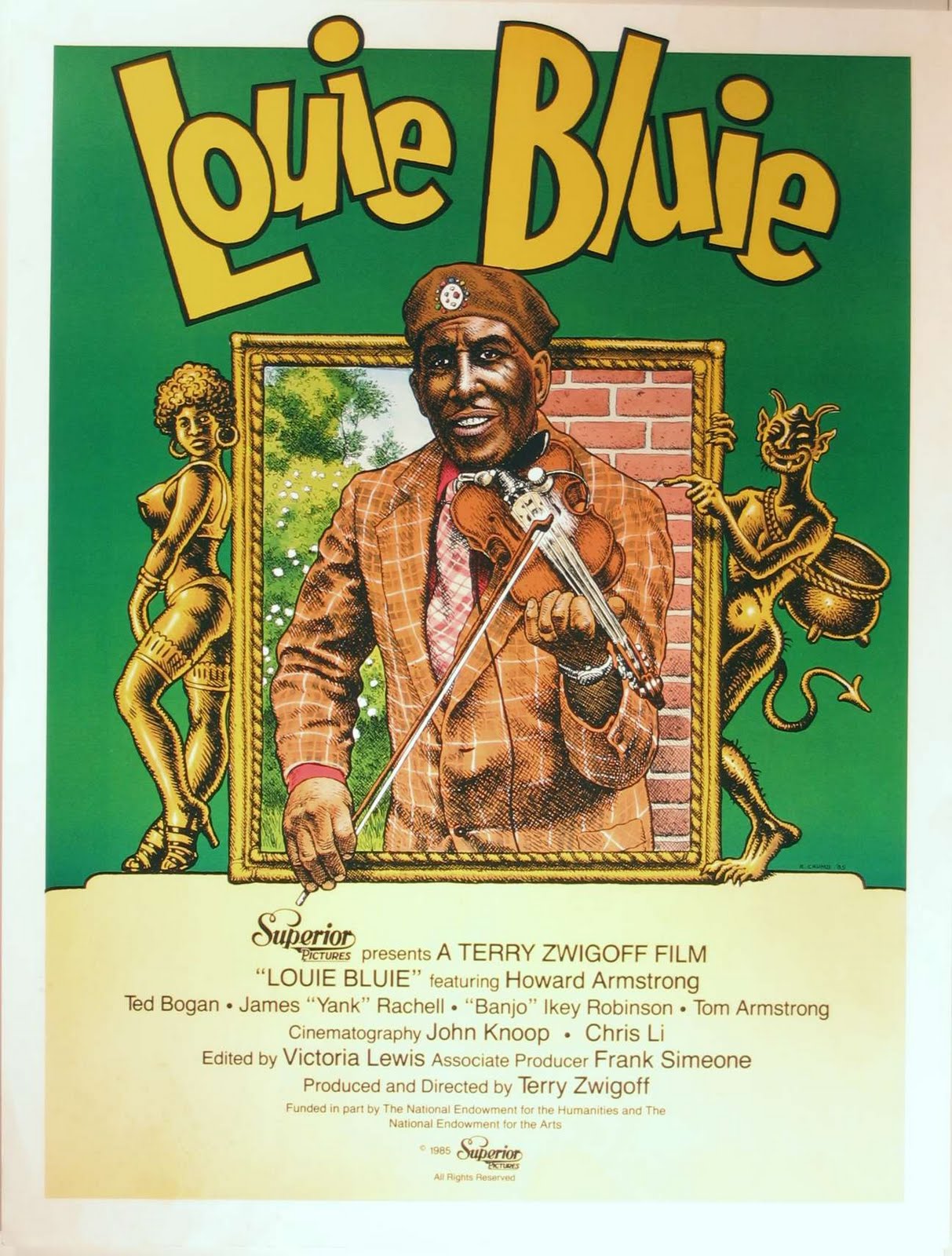
"I first met him at the Telluride Film Festival in 1984 where I had my first film Louie Bluie and I had only been accepted in one other film festival before that; it was down at Filmex, which is now called the L.A. Film Festival. I think 12 people showed up to see the film down there. So I didn't expect much when I went to Telluride; but, one of the people in line to see the film was Roger Ebert, which was a big deal to me. I remember I was in the lobby selling LPs—that sort of dates the whole thing; but, at least they weren't 78s—and they were soundtracks to the film Louie Bluie. Roger wanted to buy a few. He came up and I said, 'Just take a few, man, take some.' He seemed rather put off and rather irritated by that because maybe he thought I was trying to bribe him or something.

"I guess the biggest criticism I have of Roger is that his reviews are often too easy on films, except for my films of course—he could never be too easy on them—but, the guy loves films so much that it's almost contagious. He's open, he's smart, he's thoughtful, he's always very clear, and he's got a really good heart and—like I said—he's really funny, which is hard to do as a writer. He manages to make you think critically without making it seem like homework. God knows the world needs more people thinking critically these days about a lot of things.

"Finally, I'm going to tell a short story for Roger's benefit that he's never heard and that probably most of you have never heard. I don't tell many people this; but, I get a kick out of it so what the hell? When I made my film Crumb years ago, my executive producer Lynn O'Donnell suggested that we have a few informal test screenings before we locked picture. She wanted some feedback from an audience and so she got about 200 people to come and she handed the audience survey cards. They would ask you things like: What do you like most about the film? Do you like this? Is it too long? Too short? That sort of thing. After the screening was over, I realized it hadn't gone very well and so I went up to Lynn and I said, 'You know what? Let me take those cards home with me and read them over tonight and I'll give them back to you tomorrow morning.' She said, 'Okay.' So I took them home.

"I was mortified reading the cards because they were unanimously down on the film. The consensus was that I should take Robert Crumb's brothers out of the film, which to me was the whole point of the film. But everyone wanted to go in a more cheery, upbeat direction, and spend most of the time on underground comic books or something, which I had no interest in. So I thought, 'Well, I better take a few of these cards and fill in my own comments to balance this out.' I knew I wasn't going to be able to find any blank cards so I took some Wite-Out and I whited out their comments, then I went down to Kinkos and I Xeroxed about a hundred of these things. I came home and got a bunch of different pens and tried to disguise my handwriting on these cards and wrote, 'Oh, the brothers were great! More of them!'

"Eventually, we had one more screening and I couldn't do that again and, luckily, at that test screening this guy Walter Murch came and everybody felt the same way except him; but, he had enough clout as an Oscar®-winning editor to just say, 'Y'know, the film is great. Just leave it alone.' He went on beyond that to do a free sound mix for me, because we had no money.

"So we locked picture and started submitting it to film festivals and everyone turned us down. Eventually, somehow, the New York Film Festival let us in and it did well there. Roger and his ol' pal
Gene Siskel saw it and they started championing the film on their show. They got it on there three or four times. The first time they did an early review to encourage theaters to actually book the film. Then after that they did it again when it came out to review it. And after that to remind people to go see the film. Eventually, by then all the other critics had gone along and come out for it. Ultimately Roger argued for it at Oscar® time and eventually it made its way onto Roger's list of great films, which was probably a greater thrill for me than winning the Oscar® itself.

"A few years ago Roger did a commentary for the film. The truth of the matter is that Sony Pictures had done a poor transfer the first time they did it and I had been on their case to correct it. Ever since then they sort of made it clear that—if they were going to do that—they wanted me to do a commentary and that's how I could pay them back for all the expense. But I just wasn't comfortable doing a commentary for a film. I think it takes the mystery and the magic out of it and it diminishes the film sometimes if you're not careful. So I was a little reluctant to do it, but I said, 'Y'know, why can't Roger Ebert do it? He could talk about this film. He knows it pretty well.' They said, 'Okay. That's a great suggestion.' So they called Roger and Roger agreed to do it and I said, 'Great! I'm off the hook.' And they said, 'No. You have to do it as a conversation with Roger.' So Roger came and we did this commentary and I tried to sit there the whole time and not say anything. I let him talk. I later found out they had used a lot of his voice from that DVD commentary to help restore his computer voice, which was great.

"Anyway, it's been my greatest hope and fondest joy to talk about Mr. Ebert here. Again, I'm glad he's been given this award. He truly deserves it."

Errol Morris

"It's an honor for me to be here tonight. Roger Ebert has given out so many awards to so many filmmakers, it's nice to be part of giving him an award this time around. Anybody who's done this long enough knows that there are two, three, four people who have made an extraordinary difference in their careers for many many many reasons. For me, Roger is most certainly one of those people. He champions unlikely films. His own film festival is the perfect example of this. It's my perfect trophy, by the way, the thumbs up. ...It's something I'm very very proud of, although I was disappointed to find out it was not Roger's thumb.

"I had made my first film Gates of Heaven. I think this is true many many films later, you don't really know if they're good or bad. You really depend on someone to tell you that they're not as bad as you might think and, in fact, they might be good! For me, very early in my career Roger Ebert—because my film went to the New York Film Festival; I was really lucky to be accepted—but, there was a newspaper strike that year in New York so no one read about the film. And then out of seemingly nowhere these reviews appeared on television and in the newspaper from Roger and Gene Siskel, almost as if he would not give up. In fact, he hasn't given up—I think it's now something like 30 years—his obsession with this film and other films I've made. I owe him an enormous debt of gratitude.

"What do you hope for when you make a film? That someone out there will appreciate it, perhaps see it in a kindly light, or maybe see things in it that you saw in it, or maybe even see things in it that you never even noticed. It's truly a blessing and Roger has certainly played that role in my life over the years. For that alone—aside from all the great writing and the great criticism—I am grateful.

"It also occurred to me—I will be brief—that there's something very odd about this man. He's not really just a film critic. He's also an icon, quite clearly. I remember when I first met him—I believe I first met him at the Cannes Film Festival years and years ago—I was told, 'Y'know, Roger always writes about his experiences at Cannes' and I read the one from that year. I remember saying to my wife at the time, 'This guy writes really really well.' And it's absolutely true. He's an extraordinary writer. If I call him 'kind', it seems like it's the wrong way to put it; but, he's an enthusiast and a person who is very much a person of conviction....

"So it's an enormous privilege for me to be here. He means—and continues to be—a lot to me. He's mastered every form of this sort of thing: as a writer, as a newspaper man, as a television personality, now as a blogger, and I'm sure that—if in the future there is a new kind of media that is developed—he will master that as well."

Jason Reitman

"Terry, I have one word of advice for when you're in a movie theater and they are laughing at the thing that's not funny. It's something I do when my wife drags me to a horrible romantic comedy. You just have to laugh three times as loud and talk about what's happening on the screen: 'Oh my God! She doesn't know that he's already in the bathroom!' And just get bigger and bigger and bigger. You can own that film.

"It's hard to give context for the life of Roger Ebert when it is he who has given us all context. He is America's critic. He's one of the few people who comprises our cinematic voice of record. He is ... 'The Thumb.' It's almost hard to come up with what we're supposed to say. Roger's name alone stands for his great writing, his criticism, all his contributions that have lived so far beyond them. One would think one could say, 'Now the Mel Novikoff Award goes to Roger Ebert' and that would be it.

"A few times a year Roger will choose a film, sometimes a studio release, but more often a film on the fringe, something small that was made for all the right reasons; something that moves him, and he will blow wind into the tiny sails of this film and give it a life that otherwise would be unimaginable. I'm not the first person to talk about this. I realize everybody's actually talking about this. I have personally experienced it. I remember arriving at the Toronto Film Festival with this tiny movie about teenage pregnancy starring an unknown Canadian actress named Ellen Page that I really thought, 'This will be a festival movie and it will not be seen otherwise.' I remember when the movie ended and people began to clap, I saw Roger—he was actually seated a few seats away from me—and he nodded to me. It was an extraordinary thing! The next morning he had already started talking about the film. He shone a spotlight on it. He gave people a reason to pay attention to it and by the end of the week I got a call saying that Roger would actually like to sit down and talk to me about the film. I was terrified but knew it was going to be a thing I was going to cherish for the rest of my life, and it was. I have no doubt that Roger is one of the very few reasons why people know the name Juno.

"There is a joy for Roger even when he doesn't like a film. I'm sorry in advance for this but here is a quote from [a review of]
a movie that will go nameless: 'I hated this movie. Hated hated hated hated hated this movie. Hated it. Hated every simpering stupid vacant audience-insulting moment of it.'—Errol, you're right, he's a great writer!—'Hated the sensibility that thought anyone would like it. Hated the implied insult to the audience by its belief that anyone would be entertained by it.' Here's the thing: even in this review, I know how much Roger loves movies. I know how much he thinks of them, how much he wants from them, what he expects from them, because these are the same things that I look to movies for. I can't quite put a finger on it but there's something about many film critics and the way they write that makes me think they actually hate movies.

"There's an enthusiasm in Roger's writing that can't be mistaken for anything else but joy. He's passionate and cannot be silenced. He's America's best friend who won't stop nagging you until you've seen this new film. Nowhere is this more evident than on Twitter. I know teenage girls that tweet less than Roger Ebert. You could put Ashton Kutcher, Britney Spears, and the entire staff of Ain't It Cool News and /Film together and not tweet as much as Roger Ebert. He tweets about movies. He tweets about politics. He tweets jokes. Yesterday he retweeted the following Twitter user named Superstanos who wrote: 'I just spent 20 minutes writing WU TANG into a lab table. This is why I go to school y'all.' The Roger Ebert Twitter feed is one of the best publications we have running. I don't mean this sarcastically. It's awesome. It's political. It's daring. It's funny. It's self-effacing. It's everything that I love about his writing. It rails against Sarah Palin. It's even about the artfulness of video games.

"He has somehow found yet another medium and a way to share what he thinks is special. This is the passion I associate with this great man who I was introduced to watching At the Movies and who I was fortunate enough to meet when I was a 20-year-old short film maker at the Toronto Festival. I introduced myself. I had no idea that as a writer he would change my life. His instinct to write and share is one thing, but then he wants you to experience what he has experienced, to feel what he has felt. It's an instinct to give and he gives so much. And so there's really only one thing left to say: thank you. Roger, thank you for everything you have done for my career. And thank you for everything you have done for cinema. I cannot imagine a more deserved honor."

Philip Kaufman

"Rose and I left Chicago during the great blizzard of '66 with our little son Peter. We'd done a couple of low budget independent films in Chicago but the films gave no return to the investors, money dried up, and Rose said it was time to head back to San Francisco: always our city of succor. We'd become best friends with Nelson Algren and he came to the airport to see us off. He started to tell us it would be lonely in Chicago without us. Nelson, as you know, wrote The Man With the Golden Arm. At that very time, maybe at that same moment that we were hugging Algren on our way out of Chicago, a bright, tough young kid was just making his way into Chicago. I like to think he took our place. He became a friend of Algren's. And Studs Terkel. And the great Mike Royko. In time he would come to be known as the Kid With the Golden Thumb. Everything you've read by this kid Ebert over all these years should be taken in the context of his being in the tradition of these Chicago guys: tough, give 'em hell, not compromising, no bullshit, tell it like it is, compassionate writers. Like them, Ebert spoke from his heart, spoke against the big boys, championed the little man against small-minded bullies. He told us the truth according to Ebert and—like Mike Royko—he could say with all humility: 'I may be wrong ... but I doubt it.'

"Once, Roger called and woke me up at about six in the morning. Rose and I had made Henry & June and by now Peter was our producer. The Ratings Board had dropped the dreaded 'X' on the film, which meant essentially that it couldn't be distributed. They demanded that I make some cuts. 'Why should I?' I said, 'You guys don't give an "X" rating when a breast is mutilated or blown away; you only give one when a naked breast is caressed. Besides, I applied the same standards I did in The Unbearable Lightness of Being and you gave that an "R" rating.' They said, 'We should have given that film an "X" too.' At which point I might have used the word fuck. They told me I could not use 'the F word' with them and that cemented the 'X' rating.

"I was going to fly to Washington that very day with a big-time lawyer to take on the system and that's the morning Roger called me and woke me up. Roger had been fighting the same fight with the rating system for years and he called us to tell us that the Ratings Board had backed down and that—because we had challenged them and Roger had led the forces of change—they were finally coming up with a new rating: NC17. This was the first I had heard of it. Roger had the news before anyone else. Good news. We felt great at the time. We thought everything had changed. Now, in America we could see films that were—as Rose used to say—'not for children of all ages.' But pretty quickly the powers-that-be found a way to make the NC-17 become the new 'X' and today studios will no longer make or distribute a NC-17 film; but, that's another story. The point of this story is that no one has fought harder or longer or with more enthusiasm than Roger Ebert for justice and fairness and good movies. He's fought for intelligence in movies and, at the same time, he's fought for fun, for sex, beauty, humanity and did I mention sex? In San Francisco, Roger Ebert's our kind of guy.

"Roger and I have both been lucky to find great loves in our lives who stood by us through thick and thin, who had our backs, at the same time led us, who were our partners. I wouldn't be here today if not for Rose and Roger wouldn't be here if not for Chaz. Chaz and Roger, I wanted to tell you a little story about Rose. I was in graduate school at the University of Chicago. Rose and I went to see a film at the Hyde Park Theatre. One of us liked the film and the other one didn't. I've forgotten who felt what. I've even forgotten the name of the film. But I do remember that—in the heat of our passionate disagreement—Rose hauled off and punched me in the face. ...A couple of hours later after thinking things over in some of the local bars, I decided, 'Who needs this shit?' I staggered back to our one and a half room basement apartment on Blackstone ready to end our relationship. Rose had bolted the damn door. I was locked out on a cold, windy Chicago night. I walked around to the alley and found a window that was slightly open. This was the window to the tiny bedroom. As I crawled through the window onto the bed, Rose grabbed me and wrapped herself around me. Tears were all over her face. She whispered, 'Enough of this crap. Let's make our own films. Let's make our own films.'

"We stayed in that bed for days and talked through those days and every night that followed about everything; a lot about films. Our conversation went on for the next 50 years. We never stopped talking. [At this moment grief overwhelmed Kaufman and he found it difficult to speak. Ebert reached out his hand to him.] It's tough being here because Rose and I saw hundreds of movies in this theater. We saw many with Mel. We loved this theater. I thought I could get through this more easily; but, anyway, Rose—as anyone who knew her can attest—never stopped telling me or anyone exactly what she thought. She was fearless and brave as hell, like Roger. As I said, I wouldn't have the honor of being up here on stage with Roger and Chaz if not for Rose.

"I just wanted to say, Roger: thanks for always keeping the bedroom window slightly open. Thanks for encouraging me and these wonderful directors up here and thousands of aspiring filmmakers all over the world to make our own films. Now, as one Chicagoan who has found his home here in San Francisco to another Chicagoan who will always have a second home here, I'd like to present you with a couple of things."

At this juncture Kaufman read aloud Mayor Gavin Newsom's proclamation of May 1, 2010 as Roger Ebert Day in San Francisco and handed Ebert the Mel Novikoff Award.

Cross-published on
Twitch. Introductory photograph of Ebert and friends in front of the Castro Theatre marquee courtesy of Pamela Gentile and the San Francisco Film Society.

Friday, 14 May 2010

SFIFF53 2010: Michael Hawley Wraps Up the Special Events

The 53rd edition of the San Francisco International Film Festival (SFIFF) came to a close on May 6, having sold out 92 screenings during its successful 15-day run. While I'm still mulling over the three dozen films I saw during those two weeks—all of which I hope to write about—here's a look back at five of this year's special events.

I've been coming to the SFIFF for a few decades now, and 2010 was only the second time I've attended the opening night festivities. Someday I might grow to feel blasé about the event, but for now I still get caught up in the glamour of it all. My suit came out of the closet for the first time since last year's opening night, and despite a major MUNI snafu I was second in line and able to secure myself a choice, unreserved aisle seat in the Castro Theater. After perusing the contents of my goodie bag—which I placed under my seat and regrettably forgot at evening's end—I spent 90 minutes chatting with friends who were equally amped up for two weeks of movies, movies, movies.

The program started 20 minutes late, presumably to accommodate late arrivals from the aforementioned MUNI delay. Late that afternoon, a man either jumped or fell onto the Castro St. Station subway tracks and was killed, effectively terminating all train service until mid-evening. Finally at 7:20PM, SF Film Society Executive Director Graham Leggat took the stage and welcomed everyone, reminding us that this was his fifth year at the festival's helm—"the best five years of my life." The resounding applause and cheers hopefully told Leggat that the feeling is mutual.

This year's opening night film was Jean-Pierre Jeunet's Micmacs, which the director assured us had nothing to do with Big Macs, and everything to do with his new favorite English word, shenanigans. I've enjoyed all of Jeunet's films, except the one everybody adores (yes, Amelie, I'm talking about you). Reviews for Micmacs have been mixed, but it turned out to be a perfect opening night film—inventive, fast-paced, comical, crowd pleasing. I couldn't remember much about it the next day, but I did recall how much fun I had while watching it. After the screening, the festival's new Director of Programming Rachel Rosen interviewed Jeunet and conducted an audience Q&A. We learned that the director "wanted to put everything I love in this film," which ranged from animator Tex Avery to Mission Impossible, and that he's "not interested in realism." When asked if he might ever work again with Marc Caro (co-director of Delicatessen and The City of Lost Children), Jeunet diplomatically replied, "it's so good to work alone." With the final question, Jeunet got off the best line of the evening in regards to Micmacs poor reception on his home front: "In France they love to hate what they loved before." With that, the ebullient crowd adjourned to the Regency Center for a swinging after-party. The nibbly things I sampled there were delicious, and I washed them down with the beer everyone who frequents Landmark Theaters loves to hate.

I hadn't attended the festival's Founder's Directing Award program since it was given to Arturo Ripstein in 1999 (when it was still known as the Akira Kurosawa Award). In the interim years I've skipped honorees both deserving (Coppola, Leigh, Lee, Herzog, Forman, Altman, Kiarostami) and, imho, questionable (Eastwood, Beatty, Hackford). When I unexpectedly found myself with a free night on April 28, I high-tailed it over to the Sundance Kabuki Cinema for this year's tribute to Brazilian director
Walter Salles (Central Station, The Motorcycle Diaries).

Firstly, I wish someone had clued me in on how handsome this guy is so I could have ogled him from the front row. But from my seat in the Kabuki's large House One it was easy to perceive the man's warmth and self-effacing intelligence. The evening began with introductory remarks by Leggat, followed by a clips reel of career highlights. Then came the on-stage conversation with Mexican director Alejandro González Iñárritu, who started things off by saying, "Let's put the guns down before we start, and talk about the sex life of Mr. Walter Salles." Hear, hear! I loved hearing about Salles' early life as a diplomat's son living atop a Parisian arthouse theater. Twelve-year-old Walter frequented that cinema so often, the ticket seller began letting him in for free. But he longed for Brazil: "I hated the drizzle, the cold, the croissants." During the talk it was also revealed that Salles spent a full year casting the boy in Central Station, that Latin Americans do not make good genre films (i.e., his own remake of Hideo Nakata's Dark Water), and that Argentina currently has the strongest cinema in Latin America (little to argue about there). He also acknowledged that "Antonioni is the director who brought me to cinema," specifically 1975's The Passenger.

Before getting to the evening's main event, Salles shared a short film that had been screened only once before—for the 60th anniversary of the Cannes Film Festival. In it, he addresses his six-month-old son, saying, "If I could choose just one film for you to see before any other, it would be this one." Then we saw an infant entranced by Chaplin dancing with the globe balloon in The Great Dictator. Salles remarked that they screened a DVD projection for the first take, and his son just wasn't interested. For the second take they projected it in 35mm and this time he became fully engaged by Chaplin's antics. What a smart, discerning kid!

As a special treat made exclusively for the SFIFF, Salles next showed us a one-hour work-in-progress documentary about his efforts to film Jack Kerouac's On the Road. It was edited in just one week from 100 hours of mini-DV and super-8 interview and location footage. Salles, who first read the book as a 15-year-old, feared that showing an incomplete film about The Beats in San Francisco might be a "suicidal act," but the festival audience ate it up. In its current state, the film gives an impressionistic overview of Kerouac's work and the times from which it sprang. An off-camera Matt Dillon intermittently reads passages from the book, and contemporary figures ranging from Laurie Anderson to Johnny Depp to David Byrne reflect on its influence. There are terrific interviews with key players who are still with us (Michael McClure, Carolyn Cassady), as well as vintage screen tests by Brendan Fraser, Ashley Judd, Mathew McConaughey and others made for a previous attempt at filming the book. Directors as diverse as D.A. Pennebaker and Jean-Luc Godard have been interested in the project, but based on the evidence presented that night, Salles is clearly the man for the job. Indeed just one week after this event, it was announced that shooting for Salles' On the Road (the narrative feature) will begin in August. The next day at the festival, Salles would conduct a master class, as well as introduce a screening of his 2008 film,
Linha de Passe.

On Saturday, May 1st, I must have changed my mind a dozen times. Should I spend the early evening at the Kabuki watching a French orangutan documentary (Nenette) and a Brazilian movie (The Famous and the Dead) before heading over to the Castro for the late-night world premiere of All About Evil? Or should I catch
Roger Ebert receiving this year's Mel Novikoff Award at the Castro? I chose the latter and it turned out to be a smart move. The combination of Roger Ebert and Peaches Christ made for one of the most fabulous evenings I've experienced in 35 years of attending this festival.

Ebert and his wife Chaz were brought onstage and seated while four directors delivered heartfelt and hilarious tributes to the man they call "The Thumb." Terry Zwigoff recalled Ebert being the first person in line for a 1985 Telluride screening of Louis Bluie, and later sold him a soundtrack LP in the theater lobby. He also told a great story about a Crumb test screening. The audience survey cards were overwhelming negative—they thought the storyline about brother Charles should be dropped—so Zwigoff "fixed" the cards with the help of Wite-Out and a late-night trip to Kinko's. Ebert would become a steadfast champion of the film, going so far as to record a commentary track for the DVD release (much of which would be used for the text-to-speech software that allows the now "speechless" Ebert to speak through a computer). Next, documentarian Errol Morris called Ebert, "not just a film critic, but a cultural icon." He was followed by Jason Reitman who, commenting upon Ebert's social networking prowess, declared "I know teenage girls who tweet less than Robert Ebert." Reitman would also add that, "It's hard to put Roger Ebert's work into context when it's him who puts us into context."

Last up was Philip Kaufman, who took a seat next to Ebert and Chaz and read a mayoral proclamation declaring May 1, 2010 "Roger Ebert Day" in San Francisco. Then the man himself fired up his laptop and brought the house down with his first sentence, "My little man is standing on his chair and applauding." The rest of Ebert's speech railed against Hollywood's current output of sequels and so-called blockbusters ("The studios are running like lemmings to 3-D") while films like Erick Zonka's
Julia, featuring a tour de force performance by Tilda Swinton, gross a measly $65,000 in U.S. release. (Locally, the film ran for one week last summer on the SF Film Society's Kabuki Screen before moving over to the Roxie). The tribute audience then got to see and judge Julia for itself, having been specifically chosen by Ebert to accompany his appearance at the festival. A letter of regret from Swinton was read to the crowd—she had hoped to attend the screening but was stuck filming on the East coast. I was thrilled to watch it a second time, especially on the Castro's big screen. It's a tough little film and there were a few walkouts, but the applause at the end was booming.

I darted out of the Castro and was greeted by the sight of blood-splattered klieg lights clawing the night sky. Then I noticed a dead body flopped across the base of the lights and a ticketholders line already around the block a full two hours before showtime. This could only mean one thing—the world premiere of Peaches Christ's
All About Evil! From my vantage point in the press line, I was able to watch the red carpet parade of outlandish costumes and mile-high hairdos, praying that none of those 'dos ended up sitting in front of me. (This was a movie theater, after all, and not a planetarium.) As Peaches would remark at some point in the evening ("Peaches" being the beloved late-night movie hostess alter-ego of one Joshua Grannell), a movie only gets one world premiere. And boy did he/she pull out the stops to ensure All About Evil's would be momentous.

The All About Evil preshow consisted of no less than four musical production numbers, the first one featuring Peaches and a dozen pom-pom shaking monstrosities performing, "I'm a Gore-Gore Girl." Afterwards, she threatened the audience with a three-hour preshow in which she would single-handedly act out the entire movie onstage. Next she brought out All About Evil cast member Mink Stole and the duo croaked out the theme song from John Water's film, Female Trouble. Peaches and Mink go way back, the latter having been the first "celebrity" to appear at Peaches' Midnight Mass film series at San Francisco's Bridge Theater. Waters was also in the house that night and stood for a round of applause. Teen heartthrob and All About Evil co-star Thomas Dekker was next on board, performing the movie's rocking theme song, "Welcome to the Horror Show." Then Natasha Lyonne, who stars as mousy theater-owner turned murderous film director Deborah Tennis (pronounced De-BOR-ah Ten-NIS) wrapped things up with a final number.

After all that hullabaloo, one almost expected the film itself to be anti-climactic. But no, All About Evil delivered the sicko thrills and chills. Two scenes in particular had all 1400 audience members screaming their collective heads off in disbelief, and neither was the film-within-the-film, A Tale of Two Severed Titties. By the time the Q&A wrapped up—with Peaches now out of drag and onstage as plain old Joshua Grannell—it was two in the morning. Everyone was handed a commemorative All About Evil world premiere poster upon exiting the theater, which I'll surely treasure for the rest of my days. It was Saturday night and the Castro Street bars were emptying out—a phenomenon I hadn't witnessed in many years. I was satisfied and spent and had no hope of making it to the next morning's surprise SF Film Society members screening.

If you weren't there that night, here's good news. Come October, Peaches will be presenting the film, complete with a preshow, at San Francisco's Victoria Theater (where All About Evil was actually filmed). She promises a full-on William Castle-like experience—I think her exact words were "we're gonna stab you and chainsaw you." Meanwhile, check out
Dennis Harvey's recollection of the evening at SF360, and don't miss The Evening Class' Michael Guillén and his interviews with Grannell, special effects artist Aurora Bergere and five cast members. Now for a special treat, the evening's complete opening number.


I spent the next few days singing, "I'm a gore, I'm a whore, I'm a gore-gore girl" and desperately needed a new earworm. One came in the form of the rousing and repetitive chorus that greeted each new chapter of Stuart Paton's 1916 silent screen adaptation of Jules Verne's
20,000 Leagues Under the Sea. This May 4 Castro Theater screening was also the world premiere of a new score composed and performed by The Magnetic Fields' frontman Stephin Merritt, with help from Daniel Handler on accordion, David Hegarty on the Castro's Mighty Wurlitzer and a gentleman playing tuba and trumpet.

Merritt was clearly having a goof with it, blending his customary old-timey vibe with injections of electronic bleeping and screechy freakouts. Speaking and singing through megaphones, Handler gave voice to the female roles in an abrasive Olive Oyl-y falsetto while Merritt handled the male parts in a low register that was mostly inaudible. The film itself is kind of unremarkable—a flatly directed mash-up of Verne's 20,000 Leagues and The Mysterious Island, with underwater photography that was stunning for its time but is now merely quaint. Merritt exploited the film's campier aspects, such as a sarong-clad "child of nature" who sings a ditty about not wanting to wear pants and who turns out to be Captain Nemo's long lost daughter. I thought it was all good-natured fun and Merritt's legion of fans seemed satisfied, but I know some likened the performance to a bad episode of Mystery Science Theater 3000. I was glad I went, but it paled compared to last year when Dengue Fever blew the dome off the Castro with their score for the stop-motion dinosaur epic, The Lost World.

Cross-published on
film-415 and Twitch. Photos by Pamela Gentile and Pat Mazzera courtesy of the San Francisco Film Society and SF360.

Thursday, 13 May 2010

SFIFF53 2010—Two Evening Class Questions For Walter Salles

"Cinema is, first and foremost, the projection of a cultural identity which comes to life on the screen. It mirrors or should mirror this identity. But that is not all. It should also dream it. Or make it flesh and blood, with all its contradictions."—Walter Salles, The Cinema of Latin America (2003).

Walter Salles received the San Francisco Film Society's Founder's Directing Award at the
53rd San Francisco International Film Festival (SFIFF53). The Founder's Directing Award is presented each year to a master of world cinema and is given in memory of Irving M. Levin, founder of the San Francisco International Film Festival. The award was first bestowed in 1986 on iconic filmmaker Akira Kurosawa, and for many years carried his name. Highly recommended is Margarita Landazurri's tribute essay "Dreaming Identity" for the SFIFF53 catalogue, which provides an insightful overview of the filmmaker's creative shift from documentary work and its influence on his subsequent feature films. She likewise profiles his tireless promotion of Brazilian master works alongside the visions of younger South American filmmakers, many of whose films he has helped produce. Further, Landazurri finesses: "In dreaming and exploring his own cultural identity as a Brazilian, a Latin American and a citizen of the world, Salles has contributed his unique perspective and in so doing significantly enriched international cinema."

To celebrate the honor, SFIFF53 organized three separate programs with Salles in attendance at each. The first was an onstage tribute at the Sundance Kabuki Cinemas, which included a clip reel of career highlights, an onstage interview with Alejandro González Iñárritu, and a special screening of In Search of On the Road (a Work in Progress), an hour-long edit prepared specifically for the Festival of a documentary about Salles's effort to make a documentary about Jack Kerouac, his seminal novel On the Road, and the Beat Generation; the second was a Masters Class in which Salles spoke to young filmmakers; and the third was a screening of Linha de Passe, introduced by Salles before rushing off to accept his award at the benefit awards ceremony. I hope to write about all three events more fully when time warrants, but until then, I offer two brief exchanges with this year's strikingly articulate Walter Salles.

* * *

Michael Guillén: You've spoken of the movement within the visual language of your films, and you've touched upon the intriguing concept of the immersive quality of 3D technology as applied to films; but, I'd like to say that I find the 2D quality of your films to be quite immersive, quite sensual. I was wondering if you could speak to the tactile language of your films? And how it is that you structure your films such that your audiences experientially feel them?

Walter Salles: It's something that is hard to define—the word is not very good—but, even in a Cartesian manner. You achieve that quality when you are on the set and you forget that you are doing a film. Everybody forgets that they're doing a film. What blossoms is something that pertains to that movement, to that moment, and has an integrity of the moment. I don't know if I'm being clear about this; but, every time that you scheme everything that is the veils of acting and pretending, you're approaching something that is quite unique and sensorial. This is why I hate to have a "making of" [camera crew] in a shoot because you're constantly reminded that you are in a shoot, you see? I think that to film is to actually forget that you're doing a film. This is when the ballet of it starts, y'know? When the jazz of it starts. You can actually communicate with the DP just by looking at him and sensing where one should go. The actor feels that. It's something that cannot be expressed by words, but has to do with—I would say—the temperature that you create on the set and the way that you reach that.

So to give you an example: in the case of The Motorcycle Diaries, we arrived in Argentina where the production started and a long time before the shoot. And we collectively did—the word is a little bit grand, but—seminars. A lot of young professors from the University came to talk about the music of the period, about heroism, and about Inca history. At the beginning, Carlos Conti (the production designer) and a group of six or seven people came to listen to that, and at the end the whole crew came. We projected films from the fifties. We brought the period closer to us and we somehow decanted it.

Picasso used to say, "Painting as you should is at the time when you forget painting, as when you were a five-year-old." The process is really about knowing all the possibilities, then forgetting about what you've learned and being inventive on the moment. On the moment, you have to forget that you're doing a film. This is how it acquires a sensorial quality.

Guillén: I'm impressed with your quotesmanship, your knowledge of other filmmakers, and especially your knowledge of other art practices. I'm interested if you can address the value of acknowledging a sibling relationship with the other arts and the value such acknowledgment lends to filmmaking?

Salles: We are part of a generation that was mostly informed about the world through films; but, also through literature, through music. This morning I was writing, for instance, [an acceptance speech for tonight's award ceremony] and it wasn't working. I was feeling too much jet lag and I was thinking, "How can I solve this?" Neil Young helped me. The interconnection between different forms of narration, of art, is something irrefutable. It is what it is.

I tend to believe that you don't need to go to film school to become a filmmaker. I actually didn't go to film school. At one point I studied philosophy, history, economics, it just happened like this and for one reason: there was no film school in Brazil—in Rio at least—at that point. I couldn't study film, you see? So I had to drift a little to find a way to get there; but, above all, the film drifts out of curiosity. Because at the end of the day, it's about storytelling. Storytelling is in the streets, it's in the books that we read, it's in the music that we hear and all of these echoes. There's a general echo that comes from that interest.

Cross-published on
Twitch.

Tuesday, 27 April 2010

FILM & FOOD: Sundance Kabuki Cinema—Who Wants a Knuckle Samwick?

The 53rd San Francisco International Film Festival started last week; one of its main venues being the Sundance Kabuki Cinema located near the intersection of Fillmore and Geary. In that neighborhood, there are plenty of options for food and guest columnist Andy Samwick suggests a few.

Sundance Kabuki Cinemas
1881 Post Street (at Fillmore), San Francisco
(415) 346-3243
Bus lines: 22 Fillmore, 38 Geary, 38L Geary Limited, 2 Clement, 3 Jackson, 4 Sutter
Parking: parking garage below the cinema.

* * *

I always love eating at SPQR, for example. They are open for brunch on weekends and dinner most nights. They have an excellent wine selection and great Italian fare prepared by Executive Chef, Matthew Accarrino. One of the highlights for me are the spiced ricotta fritters with smoked maple syrup. Truly a dish not to be missed. I can say the same for the grilled wild salmon belly with golden raisin saor and pepper jam. It is remarkably unique. Another innovative dish I like is the crispy pig's ear, pickled jalapeno, tomatillo & radish. I recently had that with a friend at dinner and we were pretty much blown away. At different times I have had the quail and the sole as a main course and have never been disappointed by either. And make sure you save room for dessert! The milk chocolate gelato and buttermilk crumble with candied almonds are outstanding. I love the passion fruit panna cotta too with the coconut spuma and coconut macaroons. Yum.

SPQR
1911 Fillmore Street
San Francisco, CA
(415) 771-7779

If you don't want to spend a lot on your meal, may I suggest venturing for comfort food at The Grove? I love the macaroni and cheese made with jack, cheddar, fontina and point reyes blue cheeses. Sometimes, I go for the healthy classic caesar with roasted chicken or a "Berkeley Bowl" with sweet 100 tomatoes, English cucumbers, red onions, ripe avocado, roasted peppers, alfalfa sprouts and garbonzo beans piled on Scarborough Farms spring mix dressed with homemade ranch dressing.

The Grove also proudly serves Jeremiah's Pick espresso and coffee. I have been known to get a macchiato with a giant homemade chocolate chip cookie or Rice Crispy treat. It is a cozy atmosphere and one of the nicest spots in the neighborhood.

The Grove
2016 Fillmore Street
San Francisco, CA
(415) 474-1419

One of my favorite new places near the Sundance Kabuki has to be the
Pizzeria Delfina on California Street, which I recently featured at my site You Want a Knuckle Samwick! Their pizzas are some the best San Francisco has to offer. The antipasti is very good, especially their fresh stretched mozzarella. I have to do a lot of stretching after I eat there! Even the insalata tricolore with lemon vinaigrette and grana padano is delicious, if you decide to eat on the lighter side. My favorite pizza has to be prosciutto di parma, caciocavallo, mozzarella, panna, arugula. Oh, and the 4 formaggi, of course.

Pizzeria Delfina
2406 California Street
San Francisco, CA
(415) 440-1189

If you like Mediterranean cuisine, you should definitely try La Méditerraneé. I usually get the Middle Eastern Plate because you have the choice of chicken pomegranate, chicken Cilicia, Grecian spinach & feta, cheese Karni, falafel, Levantine meat tart, dolma, Levant sandwich, and lamb lule. You are limited to three selections but if you bring friends, that always helps. I love their hummos and baba ghanoush too and I frequently order the lentil salad. Brunch is a treat and a great value. You get so much food!

La Méditerraneé
2210 Fillmore Street
San Francisco, CA
(415) 921-2956

Tuesday, 20 April 2010

SFIFF53: Frako Loden's Review Capsules

And since variance of opinion by its very nature defines a film festival audience, The Evening Class is proud to offer 24 review capsules from Frako Loden to compare, contrast and conflate with Michael Hawley's previous 14. [Frako warns that a few of these capsules allude to what may be plot spoilers!!]

* * *

Father of My Children (France/Germany: Mia Hansen-Løve, 2009)
This film is a realistic rendering of a French art-film producer with a loving wife and three adorable daughters, who is millions of euros in debt with several film projects hanging in the balance. Gregoire's family is resigned to his being in the room with them but always distracted by his cell phone and deal-making at their country home on weekends. Clearly he's a loving, if distracted, father and husband. But things are closing in on him, much as he'd like to deny it and stay hopeful. A Swedish director (based on Lars von Trier) is being difficult, but he's a "genius" that Gregoire must humor. A Korean filmmaker brings her larger-than-expected entourage to France and complains about an incompetent French crew. Gregoire grows more and more withdrawn, until one day he shoots himself on the street. (The story alludes to the real-life suicide of Humbert Balsan, who produced films by Claire Denis, Lars von Trier, Béla Tarr.)

The rest of the film shows everyone looking to his inexperienced widow to pick up the pieces, doing Gregoire's job and trying to save their production firm in the face of financial disaster. She even goes to Sweden to talk with the genius director and be set straight on how much Gregoire's vision meant to him—and that his successor Serge (played by the actor who will appear as Serge Gainsbourg in another filmfest film, Gainsbourg [Vie Héroïque]) has no such vision, in fact dislikes the director and "hates cinema." Meanwhile, their eldest daughter befriends a young filmmaker whom we saw Gregoire court at the beginning of the film and who is left out in the cold when Gregoire dies. Nothing is made of this coincidence really—there's no shattering realization when the daughter finds the filmmaker's script in Gregoire's office. The most powerful part of this last half is watching the eldest daughter mourn. At the very end, their visit to Gregoire's grave is cancelled because they've run out of time in their preparations for departing Paris. She suppresses her tears as they drive away in the car.

I was completely absorbed in this film—maybe to an unhealthy degree, since knowing Gregoire was eventually going to commit suicide created enough suspense. I just wasn't sure how soon he would do it. I believe it happened at the halfway point, at least it felt that way. The film gave us a long time to appreciate how much love and patience there was in the marriage and family so that we would equally appreciate the loss. All acting performances were understated and effective. There is something terrified and terrifying in the eldest daughter's eyes as she absorbs the enormity of her father's death. (Seen at a festival press screening.)

The Man Who Will Come (Italy: Giorgio Diritti, 2009)
Another film with extremely effective and moving acting performances by young females is The Man Who Will Come, about a 1944 massacre of nearly 800 Italians by the SS near Bologna. Unlike City of Life and Death (about the Nanjing Massacre), this film doesn't feel a need to follow a sympathetic Wehrmacht soldier. Instead it focuses on a small village, the partisans who try to protect it, and the Nazis who target it for termination. It has similarities to Pan's Labyrinth in its main protagonist's being a canny little girl who's trying to protect her infant brother from Fascists—minus the rich imagination, of course. I guess one interpretation of the title The Man Who Will Come refers to the child who is born in the middle of the massacre—a review reminds me that the story time of the film begins at conception and ends at the first month after birth. But I think it could also refer to the second coming of Christ. Like in City of Life and Death, we have a long time to be with the villagers until they are almost totally wiped out by gunfire. At the end we're left with a tiny bit of hope, with the little girl cradling her baby brother sitting on a bench. She's escaped from another church whose parishioners she knows are doomed, since she survived a massacre of her own. (Seen at a festival press screening.)

My Dog Tulip (USA: Pau & Sandra Fierlinger, 2008)
I was expecting to make heavy use of my handkerchief for this one, but it never left my purse. I thought it was going to be another Umberto D. Instead, this is a lighthearted, naughty-minded animated story of the love between an old man (based on ex-BBC correspondent J.R. Acklerley) and his rambunctious Alsatian dog Tulip. It's hard to say if the film's focus on Tulip's scatological and sexual tendencies is due to J.R.'s personal obsession or just an integral part of living with a dog that doesn't get full coverage in more prudish stories. Still, all the energy expended in breeding Tulip seems so unnecessary, maybe even a bad idea. I found that the animation illustrating these sequences, in which Tulip wears a dress, was overliteralizing and not as funny as it thought it was. I'm sure dog-training ideologues will find plenty here to complain about the proper way to handle a dog, but in the end it's clear this is a grand love story. (Seen at a festival press screening.)

The White Meadows (Iran: Mohammad Rasoulof, 2009)
This hypnotically beautiful film absorbed me from the beginning, as a man rows his boat toward a white-salt island to perform rites over, and take away the corpse of, a young woman. It's said she was bound to die because her beauty humiliated all the men around her—like one man says, "She led men to the well and left them thirsty." This boatman also collects sufferers' tears in a bottle and pours them into the very salty waters of Lake Urmia. In his voyages from island to island, the man gathers and helps reconnect unfinished stories through his healing, if sometimes cruel, rituals.

Director Mohammad Rasoulof, who was recently released after having been arrested at a party thrown by fellow filmmaker, arrestee, and this film's editor Jafar Panahi, follows his excellent film Iron Island (2005) with this saga set in spectacular vistas of white-salt beaches and islands in remote Western Iran. His themes from that earlier work of the exoticism of Iranian minorities, the rule of ancient laws and behavioral codes over human collectivities, and our relationship with the sea are in rich evidence here. It's definitely one of the most beautiful and suggestive films at this year's festival. (Seen at a festival press screening.)

Simonal: No One Knows How Tough It Was (Brazil: Cláudio Manoel/Micael Langer/Calvito Leal, 2009)
On first viewing, this felt like a not-totally-successful documentary about a person who's no longer around to speak for himself. In other words, I didn't feel there was enough definitive information about his aborted career to commit to an interpretation about what disaster befell him. It's about Wilson Simonal, who was a huge Brazilian pop star in the 1960s until rumors of dictatorship collusion and spying, and ultimately racism, got him blacklisted from the entertainment world. He died in 2000.

Simonal admired Sammy Davis Jr.'s persona as the total entertainer, a showman. He adopted Davis's attitude of multiple musicianship and total control over the audience, telling jokes, getting them to sing in parts and even walking off the stage and taking a break while they sang. I'm sure the filmmakers used the best available footage they could find of Wilson Simonal's performances, but I wish there was more. I like that he sired two sons, Wilson Simoninha and Max de Castro, who became successful entertainers themselves and speak in support of him even if he might have been an imperfect father. They talk about the racism Simonal encountered trying to "pass for white" as a big-time entertainer. They even show a musical skit he did on TV bemoaning his minstrel-like status. But he was no civil-rights activist.

I didn't know anything about pilantragem until I saw this. Apparently this "rascal" or street style, or vernacular attitude toward music, involves dropping final syllables of words—"faking it," deliberate cheesiness. (The talking heads disagree about pilantragem's authenticity or whether it helped or hurt Simonal. One says it was the only style that could compete with rock 'n' roll in dance clubs—it made everyone dance.) I loved some of the montage sequences and colorful '60s-style collages. There's a great clip of him silkily singing "The Shadow of Your Smile" with Sarah Vaughn. He was a huge star in Central and South America, the first international Brazilian star. He did commercials for Shell—in one ad he's flying a helicopter over motorists, flirting with them, calling himself "Super Shell, the best for your engine." He was identified with the Mug, a stubby little black doll with a carrot top.

Simonal's success at the International Song Festival in the years 1967 through 1972 apparently caused envy that turned into resentment and the beginning of his career slide. He opened for Sergio Mendes (which I learned you pronounce "Ments") at a return-to-Brazil concert after Mendes' Grammy win. That's when he wore his signature headscarf wrapped around his forehead—some say it was just for show because he didn't need to hold back nappy hair, but his son says it was to fix in place a potato or onion that would relieve a terrible nervous headache. The stage people called him and he left the scarf on. He had the huge audience (and this was before the era of stadium concerts) in the palm of his hand, so much so that Mendes didn't want to go on after him. Maybe Mendes thought he was being cocky—that he should show more deference for an artist who had just won a Grammy, or who was "white."

The reaction to his living large, with big cars and big blondes, seems to have been his downfall, like boxer Jack Johnson. He dedicated songs to other men's wives. He was friends with Pele and got tricked into thinking he might join the national soccer team. The film's explanation of his supposed kidnapping of an accountant that started all the trouble is a bit confusing, or maybe the events are just confusing. But watching this a second time is making me like it more than I did the first. (Seen on DVD screener.)

Presumed Guilty (Mexico: Roberto Hernández, 2008)
An effectively told story of an innocent man's struggle to clear himself in the corrupt Mexican court system. The filmmakers have an appealing subject, a monolithic bad guy, and a cause to fight. Their crisp, uncomplicated storytelling style and amazing footage of the trials conducted in what looks like a busy, indifferent office make for riveting filmmaking. Winner of SFIFF's Golden Gate Award in documentary. (Seen on DVD screener.)

Micmacs (France: Jean-Pierre Jeunet, 2009)
I never got into Micmacs at all. All the whimsy and humor seemed terribly forced or just too mild. It made me wonder if I really liked Jeunet's previous films or just put up with their tics to favor their overall conception. The filtering resulted in a dingy yellowish cast to everything that made me slightly sick to my stomach. And I couldn't help wondering how much more interesting Jamel Debbouze (Days of Glory, Angel-A), for whom the script was originally written, might have been in the lead role. I had a feeling for Micmacs similar to how I felt about The Imaginarium of Doctor Parnassus—scattered moments of elation between long stretches of boredom and even slight embarrassment. However I loved Yolande Moreau—she was just wonderful in her scenes. (Seen at a festival press screening.)

The Invention of Dr. Nakamats (Denmark: Kaspar Astrup Schröder, 2009)
A documentary about an eccentric Japanese inventor that simultaneously shows how special and perhaps how bogus he is. Most famous for inventing the floppy disk and a pump that sucks soy sauce out of a large can into a small dispenser, Nakamatsu Yoshiro continues to patent thousands of his products, from sproinging running shoes to the libido-enhancing Love Jet. Meanwhile he's well on his way to achieving his target age of 144, eating only one meal a day, needing only four hours' sleep a night, and getting ideas for new inventions as he takes notes underwater. Apparently the filmmakers never met their subject, getting all their material via Skype and the Internet. I see no ill effects from this kind of long-distance collaboration. (Seen on DVD screener.)

A Brand New Life (South Korea: Ounie Lecomte, 2009)
Very moving drama about a little Korean girl whose father dumps her in an orphanage and never returns. Without an explanation for his actions, she digs in her heels and resists efforts to be adopted by a Western family while everyone around her aspires to it. Her pale little face still haunts me, as her joyous smile fades and one anchor in her life after another slips away. She seems almost to understand what will happen to each child sent out into the world, and it's not exactly a middle-class life of privilege in a Western suburb. So far this festival has been a showcase for excellent performances by girl actors (Father of My Children, The Man Who Will Come), and Kim Sae-ron as the non-orphan gives perhaps the best. At 10, she's older than Victoire Thivisol, who won the Best Actress award at Venice for her four-year-old turn in Ponette (1996). But the two actors resemble each other in their unself-conscious and utterly natural responses to the loss of their parents. A Brand New Life is a great fictional counterpart of the numerous transnational-adoption-themed documentaries screening at Asian American film festivals of late. Unlike so many of them with their adult-POV retrospection, the point of view here is deeply immersed in the pre-adoptee's immediate present. (Seen on DVD screener.)

Shirley Adams (South Africa: Oliver Hermanus, 2009)
This film opens in a poor Cape Town apartment, with the title character fighting to revive her teenage son from a suicide attempt. Donny lost the use of all his limbs when he was shot in the neck over a year ago. Her husband vanished without a trace three months before. Deeply wounded by his desertion and Donny's despair, Shirley soldiers on with her son's full-time care, unable to work for pay and relying on handouts from friends. The more help she's offered the more stubborn her refusals grow, and she fiercely resents the young white physical therapist who comes with groceries, offering to make life easier for Shirley and Donny. After accepting a Tupperware full of cookies from the mother of Donny's childhood pal Jeremy, Shirley learns that Jeremy is a suspect in the shooting. This litany of outrages doesn't sound like a pleasant invitation to a film, but you will be riveted by veteran South African actress Denise Newman's remarkable performance as Shirley, a woman who must hold her head up because pride is all she has left. Director Oliver Hermanus admires a 19th-century painter "who always painted women from behind, so we never truly know what they are thinking about." The camera simulates this technique by perching on Shirley's shoulder, hounding her and monitoring every move she makes. This restless camera is a visual correlative of Shirley's status as a colored (mixed-blood) woman hounded by violence and poverty in post-apartheid South Africa. Its precise, unsentimental focus seeks along with her the resolution that will free her from its bounds at last. (Seen on DVD screener.)

Joan Rivers: A Piece of Work (USA: Ricki Stern/Annie Sundberg, 2009)
Closing Night picture. Frankly, I wasn't expecting much from this film since I feel near-indifference for the subject, but the filmmakers have made great documentaries on what feel like weightier issues: they produced/directed The Devil Came on Horseback (about the Darfur genocide) and The Trials of Darryl Hunt (about an African American man who was wrongly convicted for a rape-murder and imprisoned for almost 20 years).

The film opens with shots of heavy makeup being applied to Rivers' surgically altered features. She's in a career slump—she complains that her spotty, low-prestige appearances don't add up to a decent tour without any Vegas-style club dates—Kathy Griffin has taken all of them. Her here-now-AWOL-tomorrow manager Billy Sammeth says that Rivers jokes she needs sunglasses to look at her datebook because the blank white page is too glary. But "this queen of comedy will not abdicate ... there will be nail marks on that red carpet before she's through." One source of hope is that both she and daughter Melissa are booked on Donald Trump's Celebrity Apprentice.

Five minutes in, I was completely captivated with Stern/Sundberg's treatment of pioneering comic Joan Rivers. We watch her get angsty and intolerable preparing for the opening of a play she's written about her life to be performed in Edinburgh and then in London. She's terrified yet hopeful about the prospect of taking the play to New York if she doesn't bomb in the UK. The memory still smarts of the way Manhattan critics savaged her performance in the play Fun City way back in 1971, and she still holds it against them. She claims, in tears, that her acting ability is dearer to her than her comic talent. As it turns out she's spared the Manhattan critics—the London critics are condescendingly cruel enough. The play dies offshore.

Despite what seems like a thick skin, she’s easily hurt and holds grudges for a long time. When Johnny Carson told her "You're going to be a star" in front of his Tonight Show audience in the 1960s, she says her life changed. She was on her way up: she became his permanent guest host in 1983 (in addition to having made comedy albums, written a bestseller, directed the Billy Crystal-starrer Rabbit Test, and hosted other talk shows). When the new Fox Network made her host of her own late-night talk show produced by her husband Edgar Rosenberg, Johnny Carson "slammed down the phone and never spoke to me again," even blacklisting her with NBC until recently. Unable to fire her own husband, Joan let herself be fired. Then Edgar killed himself.

I guess what makes this film so good is that we get a few glimpses of Joan's irritating side—the way she doesn't listen to Melissa and makes every conversation all about herself, her petulance, her inability to shut up—but then we see her essential decency and professionalism. She supports relatives; she needs a 17-foot-long dining table to seat invited "strays" for Thanksgiving; on her pre-turkey dinner charity deliveries for God's Love We Deliver, she's moved by a blind woman who used to be a Life photographer.

But best of all, we see her skill as a performer. She masterfully shuts down an off-screen heckler who's offended by her Helen Keller joke ("I have a deaf son!"). And she's unbearably funny, especially when she's making herself look bad. It's amazing how much she puts up with during her recent roast at Comedy Central. She is such a sporting pro and—and she loathes this word—an icon. As Addison DeWitt would say, "You're maudlin and full of self-pity—you're magnificent!" (Seen at a festival press screening.)

14-18: The Noise and the Fury (France: Jean-François Delassus, 2008)
This documentary for French TV uses colorized newsreel footage, dramatic and propaganda films, sound effects and voiceover narration (dubbed into English) to tell a story of a low-ranking French infantryman who witnesses the worst of World War I. During his four years of combat, the soldier sees everything but a good reason why so many of his fellow combatants must live in ghastly trenches and be bombed, gassed, killed and maimed in the "war to end all wars." Much has been made of the effect of all this post-production tampering of the silent image, that it brings the subjects' faces and emotions alive and introduces the horror of the early 20th-century war to a generation who wouldn't sit still for a plainer, black-and-white film without sound. It's wonderful if this compilation will indeed have such effects, but those of us who already love silent film may not appreciate the anachronistic tinting, sound effects and constant background chatter to match the moving lips of speaking characters. I think I would have been able to imagine "the noise and the fury" without all those simplistic audio-visual aids. (Seen on DVD screener.)

Littlerock (USA: Mike Ott, 2010)
Waiting for a replacement rental car, Japanese tourist siblings Atsuko and Rintaro are stuck in the tiny town of Littlerock in the desert north of Los Angeles. Their plans to visit Manzanar and San Francisco are stalled at the Pearblossom Motel, where they get mixed up with partying local teenagers. If you're reminded of the kooky Japanese couple in Mystery Train ("Elvis Presley." "Carl Perkins."), forget it—this couple isn't interested in paying homage to their Memphis rock gods and they're drearily passive. Still Atsuko is feeling the power her exotic beauty, and inability to communicate, have over the small-town boys, while Rintaro wants to get away from there as soon as possible. When Rintaro leaves unable to persuade his little sister to go with him, she moves in with the infatuated Cory and tries to learn how to make burritos for his father's bodega. In Littlerock she gets a lesson in American life that no trip to Disneyland or Fisherman's Wharf could teach her. This movie is worth watching only for the performance of Cory Zacharia as an ersatz Crispin Glover-like airhead who invites himself on dates, wants to be told he could be a model, and may win you over by the end. (Seen on DVD screener.)

The Loved Ones (Australia: Sean Byrne, 2009)
Imagine Brian De Palma's Carrie as a vengeful reject even before her prom disaster, and imagine Tommy, the high school's cutest boy, traumatized by a car accident in which he—to avoid a suddenly-appearing figure in the road—crashed into a tree, killing his father. Withdrawn, getting high all the time and trying out his death wish on a local cliff side, Brent at least has a nice girlfriend Holly, with whom he's going to the dance. But he's not prepared for what happens when Lola, the school dork, asks him to the dance and is rejected. What follows is an ordeal that we've seen in torture-porn movies, but this film actually has a heart and a sense of humor. Sure, the horror takes precedence over everything else and the levels of horror get pretty implausible, but within its limits it's an entertaining ride, giving a nod to moments from iconic teen films like Carrie of course, Pretty in Pink and even Donnie Darko. A subplot involving Brent's best friend and a surly Goth girl has an unexpected outcome. (Seen on DVD screener.)

Northless (Mexico: Rigoberto Perezcano, 2009)
The English title for Norteado seems wrong somehow. I'm not a Spanish speaker, but doesn't Norteado mean more like "northerned" or "turned north"? I understand it implies disorientation or dislocation, but the north is certainly still there.

It's there because our young male protagonist Andrés is trying to get there. But, leaving his wife and children behind in Oaxaca, he's apprehended at the border between Mexico and the US because his coyote has abandoned him. As he waits back in Tijuana for the next opportunity to climb the fence and cross the river, he feeds himself by helping a woman and her helper run a bodega. Each woman is still waiting, years later, for a man who went north and cut off all contact with her. Sensing that that is what Andrés will do as well, they try to get him to stay while their friend Don Asensio, to make up for one unsuccessful attempt, tries to find another way for Andrés to get across at last. In a plot turn that recalls The Graduate, Andres tries to squirm out of the older woman's grasp in order to woo the younger.

The film's deadpan, often silent exchanges give it authenticity and authority, and the photography conveys a landscape that makes heat, hunger and thirst the biggest threats to life. Repeated visual clues of plot development are slyly funny: portraits of Bush and Schwarzeneggar on the wall signal deportation yet again, and Andrés commemorates his dates in a photo booth. And the final result of all the characters' concerted efforts is so surreal in its melancholy humor that it may have you laughing too much for tears. (Seen on DVD screener.)

Marwencol (USA: Jeff Malmberg, 2010)
(The screener DVD was a temp rough cut, but it was good enough for me!) Winner of the Grand Jury Award for Best Documentary Feature at South by Southwest 2010. In the tradition of Jeff Feuerzeig's 2005 The Devil and Daniel Johnston and Jessica Yu's 2004 In the Realms of the Unreal, this documentary takes us into the very private fantasy world of an outsider artist whose work flourishes as a result of mental disturbance. The preceding 38 years of bad alcoholic Mark Hogancamp's memory was wiped out in a vicious 2000 barroom attack by five teenagers. Brain damage forced him to relearn how to eat, walk, read, write and remember his previous life. Miraculously, his desire for alcohol vanished. He was making progress when his therapy was cancelled due to inability to pay, and this is when he decided to "create my own therapies."

The solution was to construct outside his trailer a dollhouse-scale model of a World War II-era Belgian town he dubbed Marwencol, into which his action-figure soldier alter ego crash-lands. The brutal SS, who have already staged one massacre in the town, keep returning and demanding to know the whereabouts of a bar called The Ruined Stocking, where owner Mark now hangs out with his warrior buddies. A coterie of beautiful battle-hardened women survivors, played by Barbies, protect Mark and his friends from the SS. On Nazi-free evenings he pays the women to stage "cat fights" for entertainment. Life is one long party at The Ruined Stocking even if soldier Mark himself drinks nothing but coffee.

Mark the artist resembles Yu's subject Henry Darger, another very introverted artist who created details-rich universes full of combat, women's clothing and more than a whiff of fetish. Darger had his Vivian Girls and Mark has his 27 Barbies, individualized into glamorous avatars of real women in his life: his mother, his boss, his ex-neighbor. In his fantasy life, soldier Mark often gets kidnapped, tied up and tortured by the SS and is rescued in the nick of time by his fiercely protective women. Mark's photographs of his tableaux, peopled by dolls loving and battling in minutely detailed landscapes, are astonishingly realistic and more evocative than the movie stills they resemble. Think Todd Haynes' Superstar: The Karen Carpenter Story or the puppet animation of Kawamoto Kihachiro: Dolls come to life for us when they play out our fears and obsessions. And they tell us of our lives—they do what we're afraid to admit we want to do.

Over the course of the film we begin to learn, through the Marwencol enactments and then in the preparations for showing Mark's work at a Manhattan gallery, what was going on in Mark's life pre-assault—and what still haunts him. I feel guilty saying how funny I thought Mark's angst was over what to wear at his opening, since it was a hugely serious matter for him. But his term "fuckin' man-shoes" has entered my vocabulary for something you feel forced into wearing. I'm not sure I've seen another film that creates so much goodwill and admiration for a damaged man trying to put himself back together and then becoming an artist in the process. (Seen on DVD screener.)

To Die Like a Man (Portugal: João Pedro Rodrigues, 2009)
When I see a film that emotionally devastates me, puts me in a real state, I usually try to see it again to figure out why I had such an extreme reaction. But I've decided not to see To Die Like a Man a second time because I'm not sure it will survive it. If it withers under my gaze, if it never coheres (a common criticism by reviewers), if I'm left cold, I don't really want to know it. We'll always have Palm Springs.

I saw this there in January and was undone by it. That's good enough for me in this case. It's about a middle-aged transvestite entertainer named Tonia who realizes that her breast implant is leaking and poisoning her to death. Her young lover urges her to have her penis surgically removed, a procedure we see described by a physician with the help of origami. Should she die like a woman or like a man? That’s just one of many sources of anguish for Tonia, whose AWOL son we see killing a fellow soldier in the opening scene, whose young lover is a junkie and treats her like shit, who's losing her top billing at the nightclub. But this plot summary is insufficient to describe a movie that affected me so much, without my being able to really say how. (Seen at the 2010 Palm Springs International Film Festival.)

Air Doll (Japan: Koreeda Hirokazu, 2009)
Now this film is one that I do plan to see again after a first viewing at Palm Springs left me undecided. Throughout it I had a feeling of mild disappointment, like I knew what the film was trying to do but not succeeding completely. What a different reaction I had to Koreeda's previous film Still Walking, which I consider a near-masterpiece. But several hours after viewing Air Doll I paused, thought, "Ahhh, that's what he was saying!" and decided to give it another try. If I'm still somewhat disappointed on a second viewing, it won't be because of Bae Doo-na's brilliant performance as the inflatable sex doll who longs to walk among humans. She's a perfect choice, being Korean walking among Japanese. That layer of her real life enriches an already complex portrait of a creature who needs to learn how females look, talk, move and work in Japanese society in order to blend in and be undetectable as the unique being that she is. (Seen at the 2010 Palm Springs International Film Festival.)

Wake in Fright aka Outback (Australia: Ted Kotcheff, 1971)
I had seen this in 10-minute segments on YouTube, so I wasn't prepared for the horribleness of the kangaroo hunt scene on the big screen. Several people walked out at the beginning of that scene at the Palm Springs Filmfest screening in January. It seemed to go on forever and I had to pull out my hankie to stop the flow of tears as I watched one kangaroo after another be thrown in the air by the force of bullets and lie there twitching or staring straight into the camera as it died.

A disclaimer at the end of the movie said that the scenes were shot during a sanctioned hunt "conducted by licensed professional hunters. No kangaroos were expressly killed for this motion picture. Because the survival of the Australian kangaroo is seriously threatened these scenes were included with approval of leading animal welfare organizations in Australia and the United Kingdom."

The story is about genteel schoolteacher John Grant (played by UK actor Gary Bond) who's stuck in the tiny outback hamlet of Tiboonda, part of a bond contract in which the state pays for his education. He starts his six-week Christmas vacation hoping to head for Sydney, but during a night's stay at Bundanyabba (or "The Yabba") before catching a flight to the city, he drinks with a cop and loses all his money in a coin-tossing game called two-up. He meets some outback yahoos and a weird character named "Doc" Tydon (played by Donald Pleasence), and they carouse, hunt for kangaroos and tear up a bar—there's even a hint that Doc rapes or tries to rape a shitfaced Grant.

The movie seems to be saying that the "horrors of mateship" happen when white men try to live in the bush. There's no explicit statement saying that, nor is there a comparison of white with aboriginal people—few aborigines appear in the film—but it's implying that the bush is a heart of darkness where the worst instincts of man come out and women and kangaroos just have to put up with it. The white natives have been twisted—by the landscape, by the isolation, by inbreeding, who knows?—into a subhuman form, something like the hillbillies in Deliverance (which was released the year after Wake in Fright). The female bar servers work grimly and a 30ish woman Grant meets at the house of one of his drinking buddies is so starved for human companionship that she takes him outside and lies down, unbuttoning her dress and practically pulling him on top of her. He pukes, ruining the moment, and he later finds out that many men in the town have had sex with her. The YouTube segments I viewed, which I now realize were of the expurgated American release (titled Outback), didn't show Grant nude or vomiting and abridged the kangaroo hunt. (Seen at the 2010 Palm Springs International Film Festival.)

Everyone Else (Germany: Maren Ade, 2009)
This is a terrific intimate drama about a relationship that starts ripping apart at the seams when a young German couple stays at his parents' beachside house in Sardinia. As Chris awaits the results of a design competition, Gitti is anxious to go out and enjoy herself. Their stay is disturbed by the presence of another couple who remind them of their shortcomings, and awkward scenes ensue. I loved this film for its unpredictability among people I might normally consider easy to peg as types. The film won't let you get away with that. (Seen on DVD screener.)

Moscow (South Korea: Whang Cheol-mean, 2009)
My viewing companion called this a "headscratcher," and I have to agree. It's not a completely satisfying experience watching two junior-high friends reunite as young women, having taken very different paths in their working lives. One has abandoned a hunger strike at a factory, and the other works robotically as an office lady. They become roommates and their relationship intensifies in complexity and tension. There's plenty of potential for significance in their conflicts involving the South Korean working world and women's aspirations, but these themes don't knit together in an interesting way. Maybe it's because I'm not familiar enough with Chekhov's The Three Sisters, to which this film apparently makes numerous references. (Seen on DVD screener.)

Woman on Fire Looks For Water (Malaysia: Woo Ming-jin, 2009)
I loved Woo's Monday Morning Glory (2005) but I missed The Elephant and the Sea (2007), which I'm intent on seeing now that I've fallen in love with his latest. I laugh when I read Tony An describe the title as something "Hong Sang-soo would have picked"—I believe the Chinese title is simply Regret(s). The plot of this lovely and haunting film is simple: An elderly fisherman visits his married lost love more frequently now that he knows he's dying. The fisherman's son loves a young woman who works in a fish processing plant, but the cockle factory owner has him in mind for his daughter's husband. As these story strands work their leisurely way through the film, we watch these people mend nets, strip fish, harvest cockles and gently manipulate events to their gain. I suspect that this film will be even more immersive and intimate on the big screen. (Seen on DVD screener.)

Around a Small Mountain (France: Jacques Rivette, 2009)
Its French title, 36 vues du Pic Saint-Loup, must be derived from Hokusai or Hiroshige's Thirty-six Views of Mount Fuji, both works being a series of woodblock prints that show Japan's emblematic mountain in all seasons from different perspectives. So this film purports to be a series of views of the famous wolf-fang-shaped mountain in Languedoc-Roussillon near Montpellier, where an Italian businessman follows a dying circus troupe as it performs to near-empty rooms, gradually wearing down the resistance of a woman (Jane Birkin) returning to the troupe after a tragic accident caused her to leave it 15 years before. I probably shouldn't be writing about this film since I dozed off for a good half-hour of it. The parts that I did see left me cold. I know that Rivette is one of the giants of the French New Wave with a brilliant body of work, and I risk sounding like a disrespectful philistine complaining about this relatively short and accessible work. But I was bored and slightly embarrassed by it. (Seen on DVD screener.)

Nymph (Thailand: Pen-ek Ratanaruang, 2009)
From the long opening traveling shot that hovers lingeringly over a jungle incident, this film tries to maintain a level of enigmatic suspense throughout that it can't sustain. A young married couple show signs of strain after the photographer husband takes his secretly unfaithful wife camping in a forest where many people have gone missing. When the husband is captivated by a mysterious tree and then vanishes, the film enters horror movie cliché-land when the wife insists on returning alone to the scene of the disappearance and comes in contact with the unseen power herself. Miraculously the husband shows up on her sofa in an altered state, but nobody—especially her illicit lover—believes that he has really reappeared. Maybe the characters are too understated, but I wasn't affected by what happens to them or how they respond. I hope I merely misjudged the tone of the film and that it wasn't a moralistic tale about adultery. (Seen on DVD screener.)

Cross-published on
Twitch.