I waited almost a little too long to interview Michael Lumpkin, Frameline's former Executive Director, before his unexpected retirement. I told myself not to hazard the same mistake twice and to make a more concerted effort to get to know and interact with his successor K.C. Price and, further, to become more involved with Frameline's championing presence in the Bay Area. I dropped the ball last year on meeting up with Price but rallied this year. My thanks to K.C. for so graciously considering my 35mm complaints even as he invited me into Frameline's office at the Ninth Street Film Center for a conversation. He carries on Frameline's ongoing tradition of being responsive to its constituency. A tall, affable and well-spoken gentleman, I sensed our conversation would be the first of many in years to come.
* * *
 Michael Guillén: K.C., I was Googling you last night to see who the heck you were and I kept getting all these hits on this Black evangelist fleecing his flocks....
K.C. Price: Frederick K.C. Price!
Guillén: That's right. But I found very little on you and so would like to start out this morning by securing a little background information for a brief profile. You've clearly been around for a while?
Price: Yes, I've been working for Frameline directly or indirectly for 11 years now.
Guillén: Were you originally on their board?
 Price: No. Michael Lumpkin hired me in 1999. I came on then and worked for four years as their Development Director. Frameline, CAAM, and the San Francisco Jewish Film Festival co-own the Ninth Street Film Center and—when Frameline moved into the building—we enhanced that partnership. All of a sudden the Center became its own non-profit so I moved from the Frameline position and became the Managing Director of Ninth Street. I did that for five years. I was still basically working closely with Michael and Frameline through those years. When Michael left, I applied for the Executive Director position and that's how I came back into the office directly.
Guillén: What are your duties as Frameline's Executive Director?
Price: The Executive Director in a non-profit typically oversees all the departments. Normally, you'll have a program department, an administration and finance department, and a development / fund raising department. I manage all three of those larger areas and am ultimately responsible for the organization. I'm the one who reports directly to the Board of Directors.
Guillén: So you've been in this position two festival years now? How are you settling in? Have you been enjoying yourself?
 Price: Absolutely! I feel lucky to have this job. No doubt about it. Of course, anybody working in the non-profit sector with the economy right now has been facing financial challenges—especially at the end of 2008 when all this started—but, we have weathered all that very well and things are going great. No, I couldn't love this job any more. Being in this role last year during my first festival—especially following in Michael's footsteps—felt pretty terrifying sometimes; but, at this point, going into my second year, it feels so much more comfortable to me.
Guillén: Are you from San Francisco?
Price: No, I've lived here for 15 years. I'm from North Carolina.
Guillén: Is that where you were educated?
Price: I went to undergraduate school in North Carolina and then went to graduate school in Washington, D.C. for a number of years. Then I lived abroad for about 2½ years.
 Guillén: With regard to this year's edition of Frameline, I'd like to focus on the two sidebars I'm most anticipating—the focus on South American queer cinema and the mini-retrospective of the queer shorts of Andy Warhol—and the festival's overriding attention to history. As you went to organize the festival, did these themes present themselves in the submissions received or did you sift through the submissions in search of works to fit chosen themes?
Price: That's an excellent question. I would probably say it's a little bit more of the former but there is a little bit of the latter to help bring it all together. For one thing, in terms of the films that we're looking at that are being screened at the larger film festivals—Toronto, Sundance, Berlin—we'll be able to see the brightest gems in LGBT cinema that are out there. On top of that we have about 500-600 submissions during Frameline's submission process; a lot of shorts but a large number of narrative features and documentaries too. So you will start to see some themes that are gelling out there in the zeitgeist in terms of what filmmakers are making.
I noticed last year that in a lot of the films that were coming in—and, of course, we were going for the high-end artistic quality films—there seemed to be a lot darker themes and more violence in the films last year. I remember some audience members mentioning that to me and all I could respond was, "That's what the filmmakers are making right now." I don't know if that was a consequence of the administration....
Guillén: Let's blame them for bumming us out.
Price: [Laughs.] Or maybe it was the war in Iraq?—I don't know—but, it was interesting to see that. Whereas this year—in terms of finding a theme—the whole South American program was definitely what was happening, which was really interesting. Back in December-January, people were asking, "What are you seeing?" and it was all these films from South America. When we drew close to the programming decisions in March, it was an easy thing to do. It wasn't just that there were a large number of films from South America, it was that there were at least 10 really great films from South America.
Guillén: Latin American cinema is primarily what I cover so it's always great when there's a respectable LGBT sampling and this year is just fantastic. As I was researching Frameline's selection, it was heartening to see these films popping up in other queer film festivals in the U.S. and Canada, most recently Toronto's Inside Out, which just wrapped a few weeks ago. How much does Frameline coordinate with other queer festivals to bring these films to North American audiences? Does it help to acquire the films since they're already on the festival circuit? Does their availability influence your programming decisions? Do you interact with these other LGBT festivals?
 Price: We do interact with them—not necessarily to make the programming decisions—but, we have a lot of close relationships with several of the other queer film festivals. We get to know each other at the larger film festivals. They're wonderful people working at the other festivals. We have a great working relationship, for example, with Outfest in Los Angeles. One thing we do get out of knowing the other programmers is that sometimes we can check in with each other for tips or if we're looking for information on a particular film; but, it's not a close network in terms of making mutual programming decisions.
You do have to remember that there is a limited body of work that's being made each year that is high quality LGBT cinema. A natural consequence of that is that you're going to see some of the same films programmed at other festivals as well.
Guillén: In terms of the spectacular dimension of the festival and inviting talent to accompany their works, there's not any coordinated efforts between LGBT festivals to finance travel costs for—let's say—bringing in directors from Argentina, Brazil or Peru to attend their screenings? I imagine the complication there would be the calendaring?
Price: You've described what the issue would be. It is mostly about the calendar. As I mentioned to you, one of the things I learned from working for the consortium at the Ninth Street Film Center is that it's not always easy to collaborate. Collaboration is beautiful and it's wonderful when it works; but, it's also a tremendous amount of work.
Guillén: It looks good on paper?
Price: [Laughs.] Yes, it looks good on paper. It sounds really great when you're describing it but then there's the whole level of actually doing the work, which can sometimes be very challenging. When you can make it work, though, it's really exceptional in the non-profit world. As you say, if you can combine resources to finance travel, that's great; however—though there are some queer festivals close by to our's—sometimes they're just not close enough to make the travel work. For example, as I said, we have a great relationship with Outfest in Los Angeles and would love to partner more on travel with them because they're situated not too far after our own festival, maybe a week or so after Frameline; but, it's always almost impossible to split costs because, no, talent can't hang around for two and a half weeks inbetween festivals.
Guillén: Does Frameline receive much consular assistance for some of the films you're bringing in from other countries?
Price: Yes. We have a number of partners that help us in different years. For example, in the two years I've been here, last year we had generous support from the Swiss consulate and some from Sweden, I believe. This year, the Israeli and Norwegian consulates are supporting us.
Guillén: Being that you have such a strong South American sidebar, are you receiving any consular support from the South American countries?
Price: No, we're not. Usually we can make the consular support happen when we already have a working relationship. Sometimes it just doesn't work because—by the time we confirm that a guest is coming in and the amount of work it takes to get the consulate's support—it doesn't work for the timeline. It always sounds really good, but—when you get to it and try to make it all happen—the timing doesn't work unless there's already an established relationship. One of our longest supporters was the Canadian consulate; but, we haven't been receiving support from them in the last couple of years. I don't know if that's due to a change in government or if there have been budget cuts.
Guillén: So let me be clear, when you're saying "support" do you mean financial support? Or administrative support?
Price: Most of the time, it's usually financial support to bring in filmmakers. That's what we use it for.
Guillén: And—since, as you know, I have a vested interest in waning 35mm culture—do the consulates help out at all with print trafficking costs?
Price: Sometimes we'll ask if they can help with print trafficking costs; but, mainly we ask for support to bring in a director.
Guillén: Can you speak to Frameline's collaborations with Bay Area community organizations? Are there any new organizations that you're particularly proud to be working with this year?
 Price: We have two different types of sponsorship support. We have corporate sponsorship where companies, businesses and sometimes non-profits donate either corporate financial gifts or in-kind gifts. The other part of it is the co-presentations where we work with different community organizations—this year I think we have more than 60 different community groups, mainly all non-profit organizations—and they help us get out the word about Frameline and the festival and we get to talk about them at the screenings as well as provide tickets to their constituents so they can attend the festival. Servicemembers Legal Defense Network is one of our relatively new co-presenters that we're excited about this year. They're co-presenting two wonderful films related to Don't Ask Don't Tell: A Marine Story (2010) and Out of Annapolis (2010).
Guillén: Taking the South American sidebar as an example, do you reach out to the Latino community?
Price: Sure, absolutely.
Guillén: Do these Latino community organizations meld with the queer community?
Price: Oh sure. We work with particular partners [Amor Sin Fronteras, El/La Program Para Trans-Latinas, Queer Latina/o Artists Collective, Somos Familia] that serve the Latino community in terms of getting the word out about this special program that we have in the festival so that the constituents they serve are aware that these films coming from South America are available. Then we give free tickets to them as well.
Guillén: I note this year that Lucho Ramirez, who I believe is affiliated with Cine+Mas, wrote up your program essay on the South American sidebar.
Price: Our Community Engagement and Communications Coordinator Harris Kornstein is amazing and has done a great job with the co-presenters this year. I'd say more than half of our programs have a co-presenter associated with them and, typically, in the introduction before the film starts we acknowledge the co-presenter; but, unfortunately, we can't get into much detail in the introduction because it will just bog things down. We're wondering if there are other ways that we can talk about co-presentation so that our community understands how many non-profit groups we work with? One of the wonderful things about the festival is its relationship with the larger community, as represented by the co-presentations.
Guillén: I might suggest profiles of your co-presenters on Frameline's recently-launched blog? That strikes me as the perfect place to get the word out. As you mentioned earlier, the other arm of sponsorship is corporate. This year Yahoo! joins Frameline as one of its premiere corporate sponsors. Talk to me about the value of that association and how it benefits the LGBT community.
Price: Frameline's been fortunate to have a long, successful set of relationships with corporate sponsors for decades now. Some of our sponsors have been with us on and off since the '80s and early '90s. What's fascinating is how these major companies have developed these rich relationships with us, supporting us so generously, which shows how far the community has come in terms of how eager these corporations are to be a part of a film festival that serves the LGBT community. That's exciting. Yahoo! has been a sponsor for four, maybe five, years and this year they went up to one of our two highest levels of sponsorship.
Guillén: As a non-profit with a festival arm, how much support do you receive from the City?
Price: Grants for the Arts is one of our largest funders. I believe about 5% of our budget comes from Grants for the Arts. They're a significant funder to Frameline and have been for a really long time. We couldn't do without Grants for the Arts!
Guillén: Then the remaining bulk of financing comes from memberships and ticket sales?
Price: We have about a $1.6-1.7 million dollar budget to run the organization year-round and the way it breaks down is that for contributed income we have individual donations and membership, which is close to about a third of our support. Our donors and members have been so much of what's made Frameline strong through the years. It's just like the audience itself, which has always been there for us. The foundation also gets government grants, along with the corporate sponsorship that we've talked about, and then we have a set of earned income and the primary one, as you said, is ticket and pass sales. We also have earned income from our distribution department through film rentals and DVD sales.
 Guillén: Speaking of the distribution arm, I'd like to follow-up on a question I asked Michael Lumpkin when we spoke a few years back. I expressed to him how much I admired the "Send It Home" program that Frameline initiated back in the late '80s, I believe, and he told me that the program had been discontinued due to administrative complications. He mentioned, however, that it had morphed into Frameline's "Youth In Motion" program, a carryover of the "Send It Home" initiative. Can you speak to where Frameline stands with its "Youth In Motion" program?
Price: Educational facilities have always been the main, fundamental customer base for Frameline Distribution, which has been around for more than 20 years now. We have about 250 titles. The "Send It Home" program from a number of years ago was a specialized program where people could order films that they could send back to the libraries and colleges of their choice, provided they were accepted. [Laughs.] Once in a while, they weren't. So—though someone might have wanted to send a title home to Nebraska—we had to check to see if they even wanted it.
The "Youth In Motion" program that Michael talked to you about has been in effect for almost two years now. The concept for the program was based on "Send It Home", but basically what we did was we made four DVDs that each covered a separate theme, such as gender identity, LGBT marriage, there's one on the Latino LGBT community, and the fourth one is on visionary leaders (for example, we have a film we've distributed on Harry Hays). So, we took different titles and grouped them into these four DVDs and created action guides and curriculum for each of the DVDs and then we started working with gay-straight alliances throughout the state of California to get them into the GSA network clubs and sometimes into the more liberal schools especially and they're using the DVDs as teaching tools in these GSA clubs so that they have discussion topics and films that they can watch. It's a great way to help end homophobic violence within schools. The program has been incredibly successful. We've confined it to the state of California because we've standardized the DVDs to conform to California curriculum.
Guillén: Another question I asked Michael but I pose it to you because I think it's important to revisit this question every so often: with increased mainstream acceptance of queer cinema—not only through the inroads we've made into outlying communities through festival, theatrical and television programming, but in the accessibility and increased visibility of our queer stories on many of the new exhibition platforms—how long will it be necessary to have LGBT identity-based film festivals? Are they still relevant? Do they continue to serve a necessary purpose for our community? Do they still help in organizing identity and community?
 Price: Yes, yes, and yes. [Laughs.] It's really wonderful that we do have all these new platforms and options to see things on television that we didn't used to see; definitely a plethora of queer images in media that weren't available, say, 10-15 years ago. On the other hand, though, Frameline's festival as well as the other LGBT festivals throughout the country still fulfill a really important need of bringing out a large collection of independent, really wonderful LGBT films that you're not going to have access to. If on your cable networks or your IPhone—should that be the medium you prefer to watch films—these films were available, I wonder if it would be a different question? Yet, it isn't. LGBT film festivals really are the only opportunity people will have to see a lot of these works.
Another thing around this is that—although we do have a specific community we serve and our films are about LGBT content—there's still this whole dimension that is no different than any other major film festival in the Bay Area. There's this other piece of it. Yup, we're offering you most of our films for the first time and giving you a chance to see them because they haven't been on television or shown up at the theaters yet. Plus, of course, the wonderful opportunity to see these works with your community in the Castro Theater. Because of those things, I don't see how queer film festivals are going to be diminished. I'm reminded of the argument made 100 years ago when the phonograph was invented that there wouldn't be any reason to meet for a symphony or an opera anymore because you could just listen to a record. As we know, that argument hasn't panned out. Queer film festivals will be around for a long time. There is a need there around it that you can't replace in a living room. Also, our numbers have not been going down. We've been increasing the last few years in terms of audience size.
Guillén: The attendant question would be whether it's become more difficult to coordinate programming with other festivals in the Bay Area who are now prone to incorporating LGBT cinema into their line-ups? Do you find yourself more in competition for some of the major titles?
Price: That's a really good question and the answer is no. Again, it's based upon collaboration. For example, within our building, we have incredibly rich relationships with the San Francisco Jewish Film Festival and the San Francisco International Asian American Film Festival, and outside of the building with the San Francisco International Film Festival. There are crossover titles; but, we always talk about it. San Francisco International will sometimes show queer titles but we're in communication with them about what we are and are not showing. Based on those great relationships, competition for titles is not a serious factor of concern.
 Guillén: A case in point would be François Ozon's Le Refuge, which I caught at Toronto, and which Frameline has included in its line-up, but which was also shown previously in the Bay Area at a preview screening at the recent San Francisco International. I'm curious, did they situate the film in their festival in that way because they knew you were going to be showing it at your festival?
Price: Those decisions are usually made by the distributor. The distributor then lets us know what they're doing and we usually just sign off on it. "Okay. Sounds great. Love it." Both festivals benefit.
Guillén: Returning to Frameline Distribution, are any of your titles available through Netflix Instant Play?
Price: I'm glad you asked. They're available through Amazon and TLA. You can actually buy some of our DVD titles through Amazon or our website directly. We've also just started making a selection of our titles available for downloading through TLA and Amazon. The benefit of associating with Amazon and TLA is that Frameline secures access to their broader market. For us to set up download streaming is cost-prohibitive so it's better to work through those partners and their technology and allow them to do it.
Guillén: With regard to the historicity that has become the underscored theme of this year's Frameline festival, was this a theme you already had in mind? Or was this again the case of recognizing what was out there on the circuit?
 Price: More of what was out there. We didn't purposely do that. We did more consciously program the Warhol sidebar just because of a number of things that had happened over the past few years. We thought it would be a nice add-on after the underground cinema we programmed last year. Plus, we were motivated by the wonderful Centerpiece documentary Beautiful Darling: The Life and Times of Candy Darling, Andy Warhol Superstar.
Guillén: Is Canyon Cinema providing the Warhol prints this year?
 Price: No, we worked with Canyon Cinema last year for our special program on underground cinema; but, this year we're working with MOMA for the Warhol films since they had the 16mm prints. They just came in the other day. I was excited when the big box arrived. Ron Gregg, the Yale film studies professor who's curated the sidebar, is absolutely marvelous and I'm personally looking forward to his lecture as well.
Around your question regarding the historical theme, that one came up after we had started programming and we started looking at what was the theme and we thought, "Wow. There are a lot of historical dramas here or films about our history in terms of narrative features."
Guillén: Do you have a take on that? Why historicity has become a thematic focus out there in the LGBT zeitgeist?
Price: I don't have a take on it. I haven't given it much thought as to why that has happened. I am interested, though, and I don't know if we could ever answer this question because it's just so mysterious what causes themes to happen. Is it just coincidence? Personally, in terms of my own taste in GLBT film, I love historical queer films. I find them fascinating. I come from a point of view of history that we didn't just start happening a few years ago. I don't feel that we've had a rich enough sense of history—whether through novels, films or art—and, for me, there's something lacking so there can never be enough of it.
 So, for example, I was really excited how much you loved The Consul of Sodom. I did too. One of the things that just fascinated me about the film so much was that I would never think that a person such as the poet portrayed in that film would have led such a life in post-World War II Franco Spain. It surprised me; but, then—watching the film—I thought, "Well, of course." I would have thought it would have been a more oppressive time where a gay man couldn't live quite as openly; but, then again, when you come from such a wealthy family, you can get away with a lot more.
Guillén: That's a valid point. I felt the same thing watching Frameline's opening night selection The Secret Diaries of Miss Anne Lister, where the individuation of a young lesbian was furthered by her social station and class privilege. Those are certainly factors worth consideration in assessing how individuals like Anne Lister and Jaime Gil de Biedma got away with as much as they did in the times they lived. But what captures my imagination even more is how the sheer driving force of their individuality pierced through oppression and repression. In each of them was their fierce desire to live an authentic life.
Price: Exactly. And just imagining the challenges that they must have been up against, especially someone like Anne Lister in Regency England. I wasn't familiar with Anne Lister when I previewed the film for the festival, although I've since found out that she is well known in women's studies courses—she's often been called Britain's first modern lesbian—but, otherwise, I didn't know anything about her. I think it's absolutely wonderful that films like this can bring a person such as Anne Lister back to a wider audience, especially since she has such a strong historic significance for the LGBT community.
Guillén: So to wrap up here, what are you hoping Frameline's audiences will take away from this year's festival?
Price: I hope that everybody gets to as many films as possible because I'm completely blown away by the breadth of excellent films in this year's festival. I keep shaking my head in disbelief at just how many beautiful films there are day after day after day. It's an especially strong year so I hope that people get to as many films as possible and don't miss out.
 Guillén: I'm likewise invested in several of the projects chosen this year. Scott Boswell's The Stranger In Us is dear to my heart and I'm so pleased it sold out its original Roxie engagement, such that you've added a second screening at the Castro.
Price: Yes, we're doing a repeat screening at our first TBA slot.
Guillén: I saw my own youth in The Stranger In Us and it confirmed for me that all I have to do is look in the mirror to experience the selfsame historicity that has thematically veined Frameline34. Having arrived in San Francisco in 1975, not only has my entire adult life been lived here; but, I've been witness to the gay liberation of the '70s, including watching Frameline grow as a festival since its early beginnings. All these years later, my interest remains in how the festival shifts along with current trends. I'm glad to see the festival continuing to grow, that you have settled in so well into your stewardship, and I look forward to participating in this upcoming event.
Price: Thank you, Michael. I appreciate it.
Cross-published on Twitch.
 Take a walk around midnight in the city / Young blood is hiding there somewhere / And if you're lookin' for somethin' to do / There's always somethin' happening there.—Ricki Lee Jones
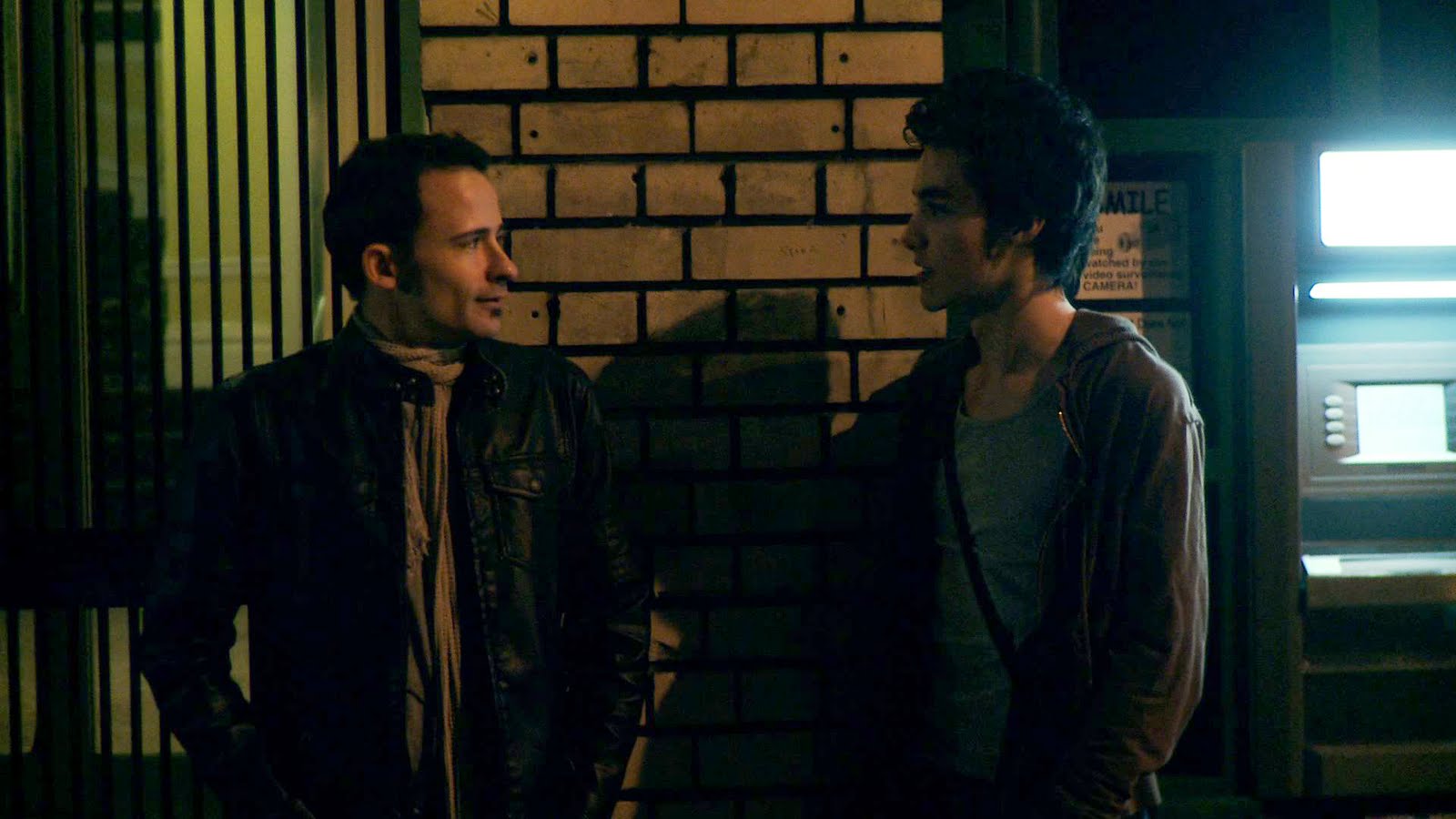
Scott Boswell's first feature The Stranger In Us faces the street with considerable compassion, observing the youthful exploration of urban night life with generous honesty and tact.
Scott Boswell is production coordinator at San Francisco State University; a hybrid position where he teaches half-time, while lending production support for all the media needs of the film students the rest of the time. Having graduated with an MFA from San Francisco State in 2004, the shorts he produced while he was a graduate student were the first shorts he distributed, with some success. His film came to me in an interim cut by way of Frako Loden who felt I would appreciate its subtleties. She handed me her screener, which I watched, and which intrigued me enough to contact Boswell to see if he would be willing to discuss the project. We met up for coffee at Bean There in the Lower Haight.
* * *
Michael Guillén: You're in post-production for The Stranger In Us; working on color correction?
Scott Boswell: We are right now, yeah. In the Fall we decided to do some focus test screenings of the film with small groups of people who didn't know anything about the project and mostly didn't know me. The result pinpointed where people were finding the plot confusing. We decided there were maybe five or six issues we needed to address and so we've done that.
Guillén: Thus, the screener I've watched is not as the film stands today?
Boswell: What you've seen is before we did a re-cut, yeah.
Guillén: I was intrigued by your film's narrative structure, which—admittedly—I "got" more upon second viewing than the first. It took me a bit to understand that your main character Anthony was remembering earlier events while on a bus to find his friend Gavin. So I'm wondering now if that's been shifted in your recent edit?
 Boswell: No, that basic structure remains intact. But we actually added chapter cards to give the film seasonal stamps to help distinguish that these are two different tracks in Anthony's life. There's actually three. There's the track of him on the bus, where he's having memories of these two people who have come into his life and who he's lost. There were lots of questions around that in the focus screenings. People typically by the end of the film pretty much understood the structure; but, the questions always landed in the first act.
Guillén: To be honest, I didn't fully catch the structure until Anthony showed up with a black eye….
Boswell: Which is easily an hour into the film.
Guillén: …and then I thought, "Oh. That's why I'm not following certain things here. The sequence is being shuffled." I liked that, however, because that's truer to how people actually remember things. People don't remember things in a linear fashion.
Boswell: That was the idea behind it. The trick with editing this project was finding the balance between people enjoying the puzzle while figuring out the structure and being annoyed by it.
Guillén: I was never "annoyed."
Boswell: I'm glad to know that.
Guillén: I've watched enough films to know there are many different ways to structure a narrative and none of them are essentially wrong; it's whatever the filmmaker wants to do. Let's back up a bit to the title: The Stranger In Us. Why that title?
 Boswell: By and large the film is about self-discovery and the character—this actually comes up in his poetry—is exploring the relationship between himself and strangers, but also the discovery of what he doesn't know about himself. For example, most people who find themselves in a situation where their partner is not treating them well and is being abusive surprises them. We don't go out into the world on a daily basis thinking that that's going to happen to us, normally, right? This particular character comes from a sheltered world and enters this urban area to discover that he's doing things that he may never have thought that he would do, on the streets with Gavin, the homeless character, experimenting with drugs and those kinds of things.
Guillén: While I was watching this again this morning in preparation for our talk, I found myself considering that an alternate title to this film could have been Face the Street. Where your film spoke to me was in my own experience of growing up on the streets of San Francisco. I arrived here in 1975 at the age of 21 during that incredible Castro Florescence where it seemed we had all been summoned by some kind of homing beacon. Anthony's experience in your film was my experience and—I might venture—will be every young gay man's experience coming to a metropolitan center like San Francisco. In some ways your film was difficult for me to watch—i.e., remember—because, of course, I'm so much more mature now. [Laughs.] I'm more centered, more grounded, and it was difficult to relive that awkward and necessary pain that a young man has to experience in order to familiarize himself with the stranger within. I appreciated how this was expressed not only through Anthony's struggles to become a poet but in the poetic vision of the film itself. Are you a poet?
Boswell: No, not in the traditional sense.
Guillén: So this isn't a situation of a closet poet coming out as a filmmaker?
 Boswell: No, but I'm drawn to it. I appreciate slam poetry, which the current generation of young people have embraced and—in many ways—they're expert at it. Before I worked at SF State, I ran a digital filmmaking program for teenagers in Oakland and, of course, I started to meet all the different worlds I ran in and all the different arts that they create. Slam poetry was one step away from what we were doing.
Slam poetry has become so popular and has received so much attention that now they feature slam poets on HBO and they're hosting national competitions. But myself, no, I'm not a poet. What you said earlier about coming to the city and sharing Anthony's experience I find particularly interesting because—since I've been working on this project—I've found a number of gay men who have told me that. There's a lot of mythology around San Francisco, especially for gay men. Hence, when we arrive here we don't quite know what to expect but we're driven by some sort of optimism.
Quite a few people have told me that they relate to Anthony's experience of feeling alien in the city at first and having trouble making connections with people while discovering this more urban, gritty street life. I love that. For me, I didn't quite know what to expect from the Castro but somehow it was disappointing.
Guillén: When did you arrive in San Francisco?
Boswell: I arrived here in 1997.
Guillén: Ah, so what you entered was the commodified Castro?
Boswell: I did! I experienced a commodified, more gentrified Castro and—at least on the surface—what I was seeing were more materialistic values and things that weren't interesting to me. I came looking for an alternative and, instead, felt alien in this enormous gay world. But I also came to discover that there were lots of us like that.
Guillén: Definitely. I have often said that the meanest men I have ever met were gay men in the Castro. Which was quite a shock to me when I arrived in San Francisco from the conservative Mormon belt of southern Idaho. I came expecting brotherhood and found brutal hierarchies of sexism and—much to my alarm—racism.
 Which leads me to one of the distressing topics in Strangers In Us: that of partner abuse, a subject that's not usually addressed in gay narratives. The self-loathing that capsizes relationships among gay men was skillfully handled in your film. Likewise, inversely, the genuine relationship Anthony had with Gavin the street kid pulled me right in for feeling so resoundingly honest. Truthfully, I learned to know myself as a young man by hanging on the streets. Anthony's desultory late night wanderings and how he learns to navigate the city—down to the broken glass and shit on the sidewalk—struck me as an urban poetic aesthetic of a young man's coming into being. I have to ask then: where did this story come from?
Boswell: The story is autobiographical and very much reflective of my experience coming to this city. Of course, whenever you work on a piece of fiction it becomes more and more fictionalized; but, the lead characters are based on people that I knew and experienced. I was largely trying to capture that experience, which is unique to people like yourself and I who have come from smaller, more conservative regions….
Guillén: Where are you from?
Boswell: I'm from central Illinois, a town called Normal. I literally grew up tasseling corn in the summertime. Normal was very much in the Midwestern Bible Belt. I moved here sight unseen. I just decided to pick up and go West. I don't regret it for a minute; but, I will say that you find yourself in this entirely new world and it's exciting and scary and makes you question everything about yourself. Ultimately, you either find your place in it or you don't.
In terms of domestic violence between gay men, you're right, I haven't seen that portrayed much in "gay" movies, or between same-sex couples at least. But it's always been of interest to me on a political level as well as a personal level and that's one of the reasons that I wanted to explore it. I mean, I've seen violence portrayed between gay men such as in Brokeback Mountain where I felt they were effectively trying to beat out the homophobia, that they were both frightened for being attracted to another male, but that violence was coming from somewhere else. I was more interested in the kinds of violence integral to a relationship, whether it's between two men, two women, or a man and a woman. I feel this is a big issue in the society at large; but, I haven't seen it dealt with a lot in the gay world.
Guillén: In some ways, it's not cool timing as it seems most gay films these days are concentrating on positive images. That's okay in and of itself, although I believe it delimits the potential of queer cinema, which—unfortunately—appears to have collapsed into rom-com fantasies that I don't feel particularly further queer sensibility, other than to offer comfort through fantasies of commodification. Partner abuse isn't a comfortable subject to look at, but, it's a real one, and I commend your film for tackling the theme, and the performances of your actors for rendering it real. Can you speak to me about your three main actors who play Anthony, Gavin and Steven? Are they San Franciscan actors?
Boswell: They were when we shot the film. Let me start by saying that my initial approach to this project was completely different. I was wanting to do something a little more experimental. And if I may back up just a little? I've always been fascinated with the Polk Street neighborhood as an older, grittier, alternative to the Castro, especially the Polk Street that I knew in the late '90s. Now Polk Street's become more gentrified itself; but I was fascinated with the kinds of bars you'd find there and the diversity of people, the rent boys on the street, the tranny hookers and all of that had some sort of appeal to me. I was thinking of doing something more like a documentary set in the Polk Street area but it would be a hybrid narrative where I would bring in actors into the scenario and film it like a documentary to see what we could make. Then as I worked on it, the script became more fleshed out and traditional, and I posted earlier than usual for actors before I'd actually finished the script, because I was still thinking of a more experimental approach. I wanted there to be a lot of improv and stuff that had to be worked out before the camera rather than in pre-production.
 One of the first people to respond was Raphael Barker, who appeared as Rob in Shortbus (2006). This threw me because I wasn't expecting to hear from someone who had some props. I thought, "Okay, well, let's meet." So we had coffee, hit it off immediately, and in some ways he inspired me to move forward with the project as it is.
Guillén: Let me be clear about this, when Raphael contacted you there was no finished script? How did he know what he was auditioning for? Had you posted a general story outline?
Boswell: Yeah. On the call for actors, I tried to pitch it in the way that I felt passionate about it. That's what drew him. He actually said something about how he doesn't normally respond to these but this sounded like an interesting project and he wanted to find out more about it. When I saw Shortbus in the theater, Raphael genuinely impressed me in that movie. He was one of my favorite actors in that film. Out of all the actors in that film, he's the one I would have wanted to contact me. So I was very excited that he was interested. When we met, I tried to explain to him what I was trying to do with the project and he got it. He was on board for it. There was another good eight months before we actually went into production. I did audition Raphael because I needed to know he could do it. He genuinely gave the best audition, which is apparent in his performance in the film.
 Adam Perez, who plays Gavin, was one of maybe forty auditions for that role. We just kept looking at actor after actor. Ultimately, he proved to be bringing to the role what we wanted. We made him audition three times because we wanted to see that he could handle it. Raphael was kind enough to come in and do a chemistry test with him. They worked together very well, which I was excited about.
 Scott Cox, who plays Steven, is a local stage actor who, incidentally, is the sweetest guy on the planet. If you've gone to plays locally, you've probably caught him at some point. I knew him because of a short I had worked on several years ago. We had been trying to find someone who could handle the difficult role of Steven. Fully qualified actors were having trouble bringing something to the role that we were looking for and I just suddenly remembered Scott and having worked with him a number of years earlier, so I contacted him and asked him, "Would you like to audition?" He was excited about it. And then it all worked out.
So that's how we came to working with those three and all three of them were such a pleasure to work with—and thank God!—because you hear nightmare stories sometimes.
Guillén: How much did they lend to the development of the script? Did you do a lot of improvisation with them to shape dialogue?
Boswell: We did. A fair amount. The script is 100 pages; but, the way it reads, there are paragraphs that say: "Now we're going to improv", with descriptions of what should happen for the set-up and I let them go where they wanted with it. I wanted to capture a naturalistic feel to the film and retain some sense of the original documentary impulse. Personally, it's also the kind of acting I enjoy. The truth is that 85% of the script was written but the actors were given liberty to adlib and then there were moments when we risked improvisation. We did spend quite a bit of time in auditions as well with improv to see if people could handle it. I have to say that sometimes the actors provided gold and sometimes they didn't; but, ultimately, I got what I needed. All of them brought moments to the script that I didn't compose myself. All of them also brought moments that were absolutely off base—which is what happens in improv—and that's when as a director you need to step in and bring it back to where it needs to be.
Guillén: Who are you imagining to be the audience for this film?
Boswell: That's an excellent question. I decided when I made this film that, first of all, I was just going to do it. That's not because I don't care about audience. But I wanted to make a feature for a long time and I woke up a couple of years ago and realized, "You can! Maybe you go a little bit into debt. But do you choose to buy a car or choose to make a low-budget feature film?" Once I had that thought, nothing was going to stop me. I'm a big believer in quality work and I believe that—if work is done well—it will find an audience. I don't think The Stranger In Us will appeal to all gay men. I do hope it plays in LGBT festivals. I hope it plays in international festivals too. We haven't aggressively started the distribution process yet. I suspect the audience will be somewhat diverse. We have shown it to maybe 100 people now and we've received some positive reactions from a diverse group of people and so The Stranger In Us needs to appeal to a certain aesthetic taste, to people who can appreciate the kind of film that we've shot and made. Perhaps those are film festival goers? Maybe there's an LGBT market for it? In general, audiences who can appreciate dramatic character-driven work. It's definitely in the indie vein so I imagine it would have to be something of a film festival audience.
 Guillén: Though the film allows access in several different ways. For example, I've approached it by way of memory because, of course, the film reminds me of my own youth and my transformation from rural to urban. In fact, because it faces the street so honestly, I was wondering how its urbanity will speak to audiences outside an urban area? I have to reiterate that the depiction of Gavin is one of the most thrillingly authentic portraits of queer street youth I've ever seen. It was the character of Gavin, and Adam Perez's pitch-perfect performance, that enthused me about wanting to talk to you about this project. Basically I just wanted to tell you exactly that. Gavin, as a character, is such a grounded, real person. Also the bartender who Anthony solicits for help in determining Gavin's whereabouts is someone I feel I already know. And, of course, I'm very intrigued by the transgender character Sonja who serves a wise and poetic function in the film, almost like a member of a Greek chorus. What were you trying to say through her character?
 Boswell: It's funny you mention Sonja. She comes up a lot in conversation, which I enjoy. My initial idea—and the way it's written in the script—is that she is another one of those lovely characters that you meet in the Tenderloin. What I love about the Tenderloin is all the crazy—and I mean that lovingly—people that you encounter. I don't think Sonja's crazy at all. I never wanted her to be a joke or a caricature or anything like that. I wanted her to be lovely. Joshua Grannell actually helped me find her. Her name is Veronica Klaus. She's a well-established local cabaret singer. I approached her and she agreed to do it and the song she sings in the film is her song. There's a studio version of her song that we'll probably incorporate into the credits in the final cut.
 Sonja is a character who's a bit mystical in that she observes what's going on around her and she sees that Anthony's in pain. She offers whatever comfort she can, even by just crossing paths with him on the street. In retrospect, I might have included her more, largely because I love Veronica's performance. Of course, going into it you don't always know what you're going to get; but, in this post phase, I have often thought that I would have put her in more often.
Guillén: That's actually a question I was going to raise. Being that this is your first feature, a project that you have strived for quite a long time, and now that it's moreorless done, would you have done anything differently? What is the main thing you've learned from your first feature?
Boswell: I've learned a lot. I've learned that you must always be extremely focused and mindful of your vision for the project. If you lose sight of that, scenes aren't going to work. Only you, as the director, carries that. Meaning that it's not necessarily the responsibility of the actor. They're not the director. You might find that they tripped, especially when you're allowing improv. For instance, Raphael loves to be funny.
Guillén: He does have some cute bits he delights in.
Boswell: And thank God because it brings layers to the character.
Guillén: His humor reveals his vulnerability.
Boswell: Exactly. But if it were to drift too far in that direction, the tone of the film would be lost. So there were times that I had to pull him back. The only thing I would do differently is that I imagined this to be a piece where all of the puzzle would fall into place more clearly than it seems to. That's one of the reasons we've done some additions and re-cutting to set up more clues to guide the audience into what they're seeing. I don't like films that hit you over the head with structure and its meaning and things like that, but I failed to realize as the writer of this piece just how obtuse it is for many viewers. I will be more mindful of that in the future.
Guillén: "Obtuse" only in the sense that, I suspect, people don't really want to know themselves very well and are, thus, reluctant to do their share of the work. As you said earlier, a lot of young gay people come to the city with preconceived notions of what life is going to be like for them once they arrive here. They anticipate a fullness of experience that real life often delivers fractured. You can become hardened because of that, jaded, which was always something I was most fearful of as a young man: I didn't want to become a jaded queen.
Boswell: [Laughs.] Which, fortunately, you didn't.
Guillén: [Knocking on the table.] Fortunately, I didn't. But, even if you don't become a jaded queen, you still hazard becoming a macho mannerist hiding behind enacted virilities. Rather than concerning yourself with the imagined failure of your narrative, I would focus on how it successfully depicts a young man who doesn't even really know what he can have or become yet—though he might have a sense of what he wants—yet, by film's end, even though it's left open-ended and is not neatly tied up, you sense that Anthony is ready for the challenge of living an authentic life. It's a subtle optimism: every young person can answer the call to lead an authentic life. For gay people, especially, it's problematic because there are all that many more barriers in the way of leading an authentic life, not the least being their own preconceptions and fantasies.
Boswell: I agree. That has been some of my own frustration with San Francisco. I don't mean to bash the Castro; but….
Guillén: [Laughs.] Oh go ahead.
Boswell: The Castro symbolizes….
Guillén: All that went wrong!
Boswell: When I first moved here, the apartment that I found to live in—and you know how competitive and difficult it is to find housing—was in the Castro, which shocked me. I never expected that to happen as someone coming from the Midwest, and everyone knowing what the Castro is, and so on and so forth. To me the Castro symbolizes the inauthenticity that you're describing. I've always resisted it. Of course, I love the Castro Theatre and I love the sense that there's this mythological community that's always festive and safe—even though it's not always—but, my attitude has largely been to resist falling into that and, as cliché as it sounds, to not become that, to remain true to myself. That's one of the reasons I moved out of the Castro. And you may notice in the film that Anthony never goes to the Castro. He's in San Francisco but he never goes there.
Guillén: I did notice that. I noticed that the film focuses on the Civic Center, the Tenderloin and Polk Street.
Boswell: That's why. Because of what the Castro symbolizes for me. I completely agree with you. I think it's reflective of what I do want to say about this city.
Guillén: As a film journalist who watches lots of movies and monitors the fantasies that basically inform movies, I often consider which fantasies (i.e., movies) can actually help people lead an authentic life and which will throw them off the track. One of my main critiques of queer cinema is that I often feel that the stories that are being told/sold are inauthentic narratives.
Boswell: I agree.
Guillén: These are not stories that are going to help anybody achieve anything, except perhaps a momentary illusion of normalcy, which itself is fraught with error. Returning to your choice of locations, and your decision to monitor Anthony's nocturnal wanderings, are you familiar with the work of João Pedro Rodrigues?
Boswell: No.
Guillén: His debut feature was O Fantasma, and he followed that up with Odete, and most recently with To Die Like A Man. One of the aspects I most enjoy about João's work—and I've talked to him about this—is that he uses the night as his mise-èn-scene. Night becomes the realm or the domain within which his characters discover themselves. Night is their mirror. Can you speak to what night means for you in The Stranger In Us?
Boswell: First of all, I can't deny that it's based largely on real experiences. In that sense, it's purely just trying to capture something I experienced myself. There was … is a Gavin and he was someone that I used to only see at night and run into in the neighborhood, and he was someone with whom I developed a friendship when I didn't feel that I had a lot of other close relationships here, and had gone through and just come out of a difficult relationship. But I love the visual symbol of being in the dark. I also love the beauty of Polk Street at night because it's so colorful and florescent and for me it sets up what is simultaneously appealing and scary about it. Because there are all these things going on around, it's possible that you could get hurt; it's possible that you could get lost; but, it's also erotic and beautiful and there are other people out there just as lost and lonely as you are. In terms of just a place on the planet where different people meet, I found the Polk Street region a fascinating place to explore and it seems to me that happens most at night.
Guillén: I've frequently considered that what was so different in the '70s was the proportion between private and public space. So much of what was public space has become privatized since then, such that it's only at night these areas are reclaimed as public. I especially took note of this in the scene in The Stranger In Us where Anthony meets Sonja. This was filmed outside the public library?
Boswell: It's actually the Asian Art Museum, but the Civic Center area.
Guillén: I was fascinated by this because the Civic Center is truly a private sector of art and cultural institutions, a government sector with city and state institutions, and yet at night it's being reclaimed as a terrain of self-discovery for an alternative culture.
Boswell: The shot where Anthony sees Gavin for the first time is in front of City Hall.
Guillén: How did you decide where you wanted to set your film? You've talked a little bit about Polk Street already. Did you have any issues filming in these locations?
Boswell: No. For the most part we had permits.
Guillén: So you weren't shooting guerilla?
Boswell: We didn't do it all guerilla, though we did do a bit when we shot a few hours past what we were permitted for. But no one asked. It's funny, we shot for days and for hours and hours on Polk Street, in the alleys around Polk Street, and the police never once asked. Which, of course, if we hadn't secured the permits, they would have asked every time we went out there. I don't know if they had bigger fish to fry; but, we chose the locations largely for aesthetic reasons and lighting reasons. We didn't set up any outside lights. We scouted very carefully beforehand and spent a lot of time walking around and driving around that area, looking for places where light always falls at night, either from street lamps or any other artificial lights set up in the area. Then we set all of our scenes beneath those lights because it's very easy to walk just a few feet away and fall into darkness in a way that wouldn't work for the visuals. We based our locations largely on the light that we could find. Some of the scenes turned out beautiful in ways that look almost lit. If you look carefully, there's light on the shoulder, on the head, on the face.
 Guillén: Which lends to its naturalistic look. It is real, without being murky as can often be the case. You've billed your film as cinema vérité, though your camera is more controlled and composed than what I would associate with cinema vérité. To wrap up here, though you're still in post-production, what is your strategy for getting the film out there once the film is finished?
Boswell: The obvious first step would be to submit to film festivals. I always find this to be a tricky step in my work because I don't just want to be a gay filmmaker; but, I get that I'm dealing primarily with gay characters and themes. I always hope that my films will screen in international film festivals as well as the LGBT festivals, and my shorts have, so hopefully this one will as well.
Guillén: Do you strategize that way? Do you aim for a general audience first and then fall back on the sure LGBT audience?
Boswell: Typically, I've done them both simultaneously and just see what happens. But there are a couple of other possible trajectories. I, ultimately, would love some DVD distribution. I obviously want it to be shown as much as it can and my hope is to interest some of the distributors who would distribute a movie like this. My producer Cheryl Valenzuela has been largely looking into these possibilities. Also, independent filmmakers are dealing with the fact that there's a lot more media being produced because it's cheaper to produce now—which is why I could make this film—but, when you hear the number of submissions that festivals are getting now, it's staggering. So how does your film get attention? There's a movement of DIY filmmakers creating distribution strategies that work for them and we're just starting to look into that to try to create our own buzz around the project. This is all new territory for me so it's simultaneously mysterious and exciting and worthy of exploration in the coming months. We're in the grey zone of thinking, "Who's going to show this? And when?" That whole international vs. LGBT issue is tricky, because you don't want to turn anyone down but you also don't want to undersell.
Cross-published on Twitch.
 I waited almost a little too long to interview Michael Lumpkin, Frameline's former Executive Director, before his unexpected retirement. I told myself not to hazard the same mistake twice and to make a more concerted effort to get to know and interact with his successor K.C. Price and, further, to become more involved with Frameline's championing presence in the Bay Area. I dropped the ball last year on meeting up with Price but rallied this year. My thanks to K.C. for so graciously considering my 35mm complaints even as he invited me into Frameline's office at the Ninth Street Film Center for a conversation. He carries on Frameline's ongoing tradition of being responsive to its constituency. A tall, affable and well-spoken gentleman, I sensed our conversation would be the first of many in years to come.
 Michael Guillén: K.C., I was Googling you last night to see who the heck you were and I kept getting all these hits on this Black evangelist fleecing his flocks....
 Price: No. Michael Lumpkin hired me in 1999. I came on then and worked for four years as their Development Director. Frameline, CAAM, and the San Francisco Jewish Film Festival co-own the Ninth Street Film Center and—when Frameline moved into the building—we enhanced that partnership. All of a sudden the Center became its own non-profit so I moved from the Frameline position and became the Managing Director of Ninth Street. I did that for five years. I was still basically working closely with Michael and Frameline through those years. When Michael left, I applied for the Executive Director position and that's how I came back into the office directly.
 Price: Absolutely! I feel lucky to have this job. No doubt about it. Of course, anybody working in the non-profit sector with the economy right now has been facing financial challenges—especially at the end of 2008 when all this started—but, we have weathered all that very well and things are going great. No, I couldn't love this job any more. Being in this role last year during my first festival—especially following in Michael's footsteps—felt pretty terrifying sometimes; but, at this point, going into my second year, it feels so much more comfortable to me.
 Guillén: With regard to this year's edition of Frameline, I'd like to focus on the two sidebars I'm most anticipating—the focus on South American queer cinema and the mini-retrospective of the queer shorts of Andy Warhol—and the festival's overriding attention to history. As you went to organize the festival, did these themes present themselves in the submissions received or did you sift through the submissions in search of works to fit chosen themes?
 Price: We do interact with them—not necessarily to make the programming decisions—but, we have a lot of close relationships with several of the other queer film festivals. We get to know each other at the larger film festivals. They're wonderful people working at the other festivals. We have a great working relationship, for example, with Outfest in Los Angeles. One thing we do get out of knowing the other programmers is that sometimes we can check in with each other for tips or if we're looking for information on a particular film; but, it's not a close network in terms of making mutual programming decisions.
 Price: We have two different types of sponsorship support. We have corporate sponsorship where companies, businesses and sometimes non-profits donate either corporate financial gifts or in-kind gifts. The other part of it is the co-presentations where we work with different community organizations—this year I think we have more than 60 different community groups, mainly all non-profit organizations—and they help us get out the word about Frameline and the festival and we get to talk about them at the screenings as well as provide tickets to their constituents so they can attend the festival. Servicemembers Legal Defense Network is one of our relatively new co-presenters that we're excited about this year. They're co-presenting two wonderful films related to Don't Ask Don't Tell: A Marine Story (2010) and Out of Annapolis (2010).
 Guillén: Speaking of the distribution arm, I'd like to follow-up on a question I asked Michael Lumpkin when we spoke a few years back. I expressed to him how much I admired the "Send It Home" program that Frameline initiated back in the late '80s, I believe, and he told me that the program had been discontinued due to administrative complications. He mentioned, however, that it had morphed into Frameline's "Youth In Motion" program, a carryover of the "Send It Home" initiative. Can you speak to where Frameline stands with its "Youth In Motion" program?
 Price: Yes, yes, and yes. [Laughs.] It's really wonderful that we do have all these new platforms and options to see things on television that we didn't used to see; definitely a plethora of queer images in media that weren't available, say, 10-15 years ago. On the other hand, though, Frameline's festival as well as the other LGBT festivals throughout the country still fulfill a really important need of bringing out a large collection of independent, really wonderful LGBT films that you're not going to have access to. If on your cable networks or your IPhone—should that be the medium you prefer to watch films—these films were available, I wonder if it would be a different question? Yet, it isn't. LGBT film festivals really are the only opportunity people will have to see a lot of these works.
 Guillén: A case in point would be François Ozon's Le Refuge, which I caught at Toronto, and which Frameline has included in its line-up, but which was also shown previously in the Bay Area at a preview screening at the recent San Francisco International. I'm curious, did they situate the film in their festival in that way because they knew you were going to be showing it at your festival?
 Price: More of what was out there. We didn't purposely do that. We did more consciously program the Warhol sidebar just because of a number of things that had happened over the past few years. We thought it would be a nice add-on after the underground cinema we programmed last year. Plus, we were motivated by the wonderful Centerpiece documentary Beautiful Darling: The Life and Times of Candy Darling, Andy Warhol Superstar.
 Price: No, we worked with Canyon Cinema last year for our special program on underground cinema; but, this year we're working with MOMA for the Warhol films since they had the 16mm prints. They just came in the other day. I was excited when the big box arrived. Ron Gregg, the Yale film studies professor who's curated the sidebar, is absolutely marvelous and I'm personally looking forward to his lecture as well.
 So, for example, I was really excited how much you loved The Consul of Sodom. I did too. One of the things that just fascinated me about the film so much was that I would never think that a person such as the poet portrayed in that film would have led such a life in post-World War II Franco Spain. It surprised me; but, then—watching the film—I thought, "Well, of course." I would have thought it would have been a more oppressive time where a gay man couldn't live quite as openly; but, then again, when you come from such a wealthy family, you can get away with a lot more.
 Guillén: I'm likewise invested in several of the projects chosen this year. Scott Boswell's The Stranger In Us is dear to my heart and I'm so pleased it sold out its original Roxie engagement, such that you've added a second screening at the Castro.