 With each edition, SFIAAFF uncovers, rediscovers and celebrates films that have "blazed the trail of independent cinema" through a fourfold Special Presentations program, which includes a film retrospective, an out-of-the-vaults screening, a filmmaker spotlight, and an on-stage conversation with a filmmaker. All but the latter receive special support from the Academy of Motion Picture Arts and Sciences. This year's retrospective "After Death: Horror Cinema From South East Asia" was a welcome tip of the hat to this populist genre, and a shout-out to its fans. The festival catalog qualifies: "While each film deals with horrifying stories about ghosts, spirits or more worldly entities, the stylistic expressions and atmospheres are as diverse as the countries of origin. The strength of these films is how they beautifully weave local folklore and superstitions into the stories."
From the Philippines comes Affliction (Yanggaw, 2008), which Twitch teammate Andrew Mack cautioned might disappoint horror fans unfamiliar with its cultural context. That's precisely what Francis "Oggs" Cruz provides in his review at Lessons From the School of Inattention. Not only does Oggs provide interesting production detail on the film's funding by CinemaOne, but he appreciates its deft genre-blending of mythic horror with the Philippine family melodrama. With his kind permission, I replicate his write-up for Affliction's SFIAAFF audience.
* * *
 Among the three horror shorts that comprise Shake, Rattle and Roll 2k5, the seventh installment in the horror franchise that started way back in the early 80's, is Richard Somes' Ang Lihim ng San Joaquin (The Secret of San Joaquin), about a man (Mark Anthony Fernandez) and his pregnant wife (Tanya Garcia) relocating to a rural town that is populated by aswangs (which—according to Filipino folklore—are monsters that partake the form of ordinary human beings during the daytime but transform into hungry monstrosities at night that feed on the blood and internal organs of humans, preferably the very young). Somes transforms what essentially is a straightforward story of survival (in fact, the short is ridden with logical loopholes and unanswered questions, the biggest of which is why any sane couple who are expecting their firstborn would relocate to an impoverished barrio with dubious residents) into a thrilling portfolio of his directorial mettle, although influences (F. W. Murnau, Tod Browning, George Romero, and Peque Gallaga: not really a bad lot to borrow from) are evident. Given the scarcity of good genre directors in the country—there's Rico Maria Ilarde (Sa Ilalim ng Cogon / Beneath the Cogon, 2005) and Altar (2007)—I was excited as to what Somes would offer next.
 Three years later after Lihim ng San Joaquin, Somes releases Yanggaw (Affliction, 2008), whose screenplay has been gestating for a number of years before it was given the green light by CinemaOne, a local cable network that gives grants to several screenplays in their annual film festival (successful CinemaOne-funded films include Dennis Marasigan's Sa North Diversion Road (On the North Diversion Road, 2005), Sherad Anthony Sanchez's Huling Balyan ng Buhi (Woven Stories of the Other, 2006), Jerrold Tarog and Ruel Antipuesto's Confessional (2007) and Adolfo Alix's Tambolista (Drumbeat, 2007). The term yanggaw is an Ilonggo term that refers to infection, more specifically, of an affliction that turns normal human beings into aswangs. Somes' film centers [on] Junior (Ronnie Lazaro)—a former barrio official who retires from service because of disillusionment and eventually manages to feed his family through meager means—who suddenly confronts the situation of having Amor (Aleera Montalla)—his beloved daughter who suddenly returns from another barrio with a curious illness—degenerate into a rabid and murderous aswang at night.
 Yanggaw is in concept, a horror film. However, Amor's horrific predicament is treated with the least sensationalism possible (especially if compared to other aswang films like Topel Lee's Yaya (Nanny, 2006), where much of the short centers on the nanny who turns out to be an aswang out to kill her wards, or Somes' Lihim ng San Joaquin, where the meticulously conceived aswangs (complete with computer-generated tongues) dominate the picture). She stays in the background (in fact, there is not much fuss as to her appearance; she is mostly hidden in the night with only the stark crimson of her victims' blood on her face to serve as her definitive feature.
Actually, Somes does wonders with his limited budget (CinemaOne gives its grantees one million pesos, or around $20,000 to complete the film). Utilizing simple make-up (there are no hideous prosthetic make-up, a staple in aswang movies), lighting (Somes shows remarkable adeptness, probably borrowed from Murnau, in utilizing shadows as implement for creating atmosphere; there's an impressive sequence wherein Amor appears from her room, complaining of her illness, with her body is partially illuminated while her face is completely unseen. It's a simply set sequence, but Somes effectively creates an awkward and eerie feeling throughout), sound (the ambient noise and the long stretched of deadening silence) and editing effects, Somes creates an effective set-up for the ensuing events.
 The horror element (the aswang aspect of the feature) of the film is not there for cheap chills and thrills, but is there as basis for the lingering familial dilemma, very much like drug addiction or infidelity in normal family dramas. In fact, much of the picture observes the simplicities and the intricacies of the relationships (like Junior's observable disappointment with his son, who returns the favor to his father with striking indifference) among the family members. However, it is the family's struggle with Amor's affliction that becomes the heart of the film, converting Yanggaw from mere genre picture into an engrossing examination into the Filipino family's psyche, especially if confronted with such a divisive situation.
 As Amor's illness worsens and her hunger for human meat escalates, Somes' audiences become witnesses to the family's encounters with moral quandaries (also escalation in gravity, from simple ones as having to choose between spending the money they don't have to bring Amor to a doctor in a faraway barrio to more delicate decisions as allowing Amor to hunt at night for her survival in exchange for the lives of the residents of their community), and eventually, to the family unit's complete deterioration. Thus, by film's end, it doesn't become surprising that the intensity of the drama heightens into near-operatic levels (the ending seems to belong more to a melodrama, with its swelling music and unneeded montage of crying faces), a slight aberration in the film's near-perfect control of mood and atmosphere. Having said that, Somes' Yanggaw, while riddled with pacing problems (there is reportedly a longer cut, which could fix the film's rushed feel) and an ending that could have been more subtly executed, is an achievement, mixing traditional elements of horror and family melodrama, creating a picture that is so bizarre, it will be stuck to your mind months after seeing it.
Cross-published on Lessons From the School of Inattention and Twitch.
 "I wish Francis 'Oggs' Cruz, Richard Bolisay, and Dodo Dayao would get space in the broadsheets, because they're far more interesting than anyone writing there regularly."—Alexis Tioseco, "Wishful Thinking for Philippine Cinema"
According to Dodo Dayao's MySpace page, he is 102 years old and chasing pavements. He further describes himself as "writer, filmmaker, infrequent painter, random komikero [i.e., comic book enthusiast], heartthrob in a past life, monkey gone to heaven." We should all be so prolific. Not only does he administer two film sites—Is It Safe? and Piling Piling Pelikula—but, he's a team contributor to Geeks United, Korean Bug and Unspoken Cinema.
 In similar collaborative spirit, his oil paintings have been featured in group exhibitions at various galleries in the Philippines (examples can be seen at Quezon City's West Gallery website as part of three group shows: "12x9", "Them!" and "2010: The Year We Make Contact"). He's also collaborated with Khavn dela Cruz as "translator" on such films as Ang dagat na nalulunod (The Drowning Sea, 2008). His film writing—especially as reflected at Piling Piling Pelikula—is hot with incendiary irreverence. I find his poetic insights brave, searing and addictive. It's no wonder that Alexis Tioseco wished him a wider audience and I'm delighted that he was quick to respond to my set of email questions.
* * *
Michael Guillén: What do you want San Francisco audiences to understand about Filipino cinema?
Dodo Dayao: That it's not all social realism and exoticized poverty. That it is multi-colored and many-flavored and more often than not—especially these days—goes on adventures. And that there's more where all this came from.
Guillén: What do you want San Francisco audiences to understand about Lino Brocka?
Dayao: That Brocka made around 65 movies and only around 10 of them have been elevated to the canon. And that the films that didn't make it to the canon—the melodramas, the comedies, the pop films—demand as much investigation, possibly even more, than those that did. Canons are moldy and rigid and play it safe and are no fun at parties anyway. I always thought cinema should be the opposite of all these (especially the part about being fun at parties).
Guillén: How do you situate yourself within Filipino cinema and Filipino film criticism?
 Dayao: I'm a fan first, a writer second and a critic a distant third. I abandon myself to tone and voice and color, to energy of language and blood in the pulse and the beating to a pulp of all anonymity and objectivity. Cinema is all about wading knee-deep in the mud and getting your feet dirty and sometimes your heart broken. And I always thought film writing—or any kind of writing for that matter—should be as vivid and fervent and as misbehaved and as given over to the moment, not dry like a dissertation. Also, would-be film reviewers should at least know basic grammar. But there should be more film writers, if only to amp the volume of discourse. There are very few of us and the ones that are doing good work—and there are a good number of these already, mind—are either people I know or have met. I want to someday be swept off my feet with awe and envy by a complete stranger's piece. All this, of course, most likely situates me in the margins—which is really where I prefer to be.
 Guillén: If there is one Filipino film that you don't think gets enough attention, what would it be?
Dayao: A trick question, as there can never be just one. But for now, let me just say that Joey Gosiengfiao's masterpiece is not Temptation Island (1980) as the world seems to think; it's Bomba Star (1980).
Cross-published on Twitch.
 "I wish Francis 'Oggs' Cruz, Richard Bolisay, and Dodo Dayao would get space in the broadsheets, because they're far more interesting than anyone writing there regularly."—Alexis Tioseco, "Wishful Thinking for Philippine Cinema"
Lessons From the School of Inattention has long been one of my favorite blogs to explore for commentary on national cinemas. Lawyer-critic Francis "Oggs" Cruz has been administering the site since 2006—after shifting away from his previous site Repository of Ideas—and offers a helpful index of all the Filipino films he's reviewed. I'm grateful for his swift willingness to respond by email to a batch of questions related to this year's edition of the San Francisco International Asian American Film Festival.
* * *
Michael Guillén: What do you want San Francisco audiences to understand about Filipino cinema?
 Francis "Oggs" Cruz: I believe the interesting thing about Filipino cinema is that it is, to put it bluntly, undefinable. In terms of how the international community sees Philippine cinema, it seems that our nation's cinema concentrates heavily on social realism (as popularized by Lino Brocka, and continued by many of his disciples from Joel Lamangan to Brillante Mendoza) or distinctly personal visions (Lav Diaz's kilometric films, Raya Martin, John Torres, Khavn dela Cruz). However, to box a national cinema based on what essentially are stereotypes is limiting (for a period, the Philippines has been an exporter of cheap exploitation flicks and gay films: Brocka's Macho Dancer).
What I essentially want San Francisco (and the rest of the world, and quite embarrassingly, even my own countrymen) to know is that there is more to Philippine cinema than what is being shown in film festivals.
 First and foremost, Filipino cinema—while it is only gaining attention very recently—is not new. I hope this newfound interest in Philippine cinema will unearth the vast history that is quickly being forgotten. There are filmmakers like Gerry de León, who is more famous in the West for his exploitation features than his home-grown films (48 Oras / 48 Hours, a taut Filipino film noir; The Moises Padilla Story, a political propaganda film that hybrids as a Jesus Christ allegory); Manuel Conde (Genghis Khan, and the Juan Tamad series); and Ricardo Abelardo (Mutya ng Pasig / Muse of Pasig). All of these directors are worth discovering. The fear here is that there is very little time to discover these directors because their films are disappearing (due to governmental lack of interest to archive these films and save them from rot).
 Second, Filipino cinema is not limited to Tagalog cinema. While Manila has represented the Philippines mainly because it is the seat of government, commerce and culture, the availability of digital filmmaking has created film communities outside Manila. The result of this is a multi-faceted and probably more truthful cinema. There is definitely a difference between a Manila-made film about the Mindanao rebellion (Marilou Diaz-Abaya's Bagong Buwan) and a digital film that is made by a director who is from the area (Arnel Mordoquio's Hunghong sa Yuta or Sherad Sanchez's Huling Balyan ng Buhi).
Guillén: What do you want San Francisco audiences to understand about Lino Brocka?
 Cruz: Lino Brocka is also a very commercial director. There is a danger of limiting Brocka to grim and socially relevant cinema. However, throughout his career, he has made several pleasing crowdpleasers. There's Ang Tatay Kong Nanay (My Father, My Mother, 1978), a melodrama about a gay man who is forced to inhibit his homosexuality while rearing his ex-lover's son. There's Santiago (1970), a taut action film. There's Natutulog Pa Ang Diyos (God is Still Sleeping, 1988), an extremely ludicrous melodrama that is strangely a guilty pleasure of mine. There's Angela Markado (Angela the Marked One, 1980), a revenge thriller where a woman who was raped starts murdering her rapists one by one.
 If we talk about Lino Brocka, it's impossible not to talk about Ishmael Bernal, his supposed rival and arguably the better director. He directed Himala (Miracle, 1982), Pagdating sa Dulo (At the Top, 1971), and Manila After Dark (1980), supposedly an answer to Brocka's Manila in the Claws of Neon.
The beauty of this Brocka retrospective is that it would most likely arouse curiosity as to the other directors during Brocka's period who are also worthy of similar retrospectives (Mike De Leon, Mario O'Hara, etc.). The danger of this Brocka retrospective is that it might limit Philippine Cinema to a single director's work.
Guillén: How do you situate yourself within Filipino cinema and Filipino film criticism?
 Cruz: The interesting thing about the current state of Filipino cinema is that there are so many new films, so many new directors, but so few critics writing about them. Filipino cinema relies too much on foreign writers and festivals to acknowledge itself. Print media is more interested in talking about gossip, actors and actresses than film. It is more interested in listing how many awards a film has won rather than analyzing why the film won such awards. One cannot blame print media too much because film criticism does not sell. Filipinos are culturally onion-skinned and courteous, and have yet to develop a critical culture.
 If digital filmmaking jump started Philippine cinema, blogging—which I think I represent—will hopefully jumpstart Filipino film criticism. Filipino film enthusiasts are getting more information about films that would normally not be able to get any attention in traditional print media from the internet and film bloggers. Little events like the Fully Booked Film Series—a monthly free screening of overlooked films that is dedicated to the memory of Alexis Tioseco and Nika Bohinc which I, Dodo and Chard curate—have become starting points for what I hope to be a revolution in film viewing.
I sincerely hope that more Filipinos would be as excited with their cinema. It's quite shameful that foreigners are more excited about our cinema than us.
Guillén: Name one Filipino film that you don't think gets enough attention and should.
 Cruz: This is difficult because I have to choose one. If I had the option of being greedy, I would choose around a hundred, in the hopes that Martin Scorsese would start noticing our cinema and make a move to restore even just a few of my nation's cinematic treasures.
But if I have to choose one, it would have to be Mike De Leon's Kisapmata (Blink of an Eye, 1981). I will not say anything more in the hopes that you would try to search for it and see it for yourself.
Cross-published on Twitch.
 With each edition, SFIAAFF uncovers, rediscovers and celebrates films that have "blazed the trail of independent cinema" through a fourfold Special Presentations program, which includes a film retrospective, an out-of-the-vaults screening, a filmmaker spotlight, and an on-stage conversation with a filmmaker. All but the latter receive special support from the Academy of Motion Picture Arts and Sciences. This year's retrospective "After Death: Horror Cinema From South East Asia" was a welcome tip of the hat to this populist genre, and a shout-out to its fans. The festival catalog qualifies: "While each film deals with horrifying stories about ghosts, spirits or more worldly entities, the stylistic expressions and atmospheres are as diverse as the countries of origin. The strength of these films is how they beautifully weave local folklore and superstitions into the stories."
 Among the three horror shorts that comprise Shake, Rattle and Roll 2k5, the seventh installment in the horror franchise that started way back in the early 80's, is Richard Somes' Ang Lihim ng San Joaquin (The Secret of San Joaquin), about a man (Mark Anthony Fernandez) and his pregnant wife (Tanya Garcia) relocating to a rural town that is populated by aswangs (which—according to Filipino folklore—are monsters that partake the form of ordinary human beings during the daytime but transform into hungry monstrosities at night that feed on the blood and internal organs of humans, preferably the very young). Somes transforms what essentially is a straightforward story of survival (in fact, the short is ridden with logical loopholes and unanswered questions, the biggest of which is why any sane couple who are expecting their firstborn would relocate to an impoverished barrio with dubious residents) into a thrilling portfolio of his directorial mettle, although influences (F. W. Murnau, Tod Browning, George Romero, and Peque Gallaga: not really a bad lot to borrow from) are evident. Given the scarcity of good genre directors in the country—there's Rico Maria Ilarde (Sa Ilalim ng Cogon / Beneath the Cogon, 2005) and Altar (2007)—I was excited as to what Somes would offer next.
 Three years later after Lihim ng San Joaquin, Somes releases Yanggaw (Affliction, 2008), whose screenplay has been gestating for a number of years before it was given the green light by CinemaOne, a local cable network that gives grants to several screenplays in their annual film festival (successful CinemaOne-funded films include Dennis Marasigan's Sa North Diversion Road (On the North Diversion Road, 2005), Sherad Anthony Sanchez's Huling Balyan ng Buhi (Woven Stories of the Other, 2006), Jerrold Tarog and Ruel Antipuesto's Confessional (2007) and Adolfo Alix's Tambolista (Drumbeat, 2007). The term yanggaw is an Ilonggo term that refers to infection, more specifically, of an affliction that turns normal human beings into aswangs. Somes' film centers [on] Junior (Ronnie Lazaro)—a former barrio official who retires from service because of disillusionment and eventually manages to feed his family through meager means—who suddenly confronts the situation of having Amor (Aleera Montalla)—his beloved daughter who suddenly returns from another barrio with a curious illness—degenerate into a rabid and murderous aswang at night.
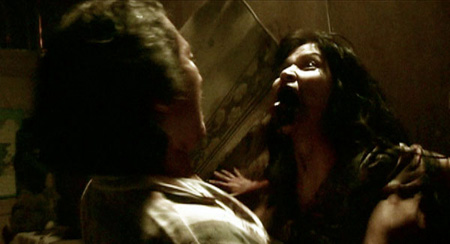 Yanggaw is in concept, a horror film. However, Amor's horrific predicament is treated with the least sensationalism possible (especially if compared to other aswang films like Topel Lee's Yaya (Nanny, 2006), where much of the short centers on the nanny who turns out to be an aswang out to kill her wards, or Somes' Lihim ng San Joaquin, where the meticulously conceived aswangs (complete with computer-generated tongues) dominate the picture). She stays in the background (in fact, there is not much fuss as to her appearance; she is mostly hidden in the night with only the stark crimson of her victims' blood on her face to serve as her definitive feature.
 The horror element (the aswang aspect of the feature) of the film is not there for cheap chills and thrills, but is there as basis for the lingering familial dilemma, very much like drug addiction or infidelity in normal family dramas. In fact, much of the picture observes the simplicities and the intricacies of the relationships (like Junior's observable disappointment with his son, who returns the favor to his father with striking indifference) among the family members. However, it is the family's struggle with Amor's affliction that becomes the heart of the film, converting Yanggaw from mere genre picture into an engrossing examination into the Filipino family's psyche, especially if confronted with such a divisive situation.
 As Amor's illness worsens and her hunger for human meat escalates, Somes' audiences become witnesses to the family's encounters with moral quandaries (also escalation in gravity, from simple ones as having to choose between spending the money they don't have to bring Amor to a doctor in a faraway barrio to more delicate decisions as allowing Amor to hunt at night for her survival in exchange for the lives of the residents of their community), and eventually, to the family unit's complete deterioration. Thus, by film's end, it doesn't become surprising that the intensity of the drama heightens into near-operatic levels (the ending seems to belong more to a melodrama, with its swelling music and unneeded montage of crying faces), a slight aberration in the film's near-perfect control of mood and atmosphere. Having said that, Somes' Yanggaw, while riddled with pacing problems (there is reportedly a longer cut, which could fix the film's rushed feel) and an ending that could have been more subtly executed, is an achievement, mixing traditional elements of horror and family melodrama, creating a picture that is so bizarre, it will be stuck to your mind months after seeing it.


