Showing posts with label Christoffer Boe. Show all posts

Monday, 2 July 2012

FANTASIA 2012—THE FIRST WAVE

The 16th annual Fantasia International Film Festival (Fantasia) is gearing up to take Montreal by storm with three weeks of inspiration and thrills beginning July 19, 2012 and continuing through August 7, 2012. Their full 2012 lineup of programming and special events won't be revealed until later this month, but—in anticipation of same—Fantasia announced several selected highlights mid-June to whet appetites.

11/25 The Day Mishima Chose His Own Fate / 11/25 Jiketsu No Hi, Mishima Yukio to Wakamonotachi (Japan) Dir.: Kōji WakamatsuYukio Mishima's masterwork isn't his literature, but the political commitment he pursued even unto death. By retracing the journey of the revolutionary writer, Japanese cinema's enfant terrible Kōji Wakamatsu delivers a violent, rabid critique of militancy. A timely, necessary film. Official Selection: Cannes 2012 [PDF press kit]. IMDb. Wikipedia. North American Premiere.

At Japan Times, Mark Schilling complains: "Kōji Wakamatsu's documentary-like film illuminates the motives behind this quixotic coup attempt, including Mishima's tempestuous relationship with the four young disciples who accompanied him that fateful day, but as a drama it is on the wordy, wooden level of a cable-channel historical reenactment." At Screen, Jonathan Romney describes the film as "glacially analytical" and predicts, "The film's chilly execution and cumbersomely fact-laden narrative will make it a tough export, although it can be expected to thrive at festivals with a bent for rigorous austerity." At Variety, Maggie Lee concurs: "Devoid of drama and shorn of superfluous technical flourishes, the pic uses characters as mouthpieces for political ideology in a manner as indigestible as raw potatoes. Hard going as cinema, yet admirable as an unbiased analysis of misplaced idealism at a particular moment in history, the pic is a worthy study topic but likely commercial suicide for distribs." Mincing no words in his bottom line, The Hollywood Reporter's Todd McCarthy concludes: "This thinly realized film makes the Japanese author and militant nationalist look like nothing but a political nutjob."  At Fandor's Keyframe, Anna Tatarska interviews Wakamatsu.

As Luck Would Have It / La chispa de la vida (Spain) Dir: Álex de la Iglesia—Spain's madman auteur reworks Billy Wilder's Ace in the Hole for today's world as an absurdist comedy. Stars José Mota and Salma Hayek. Official Selection: Berlin 2012, Tribeca 2012. IMDb. Canadian Premiere.

At Variety, Jonathan Holland writes: "A would-be Death of a Salesman for our times, given that it studies a man prepared to swap his dignity for his family's future, As Luck Would Have It reps an entertaining but unsubtle satire on the moral confusions of a marketing / media-driven world. Though it slickly offers up drama, black comedy and enjoyable perfs in due measure, the pic never develops much bite, though it does bare its fangs. Arguably helmer Álex de la Iglesia's most accessible item to date...." At indieWire, Gabe Toro describes the film as "mordantly funny and sharp as a razor" and proclaims it as "one of the treasures of the Tribeca Film Festival."

Blood-C: The Last Dark (Japan) Dir: Naoyoshi Shiotani—In a futuristic Tokyo where youth struggles for its freedom, Aya must face off against the man who has a stranglehold on the city and nightmarish creatures that are spreading terror. Twelve years after Blood: The Last Vampire, here is the big comeback to the big screen of this influential Japanese animation franchise. Official site [Japanese]. IMDb. International Premiere.

Beast (Denmark) Dir: Christoffer BoeNicolas Bro, Marijana Jankovic and Nikolaj Lie Kaas star in this disturbing and poetic nightmare drama that treats Love as both a force of nature and a chemical imbalance. Official Selection SXSW 2012. IMDb. Canadian Premiere.

At Variety, Alissa Simon praises the sharp dialogue and strong performances in this "perversely fascinating psychodrama." At Twitch, Shelagh M. Rowan-Legg characterizes Beast as "A visceral, dark and disturbing portrait of a man whose love drives him to chaos."

Crave (USA) Dir: Charles de Lauzirika—The long anticipated feature directorial debut from regular Ridley Scott collaborator de Lauzirika stylishly depicts an alienated crime scene photographer (Josh Lawson) teetering on the verge of vigilantism. Also stars Ron Perlman and Edward Furlong. IMDb. Facebook. World Premiere.

Citadel (Ireland-Scotland) Dir: Ciarán Foy—A man suffering from extreme agoraphobia confronts murderous packs of feral, hooded children in this powerful and frightening film that took home the Midnighter Audience Award at this year's SXSW. IMDb. Canadian Premiere.

At Variety, Joe Leydon states that Citadel "will be especially nerve-wracking for any parent who's ever doubted whether he or she could overcome immobilizing fear and spring into action to defend an endangered offspring. Foy exploits that cruel doubt with ruthless efficiency in this impressive debut feature." At FEARnet, Scott Weinberg writes: "Citadel employs simple and effective horror tropes in service of a film that has something a little bit angry to say about crime in low-income neighborhoods, but says it in a frank and starkly entertaining fashion." Quiet Earth claims that "Citadel is one of those films that works not because it has a groundbreaking setup or movie monster (it doesn't), but rather because it fully explores its main character's conflict...."

Doomsday Book (South Korea) Dir: Yim Pil-sung and Kim Ji-woon—Yim Pil-sung (Hansel & Gretel) and Kim Ji-woon (A Tale Of Two Sisters) join forces in this anthology film featuring three stories tackling in very different ways as many apocalyptic scenarios. Be prepared to deal with a zombie invasion, a delicate moral dilemma raised by a robot who's the reincarnation of Buddha, and a most unusual object that's about to destroy the planet! Official website [Korean]. Wikipedia. Canadian Premiere.

Graceland (Philippines / USA) Dir: Ron Morales—A working class chauffeur is dropped into the darkest side of the Philippine underworld when his daughter is kidnapped by ruthless mobsters in this shocking crime drama that won major acclaim at the Tribeca Film Festival. Official website. IMDb. Facebook. Canadian Premiere.

 At Complex Pop Culture, Matt Barone describes Morales' Graceland as a "vigorously breathless thriller" that "quickly presents his case, raises the stakes to gargantuan heights, and roars through a plethora of shocks, dangerously concealed secrets, and thick intensity so to-the-point that you'd think he's got a bus to catch." In a separate entry, Barrone commends Morales for turning "a lean storyline into a muscular and aggressive showstopper." At Sound On Sight, Mark Young qualifies that Graceland's "brisk" running length of 83 minutes is all that's "needed to change a film's delivery from 'wallowing' to 'riveting.' " Tasha Robinson interviews Morales at Tribeca for A.V. Club. Gene Shalit likewise speaks with Morales and lead actor Arnold Reyes.

Errors of the Human Body (Germany-USA) Dir: Eron Sheean—Written and directed by Sheean, who penned last year's The Divide, Errors of the Human Body is an unsettling, stylistically bold look at the personal and ethical horrors of modern genetic engineering, oscillating quite ambiguously between pure science and terrifying science fiction. Stars Michael Eklund. IMDb. World Premiere.

Funeral Kings (USA) Dirs: Kevin McManus & Matthew McManus—They're rebellious, irreverent and vulgar. They're ... 14-year-old! Even though they're altar servants, Andy and Charlie are hardly choirboys. When they meet David, a little mama's boy, they'll do anything to force their life philosophy on him. From then on, they'll really get into trouble. With this debut film that was a sensation at SXSW, the McManus Brothers impose themselves a new comic duo to keep a close eye on. Official Selection: SXSW 2012. Official website. IMDb. Facebook. International Premiere.

At Twitch, Scott Weinberg describes Funeral Kings as "a very funny, generally fast-paced, and resoundingly foul-mouthed little comedy. It's got some edge and a little hint of darkness, but it's mostly a rather humane tale about how boys are often forced to become 'mature' at one of the most egocentric stage of their lives." At Hitfix, Drew McWeeny writes that Funeral Kings "is confident and controlled and, with an unabashed vulgarity underscoring everything, about as pure a piece of movie memory as I can name."

The Human Race (USA) Dir: Paul Hough—From the director of The Backyard comes this stunning action / sci-fi / horror film that challenges conventions and takes enormous risks (among them the casting of a charismatic one-legged lead, a deaf performer who execute his scenes via subtitled sign language, etc). An astoundingly impressive achievement. Official site. IMDb. World Premiere.

Isn't Anyone Alive? (Japan) Dir: Gakuryū Ishii—Filmmaker Gakuryū Ishii, who notably directed Electric Dragon 80.000 V under the name Sogo Ishii, returns with this completely off the wall adaptation of an absurdist play about students at a university campus who mysteriously die one after the other. The apocalypse has rarely been this strange and funny. Canadian Premiere.

La Memoria del Muerto / Memory of the Dead (Argentina) Dir: Javier Diment—This bedazzling giallo-inspired supernatural horror film boasts a strong visual design and a ferociously Grand Guignol sensibility. Prepare for Latin American demonic fury. IMDb. Facebook. World Premiere.

A Night of Nightmares (USA) Dir: Buddy Giovinazzo—One year after winning an award at Fantasia for his entry in The Theatre Bizarre, Combat Shock director Giovinazzo is returning to Montreal with this hair-raising and unique occult chiller that stars Marc Senter and Elissa Dowling. World Premiere.

Poongsan (South Korea) Dir: Juhn Jai-hong—In this dark, intense thriller written by Kim Ki-duk (Bad Guy), a mysterious man who regularly crosses the border between the two Koreas to smuggle goods or people finds himself being hunted down by both sides, which will have their hands full with him. IMDb. Wikipedia. North American Premiere.

At Variety, Jay Weissberg says Poongsan "plays like an enjoyable Cold War-themed TV pilot featuring a mute protag of uncertain political persuasion whose physical endurance puts him in the near-superhero category." At The Hollywood Reporter, Maggie Lee declares that "Poongsan injects new life into Korean North-South espionage thrillers with its edgy portrayal of a mysterious man who crosses the DMZ to provide a unique kind of courier service. From its heart-wrenching opening shot to its breathtaking end, the film is unfaltering in its momentum and often unbearable in its intensity, delivering shocks to the system as it runs the extraordinary gamut of love, longing, jealousy, hate, desperation, intrigue, cruelty and madness."

Resolution (USA) Dirs: Justin Benson and Aaron Scott Moorhead—A captivating waking nightmare of a film, Resolution tore out of nowhere when it premiered at the Tribeca Film Festival in April and made almost every critic's best-of-fest lists. Be prepared for something truly original, scary and special. IMDb. Canadian Premiere.

At Twitch, Peter Gutierrez interviews the directors and writes: "Resolution uses its smarts and DIY feel to create something that works on its own terms, achieving moods and moments that would be impossible to duplicate with a much bigger budget." indieWire also interviews Benson and Moorhead, as does You Won Cannes, Andrew Lucre at Vimeo, and Matt Barone at Complex Pop Culture.

Roller Town (Canada) Dir: Andrew Bush—A riotously funny, high-energy send-up of that ever-so-brief but immortal trend of disco celebration films that boogie-blasted cinemas in the early '80s, Roller Town is the warped brainchild of comedy collective Picnicface, brilliant sketch comedians hailed by many as the SCTV of our day. Official Selection: Slamdance 2012. Official site. IMDb. Facebook. Quebec Premiere.

V/H/S (USA) Dirs: David Bruckner, Glenn McQuaid, Radio Silence, Joe Swanberg, Ti West, Adam Wingard—The latest in an ongoing wave of both sledgehammer-strong anthology horror features and subjectively-shot found-footage chillers, V/H/S ranks among the best of the pack in both camps. Official Selection: Sundance 2012. Official site. IMDb. Wikipedia. Facebook. Quebec Premiere.

At The Hollywood Reporter, Justin Lowe states: "Refreshingly, V/H/S promises no more than it delivers, always a plus with genre fare." At Variety, Dennis Harvey notes that this "passel of rising indie horror helmers and writers, plus a couple of talents new to the genre, put several spins on found-footage fright in V/H/S. Omnibus feature brings energy and diverse story ideas to the subgenre kickstarted by The Blair Witch Project and kept commercially viable these days by Paranormal Activity sequels, but the segments vary in quality and the whole overstays its welcome at nearly two hours."

Warriors of the Rainbow: Seediq Bale (Taiwan) Dir: Wei Te-Sheng—The most expensive Taiwanese action epic ever made, Warriors is the extraordinary untold story of the indigenous tribe, the Seediq and their fight for survival. Executive produced by John Woo. Presented roadshow style for the first time in Canada, uncut four-hour version with intermission! Official site. IMDb. Wikipedia.

At Variety, Justin Chang describes the film as a "wildly ambitious rumble-in-the-jungle battle epic arrives bearing so heavy a burden of industry expectations, one wishes the results were less kitschy and more coherent", but "still, the filmmaking has a raw physicality and crazy conviction it's hard not to admire." Chang also writes "there's an impressive degree of variation and anthropological detail in the weaponry and fighting techniques." At The Hollywood Reporter, Deborah Young finds the film "stunning to look at, authentic to a fault and a little tedious to follow", and praised the action set pieces as "spectacular, almost non-stop sequence of grisly hand-to-hand combat scenes." Young nonetheless cautions that "no matter how ingeniously it is varied, the non-stop fighting becomes oppressive in the long run" and the film's best scenes are in its "quieter moments."

Within his preview piece of the New York Asian Film Festival for The Village Voice, Michael Atkinson considers Warriors: "Wei Te-sheng's two-part Seediq Bale (2011) clocks in at more than 4.5 hours, but it moves like a runaway herd through the story of 'the Wushe Incident,' the bloody 1930 uprising of Taiwanese tribes against the occupying Japanese forces. It's a fresh slice of crazy history to us (I didn't know that Taiwan had so many loincloth-wearing headhunter clans deep into the 20th century), and Wei moves methodically, from the 1895 invasion and subsequent years of uneasy coexistence, to the eventual explosion of jungle combat (axes hack, heads roll, blood rivers flow) and the subsequent retaliation by Japan. The robust Seediq tribespeople all look like hunky members of Powers Boothe's extended family, and the film is daffy about the Seediq 'rainbow bridge' mythology, but the unrelenting battles are shot and cut with breathless intensity." [Hyperlinks omitted.]

Wrong (USA) Dir: Quentin Dupieux—If you were among those who caught the international premiere of Dupieux's previous oddity Rubber at Fantasia in 2010, you've got an inkling of the spectacular brand of absurdist imagination you're in store for here. As officially synopsized: "Dolph Springer wakes up one morning to realize he has lost the love of his life, his dog, Paul. During his quest to get Paul (and his life) back, Dolph radically changes the lives of others. In his journey to find Paul, Dolph may lose something even more vital—his mind." Official Selection: Sundance 2012. Official site. Canadian Premiere.

Anticipating Wrong at Sundance (where the film was nominated for the Grand Jury Prize), Eric Kohn noted at indieWire: "French director Quentin Dupieux—also known as the DJ artist Mr. Oizo—last caught the attention of the film world with the highest high concept to hit theaters last year with the outrageously meta 'killer tire movie' known as Rubber. Love it or hate it, Rubber was an utterly unique exploration of cinematic narrative, a riotous takedown of Hollywood formula and unapologetically amused with itself from start to finish. Now Dupieux has made a movie seemingly eager to state its edginess in title alone: Wrong, which stars William Fictner and Steve Little, apparently involves one man's quixotic journey to find his missing dog. Early buzz suggests that Dupieux really brought the crazy this time out, and the official synopsis makes it sound that the story really tracks the dissolution of its protagonist's sanity." Kohn then followed suit with his review.

"From the start," Dennis Harvey writes at Variety, "Dupieux seems more delighted with the pic's forced quirkiness than most audiences will be." At The Hollywood Reporter, John Defore notes that lead actor Jack Plotnick's "unkempt persistence" and "a wry score by Tahiti Boy and Mr. Oizo (Oizo being the nom de musique of Dupieux himself) give the film just enough narrative momentum to carry it through short stretches in which cryptic plotlessness threatens to sink it."

Wrong's press kit (PDF) offers insightful interviews with both Director Quentin Dupieux and Producer Gregory Bernard. Further interviews with Dupieux are available at The Hollywood Reporter (which also offers a sneak peek of the film), Anthem, and The Film Stage. An alternate interview with Bernard is available at Screen International.

Thursday, 23 February 2012

PSIFF 2012—ENDNOTES

"The film festival is a parallel universe: detached from reality and more fictional than the sum of its constituent narratives."Jay Kuehner

Jay Kuehner's wry observation holds especially true for the Palm Springs International Film Festival (PSIFF) for a number of reasons. First and foremost, the weather. When I attended previous editions of PSIFF, it was to get away from fogbound San Francisco. Now it's to get away from snowbound Idaho. Either way, walking around in short sleeves and sandals feels decadent and irreal, though most welcome. Not that it's always been beautiful when I've been in Palm Springs—I recall rain one year, and wind that had me running in terror from falling palm fronds—but, as a whole, yes, PSIFF consistently sports fair weather that is definitely detached from the reality on the homefront; a parallel universe, indeed.

Also, I attend PSIFF primarily to take advantage of their Awards Buzz sidebar, which features a curated selection of the official submissions to the foreign language category of the Academy Awards®. As the last promotional stand to lobby for inclusion on the Academy short list, PSIFF offers many of these foreign directors in attendance; but, the questions always remain: are these really the
best films of their respective countries or are they selections second-guessed by national committees to court Academy members? Further, does the concept of a national cinema still have currency in the age of international co-productions? How real is PSIFF's curated program of foreign films in contrast to all that is overlooked and omitted in world cinema? And how accurately do these foreign entries reflect a global film culture when so many of them simply disappear from distribution after their last stand in Palm Springs?

Then, again, there is the frequently-stated concern—addressed by Robert Koehler in his feather-ruffling dispatch to indieWire—that the festival is held hostage by its predominantly senior audience and their likes and dislikes. I always appreciate hearing Robert Koehler complain about film festivals—an ongoing and necessary critique to programmers, I suggest—even as
my reality is more that I am one of the senior citizens he's criticizing, which is very much a reality from which I would prefer to be detached. As Chris Fujiwara has sagely suggested elsewhere, every festival filmgoer experiences their own private film festival, especially at events like PSIFF, which—despite Koehler's complaints—offer a fair and wide sampling of films. Koehler is on assignment so he might often have to watch films that are not as good as the ones I've researched and know to have some pedigree. Possibly he's already seen many of the best at other festivals? With a little homework, I ordinarily have a rewarding experience at PSIFF, catching up on titles that I didn't catch at the Toronto International (TIFF), especially Latin American entries curatorially distinguished from those at TIFF. Besides, those senior citizens know stuff! A quite pleasant old lady taught me the word "Triskaidekaphobia" on Friday, the 13th.

But even all these valid concerns dissipate for me among the consistent pleasures gleaned from attending PSIFF. I always enjoy Udo Kier making appearances in the press lounge. That, in itself, always seems a bit detached from reality. I enjoy the challenge of trying to find good places to eat near the festival village, when the crudité, Pop Chips and energy drinks in the press room wear out their welcome. This year I was very sorry to see the carry away sandwich and soup services of Blame It On Midnight vanish with that restaurant's demise, as well as the dinner deals at the Spa Resort Casino. Sherman's Deli is good, of course, if you don't mind paying those prices and standing in timesinking lines. This go-round I became enamored with Lulu who had the most decent cup of coffee I could find in Palm Springs as well as a tasty breakfast menu at affordable prices within a comfortable environment. Another great find was Woody's Burgers and Beer where for $8.00 I could get a great-tasting cheeseburger with crispy fries, and even shake it up by substituting chicken for the beef (at no extra cost). Speaking of shakes, their caramel shakes were to
die for. Then, of course, there's always Mexican food at Las Casuelas Terraza where—inbetween eating my enchiladas suizas—I could channel St. Francis and feed flocks of little birds with bits of tortilla chips.

But what is this: a food blog? No, no, no. With my Latinbeat preview; reviews of Geraldo Naranjo's Miss Bala (Miss Bullet, 2011) and Béla Tarr's A Torinói Ló (The Turin Horse, 2011);
six (count 'em!) interviews transcribed and under my belt—Agustí Villaronga and Isona Passola for Pa Negre (Black Bread, 2010), José Padilha for Tropa de Elite: O Inimigo Agora E Outro (Elite Squad: The Enemy Within, 2010), Mark Cousins (The Story of Film: An Odyssey, 2011), Michaël R. Roskam for Rundskop (Bullhead, 2011), Tatiana Huezo for El lugar mas pequeño (The Tiniest Place, 2011) and Markus Schleinzer for Michael (2011)—my coverage of the 2012 Palm Springs International Film Festival draws to a close. There is one final interview in the works and that should be up as soon as possible; but, until then, here are my endnotes regarding the films I saw at PSIFF, arranged alphabetically.

Alois Nebel (dir. Tomáš Lunák, Czech Republic, 2011, 84 min)—I can't deny that Tomáš Luňák's Alois Nebel is gorgeous to look at and that it's one more instance (Persepolis, Waltz With Bashir, Tutsami) of an animated feature bravely embracing adult themes and political concerns; but—much like Christian Volckman's earlier B&W rotoscoped Renaissance (2006)—its dazzling veneer doesn't allow much emotional penetration. Admittedly, a skillful adaptation of an important graphic novel that addresses a Czech history censored until just recently, the narrative stumbles not so much on its own right as in its international presentation. Someone needs to remind foreign film makers bringing their films to PSIFF that it's vital not to place white subtitles on white backgrounds. Not only does this make an already difficult story confusing to follow; but, it fails to impress.

Beast (dir. Christoffer Boe, Denmark, 2011, 83 min)Beast might end up working more as an example of a producer's sleight-of-hand—indulging the director's wish to work with two of his favorite Danish actors within the three weeks they had off in common—than an earnest auteurial statement. Still, within the limited production funds secured and the short shooting schedule provided to make the movie, Boe has clearly had fun with his genre tropes. A touch Rosemary's Baby (Bruno and Maxine should never have moved into that condo), a touch Cronenberg's body horror, part Alien, and part Who's Afraid Of Virginia Woolf?, Beast delights in being a grab bag of visceral shocks.

Filmbuds Kurt Halfyard and Peter Nelhaus have both recommended Boe's earlier films Reconstruction (2003) and Allegro (2005). Peter wrote up
Allegro at his site Coffee Coffee and More Coffee, in which he links to Nick Dawson's Filmmaker interview with Boe.

Blood of My Blood / Sangue do Meu Sangue (dir. João Canijo, Portugal, 2011, 140 min)—After watching the U.S. premiere of Blood of My Blood, film companion Frako Loden turned to me and quipped, "What's a mother to do?" I responded by quoting Eleanor of Aquitane in The Lion In Winter: "Ah well, what family doesn't have its ups and downs?" As prurient as a telenovela, this sprawling overblown family narrative is redeemed by an effectively claustrophobic sound score and visual stylistics that overlap frames as near approximations of split screen, creating a tense soap opera dense with texture. With so much going on—drug crimes, sibling rivalries, incest, teenage pregnancy, you name it—the family unit becomes a site of exposure and suppression. There's no privacy to be had within this family.

Elena (dir. Andrey Zvyagintsev, Russia, 2011, 109 min)—Winner: Special Jury Prize, A Certain Regard at the Cannes Film Festival and a U.S. premiere at PSIFF. In Zvyagintsev's slow-burning Elena, shadowed interiors characterize not only the film's mise-en-scène but the psychological motivations of its characters. The wealthy patriarch of a family is dying and the question of his inheritance becomes the film's dramatic conflict, especially when an estranged daughter returns to make amends with her father to reclaim her share. As the patriarch's second wife, Elena (in a grounding performance by Nadezhda Markina)—despite knowing her own bloodline is on the "sketchy" side—does whatever she has to do to make sure her fertile progeny win out over the infertility of her step-daughter. Elena's rationalized concern that it would be evil to have her husband's money left to a woman who cannot bear children reminded me of Lyall Watson's fascinating Dark Nature: A Natural History Of Evil (HarperCollins Publishers, New York, 1995), wherein he ranked various criteria to define the nature of evil. One of the strongest definitions of evil consensually adopted around the world, Watson proposed, is anything (or anyone) that counters the preservation of the human species. I thought of this watching Elena's maneuvers to protect her family. She could have easily quoted Watson: "Rules inside the family are easy, the genes take care of that (supra, p. 135)." Elena works with this definition of evil to justify her actions, which Zvyagintsev pursues as a sly metaphor of evolving class relations.

Generation P (dir. Victor Ginzburg, Russia, 2011, 116 min)—A completely different style of Russian film than Elena, and a major box office success in Russia, I got a contact high watching the U.S. premiere of Generation P; a kaleidoscopic drug-fueled satire of post-Soviet existence after the fall of communism, amplified through an advertising lens. Immensely clever and laugh-out-loud funny at points (especially the ads for God). Can't wait to put this one under my tongue again. The film's density and collage-like visual aesthetics accurately simulated what I remember best about various hallucinogenic experiences.

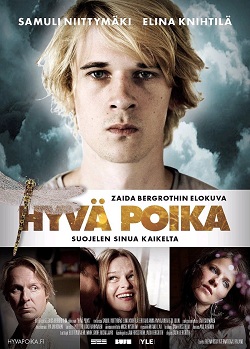
The Good Son / Hyvä Poika (dir. Zaida Bergroth, Finland, 2011, 88 min)—Advertised as a "black comedy", this Finnish film is undeniably more "black" than "comedy." The first third of the movie boasts a rather droll and hilarious party sequence but then the film capsizes into the Finnish We Need To Talk About Illmari. Sorry, Tilda, but sometimes it is the mother's fault.

How Big Is Your Love / Kedach ethabni (dir. Fatma Zohra Zamoum, Algeria, 2011, 98 min)—The North American premiere of the precious but negligible How Big Is Your Love adequately achieved poignancy in its look at the relationship between grandparents and their grandchild; but, was hardly revelatory.

The Invader / L'envahisseur (dir. Nicolas Provost, Belgium, 2011, 95 min)—In recent years I have developed a fondness for Belgian films, which skillfully capitalize on generic tropes to accentuate social issues. The Invader starts off with a provocative shot of a vagina, backs up to reveal a nude woman on a beach who then becomes distracted by the arrival of two black men emerging from the sea; one half-drowned, and the other stunningly virile. A relationship, of sorts, ensues. It's a relationship that has a naturalistic eroticism; but, hints at deeper allegories. Newcomer Issaka Sawadogo is a powerhouse figure in this dark thriller.

José & Pilar / José e Pilar (dir. Miguel Gonçalves Mendes, Portugal, 2010, 117 min)—I need to shout out to Boyd van Hoeij for personally recommending this Portuguese documentary, which is not only a commanding introduction to the life and work of Nobel-laureate Portuguese novelist José Saramago and his wife Pilar del Rio; but, a sensitively crafted document of the demands placed on creative success.

Las Acacias (dir. Pablo Giorgelli, Argentina, 2010, 85 min)—It's clear to me why, at this point, Argentine filmmaker Pablo Giorgelli's debut feature Las Acacias has won 20+ awards on the festival circuit, including the Camera D'Or at the Cannes Film Festival. Las Acacias tells a spare but resonant story, hewing away all excess to reveal perfect sentiment. A film about fathers and loneliness and transformation; it is everything I love about Latin American cinema. Most audiences watching Las Acacias will presume it was easily made with a handheld camera, a couple of actors and a truck; but, this is the elegance of Pablo Giorgelli's artistry: he is a master at complicated simplicity. Anticipate an Evening Class interview with Giorgelli in the near future.

Last Winter / L'hiver dernier (dir. John Shank, Belgium, 2011, 103 min)—My exploration of Belgian cinema continued with the U.S. premiere of first-time director John Shank's Last Winter, which reveals a new talent to keep an eye on. This gentle, melancholic story about the disappearance of yet one more rural way of life rests on the understated and sympathetic performance of Vincent Rottiers. Lacking pretension (as suggested by colleague Robert Koehler), the film might be criticized for playing it a little too safe.

Montevideo: Taste of a Dream / Montevideo, Bog te video! (dir. Dragan Bjelogrlić, Serbia, 2010, 140 min)—I was amused by this pleasant, well-produced Serbian crowd pleaser, which—though flawed by perhaps a bit too much predictable sentiment—is forgiven because of its generous supply of handsome eye candy and its romanticized reconstruction of the early days of a national soccer team. "Locker room tensions, bedroom dalliances, boardroom strategizing and plenty of well-staged game action."

Niño (dir. Loy Arcenas, Philippines, 100 min)—My Philippine colleagues Oggs Cruz and Dodo Dayao encouraged me to watch Niño, an enjoyable and affecting melodrama about a family as worn about the edges as the delapidated house in which they live. The patriarch has fallen into a coma and his sister Celia, a former opera star, tries to revive him by dressing her grandson up as Santo Niño de Cebú, the Philippine variant of Santo Niño de Atocha, seen here wandering far from his holy chair, running throughout the old house and among the complicated—if not quite modern—lives of its inhabitants. The film's comic flourishes are its highlights.

Omar Killed Me / Omar m'a tuer (dir. Roschdy Zem, Morocco, 2011, 85 min)—Anyone who knows me well is aware that life has made me somewhat of a scofflaw with regard to law enforcement as administered by judges and their "wooly little sheep" lawyers (let alone their police thugs). In fact, I'm not alone in my qualified disrespect of the judiciary and the legal industry. As Joni Mitchell sings, "Money is the road to justice and power walks it on crooked legs." It has long been a dream of mine to one day program a film series about corrupt judges; a theme revealed throughout cinema history as frequently as it has been a presiding concern throughout human history. The U.S. premiere of Roschdy Zem's Omar Killed Me, Morocco's official submission to the foreign language category of the Oscars®, would fit the bill perfectly. This gripping courtroom narrative pitches its melodrama just right to elicit sympathetic outrage over a predictable miscarriage of French justice. The judge in this courtroom is, as the French would say, un véritable asshole. Though Omar Killed Me offers little that is new by way of its indictment of race relations in France, it allows lead actor Sami Bouajila to deliver one of his finest performances ever.

Once Upon A Time In Anatolia / Bir Zamanlar Anadoulu'da (Nuri Bilge Ceylan, Turkey, 2011, 157 min)—Personally recommended by film critic Robert Koehler, I went into Ceylan's Once Upon a Time in Anatolia fearing I might doze off (as I have in his previous films); but, instead, I found myself completely engaged with the film's visual beauty, mordant humor, and pensive laminations on the subtle discrepancy between personal truths and official records. The film's nocturnal first half is a stunning piece of cinematograpy by Gokhan Tiryaki: roadside grasses illuminated by headlights; an apple rolling down a hill into a bubbling brook that carries it—suspensefully—even further, like a dead-end clue. Several members of the PSIFF audience grumbled that, "Nothing happened"; but, nothing could be further from the truth, subjective or otherwise.

After his second viewing of
Anatolia, Robert Koehler commented on Facebook that Once Upon A Time In Anatolia was "even more clearly a great masterpiece, astounding in its visual, narrative and thematic shifts from the early sequences to the latter. It's also one of the most creative adaptation of Chekhov short stories ever done for the cinema." Koehler confirmed that "Chekhov has always been the key literary voice for Ceylan. The stories adapted and massaged and altered for Anatolia are 'On Official Duty,' 'The Examining Magistrate' and 'Happiness'."

Rumble of the Stones / El rumor de las piedras (dir. Alejandro Bellame Palacios, Venezuela, 2011, 101 min)—The U.S. premiere of the interminable Venezuelan film Rumble of the Clichés ... er ... excuse me, Rumble of the Stones was introduced by its director as a film depicting the problems in his country: namely, that films like this are being made about the problems in his country.

To add insult to injury, Ibero-American programmer Hebe Tabachnik carried on to excess about how PSIFF's Awards Buzz program is a "curated" program of films selected from the many official submissions to the foreign language category of the Academy Awards®. I've no doubt that PSIFF's programmers have chosen their favorites, but
Rumble of the Stones was hardly the film to be boasting that fact. This film was about as curated as a beheaded chicken. Followed by a widely-publicized "gala" event, I can only wonder how much Venezuelan money was poured into this so-called curation? "Clearly the worst movie I've ever seen at this festival," Michael Hawley grumbled as we headed to our hotel, conceding that the lead actress Rossana Fernández Díaz did the most she could with the role. "Really?" I countered, "If you ask me, she could have done a lot less."

The Salesman / Le Vendeur (dir. Sébastien Pilote, Canada, 2011, 107 min)—I was saddened by Pilote's Canadian drama The Salesman, and impressed with Gilbert Sicotte's sublime central performance as an aging car salesman trying to keep his stats up in a town hit by economic recession. As a character study, the film tracks the dangers of being too heavily invested in an occupation. As a social metaphor, the film tracks how mutually indebted members of a small community must be in order to not become lost lives in lost times.

The Silver Cliff / O Abismo Prateado (dir. Karim Aïnouz, Brazil, 2011, 85 min)The Silver Cliff won Aïnouz the Première Brazil Best Director Award at the 2011 Rio de Janeiro International Film Festival. His desultory and atmospheric overnight narrative made me wonder how associated urban environments are with narratives of compulsion? The Silver Cliff calmly observes how Violeta (Alessandra Negrini) struggles with conflicted feelings after being deserted by her husband. With only a voicemail advising that he has left Rio de Janeiro for Porto Alegre and that he's not coming back, Violeta at first frantically races to the airport to try to catch him; but, his flight has left and there are no further flights until the following morning. Thus begins her proverbial night of the soul as her emotions ebb and flow like the waves on Rio's beach. At turns accusatory and self-lacerating, Violeta turns to the city for relief, shaking off her sorrow by dancing like a maniac under disco strobe lights, edging into a lustrously-lensed slomo stroll alongside trafficked streets, until a random encounter with a little girl and her father offers Violeta her first glimmerings of hope and acceptance of how her life must change. The film ends with a lovely grace note: when Violeta realizes she has to learn how to say good-bye to the little girl she has befriended in the middle of the night. Not even temporary relief can be held onto when one "joyfully participates in the sorrows of the world."

The Squad / El Páramo (dir. Jaime Osirio Marquez, Colombia, 2011, 90 min)—I'll credit Jaime Osirio Marquez for flexing his genre chops with The Squad. The film will satisfy the indiscriminate enthusiast of horror films. Competent camera work and sound design sustain tension—albeit through familiar tropes—in this disturbing tale of how the Colombian military has demonized the civilian population. Has "The Squad" truly encountered a witch? Or is the war the proverbial witch hunt in which inquisitors break ranks and turn on each other? Irregardless, The Squad has serious issues even as a genre film; partly because of a slippery trend to "dignify" genre films with auteurial flourishes. The film's basic concept of the demonization of the civilian populace by the military, rendered through a local inflection of Colombian witchcraft, had sufficient potential to keep me attentive; but, the one-note shouting matches between the soldiers and the inevitable "let's kill each other off" premise wore thin very fast. Also, I anticipate that unfortunate subtitling will make it difficult for this film to traffic among American audiences, who might perceive it as racist. Still, Marquez shows promise as a genre film director if he practices restraint and paces his film less exhaustively. In gist: his technique shows.

Tatsumi (dir. Eric Khoo, Singapore, 2011, 96 min)—Eric Khoo's engaging animated portrait of Tatsumi Yoshihiro proved a solid introduction to the artist's work. Tatsumi is credited with creating an adult form of manga called gekiga, and director Khoo samples the themes and concerns of gekiga through enactments of five of Tatsumi's most famous stories: survivor's guilt, threatened masculinities, compromised femininities, and the steep percentage paid by creative souls in commodified markets.