Sunday, 7 July 2013

SMOKE: SET VISIT—The Evening Class Interview With Actors Joel Nagle and Amadeus Serafini

Photo courtesy of Debbie Courson Smith
In a particularly lovely entry on his Facebook timeline, award-winning author Alan Heathcock recalls that when he was nine years old, his grandfather told him a story. The story sat inside him, "roiling about for years." When he grew into manhood, he wrote "Smoke", a story to make sense of his grandfather's story, to make sense of things that scared and confounded him. The story, as he puts it, "found its people." Two of the people it found were aspiring filmmakers Stephen Heleker and Cody Gittings, previous students of Heathcock's, who asked permission to adapt "Smoke" into a film, secured seed funding through a successful Kickstarter campaign, and organized a production crew of smart and talented people from all over the country who, along with Heathcock, came together to make a film based on the story he had written to make sense of the story his grandfather had told him when he was nine.

An odd and extraordinary blessing, indeed. And one of this Summer's most creative flourishes within the state of Idaho, winningly detailed by Frankie Barnhill at KBSX (who earlier reported on Smoke's crowdfunding efforts). My thanks to Alan Heathcock for inviting me to Smoke's wrap party where I had the chance to sit down with actors Joel Nagle and Amadeus Serafini to discuss filming within the Gem State.

* * *

Michael Guillén: Amadeus, I understand you come from a modeling background and Smoke is your first film?

Amadeus Serafini: Yes. I started modeling out of high school at 18 years old in L.A. with Ford Models. I'm still with them; but, as I progressed, I wanted to study film so I went to college, took a few film classes for a few years, did some theater, and then I decided to take some professional classes. I'm studying with Eric Morris. He's 80 years old and he's got an actors workshop on Wilshire Boulevard in L.A. He's coached such people as Anthony Hopkins, Jack Nicholson, on and on. I studied with Morris for a year, took what I learned, and the selfsame friend who introduced me to Morris' workshop, is friends with Cody Gittings—small world, they grew up in Nevada together—and he said, "Hey, we have this audition. You should try out."

Guillén: My understanding is you came in quite late to the audition process?

Serafini: I did! The day of. I was working that day and I had to ask my manager to get a couple hours off to drive to the audition. I hadn't had a chance to read the sides or anything, but I read for them anyway, didn't expect anything, and they asked me to send in a taped audition. So I did it and the next thing I knew I booked it and I was on my way to Idaho.

Guillén: Congratulations. Advise me a bit on how this works here: you have a modeling career, you want to shift into acting, so do you use the same agent? The same manager?

Serafini: No, not at all. I don't have an agent, not for acting anyway.

Guillén: You, on the other hand, Joel, are a seasoned actor who recently won a special jury award at the Sundance Film Festival for your performance in the short film Palimpsest (2013), which I had an opportunity to see at the Sun Valley Film Festival. The Sundance jurors stated: "This performer's quiet presence and subtle depth was a standout amongst talented actors and actresses." Congratulations.

Joel Nagle: Thank you. I started acting years and years ago in the '80s as a 20-some-year-old kid. A lot of it was learning about myself. The first 10 years of "acting" was really about instinct. Somewhere in the mid-'90s I thought, "I've got to learn the craft, the mechanics, I've got to get some tools and not just go off instinct." So I did that and have done a lot of short films plus I try to do one or two plays a year. Theater brings you back to those moments. When you're living through them, there's not another take, so that keeps everything stable. I like the process of rehearsing for a few weeks, knowing every night of performance has to be fresh.

Guillén: Theatrical acting is quite distinct from acting in films. For one thing, with a theatrical performance you get to do it and play the whole thing out. Film is really stop-and-go and, in my opinion, much more difficult to hold onto the momentum of a performance.

Nagle: But that's where knowing yourself can help. Filmmaking can drive you nuts. They might be setting up lights for 20-40 minutes between shots and yet you have to be able to continue your performance from where you left off. You have to be able to either stay near that place or just be able to recreate it. But it's hard to stay in the same place. If you try to hold it and stay in that place all the time, you can wear yourself down. It's also hard to have too small a part that doesn't allow you to build. I appreciated the opportunity to do Smoke because it allowed me to create a character from start to finish. Amadeus and I fed off each other. The film naturally progressed, but also the characters progressed as Amadeus and I found out about each other.

Serafini: Another difficulty with film acting is that scenes flip. You're doing a part of a scene that comes before another scene or after another scene and you have to switch back and forth.

Guillén: How did you come to the project, Joel?

Nagle: It wasn't that odd. I had seen a listing on Breakdown Services and—though I won't submit to everything—sometimes you submit to projects where, when you get the script and you have your audition, it ends up not being anything you're really interested in; but, you may do it because you have time. But the description for Smoke seemed really interesting.

Guillén: Had you read Alan Heathcock's short story?
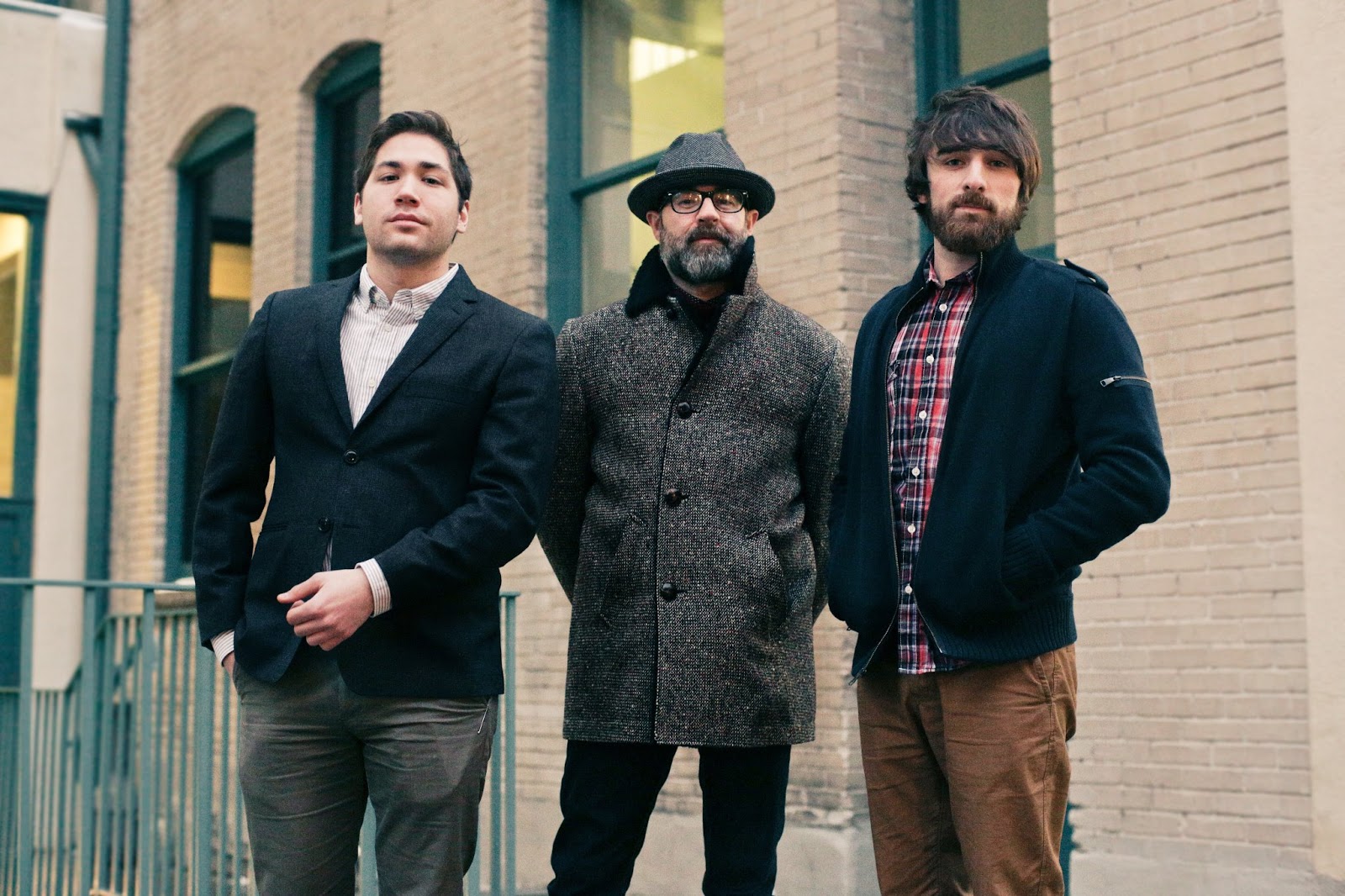
Stephen Heleker, Alan Heathcock, Cody Gittings.  Photo courtesy of Matthew Wordell.
Nagle: After I got cast. It all happened very quick. I was preparing to go out of town and I submitted to Stephen and Cody but, at the same time, they had also seen Palimpsest at the Sun Valley Film Festival. They contacted me and sent me two scenes that were two-character scenes; but, I was getting ready to go out of town and couldn't get anybody to help me out on such short notice so I told them, "Guys, I don't have time to round somebody up because I'm really busy; but, can we condense these two scenes into a monologue?" That's what I did, though it was a little difficult. So the night before I left town, I set up a camera at 3:00 in the morning and said, " I'm going to rehearse and then I'll do it in the morning." I did three takes and chose two to send them. They contacted me—this was prior to their going to San Francisco and Los Angeles for auditions—and they said, "We really love it and you're right there; but, we have to continue auditions."

Guillén: So whereas you were found early in the casting process, and Amadeus much later, at what point did the two of you finally meet? Was it here in Idaho on location?

Photo courtesy of Matthew Wordell.
Serafini: Oh, yes. We had a couple of days to rehearse and then we started shooting.

Guillén: Provide a glimpse into how two actors who have never met before are supposed to have such a deep and intimate family relationship. How do you develop that after only two days of rehearsal?

Serafini: We made full use of those two days.

Nagle: It was even shorter than that. When Amadeus says rehearsal days, there was one day we didn't really rehearse. There was one day when we were supposed to rehearse, we were both there, but there were production things happening and I literally sat there for 2½ to 3 hours semi in-character waiting for it all to begin. We did moments of blocking, like picking up the body and how we were going to work it out and that's all we did with the rehearsal. But like Amadeus said, we made great use of those couple of days. The day after we got in, Stephen took us out on location just to see the area.

Guillén: I bet that got you excited!

Serafini: It was wilderness! I wanted to see Idaho!

Nagle: He was coming from L.A., I was coming from New York, and we spent four hours looking around.

Serafini: While we ran scenes. We spoke a lot and opened up to each other.

Guillén: What has it been like for you two city dwellers to film in Idaho?

Serafini: Permissive, that's the word I would use. Not only is everyone good-natured, but it wasn't restrictive. In L.A., for instance, if you try to shoot in front of a taco shop, they'll try to find a way to charge you! Here, everyone seems willing to have something shot. Granted, there's not as large of an industry here ...yet... but I think Idahoans are much more willing to be a part of the project and be a part of the art.

Guillén: Filmmaking in Idaho strikes me as a particularly hybrid phenomenon fusing regional enthusiasm with industrial know-how, frequently brought in from outside the state.

Nagle: I loved everyone involved. Although no one had a ton of experience, including myself, the passion was unbelievable. Speaking of Idaho and Boise in particular, you know it's going to get done because people have the passion to do it.

Guillén: "Get 'er done" is a favorite local saying.

Serafini: We had quite a few people coming in from L.A. to work on this movie and there wasn't an exploitive feeling to that. We were working with so many people who were local and connected to this state. They know what it's about. They're representing their own. It's not like we were busting in and shooting our movie on their landscape as a backdrop. They were a part of it.

Guillén: Exactly, that's the hybrid quality I'm talking about that greases the gears. Obviously, Amadeus, you enjoyed the experience of making a film in Idaho, but what did you learn by working with a more experienced actor like Joel?

Serafini: It was incredible. He made himself emotionally available. I was worried. To quote from the movie, "I was scared shitless." I was like a rope of sand. But Joel really made me feel comfortable. What this experience taught me is that actors have to make themselves available to each other. You can't be selfish. It's not a selfish endeavor. Because you will go down if you're selfish. It's a tandem process.

Photo courtesy of Matthew Wordell.
Guillén: Do you want to continue acting?

Serafini: I think I absolutely do. This was my first official project and it was incredible. Of course, I'd love to see the end product. I don't know what to make of it, but everyone is raving. I hope it comes out as well as they say. I'm sure it will. I have confidence in our directors and our writer.

Guillén: What I've appreciated about monitoring Smoke is to witness that Stephen and Cody have such a professional vision and can see this film past its making. They see it out there in the world or, as I like to say, they dream in detail. That's admirable in that, usually, young filmmakers can't see that far and are struggling just to get through production.

Serafini: And it came out of Kickstarter, of all things!

Guillén: There have actually been several successful Kickstarter campaigns for film coming out of Idaho.

Serafini: Really?!

Guillén: Oh yeah. This is, again, another element of that hybrid filmmaking I mentioned earlier, where the regional input comes directly from community engagement and support. At this point, for independent filmmaking to succeed, the community has to want it, that's the bottom line, and that's a great plus for regional filmmaking.

Photo courtesy of Matthew Wordell.
Quick question for you, Joel. You're a seasoned pro, you've been acting for a while but you say you're constantly learning. What did you learn from working with a newcomer like Amadeus?

Nagle: Amadeus is way beyond his years. I didn't even think of acting until many years after his age. But if you stay in it in every moment, it doesn't matter how much experience you have. You're building a character but your own character infuses every role. Seeing someone as young as Amadeus come into this project without any experience of having acted before blows me away. At his age, I would have felt the need for permission. I wouldn't have had the balls to say, "I can do this." Obviously, the story moved him as much as it moved me. So what I've learned from Amadeus is not to fear anything. If you feel a connection to the material and you don't put too much pressure on yourself, you can do amazing things. May I ask Amadeus a question?

Guillén: By all means, help me out.

Nagle: You had to have questioned yourself coming into this project; but, in the process, were there times when you wondered what you had gotten yourself into? Because I never sensed that. I sensed here was a guy who wants to do his best but I never sensed that you were there to please anyone; you were there to serve the story. It was like you took off a layer of self-censoring.

Serafini: Maybe I'm just really good at deceiving people? Because I was scared the whole time. But I did get it in the back of my head and I had to keep telling myself, "This is for me. I'm making the project for all of us, clearly, but I'm doing this for me. I'm not trying to please anybody. I'm just trying to be good at what I can do. I want to put out the best work I can." But was I scared the whole time? Yes!! I'm still scared, because I haven't seen any of it.

Guillén: I'm interested in the craft of acting, which I find quite idiosyncratic, so I need to ask both of you: with this script, which is such a character-driven narrative that rests wholly on the shoulders of these two individuals, in terms of craft what was the way that you each found your way into your characters? How do you start your work in developing a character for a role?

Photo courtesy of Matthew Wordell.
Nagle: For me, I think it started the night that I made that audition tape. It obviously started before when I read the material, but that night when it was 2:00 or 3:00 in the morning, I was exhausted and—through my exhaustion—I felt how this guy was in such a bad situation and who does he turn to? He turns to his son. But what an awful thing to bring your son into. So my entry into the character was through this physical exhaustion. A couple of weeks later when I learned I got the role, I was in Thailand and I remember asking myself, "Okay, how do I get back to that guy from a week or two ago at 3:00-4:00 in the morning in New York City sitting in an apartment all alone with a camera?" And it was the physicality of this last chance the father has. I need to feel a role. I would like 24 hours, or at least 12 hours where I can literally be awake with it, go to sleep with it, and then wake up with it and boom. I don't memorize lines. I get the character through osmosis. But when I wake up in the morning I'm doing the lines, and not just lines, I'm feeling it....

Serafini: Intention, you've said to me. "I do intention; I don't do lines."

Nagle: I never go for lines. If I can get across in what I'm saying to myself the physicality of the role—the feel for it?—I know I can do it. I know I've got the in. And that's what it was. It's the feel.

Guillén: Was it the same for you, Amadeus?

Serafini: There isn't any one way to go about it. Empathy has a lot to do with it. You have to be able to feel for the character and understand what they're going through to feel it yourself and to recreate it. Then, of course, being in the location or forcing the physicality upon yourself that the character experiences pushes you. It might sound silly to people who aren't in film, but a lot of arbitrary action gets you there. You may not be sad but try to cry. Once you start crying and start thinking about the character and about their back story, you can invent anything you want about their life to get there. It's a hard question for an actor to answer.

Guillén: Which is why I ask it. [Laughs.]

Serafini: It's an intuitive process.

Guillén: It's intuitive, yes, but it's a craft.

Nagle: And let's not shortchange the work. I've done some films where there's not a whole lot of dialogue. You can get into it, you can get the flow, and it's acting as non-emotion. It's either there or it isn't. If it's not there, you don't push. What's in the tank is in the tank; but, I got to tell you, especially with this project, the words, Alan's words, was how I got the feel. It's not a natural way to speak some of these lines. It's period and it's poetic. Alan's words made it a lot easier for me as an actor to get in to the character. The words are crucial.

Serafini: And one last thing that I might add is that you use a lot of events from your own life that mirror those of the character. That's your tool box: your life! And you use whatever you can from your own life to mirror the character and—once you tap into that—you can recreate those feelings, you delve into the story and use those lines and everything just melds. You and the character get stitched together.

Photo courtesy of Matthew Wordell
Guillén: What has it been like for you to have the author on set? Did you check your characterizations against him? Did you get direct feedback from him?

Serafini: It was a blessing! How often does that happen? I was constantly asking him to clarify certain things because—when you read a story—you still have your own interpretation and I wanted to know what his interpretation was; I had mine. I wanted to be true to his story.

Guillén: As instincts go, were you accurate in your interpretations?  Did Alan confirm them?

Serafini: A lot of the time, yes. He told us. He was impressed with that. But that's what we as actors are supposed to do.

Guillén: Finally, along with children and animals co-directors can be a real sticky wicket. What was it like being directed by two directors?

Nagle: With the amount of challenges—the locations, the fact that a lot of these people had not worked with each other before, some had—I thought it worked out good where Cody handled the technical stuff and oversaw our DP and the camera crew, and Stephen was with us 98%-99% of the time.

Serafini: They had their division of labor but overall they had the same vision.

Nagle: It worked out great. Stephen was there for us every step of the way. Early on in one of the first plays I ever did, at the end of the rehearsal everyone had notes from the director but I didn't get any notes. I thought, "What's wrong? They don't like me?" So I approached the director and all he said was, "No notes is good notes." I told both Stephen and Cody, "Listen, I'm just gonna go, but don't be afraid to come up to me. I want you to come up to me if there's something off; but, please, just let me go. If something isn't technically right, just come in and yell, 'Father, five minutes' or whatever." At one point I think Stephen just wanted to stay away from me. [Laughs.] He didn't even want to look at me. In hunch, I thought that was kind of a good thing because he felt I was "in the zone", whether I was or not. That was good. Stephen and Cody do have different personalities, but they work very well together. They were as efficient as they could be with everything that was going on.

Serafini: Our output was incredible.

Nagle: You know what, Amadeus? You're going to see probably a quarter or a half of what we did, I guarantee it. You're not going to see all of it. You'll see blips; a fraction of what we did. But, you're right, we got a lot done. That was good. There were no battles between them.

Serafini: It was a very respectful atmosphere.

Nagle: You're always going to have bumps and things that happen; but, what kept me coming back—after I'd walked away from things that had gone a little off—was the passion. Everyone was so genuine and supportive. They felt it. When people don't have that passion, when they don't feel that, and there are mishaps or miscommunications, that's when it gets really discouraging as an actor because you go, "Wow. There's not even passion." Passion helps you through miscommunication or rocky times.

Serafini: And what fueled that passion is that Smoke isn't a project aimed at the box office. It's meant to be art, which allowed everyone to work as hard as they could in their craft.

Guillén: An excellent place to stop. I want to thank you both for taking the time to talk with me. Congratulations to both of you. I look forward—just like you—to seeing the final product and we'll probably be attending the premiere together. Until then.

Friday, 5 July 2013

FANTASIA 2013—Adam Wingard and Simon Barrett Bare It All In Joe Swanberg's 24 EXPOSURES

The Fantasia International Film Festival (Fantasia) will unveil the world premiere screening of mumblecore icon Joe Swanberg's recently completed 24 Exposures (2013) as part of its Camera Lucida section. The feature stars filmmaker Adam Wingard (who, at 19, premiered his first film, Home Sick, at Fantasia) and his constant collaborator Simon Barrett, the director / screenwriter duo behind A Horrible Way To Die (2010) and You're Next (2011). On his Twitter feed, Swanberg describes 24 Exposures as his "fantasy version of Godard directing a Zalmon King script for Showtime in 1991," and his "fever dream of Herzog directing episodes of Red Shoe Diaries and Silk Stalkings."

Wingard, a gifted cinematographer who also lensed Swanberg's Silver Bullets (2011), plays a fetish photographer whose models begin to turn up dead, with Barrett portraying a melancholic cop tasked with investigating him. Swanberg, director of Alexander the Last (2009) and Drinking Buddies (2013), previously collaborated with Wingard and Barrett on Autoerotic (2011) and the anthology horror hit V/H/S (2012). As an actor, Swanberg also collaborated with the filmmakers several times, playing lead roles in A Horrible Way To Die and You're Next, the latter exhibiting Swanberg's consummate comic timing.

On a related note, Fantasia 2013 will showcase the Quebec Premiere of Wingard's brilliant You're Next the night before 24 Exposures, offering their audience the rare chance to observe the flipping of an actor / director / screenwriter creative relationship from one night to the next. Joe Swanberg will host both screenings.

The Wayback Machine takes us to an Evening Class conversation with Wingard, Barrett and Swanberg when A Horrible Way To Die had its world premiere in the Vanguard sidebar at the 2010 Toronto International Film Festival.

FANTASIA 2013—Extensive Artist Talks with Bryan Singer and Simon Boswell

The Fantasia International Film Festival (Fantasia) will once again offer audiences the opportunity to participate in illuminating artist talks, expositions, and panels, with a chief highlight being "Rated X—A Night with Bryan Singer"! Fantasia audiences will see the gifted filmmaker behind the X-Men films (2000-2014), Public Access (1993), The Usual Suspects (1995), Apt Pupil (1998), Superman Returns (2006), Valkyrie (2008), and Jack the Giant Slayer (2013), sit down for an extensive hour-long discussion with moderator Tony Timpone and the audience, in a special evening of superbeings, superstars, and one superfilmmaker.

"Simon Boswell: A Talk on Film Scoring" brings the brilliant UK composer to the stage with moderator Chris Alexander for a career-spanning talk about his adventures in film scoring for some of genre cinema's most individualistic filmmaking talents, including Alejandro Jodorowsky, Alex de la Iglesia, Dario Argento, Danny Boyle, Michele Soavi, Richard Stanley, Clive Barker, and Lamberto Bava.

Thursday, 4 July 2013

FANTASIA 2013—THE SECOND WAVE

The Fantasia International Film Festival (Fantasia) announced the first wave of programming for their 17th edition last week, and now proudly unveil several additional highlights in anticipation of their July 9th press conference where their full 120+ film lineup will be unveiled.

Shield of Straw / Wara No Tate (Dir: Takashi Miike, Japan, 2013)—Joining James Wan's The Conjuring (2012) on opening night, Miike's Shield of Straw officially annoints the festival's opening night. Hot off its screening in official competition at the Cannes Film Festival (where it was nominated for the Palme d'Or), Miike's riveting crime thriller kicks off Fantasia's 2013 edition with its first screening on the North American continent. Shield of Straw stars Takao Osawa, Nanako Matsushima, and Tatsuya Fujiwara. Fantasia's 1997 screening of Fudoh marked the first time that a Miike film had ever been shown in North America, making it all the more joyous to open our 2013 festival with his latest work. Official site [Japanese]. IMDb. Wikipedia.

Critical response has been mixed to tepid for Miike's Shield of Straw, which several felt was out of place in the Palme d'Or competition at Cannes, particularly for a film whose execution was "lackluster" (according to Peter Debruge at Variety). Debruge foresees that Shield of Straw is "ripe for a more energetic remake." At The Hollywood Reporter, David Rooney concurs Miike's latest is "remake fodder". His bottom line is that Shield of Straw is a "diverting but generic dose of psychologically thin B-movie suspense from the normally more outré Takashi Miike." At Screen Daily, Tim Grierson writes: "Pitting a few brave police officers against an entire nation wanting to kill the prisoner they're transporting, the movie has its pulpy thrills—not to mention a gripping central performance from Takao Osawa—but plausibility issues and an unconvincing exploration of the limits of justice noticeably dampen the fun." Confirming the trades, Brian Clark at Twitch feels Shield of Straw gets "middling results" from its high concept. For a much more thorough shakedown, check out David Hudson's aggregate of Cannes reviews at Fandor's Keyframe Daily.

009 Re: Cyborg (Dir: Kenji Kamiyama, Japan, 2012)—Mechanized mayhem, mysticism and moral ambiguity meet when the influential '60s manga / anime property 009 Cyborg gets a dark, postmodern makeover care of the mighty Production I.G, in the spirit of the iconic Ghost In the Shell films. Anime fans won't want to miss this one. North American premiere. Official site [Japanese]. IMDb. Wikipedia.

At Twitch, Ard Vijn extols the film's beauty—especially projected on a large screen—but qualifies that 009 Re: Cyborg is "also frustrating and confusing, often infuriatingly so", though as "odd and flawed as it is", it emerges as "one hell of a ride." At Cinevue, Joe Walsh wraps it up: "The firm behind the film is Production I.G, the people who created Ghost in the Shell and Patlabor, and they have long held a track record for stunning animation. That is once again proven as, along with Kamiyama, they seamlessly blend the hand-drawn backdrops and characters with attractive 3D sequences. Depth of field enhances this tale greatly and it is here that most pleasure can be derived. However, despite its good looks, there's no escaping 009 Re: Cyborg's tiresome and hollow script."

Animals (Dir: Marçal Forés, Spain, 2012)—Evocative of both Donnie Darko and Leolo with a touch of Charles Burns, Animals taps into a volatile whirlpool of adolescent anxieties and identity issues, addressing complex themes through a wealth of unconventional approaches. A heavy trip, but an entertaining and fantastical one. Winner: Best First Feature, Sant Jordi de Cinematografia 2013, Official Selection: Sitges 2012, Miami International Film Festival 2013. Quebec premiere. IMDb.

At Exclaim!, Robert Bell writes: "It's true that Forés owes a lot to Richard Kelly's Donnie Darko, having a similar dark fantasy tone emerging from the self-hatred and worldly rage associated with abject sexual awakening, but he's taken the format in a different direction. He's externalized the homosexual yearning and interpretation of the 'other' and simplified the representation of adult hypocrisy as an imposing force on those vacillating between maturity and youthful idealism. ...Here, just as humans and animals are presented as flawed creatures of instinct, innocence isn't made heroic, instead having a life of its own that unfortunately, like everything else, has to die." At Big Gay Picture Show, Adrian Naik's overall verdict is: "If you enjoy the unease and unpredictability of Lynch, as well as the gothic sweetness of Donnie Darko, you will enjoy this. The general feel of the film, from setting to characterization, does feel derivative [of] Richard Kelly's masterpiece, but Animals has its own strengths. Forés work is unsettling and yet slightly self-indulgent, trying to toy with the audience. For those who are looking for more traditional storytelling and less mind-meddling, search elsewhere."

Antisocial (Dir: Cody Calahan, Canada, 2013)—On New Year's Eve, five university friends find themselves engulfed by a zombie-like attack. The team behind Neverlost deliver a gory, inventive, next-generation horror satire with an absolutely genius hook. World premiere. IMDb. Facebook.

Bad Milo (Dir: Jacob Vaughan, USA, 2013)—Ken Marino, Gillian Jacobs and Peter Stormare star in this insane comedy / horror UFO about an office worker's repressed rage manifesting as a mutant ass monster that leaves his body during blackouts, commits murders—then painfully burrows its way back up his butt. Regularly. Ouch! Official Selection: SXSW & Karlovy Vary 2013. Canadian premiere. Official site. IMDb. Wikipedia. Facebook.

At Horror 101 With Dr. AC, Aaron Christensen nails it: "For a movie whose synopsis more or less boils down to 'carnivorous demon living in our protagonist's lower digestive tract escapes from backside in search of fresh meat,' there's an incredible sense of sweetness and gentle humor amidst the slapstick and the scatological. Ken Marino is delightful as the owner of the unwanted titular intestinal tenant, struggling to avoid stressful scenarios for fear of prompting a bout of explosive (and lethal) demonic expulsion; he carries off the potentially cartoony premise with a surprisingly grounded and relatable performance." At Sound On Sight, David Tran hails Bad Milo as "an irreverent gross out comedy" and not actually a gore fest as it's "not scary enough to really be a horror movie. It is the kind of genre film that takes irreverent joy in its crazy concept, rolls with it, and sees how far they can go with it." At The Macguffin, Spencer Fornaciari adds: "Huge points have to be given for the use of a real puppet rather than CGI for the demon; not only does this add a more realistic feel to the acting, but the puppet itself adds a huge part to the experience of the movie. The puppetry work is excellent and is a throwback to classics like Sesame Street. The demon's presence opposite Marino is really the driving force behind the movie, and is the most engaging relationship. Describing it as a demon is technically correct, but that doesn't really do a good job of explaining it. Think more of a buddy comedy with a bit of a horror bent."

Big Ass Spider! (Dir: Mike Mendez, USA, 2013)—A volatile 50-foot spider wreaks havoc against the city of Los Angeles in this fast, funny and surprisingly smart arachno-coaster ride that's not afraid to enjoy itself but at the same time, never goes for the easy stupid. Official Selection: SXSW, Dead by Dawn, Boston Underground, Calgary Underground Film Festival 2013. The film's Quebec premiere will be hosted by director Mike Mendez and producers Patrick Ewald and Travis Stevens. IMDb. Facebook.

"Dramas are great and thought-provoking cinema is wonderful, but sometimes a giant spider is all you want," quips Scott Weinberg at Fearnet. Breaking it down into bullet points, Weinberg states Big Ass Spider's "ensemble plays the material with tongues firmly in cheek but never goes too far"; "the digitally-created mayhem is rather a lot of fun"; "the violence is raucous and gory without ever becoming too ugly or mean-spirited"; and "the little extra effort" taken by the filmmakers to incorporate "a fantastic score by Ceiri Torjussen that evokes monster themes from the classics and brings a touch of wide-scale class to a very little movie." At Twitch, Peter Martin notes Big Ass Spider! "has fun with the idea of a giant spider terrorizing Los Angeles" and explains that "what differentiates the movie from its cheap SyFy Channel, basic cable television counterparts is that director Mike Mendez, who also served as editor, keeps the action clipping along faster than the giant spider can munch its way through the beleagured citizens of Los Angeles. The visual effects, low-budget though they may be, are surprisingly effective, and the design of the spider itself is clever and distinctive." At Horror 101 With Dr. AC, Aaron Christensen concludes: "One can see why the SXSW programmers felt this high spirited rampage romp deserved a place on their 2013 slate. While no cult classic in the making, it's more beer n' pizza fun than it probably has any right to be; in the annals of supersized spider cinema, that's more than enough." Several more reviews and interviews on the film's Facebook timeline.

Broken Circle Breakdown (Dir: Felix Van Groeningen, Belgium, 2012)—Felix Van Groeningen (The Misfortunates) returns with a fourth film establishing him as a masterful director; a non-linear, emotionally devastating story of two Flemish bluegrass musicians' love, as they drift apart when they learn their daughter is dying from leukemia. Winner of the Panorama Audience Award at the 2013 Berlin International Film Festival as well as awards for Best Screenplay and Best Actress in a Narrative Feature Film at the 2013 Tribeca Film Festival. Canadian premiere. IMDb. Facebook.

At Variety, Boyd von Hoeij writes: "Inspired by a stage performance conceived by Johan Heldenbergh (one of the stars of The Misfortunates) and Mieke Dobbels that consisted of bluegrass songs interspersed with the story of a sad love affair, the film had to be entirely reinvented for the screen. And so it was; much to van Groeningen's credit, Breakdown, shot in gorgeous widescreen, never feels like a filmed play or concert, though music is performed throughout." At Sound On Sight, Christopher Clemente affirms: "With many highs and lows, The Broken Circle Breakdown is a raw and realistic look at life's unexpected occurrences done so with great tenderness and reverence to both joy and pain." David Rooney's bottom line at The Hollywood Reporter is less enthusiastic: "Invigorating musical elements and the lead actors' potent chemistry can't entirely protect this tragic relationship drama from its encroaching shortage of subtlety."

The Dead Experiment (Dir: Anthony Dixon, Canada, 2013)—At once horrific and cerebral, this remarkable independent Canadian production situates itself somewhere between Re-Animator and Primer, fusing wild scientific theories with a morbid tale and sustained drama for an impact that is wholly unique and satisfying. IMDb. Facebook.

The Dirties (Dir: Matt Johnson, Canada, 2013)—An astonishing, illuminating and surprisingly funny film, The Dirties takes on the mortifying topic of high school shootings with an insight and wit that will leave you slack-jawed. And deeply haunted. Winner of numerous awards, including two at this year's Slamdance. The Dirties' Quebec premiere will be hosted by director / actor / co-writer Matt Johnson, co-writer Josh Boles and actors Owen Williams and Krista Madison. Official site. IMDb. Facebook.

At Filmmaker, Brandon Harris describes The Dirties as "a poorly shot, cleverly assembled rough hewn verite narrative" that "elegantly and depressingly explore[s] the dangers of high school bullying" and "the kinds of empty, pop-culture obsessed lifestyles most American teenagers are subjected to." At the San Francisco Bay Guardian, Jesse Hawthorne Ficks exclaims the film is "controversial and inspired" and "an utterly brilliant, unstoppably hilarious found footage entry that follows two high school cinephiles as they try and make a documentary about 'bullying,' while they themselves continue to get uncomfortably bullied at their own school." Ficks stresses "the level of honesty, originality, and terrifyingly timely subject matter this filmmaker brings to this incredibly contemporary story." At Twitch, Ben Umstead states Johnson exhibits "mad style and intelligence" with his "bromance", which Umstead categorizes as "something so fresh, so bizarre and just as sincere as it is unsettling."

The Demon's Rook (Dir: James Sizemore, USA, 2013)—A micro-budget, monsterific orgy of grue that can only be described as Return Of the Living Dead by way of Jodorowsky with a touch of The Neverending Story, shot in Georgia with a nearly all-amateur team, boatloads of heart and a horde of DIY prosthetic creatures. This film is F-U-N. Co-executive produced by celebrated Toronto Internation Film Festival programmer Colin Geddes and Toronto Film Scene / Exclaim! film critic Katarina Gligorijevic. The Demon Rook's world premiere will be hosted by director / actor / co-writer James Sizemore and his übergang of DIY magicians and maniacs! Official site. IMDb. Facebook.

Hello, My Dolly Girlfriend / Figyua na anata (Dir.: Takashi Ishii, Japan, 2013)—A man believes he's found redemption in a mysterious female mannequin that has come to life. Eroticism, perversity and deviant poetry collide in the latest from Takashi Ishii, an auteur who brought so much to Fantasia's history with such major work as Freeze Me and Gonin. International premiere. Official site [Japanese]. IMDb.

At A Page of Madness, Nicholas Vroman outlines that the first half of Hello, My Dolly Girlfriend "rolls out with low-budget grindhouse urgency going through tons of blood, sex, rape and other unpleasantries. It's engaging, if disquieting. Ishii is a solid filmmaker with a baroque flair."

How To Use Guys With Secret Tips (Dir.: Lee Wonsuk, South Korea, 2013)—A young woman toiling in an obnoxiously sexist workplace comes across a VHS tape with advice on how to manipulate men in this uproarious romantic comedy which turns the gulf between men and women into a faultline through your funnybone. Winner of an audience award at the most recent Udine Far East Film Festival. Canadian premiere. IMDb.

I'll Give It My All ... Tomorrow / Ore wa mada honki dashite nai dake (Dir.: Yûichi Fukuda, Japan, 2013)—A single dad in the grip of midlife crisis quits his stable job to pursue a career as a manga artist. Loaded with imagination, this funny, touching tribute to putting things off goes far beyond sitcom silliness with an array of unforgettable characters. International premiere. IMDb.

Machi Action (Dir.: Jeff Chang, Taiwan, 2013)—This clever, racy and yet very humane Taiwanese comedy takes aim at the over-the-top tropes and antics of tokusatsu (giant monsters and masked space heroes) TV and at the absurd ups and downs of a performing artist's life. Fresh from stomping all opponents at the Taiwanese box office, Machi Action begins its quest for North American domination at Fantasia. North American premiere. IMDb. Facebook.

Missionary (Dir: Anthony DiBlasi, USA, 2012)—The director of Dread and Cassadaga is back with a mean, lean, character-driven thriller of exceptional impact. Playing on the inherent fear that many people have of strangers, their possible delusions and perhaps worse, their bubbling insanity, Missionary also looks at the figure of the man of faith as complex and unpredictable, while also exploring the duplicitous nature that is easily attributed to missionaries of all ilk. Stars Dawn Olivieri, Mitch Ryan, Kip Pardue and J LaRose. Missionary's world premiere will be hosted by director Anthony DiBlasi. IMDb.

OXV: The Manual (Dir: Darren Paul Fisher, UK-Australia, 2012)—One of 2013's most minblowing discoveries, OXV: The Manual is an endlessly imaginative "scientific-philosophical romance" that plays like the mutant offspring of Michel Gondry, Neil Gaiman, Terry Gilliam and Shane Carruth—yes, really. One of those little miracles that only independent cinema can produce, this is a resoundingly original piece of work that will have you smiling for weeks. OXV's world premiere will be hosted by writer / director Darren Paul Fisher. IMDb. Facebook.

Plus One (Dir: Dennis Iliadis, USA, 2013)—Teens at a wild house party quickly catch on that all isn't right, as doubles of themselves and everyone else attending are popping up and reliving the evening, just about 45 minutes prior. With each blackout of lights, the doubles catch up a little more in time. An entertainingly inventive and clever slice of high energy teen oblivion from the director of the Last House on the Left remake. Official Selection: SXSW. Canadian premiere. IMDb.

At Twitch, Peter Martin writes: "Iliadis displayed considerable skill as a filmmaker with the Last House on the Left remake, committing fully to the more odious aspects, while jerking the narrative forward in uncomfortably irregular spasms. In Plus One, he commits fully to presenting an adult-oriented college party movie, complete with strippers and other bared bodies, along with copious amounts of alcohol and foolish behavior. And when things go haywire, he commits fully to that as well, in explicit detail." At Horror 101 With Dr. AC, Aaron Christensen was left with "the bitter aftertaste of missed opportunity" burning sour in his throat.

The Resurrection Of A Bastard / De Wederopstanding van een Klootzak (Dir: Guido van Driel, Netherlands, 2013)—Riveting with its innovative cinematic style, doused in outrageous bursts of wicked carnage, and topped off with a smattering of shadowy Lynchian humor, The Resurrection Of A Bastard is a deliciously oddball investigation of the mystery of life, and all the violent possibilities it has to offer. A blissful cinematic experience that represents the current renaissance in Dutch genre filmmaking. Stars Yorick van Wagenigen (The Girl With the Dragon Tattoo). Opening film of the 2013 Rotterdam International Film Festival. International premiere. Official site [Dutch]. IMDb. Facebook [Dutch].

Saving General Yang (Dir.: Ronny Yu, Hong Kong, 2013)—It is up to General Yang's seven sons—each a master of his own kung fu discipline—to rescue him from behind enemy lines. Ronny Yu (Fearless, The Bride With White Hair, Bride Of Chucky) revisits anew the oft-told tale of the Yang clan, legends of Chinese martial arts literature and film. Official Selection: Hong Kong International Film Festival 2013. North American premiere. IMDb. Wikipedia. Facebook.

At Twitch, James Marsh deems Saving General Yang "solid with glimpses of greatness." At SBS, Don Groves admits: "Yu has a very good eye for spectacle but a tin ear for dialogue and a slapdash approach to fleshing out characters, and thus fails to redress obvious defects in the screenplay by Edmond Wong.... The result is a handsome looking but sporadically satisfying, gory tale of betrayal, familial loyalty, bravery and sacrifice." "It's as close to a Chinese blockbuster as can be with a lightweight narrative propped up by heavy duty battle scenes," writes Stefan S. at A (Nutshell) Review, and adds, "Who would have thought though, that the more dramatic moments in the film, turned out to be its key strengths...."

Secretly Greatly (Dir.: Jang Cheol-soo, South Korea, 2013)—A North Korean spy is sent south, where he must blend into a town's community … as the village idiot. This punchy action-comedy broke box-office records on its home turf. From the director of Bedevilled. Official Selection: New York Asian Film Festival 2013. Canadian premiere. Official site [Korean]. IMDb. Wikipedia. Facebook.

Sweetwater / Sweet Vengeance (Dirs: Logan Miller, Noah Miller, USA, 2013)—Ed Harris, January Jones, and Eduardo Noriega star in one of the most eccentric and surprising Westerns to storm cinematic saloons in some time, bursting with tension, violence and theatricality, owing as much to Toshiya Fujita and Lady Snowblood as it does to Ford and Leone. Harris delivers the single most outlandish performance of his career. Official Selection: Sundance 2013. Canadian premiere. IMDb.

Todd McCarthy's bottom line at The Hollywood Reporter: "A watchable, derivative revenge Western with some colorful moments but no great distinction." At Collider, Matt Goldberg complains, "It's difficult to get upset at Sweetwater for being a bad western since the decision to set the film in the Wild West seems as arbitrary as everything else in the movie. ...Sweetwater would be an embarrassment in any genre." David D'Arcy summarizes at Screen: "The tone in Sweetwater is as heavy as that firepower, and the film can feel like stiff medicine. The Millers are searching for iconic drama that is as grand as the iconic conflicts in their script. What they got is stagy melodrama with a message."

Uzumasa Jacopetti (Dir.: Morirô Miyamoto, Japan, 2013)—Miike meets Jeunet as a father's one-track-minded quest for his family's happiness warps into murderous, absurdist carnage; a uniquely mesmerizing, magical, magnetic mind-melt of a movie from mysterious Kyoto filmmaker Morirô Miyamoto, heralding the return of true underground Japanese cinema. North American premiere. Official site [Japanese].

At Midnight Eye, Tom Mes stages the importance of an independent Japanese film like Uzumasa Jacopetti. He writes: "Odd but also oddly endearing, Uzumasa Jacopetti has loopy ideas to spare, yet its 83-minute running time means the film never overstays its welcome."

Saturday, 29 June 2013

PUNTO DE VISTA FESTIVAL—Oskar Alegria Appointed New Artistic Director

One of the definite highlights of my participation in the recent San Francisco International Film Festival was befriending Oskar Alegria and having the opportunity to watch his transcendent experimental documentary In Search of Emak Bakia (2012) three times, which proved the charm. I'm delighted to announce the following, cribbed from the Punto De Vista Festival website.

Taking over from Josetxo Cerdán, Oskar Alegria will be the Artistic Director of the Punto de Vista Festival for the next four years. The festival is maintaining its policy of having two directors, an Artistic Director, a position that is periodically renewed, and an Executive Director. Ana Herrera will once again be the Executive Director in this new period, having previously held this position between 2005 and 2010. The festival is organized and funded by the Regional Government of Navarre, through Fundación INAAC. In February of 2014, Punto de Vista will be holding an international seminar, the dates for which will be announced soon.

Having trained as a journalist, he began working as a reporter in Madrid for the Canal Plus and CNN+ news programmes. He has been an editor for cultural programmes and coordinated literary programmes on the TV channels Telemadrid (Los Cinco Sentidos) and Euskal Telebista (Sautrela). In 2010, he produced a series of five documentaries entitled Maestros de la cocina vasca for ETB-televisión with the chefs Arzak, Subijana, Aduriz, Berasategui and Arbelaitz. For over a decade, his travel features have been published in the supplement El Viajero de El País and he is the author of an artistic photography project called Las ciudades visibles (Visible Cities), endorsed by the writer Enrique Vila-Matas, who praises the fact that he has "the gaze of a modern-day Marco Polo."

In the academic sphere, for the past five years he has been teaching and coordinating the documentary module of the MA in Audiovisual Screenplays taught at Navarre University and he has led a Workshop on Abstract Photography for children at the Chillida-Leku Museum. His first full-length feature, La casa Emak Bakia / The Search for Emak Bakia (which tells of the search for a mansion on the coast of Biarritz where Man Ray spent his holidays and shot his cine-poem Emak Bakia) premiered at the Zabaltegi section of the San Sebastián International Film Festival in 2012 and in the year following its release it toured 25 festivals (Morelia, Telluride, BAFICI, FICCI Cartagena de Indias, DOC Lisboa, San Francisco International Film Festival, DOXA Vancouver, Shanghai International Film Festival, Sydney International Film Festival), picking up four awards along the way (Best Film 2013 at FIACID Lima, Honorary Mention at RIDM Montréal, Special Mention at PAFID Patagonia and best documentary ex aequo at Nantes CINESPAGNOL). In Pamplona it was presented at a special session during the last Punto de Vista Festival together with an exhibition held in Condestable, entitled: "Emak Bakia, found objects."

Recently, Variety magazine included Oskar Alegria among the 10 most promising Spanish film-makers in its latest special issue dedicated to Cannes. These are some of the many prominent figures that have welcomed his first film.

John Banville: "Is this a poem or a film? I believe it is both."
Frédéric Beigdeber: "Exciting and wonderful, like one long magic show."
Víctor Erice: "A film that would have delighted Man Ray."

FANTASIA 2013: SPECIAL LIVE THEATRE EVENT—Clive Barker's A History of the Devil

Photo courtesy of Julia Milz
The Fantasia International Film Festival (Fantasia) will again be delving into the realm of live theatre with a special three-night engagement of Title 66 Productions' acclaimed adaptation of Clive Barker's play, A History of the Devil. An epic show to stage, History weaves a tale told across thousands of years over the span of a near-three-hour running time. Director Jeremy Michael Segal and his team have created a macabre mounting that writhes with visual invention and primal acrobatics of performance. Black divinity will strike on August 1, 2 and 3, at Place des Arts' Cinquième Salle.

When Fantasia co-director Mitch Davis caught the Title 66 production earlier this year, he wrote: "This thing is alive with ingenuity and flair that productions many times its budget could only hope to attain. Wildly fun—somtimes downright volcanic—performances across the board too. Three hours of dark, inspired bliss. I loved it, as did everyone I was with. Wow."

FANTASIA 2013—A Lifetime Achievement Award for Andrzej Żuławski

Photo courtesy of SIPA Press / East News
For his singular vision, passion and bravery, the Fantasia International Film Festival (Fantasia) is bestowing their 2013 Lifetime Achievement Award to the great Polish master Andrzej Żuławski, director of such individualistic and award-winning acts of filmmaking as Possession (1981), La Femme Publique (1984) and L'Amour Braque (1985). A gifted and enormously unconventional talent, Żuławski has created some of the most breathtakingly unique films you will ever see. Feverishly cinematic and often controversial, Żuławski's filmography explodes with dizzyingly evocative imagery, primal, animalistic performances and raw sexuality and emotion. His work pulverizes societal norms with surrealism, grotesquerie and above all else, honesty, ferociously buzzing with poetry and a black sense of humor. He has remained pure throughout his career, never compromising for the sake of mainstream appeal.

Fantasia will give the award to Mr Żuławski at a special screening of Szamanka (1996) on the night of July 25. We will also be screening L'Amour Braque as a special co-presentation with the Cinémathèque québécoise.

In conjunction with this special event, Fantasia and the Miskatonic Institute of Horror Studies will co-present a rare exhibition of the work of Barbara "Basia" Baranowska—best known in North America for her poster for Żuławski's Possession—the unsung hero of Polish poster art. To kick off the BASHA exhibition, leading scholar of Eastern European cult cinema Daniel Bird will give a talk on the history, styles and influence of the Polish Poster School, including rare clips and stills. By way of introduction, The Horse Hospital offers a write-up on Baranowska.

In addition, Mr Żuławski will be participating in Fantasia's Frontières International Co-Production Market (profiled at IndieWire) with a new project, Dark Matter, to be produced by Marcin Wierzchosławski.