The 54th edition of the San Francisco International Film Festival (SFIFF54) gets underway this Thursday, April 21 and runs until May 5. Since the Opening Press Conference three weeks ago, the fest has announced that Oliver Stone will receive the 2011 Founder's Directing Award, in a program that will include an onstage interview, clips reel and screening of 1986's Salvador starring James Woods. It has also been revealed that actors Zoe Saldana (Avatar's Na'vi princess) and Clifton Collins Jr. (Perry Smith in Capote) will accept this year's Midnight Awards, in a late-night talk show-styled ceremony hosted by Beth Lisick at the W Hotel. Still waiting to be announced is the recipient of SFIFF54's Peter J. Owens Acting Award. Since posting my two-part overview of the full line-up, I've previewed 10 films on DVD screener. Here are some impressions.
 The SFIFF54 Latin American selections were mostly a field of unknowns (at least to me), so priority #1 was checking out some of those. I had little interest in Tatiana Huezo's The Tiniest Place, until I read Robert Koehler's rave in an indieWire report from the recent Guadalajara Film Festival. Indeed, the film is a revelation. It's one of those documentaries that does more than cogently impart information and exists as a work of art. This is the story of Ciquera, an El Salvador mountain village that was bombed into non-existence during the country's civil war. The director starts us off in the present day, rendering a tranquil, thriving village and the quotidian goings-on of its inhabitants. Just as you become impatient and start wondering if the film is merely an innocuous ode to rurality, the villagers begin to speak—both on camera and in voiceover—of their experiences during the civil war years (1980-1992). Captivating storytellers all, their personal tales escalate in horror as the film progresses, until it becomes nearly unbearable. No archival footage is used, just some faded photographs and the villagers' words disconcertingly contrasted against the idyll of contemporary Ciquera. Miraculously, Huezo manages to end her film in a place of hope. Huezo, whom Koehler called "one of the bright new talents of Latin American cinema," will be at the festival to present her film. The Tiniest Place is beautifully shot and will be screened in 35mm, a rarity for documentaries these days. Don't miss it.
 I was also impressed by Ulysses, Oscar Godoy's fictive portrait of a Peruvian immigrant establishing a new life in Santiago, Chile. Before the opening credits, we see Julio wake up on a busy sidewalk with his head resting in a pool of blood. How this came about is never really explained, and it's the first of several nice touches of ambiguity in Godoy's screenplay. Ulysses is more than another grim case study of a downtrodden immigrant, although there are certainly elements of that. Julio's story is more complex—a former history professor whose reasons for immigrating seem born more of escape from personal tragedy than fiscal necessity. We observe as he battles loneliness, first with prostitutes and then in a promising relationship with a music store clerk, and watch as he gradually improves his economic lot. The result is a quietly heartbreaking, but ultimately optimistic film that achieves its full power cumulatively.
Two other Latin American films are recommended as well. Alejandro Chomski's Asleep in the Sun plays like a sumptuously art-directed Twilight Zone episode involving dogs, trepanation and the migration of "diseased" souls. Then in Carlos César Arbeláez' straightforward but affecting The Colors of the Mountain, a Colombian boy's new soccer ball gets booted into a minefield, an apt metaphor for a place where adults navigate the treacherous choice between allegiance to guerrillas and government soldiers. Young actor Hernán Mauricio Ocampo is unforgettable in the lead role.
 Every year the SFIFF line-up includes a few movies—about the movies. And Mila Turajlic's Cinema Komunisto is "the story of a country that no longer exists, except in the movies." In 1948, Marshal Tito's slightly more benevolent brand of Yugoslav communism caused a rift with the USSR. The Soviets stopped the flow of Russian films to the renegade republic, and of course, Hollywood happily filled the void. Soon Yugoslavia developed its own successful homegrown industry of WWII "partisan" films, which helped kickstart an era of international co-productions. Starting with Jack Cardiff's The Long Ships in 1962, these epics brought in western currency and jet-setting movie stars. Tito himself was a movie buff, handpicking Richard Burton to star in The Battle of Sutjeska, a hagiographic biopic about Tito's WWII exploits. Providing a nifty frame of reference in Cinema Komunisto is Levic Konstantinovic, Tito's personal projectionist for 32 years who asserts that he screened 8,801 films for the leader between 1949 and 1980. His personal recollections, combined with choice movie clips and archival materials, make this a breezy examination of one nation's brief cinematic legacy.
 If you've seen the films of Wong Kar-wai, Hirokazu Koreeda, Tran Anh Hung, Jian Wen and especially Hou Hsiou-hsien, you've no doubt exalted in the visual aesthetics of cinematographer Mark Lee Ping-bin. In Kwan Pun-leung and Chang Hsiu-chiung's documentary Let the Wind Carry Me, they seek insight into the Taiwanese DP's artistry, which Lee himself ascribes to a balance between "visual poetry and realism." All the aforementioned directors go on camera to discuss Lee's artistry and work methods, praising his use of natural and household light, and his adaptability to fickle weather conditions. Actors Shu Qi and Romain Duris speak of his ability to accommodate his camera to their movements, which Mark claims is unintentional and unconscious. For me, it was a pleasure to finally see the man who's given me so many moments of cinematic ecstasy, like for starters, the opening scene of Hou's Millennium Mambo with Shu Qi's trance-inducing strut along a neon-lit urban skywalk. Lee, it turns out, is a long-haired, bearded man with a rugged frame and deep voice who speaks about how pottery taught him color and how his chosen profession is a lonely one (he has an American wife and young son who live in L.A.). Unfortunately for a film about someone as visionary as Lee, this documentary is somewhat perfunctory and artless, filled with static talking heads, awkward edits, ill-fitting music cues and moments of superfluousness. Also, many of the clips are of poor quality, at least on the DVD screener I watched (but verified by Russell Edwards in his Variety review from the Tokyo Film Festival).
 Of the 10 films I previewed, the biggest surprise was Hong Sang-soo's Hahaha. I am not a fan of this Korean director's work. For me, they have an exasperating sameness—full of immature, narcissistic, sexist, alcoholic intellectuals and their codependent female counterparts, all rampaging through fractured narrative structures. Hahaha has all of that, but it's been dialed way down. There's almost—dare I say—a sweetness to it, making this the first Hong film I've enjoyed without reservations. Here's the set-up. Two friends, an unemployed wannabe film director who's about to emigrate to Canada, and a depressed, married film critic meet for drinks to reminisce about their summer holidays in the port city of Tongyeong. This reunion is only heard in voiceover, and only seen via B&W snapshots. The bulk of the film consists of their separate tales being dramatized on-screen. It's a bit confounding how the two narrative strands connect until Hong slips in a revelatory a-ha moment and then runs with it for the film's duration. If you've never seen a Hong Sang-soo film, this would make as good an entry point as any.
 I previewed two more documentaries and one narrative feature. From French actor/director Romain Goupil comes Hands Up, a timely tale of 5th graders plotting to prevent the capture and deportation of a Chechen classmate. It's like a classic caper film as conceived by the minds of stealthy children, with coded text messages and ring tones only kids can hear. Valeria Bruni Tedeschi is wonderful as always, playing the cool Mom who's in on it. Also from France is the documentary Detroit Wild City, an outsider's portrait of a city that's lost 25 percent of its population in the last decade and where nature is reclaiming its stake. Director / cinematographer Florent Tillon has a tremendous skill for photographing the city's once-majestic buildings now in ruin, as well as an eye for the absurd (a bus whose sign alternately flashes "Have a nice day" and "Not in service"). The film's profiles of Detroit's remaining denizens, however, vary greatly in interest and relevance—a major exception being a poetic young urban explorer whose observations and laments perfectly compliment Tillon's visuals.
 And finally there's The Ballad of Genesis and Lady Jaye, Marie Losier's oddly touching documentary about industrial music pioneer Genesis P-Orridge (Throbbing Gristle, Psychic TV). While the film begins with a nifty overview of his music career, the greater part is given to P-Orridge's all-consuming relationship with Lady Jaye, a nurse / dominatrix almost half his age who died in 2007. "You know how it is. You fall in love madly with someone and there's this moment when you just want consume each other and not be individuals anymore. We wanted to pursue that. Not just talk about it, but live it." And "living it" involved extensive plastic surgery, matching breast implants and beauty mark tattoos, not to mention identical hairdos and wardrobes. Losier effectively uses a mix of home movies, interviews and concert footage to recount this strange tale in a completely non-judgmental way.
Cross-published on Twitch.
 Joanne Parsont has worked in the Bay Area film community for 15 years as a film programmer, writer, editor, consultant, project manager and media educator, specializing in outreach, education, youth media, children's and documentary programming. She spent eight years directing the Mill Valley Film Festival's Children's FilmFest and the Film Society's Schools at the Festival program and curated children's programs for the Pacific Film Archive and the Boston Museum of Fine Art. She has a bachelor's degree in Russian and political science from Duke University and a master's degree in mass communication studies from the University of Michigan. She worked in Washington, D.C. for both the Public Broadcasting Service and the Learning Channel before arriving in the Bay Area in 1994.
* * *
Michael Guillén: Joanne, can you tell me a bit about your background and how you became involved with the San Francisco Film Society (SFFS)?
Joanne Parsont: I've been involved with the Film Society since 1997. For several years I worked as temporary staff for the festival. My first actual job was in publications and then I segued into working in the Schools at the Festival program. I continued to work seasonally at several different film festivals as a children's film festival programmer for many years. I stuck with it over time because I was committed to the program and what they were doing around education and I wanted to see where it was headed.
In 2005, it became a year-round program and they hired Keith Zwölfer to run it year-round. I stayed on as a consultant and contractor for a while and then in 2009 they decided to broaden the Education Department and incorporated all the educational programs from the Film Arts Foundation, combining the education portion and the filmmaker education portion under one umbrella. At that time, they hired me as the Director of Education for the whole department.
Guillén: What a great journey. Was your university training focused on education?
Parsont: Not at all. My undergraduate degree is in Russian and political science and I went back to grad school for a Masters in Communication. While I was there, I did spend a lot of time studying elements around media, education and children, representations of children in film, and the impact of media on children. That was by interest and not intention. So when I moved to San Francisco I fell into it without really meaning to. Though I had an interest in it, I wasn't anticipating working in that field.
Guillén: The educational arm of any film society, and its impact upon an international film festival, is of such importance that I'm delighted to have the chance to talk to you today. Clearly, the audiences of the future are cultivated by educating them through cinema literacy. It's my understanding that the Schools at the Festival program is celebrating its 20th anniversary?
Parsont: That's correct.
Guillén: Congratulations! This might seem like an overly broad question but it's important to articulate the essentials: what is the value of education within a film festival's architecture? Specifically within the San Francisco International Film Festival (SFIFF)?
 Parsont: There are a lot of important elements to it. For us, part of it is—as you said—developing the audiences of the future so they have a real appreciation of cinema outside of the multiplex and the mainstream movies that kids usually gravitate to or only get to see, broadening their appreciation of the film experience, but also using film to connect them with the rest of the world. Education develops cultural awareness so the kids can actually see on screen other cultures, other people, and especially other kids their own age in other places. But education can also engage them with the filmmakers so it becomes an opportunity to—not only watch films in their classrooms—but to engage with the people who make the films; an even broader opportunity to learn about the subject in the film and also to learn about how the films are created. To learn how an art form is constructed and created from the artists themselves is incredibly inspirational for them, whether they are interested in filmmaking or not, and helps them understand how media is constructed. Not only does this develop their media literacy skills but it provides insight into how media is created for different audiences and how even editing, or the selection of sound or image, affects how they experience a story. Part of it too is engaging them with the film festival as a whole. We want the festival to be accessible and open to our community. Connecting the educational community with the festival is a big part of the program's mission.
Guillén: How is that effected? Do you bring children to the festival proper or do you take the films to the classrooms?
Parsont: We do both. Because a lot of it too is about providing teachers with useful teaching tools to use media as a way to teach whatever they're teaching in the classroom, to support their curriculum. But we also bring about 3,000 students to the theaters during the festival.
Guillén: Really?!! I had no idea. That's fantastic.
Parsont: We pick about a dozen or more films from the overall program and sometimes add a few of our own selections for schools and provide weekday matinees throughout the festival at the Kabuki. We get groups of hundreds of students at a time for each of these screenings that includes elementary, middle and high school. We also send filmmakers out to the classrooms throughout the festival. In the last couple of years we've managed to do about 30 school visits during the festival's two weeks, in addition to all of the screenings, so that about 4,000 kids in schools all around the Bay Area get to experience the festival. We don't just focus in the city and a lot of times we'll take filmmakers further afield—to Woodside, Moraga, or Novato even—so that we can reach kids who aren't able to come to the festival.
Guillén: That's great. I truly admire that. So logistically, when you invite talent to the festival to satisfy its necessary spectacular dimension, it's wonderful to hear that they also participate in satisfying the festival's educational outreach.
Parsont: I have to add that frequently for the filmmakers the experience is equally compelling. The feedback we get from filmmakers who have participated in these student screenings and classroom outings is enthusiastic. It's sometimes the first time they have shown their films to a youth audience and they've been surprised and blown away by the insightful and inspired questions they get from the kids. It shifts the perspective on how they see their own films. After being to too many film festivals and hearing the same questions over and over again from adult festival audiences, to see it through the eyes of kids is actually enlightening.
Guillén: I'm sure it's refreshing for them. How do you determine which talent participates with the schools?
 Parsont: It works two ways. When guests are confirmed, our guest services will send information to them about our program and ask if they're interested in participating? A lot of times the program will be self-selecting by filmmakers who really want to participate, they're interested in the idea, and they'll contact us. Our coordinators will then view their films to confirm that they're appropriate for students. Usually we can make a film work for the program, even if we only show suitable clips from it, but generally it's self-selective with films that have interesting subject matter that kids would be engaged with and connect to whatever they're studying in school. We'll seek out certain filmmakers that we know will fit that criteria.
Guillén: Along with the Schools in the Festival program, the SFFS Education Department likewise caters to upper age brackets, such as young students in or fresh out of film school. Can you speak to what you offer them?
Parsont: Sure. We have a relatively new colleges and universities program called SFIFF College Days. It grew out of a program that had been running for many years in conjunction with San Francisco State University that was an offered weekend elective course. It was a three-day series of five festival films that were privately screened for this San Francisco State class. We have since opened that up to other colleges and universities to participate. The program is the same: we have five films over three days with guest filmmakers and Sean Uyehara, one of the festival's programmers, serves as a guest lecturer to keep a consistent, overarching structure. He still teaches the San Francisco State class and this year we've added a class at the University of San Francisco called "Inside SFIFF" that's all about the film festival and that class is culminating with this College Days program. It's a way for college students to engage with the festival in a way that's both affordable, get a huge dose of the films, and meet several of the filmmakers to really see what the festival's all about.
Then, as part of our year-round film craft and film studies classes for adults, we've added another program into the festival that consist of a series of master classes with some of the festival guests that give audience members an opportunity to go a little more in depth about the craft of filmmaking behind the scenes. In this year's edition we have one class on film criticism—"The Critic's Response and Responsibility"—with the French film critic Jean-Michel Frodon, who's in the Bay Area on a Stanford residency. We have another master class with Frank Pierson, the screenwriter of Cool Hand Luke and Dog Day Afternoon, who's receiving this year's Kanbar screenwriting award. Finally, the producer-director team of Alison Dickey and Azazel Jacobs of our Centerpiece film Terri will be conducting a master class on the producer-director collaboration.
In addition to that, we've added a whole new series to the festival this year called "Salons" to really give audience members a chance to appreciate and engage a lot more deeply with the films, the subjects and the genres they're seeing during the festival. The idea is to take the Q&A to a whole other level where you want to talk about the film but you don't have the opportunity to go into any depth because of the festival's schedule restrictions. The salons will be hosted by Bay Area film scholars. One will be on "Expressions of French Cinema" and the other will be on "The Social Justice Documentary."
Guillén: And as if that's not enough, you also have classes going on outside the festival within the community at such venues as the Roxie Theater and The Lab?
Parsont: Yes, as part of our year-round programming, we've added educational classes at these two new venues, and will be including a program at the Red Vic later this summer. It's just our opportunity to reach into other neighborhoods and communities in the City and also to expand into larger venues than the ones we've had in the past to accommodate more interest.
Guillén: I'm glad the SFFS has decided to venture into those neighborhoods with their educational offerings because—though SFFS's offices are located out in the lovely Presidio—that's not convenient for most transit-dependent cinephiles in San Francisco. So thank you for broadening your reach.
Parsont: Absolutely.
Guillén: So as someone who has been monitoring educational outreach within film festival culture for the last 10-15 years, and with the addition of these master classes and salons at the festival proper, are you sensing that Bay Area audiences have become more cinema-literate and require upping the ante?
 Parsont: In some ways. The San Francisco Bay Area audience is already cinema-literate. The City has one of the most film-savvy and film-appreciative communities in the country in many ways so some of our efforts are about satisfying the hunger for additional educational resources and information about films. Our new programs came about from observing how people were engaging with the festival last year and how we could serve them better from an educational perspective. It became very clear to me that there were people who felt passionately about films and appreciated films from a variety of styles, genres and countries and that they only get these two weeks to appreciate it. It felt like there was so much more ground for us to cover year-round in order for us to be able to serve them better. That's one of the reasons we expanded our film studies section in our Film Craft and Film Studies program because we didn't want to be just serving filmmakers with our film craft classes for emerging and working filmmakers. We wanted to be able to engage that other person in the audience who appreciates film but doesn't necessarily want to make film; but, does want to become that much more literate. We wanted to give them a range of classes they might be interested in from Hong Kong crime films to science fiction. It's been fun for us and it has demonstrated to us that there's a huge audience out there that wants more than to just go to a movie; they want to explore.
Guillén: I attended that Hong Kong crime films class and found it to be a useful primer to understand that specific genre. I commend the SFFS Education Department for providing these introductory courses on various genres or in-depth explorations of films that might be a bit difficult and require means of entry. I commend you on that arm of the program. In fact, I commend you on the whole program. It has amazing breadth and moves into many different areas of the Bay Area community and I thank you today for taking the time to detail your outreach.
Parsont: Absolutely. I'm appreciative that you noticed and that you're interested and that it looks like the program is filling a niche, which is what we were hoping.
Cross-published on Twitch.
 "Men perish because they cannot join the beginning to the end."—Alcmaeon of Croton.
Mike Mills' Beginners had its world premiere at the 2010 Toronto International Film Festival where its initial reviews (as rounded up by David Hudson at MUBI) applauded Mills' sage restraint of a subject matter that might have become insufferably cute. With Ewan McGregor to offer onstage allure—and just enough cute to matter—Beginners is a sure bet for SFIFF's opening night, alternating safely between comic and poignant, posing ageold questions of youth that won't really require answers from an audience rushing off to the afterparty.
Through a Jungian lens, however, such answers would deepen into relevance. Mills' narrative is a classic senex-puer dyad with a father (Christopher Plummer) who comes out young at heart late in life and his son Oliver (McGregor) worried old beyond his years. They are one and the same passing through each other. The most telling line is Oliver's: "Our good fortune allowed us to feel a sadness our parents didn't have time for." Mary Page Keller's performance as Oliver's mother is radiant and grounding. The subtitular one-liners of the Jack Russell terrier a brilliant stroke of projected folly.
Cross-published on Twitch.
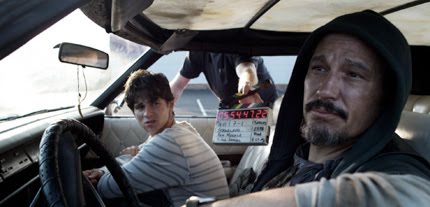
 Jim Mickle's Stake Land (2010), co-written by its leading star Nick Damici, has been a consensual favorite for the Twitch team even before its world premiere at the 2010 Toronto International Film Festival (TIFF), where Midnight Madness programmer Colin Geddes described it as "a road movie with fangs" and praised producer Larry Fessenden's "choice to take bigger chances and make bolder choices in spite of budget limitations." TIFF's audience wholeheartedly agreed and Stake Land won the Midnight Madness Award.
Twitch teammate Todd Brown proclaimed Stake Land: "The American horror film of the year. Plain and simple"; a pullquote picked up by the film's marketing team. Sean Smithson, Kurt Halfyard, and Swarez likewise placed Stake Land on their year-end top lists. "Mickle is just happy and unashamed to be making a genre picture with no pretensions to Deep Meaning," Grady Hendrix suggested; Stake Land "alternates between scrappy and stately" commented Kurt Halfyard; and Andrew Mack praised the film's "beautiful musical score that helps evoke that feeling of frontier spirit of the film."
 With a a couple of Late Show screenings at SFIFF54 and a "decongestive" three-day stint at the Roxie (April 29-May 1, 2011) as part of Mike Keegan's "Spring Slaughter on 16th Street"—"a respite from the fluff clogging your cinematic sinuses this time of year" (a wry snipe if ever I've read one)—Stake Land bombs the hell out of San Francisco with its devastatingly feral undead.
Although Todd Brown already interviewed Mickle for his "New American Horror" series, and followed through with a handful of supplemental inquiries at TIFF, I couldn't resist my own round with Mickle to promote Stake Land's Bay Area premiere. My thanks to Todd for getting Mickle and I in touch.
[This conversation is not for the spoiler-wary!!]
* * *
 Michael Guillén: Jim, your opportunity to interact with audiences and engage their feedback has been primarily through the festival circuit at this point?
Jim Mickle: Yeah. So far, only the festival circuit. I went over to see it at Cinefest this last weekend and that was the first time I'd seen it with an audience in a while.
Guillén: How are audiences taking the film?
Mickle: Great! Since our first screening at Toronto, it's all been great. Mulberry Street (2007) had a weird response. We premiered at South by Southwest and there was a weird response there. I don't think people really knew what to think of it. It floundered a little bit and then it played at the European fantasy festivals where it started to get its legs. People started to appreciate it and realized it wasn't what they thought it was going to be but they liked it for what it was. By the time it hit Tribeca a couple of months later, it had achieved momentum and had a much stronger reception. It really seemed to connect with people.
But Stake Land right off the bat in the middle of September when we hit Toronto really connected with people and seemed to trip the response I like to hear and that I hear kind of often—"I don't really like horror movies but I like this movie"—which I feel is good. People who do like horror movies are increment when they bring their friends or dates or family and those people wind up enjoying it too.
Guillén: You won the audience award at TIFF's Midnight Madness, which isn't a bad start to a festival run.
Mickle: Yeah, that was good validation from them at the start.
Guillén: Did that audience validation come as a surprise? Or did you already have a sense that your reversion of the vampire mythos was strong and sure?
 Mickle: It's tough to be able to look at it that objectively, especially that early on, and I remember moments of being on set and thinking, "Wow, this is low budget. This is very DIY. This is like going in the backyard and making a movie." On the one hand, that's great; but on the other hand, that often doesn't translate into a big audience. I remember considering these things at some point and having to black that all out just to keep moving forward, making the movie and trusting the script, characters and actors.
So that was the first thing I remembered when we did win. I didn't expect to win because there were a lot of great movies in Midnight Madness. A lot of movies that played earlier than we did seemed to have a giant reception so I was pretty shocked and excited when we won because I had spent a lot of years in Toronto in high school. It felt like a family field trip to remember all the crazy midnight movies I used to see there and it had always been a goal to have a movie of mine play there at some point.
Guillén: You went to school in New York, is that correct?
Mickle: Yes, I went to film school in New York. I grew up outside Philadelphia.
 Guillén: And you've been friends with Nick Damici, the film's screenwriter and lead actor, for going on 10 years now?
Mickle: Yeah, 10 years this week actually. I just found a journal I used to keep in college when I was working on films and jotted down contact info. I looked through it and found "4/19: Met Nick Damici, actor." So, yeah, it's pretty cool to think that Stake Land will be coming out to the day almost 10 years after.
Guillén: I know it's difficult to pinpoint such things and narrow them down, but, what was it in Nick Damici when you met him that gave you a sense that you could collaborate with him in the future?
Mickle: That's a good question. I met him during a student film and he really stuck out. Usually you don't see actors in a student film where you think, "Wow, this guy's great." But he really stood out in that little student film and—especially in film school—you do a lot of work on family melodramas and coming-of-age stories where everybody's finding their voice but they're all 19-22 years old. That was at a time when I was starting to lean towards enjoying genre again. I had gone through a snobby patch of only liking foreign films and forgetting that I had grown up loving horror movies. I sort of fell back in love with them and realized that genre films were the most fun thing to be working on. So I met Nick at that time and he was one of the only people that I talked to on these sets that sort of felt the same way. But also, I have an odd sensibility and have been influenced by a mishmash of a lot of genres and it was sort of the same for him. Then in a weird way we kind of completed each other because he was 20 years older than I am and he grew up with a whole different set of influences whereas I grew up with the films that came a whole generation after so—through our friendship—we were able to pool from a wide range of movies that pertained to what we were into. At the same time, they completely overlapped. We're both turned on by the same material, the same ideas, so I think it was all about that.
 Also, we had the same kind of desperation. I was getting out of school and I was in a panic because when you graduate from school you have no idea where you're going to go or what the next step is going to be. It's terrifying. At the same time, Nick was doing In the Cut (2003), the Jane Campion film, he had a role in that, and there was all this uncertainty about whether the film was going to do well and what that might mean for his career. Both of us hit a patch for a couple of years where we were both frustrated and feeling like we weren't getting anywhere. He really wanted to act and write and I really wanted to direct and so it seemed like a perfect pairing.
Guillén: Is it fair to say that it was precisely your mutual love for genre that motivated your decision to collaborate?
 Mickle: Yeah, I think so, definitely. When we were working together on that student film it was a crazy shoot where we were staying in cabins out in the middle of the woods for about two weeks and at one point the guy who owned the cabins invited us into his cabin at about 2:00 in the morning after a long shoot to sing karaoke with his family. It was an incredibly weird and surreal experience with all of us film students invading this guy's home and his daughters sitting there in their night gowns with the lights off and karaoke on the TV screen. At one point there was a Barbie doll on the floor and Nick looked at me and said, "I feel like I'm in a David Lynch movie." When he said little things like that was when I realized that he was into the same stuff I was into, I saw the same absurdity too, and right after that experience someone told me, "Hey, that guy Nick just wrote a horror film." That was right at the time I was back into horror films but I couldn't find a lot of other people who were so Nick and I bonded over genre and also bonded over wanting to do something more with the genre, to stretch it. Neither of us were interested in typical horror standards. We were thinking about how we could mix horror with the western genre and come up with a weird mixture.
Guillén: Well, it's true when you mash up genres you get some weird mixtures, but also some exact articulations of contemporary feeling. I've long thought that the juiciness of genre lies in the emotions they trigger. Specific genres trigger specific feelings and I imagine that's why audiences relate to them. When you go mixing up genres, however, you generate some complicated feelings. That's what drew me into Stake Land. Yes, it was a monster movie and I run to every monster movie I can see, but I came away with an appreciation of its complicated emotionality. Colin Geddes has used that term "elevated genre" to describe films like yours and I have to agree it's absolutely appropriate to Stake Land where you've elevated the horror narrative by plumbing its emotional depths.
Mickle: Good! Thank you. I like the horror genre because it gives a filmmaker an avenue to heighten emotions and the complexities of relationships. You can transpose other genres into that and all of a sudden you discover deeper ways of telling the story. Also, a lot of the things we deal with in Stake Land, if it weren't a horror film I think the audience might come away feeling unsatisfied because we never really come to a conclusion. We point out a lot of things about the world around us but we don't try to make Stake Land a strict message movie. We leave a lot of those threads open for discussion. If the film had been an artsy drama with a social critique and didn't have these other fun elements to it, it might have ended up being unsatisfying overall.
 Guillén: I consider Stake Land a narrative of blood and salt, in the sense that it's a recapitulative narrative and—as we all know—looking back can be hazardous; you can turn into a pillar of bitter salt. But the positive aim of recapitulation is precisely to consciously place things behind you in order to move on. You accomplished this in Stake Land through Martin's voiceover reflecting on evocations of the Depression era and the frontier West and his own journey into manhood. Connor Paolo, incidentally, inhabits Martin's character arc with tremendous tenderness and dexterity. Can you speak about your choice to use narrative voiceover?
Mickle: I always really liked voiceover and so I'd write it into my scripts in film school and my professors would say, "Oh this is really bad. Never use voiceover." At some point I got trained out of it. At another point, Nick and I were discussing something else—we were adapting a book that was in first person narrative—and both made the decision: "No narration." But I always thought there was something there, a context that was a way of looking into the story that we were missing without it.
When he started sending me the first couple of pages of Stake Land and once the narrative voiceover popped in I was totally like, "Ah, yes! Finally." I really like narrative voiceover and I like how you can use it as a rhythm and use it as almost another thread of the music. It's not just about story but it's also about the tones a lot of times. I was so excited when he first gave those pages to me. It also started to give Stake Land a feel of Terrence Malick, a Badlands feel, a Days of Heaven feel, and those were both movies that I appreciated but never actually thought that I would get to take a stab in the realm, especially by making a horror film. I think the narrative voiceover opened the film up to not having to be just a genre story.
The film is sort of like a backwards time machine that starts in a post-industrial world that is falling apart, then works back through the Civil Rights era almost, back through the Depression, and at one point we're bordering on the Civil War and pioneering, back to hunting and gathering.
 Guillén: That's an interesting take. Stake Land is also being likened unto a road movie and within that domain of reference I appreciated that there were journeys within other journeys or journeys that were relayed into further journeys. The journeys overlap and become layered, in other words. So when you talk about the narrative being irresolute—and though that might be considered a criticism by some—that's exactly what I liked. The open-ended quality of the journey has a poetic feel.
Mickle: Absolutely. And I've read critiques of Stake Land that point that out and call it a flaw, like it wasn't a choice, like it was something we forgot. It was kind of the same thing with Mulberry Street, which was raw and we didn't quite have the tone yet. By seeing Mulberry Street several times with audiences, I got a sense of how much we can get away with and how much we can't, and the ways we could have pushed things even further, and so it was fun to come back and take a second stab with Stake Land. I could rely more on my instincts and I could rely on how I knew it would play in the theater with people who are either into it or not into it.
Guillén: I can't believe anyone wouldn't be into Stake Land but different strokes for different folks, I guess.
Mickle: It happens. There are people out there. But I'd rather have people who either love it or hate it. I'm glad it's not a middle-of-the-road movie.
 Guillén: Agreed. There's nothing worse than lukewarm genre. I know you've talked to several different people about the design of your vampires. There's been a lot of witty repartee about how different your vampires are from Twilight's glittering vampires. I think one reviewer wrote that your vampires would eat up one of the Twilight vampires and spit out the glitter. How I'd like to angle in on them, however—having just watched the film again the other day—is the peculiar way in which your vampires are a metaphor for America's current economic crisis. These are creatures who maybe at one time were decent law-abiding citizens that have been drained of life—i.e., transformed—by economic forces. You could say these people have had the life sucked out of them by predatorial banks and lending institutions. Do you think that's a valid read?
Mickle: Yes, absolutely. That's part of the film's open-endedness also. We don't try to fit things too tightly into a box or to be too set in our ways. We tried not to play our narrative in any specific time in history. We were vague and unspecific about names and politics—who was the President?—and yeah, the final draft that got greenlit was in September or October 2008 before the election and it was right when people were feeling the vibe between Blue and Red states and the us vs. them politics. Also, there was all that uncertainty about which direction the country would be heading? And what these overall attitudes were going to do to the country? But the time that we were in a lot of ways more interested in was this idea of terrorists and terrorism being used as a way to control people through fear. A lot of that plays into the Brotherhood and their relationship to the vampires. That's what's sort of nice about the zombie and vampire genres—some people say our creatures are zombies/vampires—they are in a sense humans, they are characters, and not just guys in zombie suits.
 Guillén: Well, that's another thing I was going to say about your creatures. They're relevant as a potential metaphor not only of how the financial crisis has drained Americans of their livelihood and created, in effect, a class of the undead; but, politically, your vampires—for as feral and ferocious as they are—achieve a certain pathos for essentially being victimized by Christian extremists. They are, in a disturbing way, misguided terrorists being used to rule others by fear. This is all the more relevant in the face of such recent headlines as Terry Jones, the Florida pastor who incited such horrific violence by burning the Koran. Christian extremism is a seriously violent issue in our country today.
Mickle: And I don't think it will cease to go that way. At one point we may have thought, "Oh we've peaked out and Stake Land might have relevance now but it won't keep being relevant."
Guillén: Christian extremism isn't going away. It's only getting worse.
Mickle: During Mulberry Street there was the moment right before we came out where there was the scandal about finding rats all over the Taco Bells in New York. It was like, "Oh my God. What are the odds that would happen right when we were making a movie about rats in New York City?" So we had that little bit of a bump or wave but I remember thinking, "That was our bump or peak and we just missed it." But then we realized, no, these things continue even though we've tried to stay away from being specific about dates and places.
 When Obama got elected, there was a week or two where we were saying, "Shit, what is this going to do to the country? What is this going to do to our story? What if he fixes everything? What if he solves the economy? And all the issues in our film are no longer issues? We'll be making a movie that brings people down because it will remind them of the old days."
Guillén: [Laughing.] That's funny. The face of new American horror will be when everything's in order and we live in a state of anxiety that everything will be taken away from us. Right.
Returning to your narrative where order has capsized and the Brotherhood seeks to re-create order through extremist means, I have to say that the sequence where they come in with helicopters and bomb the refuge of settlers with vampires is one of the most brilliant moments of horror ever. What a concept! Every time I watch that scene my heart comes up my throat like I'm going to vomit. It's terrifying.
Mickle: Oh good! [Chuckles.]
 Guillén: Lately I've been interacting with several young people engaged with the disposable film movement that seeks to put affordable and available tools into the hands of aspiring media makers. Naturally, there's some discussion about the necessity of going to film school. Can you talk about whether you think it's still important to go through film school and why?
Mickle: Good question. I remember that being the big question in my mind when I decided to go to film school: does it make sense to do this? Or should I just spend my money and time and go off and make my own films? What's great about film school is it provides a structure that allows you to go out and experiment. If people are interested in making film and art, sometimes it's hard for them to focus and get down to it. The one thing you always hear from people is, "I'm going to make a movie. I'm going to make a movie." Three years later you still hear them saying, "I'm going to make a movie." So what was good for me about film school and what was the best class by far was where I made five films in a semester. You're directing a film one week, you're editing it the next, you're working on your friend's movie the next week, then the next week after that you're making another short film and so it keeps you in a mode of constantly being forced to come up with an idea that fits existing criteria and try to find your own way to make it different.
 That being said, any form of community-based interest in film is good if it has that sort of film school mentality. For example, the 24-hour film, 48-hour film competitions, are great because they force people to go out and do it because that is the biggest obstacle: going out and doing it. Anything that supports that, I think is good. Especially now with the RED camera, and so many of the DSLRs, there's so many amazing cameras with Final Pro Cut being available, that you can very easily make a film on your own that can hold up to much higher standards than ever before. So the big obstacle now is getting out there and doing it.
Guillén: So if I'm hearing you right, what you're saying is that the value of film school is that it teaches you discipline about production?
Mickle: Yeah, discipline. And networking also. When I look back now and think about the people who I was friends with when I was in film school, there weren't tons of them but I was in that bubble surrounded by others who were dealing with the same sorts of issues, and learning from them, sometimes from seeing what they did wrong. That kind of experience is invaluable and you can't get it from books. There are groups like Blue Tongue films....
Guillén: Ah yes, I deeply admire their collaborative ethos!
 Mickle: Well, I look at them and I think, "That's what I would be doing now if I weren't going to film school." I would surround myself in a bubble with people who are making films and who are able to support each other. Larry Fessenden does something like that with Glass Eye Pix. He's got all different scales of movies happening over there in all different stages of production. He's in this awesome world where he gets to bounce around and make his own films but also be able to comment on people's scripts and look at cuts.
Another thing about film school that's good is the competition. You go into a class and you have to watch 30 films that day. I didn't get a sense that NYU was cutthroat but you did want the things you were working on to stand out. Your films are held up to this harsh reality where people critique them. You might not like what they say but that's also something important to learn, rather than loading something up onto YouTube and ignoring the reception. There is value in learning how to handle criticism.
Guillén: Do you know if it's essential to have had film school training in order to break into the industry of studio filmmaking? Does one lead to the other?
 Mickle: I think it's absolutely just the opposite. It's weird, you know. I'm in New York and I'm in the independent world here but I just spent two weeks in L.A. working on a film and doing a lot of meetings and started to get a little bit of a sense of that studio system; by no means any real sense of it but for the first time I stuck my toe in those waters. I was blown away by how much it seemed—and I know this sounds cliché—to be a corporate culture. I don't know if there really was or is a presence of film school background, maybe there is but they take things for granted and don't talk about it? But then, the other night I was back in New York and went to a party for IFC Films and wound up in a conversation with a bunch of guys from L.A. and I was blown away by the topics in our conversation. One of the guys I talked to had worked on a T.V. show in L.A. doing lighting but we wound up having a conversation about Terrence Malick. So I guess there's two very different worlds going on there.
One of the best things I did as a young filmmaker was working on a lot of different types of movies, pre-production, production, and post-production, and having that as a background. It helped me navigate but I've started to realize that all that stuff was not essential at all.
 Guillén: When you were talking to Todd Brown you said, "I could retire if I got to do a western." That intrigued me, partially because there is such a strong western feel to Stake Land, but also because the western seems to be making something of a comeback not in and of itself but through its galvinization with other genres, particularly horror and sci-fi. Case in point would be this summer's upcoming blockbuster Cowboys & Aliens. Yet I would love and encourage you to do a pure western.
Mickle: Yeah, me too! It's fun to see some of these western mash-ups, but it would be great if all that meant there would be a resurgence of the pure genre. I'm in a minority but I wasn't really impressed with the remake of True Grit. It just felt like it was the best we had for a western and that's okay but I would like to think that the fact that it did well would make it much easier to do it better. Unfortunately, there's a mentality—especially with remakes being so prevalent—where studios don't want to spend a lot of money and westerns with desert sands and period costumes mean money; therefore, no.
Guillén: Well, if anyone could do it, I think it's you. The value of a western lies in its characters and—as someone recently said—there's no small parts in a western. All the characters are important. You've shown us in Stake Land, a horror film, that it's the characters that vitalize the genre.
 Shifting into the noir genre, I understand you're adapting Joe Lansdale's Cold in July, which you've describe as a western noir hybrid. Is that still in the works?
Mickle: Yes, it is. It's been an up and down back and forth sort of in the works but just in the last week or two it's gotten a big boost behind it. Half the task is finding the cast and financing but now it looks like the financing is there and a good chunk of the cast is there so I'm hoping by the end of the month that all those nuts and bolts will be put on and it will be ready to go. We're looking to do an August or September shoot.
Guillén: Can you provide a synopsis of that project and why you're being drawn to it?
Mickle: Yeah, sure. It's a story with a lot of twists and turns so it's been a tough pitch, which I sort of like. I don't like the this-meets-that sort of pitch. Cold in July is about a guy, a father, who wakes up one night to find a burglar in his living room. He shoots the guy and kills him and winds up facing off against the father of the dead burglar and they end up having an odd relationship, which is I guess the best way to put it. I like it because in a lot of ways it's two or three different stories in one. By the time you get to the end of it, you can't believe you started where you did. I really like those kinds of stories. I find that so many times when I come to see movies or I read scripts that I know exactly how they're going to end and who's going to be there and where the location is and so this is one of those narratives where some place in the middle you give in to the story and explore it to see where it goes. But it is a morality tale. It's a character-based thriller. What made it tough to get done for a while was that it wasn't a straightforward thriller and I think people wanted something that was going to be easily defined: a thriller that could be put in the thriller section. It finally will go forward without having to lose any of its character stuff.
 Someone has pointed out the family stuff in Mulberry Street and Stake Land and Cold In July is going to fit into that, again without really trying, but it's a strong ode to fathers, good dads and bad dads. Nick and I both have great dads and so I think in a lot of ways this is a love letter to them. But also, I'm a huge fan of Joe Lansdale and he's best known for Bubba Ho-Tep and some of the crazier over-the-top stories, but he also has these quiet, simmering, contained stories with twists and turns that are not over the top or big genre mash-ups. He writes both of those equally well but he's not really known for his quiet stories. As a fan of his work, I'm proud to be able to bring that quiet side of his universe onto the screen.
Guillén: Sounds great. Good luck with that. Since you've brought up the suggested father-son dynamic between Mister and Martin, I can reference its sad and lovely poignance in Stake Land's final scenes where you've brought up the necessity of the father having to let go in order for the boy to become a man. Any sense of what happened to Mister?
Mickle: No. Actually no. I had ideas and Larry had ideas and Nick had ideas but the one idea that really came to the forefront was that we shouldn't really know and, to a certain extent, don't really even need to know or want to know. Anytime we pushed in that direction it felt wrong. It's the simplicity that makes it more interesting.
Cross-published on Twitch.
 The 54th edition of the San Francisco International Film Festival (SFIFF54) gets underway this Thursday, April 21 and runs until May 5. Since the Opening Press Conference three weeks ago, the fest has announced that Oliver Stone will receive the 2011 Founder's Directing Award, in a program that will include an onstage interview, clips reel and screening of 1986's Salvador starring James Woods. It has also been revealed that actors Zoe Saldana (Avatar's Na'vi princess) and Clifton Collins Jr. (Perry Smith in Capote) will accept this year's Midnight Awards, in a late-night talk show-styled ceremony hosted by Beth Lisick at the W Hotel. Still waiting to be announced is the recipient of SFIFF54's Peter J. Owens Acting Award. Since posting my two-part overview of the full line-up, I've previewed 10 films on DVD screener. Here are some impressions.
 The SFIFF54 Latin American selections were mostly a field of unknowns (at least to me), so priority #1 was checking out some of those. I had little interest in Tatiana Huezo's The Tiniest Place, until I read Robert Koehler's rave in an indieWire report from the recent Guadalajara Film Festival. Indeed, the film is a revelation. It's one of those documentaries that does more than cogently impart information and exists as a work of art. This is the story of Ciquera, an El Salvador mountain village that was bombed into non-existence during the country's civil war. The director starts us off in the present day, rendering a tranquil, thriving village and the quotidian goings-on of its inhabitants. Just as you become impatient and start wondering if the film is merely an innocuous ode to rurality, the villagers begin to speak—both on camera and in voiceover—of their experiences during the civil war years (1980-1992). Captivating storytellers all, their personal tales escalate in horror as the film progresses, until it becomes nearly unbearable. No archival footage is used, just some faded photographs and the villagers' words disconcertingly contrasted against the idyll of contemporary Ciquera. Miraculously, Huezo manages to end her film in a place of hope. Huezo, whom Koehler called "one of the bright new talents of Latin American cinema," will be at the festival to present her film. The Tiniest Place is beautifully shot and will be screened in 35mm, a rarity for documentaries these days. Don't miss it.
 I was also impressed by Ulysses, Oscar Godoy's fictive portrait of a Peruvian immigrant establishing a new life in Santiago, Chile. Before the opening credits, we see Julio wake up on a busy sidewalk with his head resting in a pool of blood. How this came about is never really explained, and it's the first of several nice touches of ambiguity in Godoy's screenplay. Ulysses is more than another grim case study of a downtrodden immigrant, although there are certainly elements of that. Julio's story is more complex—a former history professor whose reasons for immigrating seem born more of escape from personal tragedy than fiscal necessity. We observe as he battles loneliness, first with prostitutes and then in a promising relationship with a music store clerk, and watch as he gradually improves his economic lot. The result is a quietly heartbreaking, but ultimately optimistic film that achieves its full power cumulatively.
 Every year the SFIFF line-up includes a few movies—about the movies. And Mila Turajlic's Cinema Komunisto is "the story of a country that no longer exists, except in the movies." In 1948, Marshal Tito's slightly more benevolent brand of Yugoslav communism caused a rift with the USSR. The Soviets stopped the flow of Russian films to the renegade republic, and of course, Hollywood happily filled the void. Soon Yugoslavia developed its own successful homegrown industry of WWII "partisan" films, which helped kickstart an era of international co-productions. Starting with Jack Cardiff's The Long Ships in 1962, these epics brought in western currency and jet-setting movie stars. Tito himself was a movie buff, handpicking Richard Burton to star in The Battle of Sutjeska, a hagiographic biopic about Tito's WWII exploits. Providing a nifty frame of reference in Cinema Komunisto is Levic Konstantinovic, Tito's personal projectionist for 32 years who asserts that he screened 8,801 films for the leader between 1949 and 1980. His personal recollections, combined with choice movie clips and archival materials, make this a breezy examination of one nation's brief cinematic legacy.
 If you've seen the films of Wong Kar-wai, Hirokazu Koreeda, Tran Anh Hung, Jian Wen and especially Hou Hsiou-hsien, you've no doubt exalted in the visual aesthetics of cinematographer Mark Lee Ping-bin. In Kwan Pun-leung and Chang Hsiu-chiung's documentary Let the Wind Carry Me, they seek insight into the Taiwanese DP's artistry, which Lee himself ascribes to a balance between "visual poetry and realism." All the aforementioned directors go on camera to discuss Lee's artistry and work methods, praising his use of natural and household light, and his adaptability to fickle weather conditions. Actors Shu Qi and Romain Duris speak of his ability to accommodate his camera to their movements, which Mark claims is unintentional and unconscious. For me, it was a pleasure to finally see the man who's given me so many moments of cinematic ecstasy, like for starters, the opening scene of Hou's Millennium Mambo with Shu Qi's trance-inducing strut along a neon-lit urban skywalk. Lee, it turns out, is a long-haired, bearded man with a rugged frame and deep voice who speaks about how pottery taught him color and how his chosen profession is a lonely one (he has an American wife and young son who live in L.A.). Unfortunately for a film about someone as visionary as Lee, this documentary is somewhat perfunctory and artless, filled with static talking heads, awkward edits, ill-fitting music cues and moments of superfluousness. Also, many of the clips are of poor quality, at least on the DVD screener I watched (but verified by Russell Edwards in his Variety review from the Tokyo Film Festival).
 Of the 10 films I previewed, the biggest surprise was Hong Sang-soo's Hahaha. I am not a fan of this Korean director's work. For me, they have an exasperating sameness—full of immature, narcissistic, sexist, alcoholic intellectuals and their codependent female counterparts, all rampaging through fractured narrative structures. Hahaha has all of that, but it's been dialed way down. There's almost—dare I say—a sweetness to it, making this the first Hong film I've enjoyed without reservations. Here's the set-up. Two friends, an unemployed wannabe film director who's about to emigrate to Canada, and a depressed, married film critic meet for drinks to reminisce about their summer holidays in the port city of Tongyeong. This reunion is only heard in voiceover, and only seen via B&W snapshots. The bulk of the film consists of their separate tales being dramatized on-screen. It's a bit confounding how the two narrative strands connect until Hong slips in a revelatory a-ha moment and then runs with it for the film's duration. If you've never seen a Hong Sang-soo film, this would make as good an entry point as any.
 I previewed two more documentaries and one narrative feature. From French actor/director Romain Goupil comes Hands Up, a timely tale of 5th graders plotting to prevent the capture and deportation of a Chechen classmate. It's like a classic caper film as conceived by the minds of stealthy children, with coded text messages and ring tones only kids can hear. Valeria Bruni Tedeschi is wonderful as always, playing the cool Mom who's in on it. Also from France is the documentary Detroit Wild City, an outsider's portrait of a city that's lost 25 percent of its population in the last decade and where nature is reclaiming its stake. Director / cinematographer Florent Tillon has a tremendous skill for photographing the city's once-majestic buildings now in ruin, as well as an eye for the absurd (a bus whose sign alternately flashes "Have a nice day" and "Not in service"). The film's profiles of Detroit's remaining denizens, however, vary greatly in interest and relevance—a major exception being a poetic young urban explorer whose observations and laments perfectly compliment Tillon's visuals.
 And finally there's The Ballad of Genesis and Lady Jaye, Marie Losier's oddly touching documentary about industrial music pioneer Genesis P-Orridge (Throbbing Gristle, Psychic TV). While the film begins with a nifty overview of his music career, the greater part is given to P-Orridge's all-consuming relationship with Lady Jaye, a nurse / dominatrix almost half his age who died in 2007. "You know how it is. You fall in love madly with someone and there's this moment when you just want consume each other and not be individuals anymore. We wanted to pursue that. Not just talk about it, but live it." And "living it" involved extensive plastic surgery, matching breast implants and beauty mark tattoos, not to mention identical hairdos and wardrobes. Losier effectively uses a mix of home movies, interviews and concert footage to recount this strange tale in a completely non-judgmental way.