Tuesday, 21 May 2013

BEFORE MIDNIGHT (2013)—Ryan Lattanzio Interviews Richard Linklater & Julie Delpy

In 1995, gen Xers Jesse and Celine met on a train in Vienna and spent 24 hours falling in love and getting to know each other. But then, the sun rose and they went their separate ways until 2005, when they met again by chance after failing to realize their mutual promise that they would meet back in Vienna six months after their initial encounter. These films, Before Sunrise (1995) and Before Sunset (2004) respectively, glowingly capture what happens to a chance romance when it goes from ideal to dissolute, as people grow old and their expectations—and their selves—continue to change. Before Midnight (2013), in theaters this Friday, makes it a trilogy for the American Jesse (Ethan Hawke) and French Celine (Julie Delpy).

With Before Midnight, these three films join the ranks of Kieslowski's Three Colors and Ozu's Noriko series as one of cinema's finest trilogies. And yet the Before set is also a kind of time lapse experiment in which we actively engage with Jesse and Celine, aging alongside and checking in on them every nine years to see how their shared lives, like ours, have evolved along time's arrow.

It was, as to be expected in the company of Julie Delpy, a scene of chaos in a hotel room high up in the Fairmont when I met with her and the always casually unflappable director Richard Linklater to discuss Before Midnight. Their appearance came on the heels of the final stretch of the San Francisco International Film Festival, where Midnight was the closing night selection. When I entered the room, phones were buzzing madly. Delpy was on her cell trying to "order gravel" while demanding more tea. But when we finally settled down to talk, what happened was less an interview and more an intimate, familiar conversation between Delpy and Linklater that I had happened upon. Though Ethan Hawke was unfortunately not in attendance, Delpy and Linklater have a rapport as comfortable and jokey as that of Jesse and Celine.


Left to Right: Julie Delpy as Celine and Ethan Hawke as Jesse
Photo by Despina Spyrou, Courtesy of Sony Pictures Classics
 I first saw Before Sunrise as a young teenager and was over the moon for these two lovers for whom time was, for better and for worse, all they had. Then came Before Sunset, in which we meet Jesse and Celine yet again, this time in Paris when they have another encounter while Jesse is on a book tour and both of them are in committed relationships (Jesse, unhappily married with a young son).

Anticipating, by coincidence—as they insist, and isn't coincidence the foundation of these films anyway?—another nine-year gap, Delpy, Hawke and Linklater gathered in Greece last summer to write and shoot Before Midnight over a period of ten weeks. Like Jesse and Celine in Sunset, they had a deadline. Linklater directed, and co-wrote the script with Delpy and Hawke.

Midnight finds Jesse and Celine in their 40s, not married but together, with two little girls. They live in Paris but are on summer holiday in Greece where Jesse is hoping to finish his next book. Celine, always a crusader, has put her own professional life as an activist on hold to be with him. But the romantic bond we once thought was so infallible in the span between Sunrise and Sunset is now a troubled paradise in Midnight, as the two must decide where they will go from here and if they will go there together.

* * *

Ryan Lattanzio: First of all, congratulations on a wonderful new film. Describe the moment when you decided you wanted to make a third film.


Left to Right: Julie Delpy as Celine and Ethan Hawke as Jesse
Photo by Despina Spyrou, Courtesy of Sony Pictures Classics
Richard Linklater: The third film is very different from the second. The scary leap was to jump into the second. Once we did, it begged the question, well you can do it again because you already did, it's just whether you're going to or not. That said, it was the same six-year blank spot (between Before Sunset and Before Midnight). And then we realized Celine and Jesse were maybe still alive in us and they had something to say about a new place they were in in life.

Julie Delpy: And then the work three years prior to actually writing is the backstory.

Linklater: It's great to take that time and follow ideas and think about the story you're trying to tell. The third one is more difficult. We knew what we couldn't do again.

Delpy: Which is meet again by accident.

Linklater: In your 40s that would be ridiculous. We had to go into a domestic world and we had to decide what that would be.

Delpy: They didn't see each other for nine years and then they meet again by accident. It would be totally silly, not real.


Left to Right: Ethan Hawke as Jesse and Julie Delpy as Celine
Photo by Despina Spyrou, Courtesy of Sony Pictures Classics
Lattanzio: You can very much feel those nine years between films. How did you go about recreating those details, and that lived-in feeling?

Linklater: We go nine years and we don't see each other that much even though we're friends. But they have to act like they've lived with each other all that time, so that's an acting thing and I think it's a comfort thing. We do extensive workshop.

Delpy: People tell me, oh you and Ethan are so comfortable together.

Linklater: But not at first! I was there the first time he put his hands on her and Julie was like, ah!

Delpy: People assume it's a natural thing, our dynamic. Ethan and I, we're very different obviously. Naturally people that have been together for a long time, they don't even notice that they're touching. It's like you're so used to it that you don't notice it so we have to go into that natural state. I mean Ethan doesn't grab my ass every ten minutes even though he'd like to.


Julie Delpy as Celine
Photo by Despina Spyrou, Courtesy of Sony Pictures Classics
Lattanzio: Early in the film, there is an extremely long single take in a car when Jesse and Celine are driving back from the airport, where Jesse has just dropped off his son who lives in the US, to their vacation spot in Greece. How did you go about mounting that scene? It certainly looked like a challenge and I was relieved for you all when you finally cut to a shot of Grecian ruins halfway between.

Linklater: But we cut back to the same take!

Delpy: We did suffer for 13 minutes. Many times.

Linklater: We shot that in two days but I didn't use anything from the first day. I knew that day would be kind of a warm up as much as we had rehearsed that scene for weeks and weeks. Still, once the technical apparatus is around, it's a hard thing to pull off. But it was worth the effort because I felt that would be a good way to reacquaint ourselves with Jesse and Celine in real time. These are real people we are hanging out with. Not all actors can pull that off.

Delpy: I think we ended up with only one good take. It was all a fine balance. I couldn't believe we were able to do it because it's not like a play. It's so scripted. We didn't change one word. Even the overlaps are written. We don't overlap each other when we want to. We know when we are going to overlap each other. Everything is timed down to, like, half a second.


Left to Right: Charlotte Prior as Nina, Jennifer Prior as Ella and Julie Delpy as Celine
Photo by Despina Spyrou, Courtesy of Sony Pictures Classics
Lattanzio: Even though it feels like improv because of the naturalistic dialogue and the timing, I understand that each of the films has been heavily scripted. Was there ever a moment where you changed a line or added something in while shooting?

Delpy: Sometimes we realize one line is one too many.

Linklater: We are always working on it. Even in that car scene there was a line I dropped. That keeps it fresh, that it's never so finished.

Delpy: Let's say that 99% of the script when we lock it stays. Basically there are two lines in this film that Richard decided, okay, don't say that line. Let's see how the rhythm changes. In Before Sunset he cut out one line, that's it.

Linklater: It was a joke, which ultimately would not have aged well.

Delpy: You don't want to say the joke. Don't say it.


Left to Right: Walter Lassally as Patrick, Ethan Hawke as Jesse and Panos Koronis as Stefanos
Photo by Despina Spyrou, Courtesy of Sony Pictures Classics
Lattanzio: Why did you choose Greece as the setting?

Linklater: It presented itself to us.

Delpy: Food. (laughs)

Linklater: Let's be honest. The food.

Delpy: We had decided to do it last year, and we were going to Spain, Italy, but he called us from Greece and said, that's it.

Linklater: There was a producer in Greece who was going to work on the film and help us get it made, he had a lot of access. The shoot was a blur, it was like a ten-week thing but we only shot those last three weeks.

Delpy: We were writing entirely for those seven weeks before, like 18 hours a day. We would start at nine, finish at six, take a jump in the sea for half an hour, go back to work until midnight every day. We had no screenplay when we got to Greece, but we had an outline.

Linklater: It was important for us to all just go there and start. We weren't in the room together as much on the second one.

Delpy: We had to take ourselves and lock ourselves in a room to really focus.

Linklater: With Before Sunset I was getting stuff from you guys [via email and phone] and that wasn't happening so much this time. It was scarier.

Delpy: It's scarier because you're there and you have to finish. The producers had no screenplay when we got to Greece. They were so trusting.

Linklater: The producers took a huge leap of faith with us. We had locations and we knew how many days we would need for certain scenes. It was a practical approach to a production but there wasn't actually a screenplay.

Delpy: I was amazed. We knew it wasn't there yet but they weren't even giving notes to censor us. It was a great creative environment.


Left to Right: Ethan Hawke as Jesse and Julie Delpy as Celine
Photo by Despina Spyrou, Courtesy of Sony Pictures Classics
Lattanzio: Were you at all worried that you might shatter some audiences' illusions about the romance between Jesse and Celine? With this film, the relationship has grown a little sour, perhaps, and is more real and raw.

Linklater: It's the difference between 22, 33 and 41. You're one more step into the real world. Sunset was that, too. We were catching them at a different place. Jesse and Celine were both busy.

Delpy: He has a kid. Things are not going to be easy no matter what decision they make.

Linklater: This had to cover a different aspect of their lives. You're in Paradise and you've gotten what you want in the world, and that's tough. It's not free. Everything is still a tough negotiation in the world. Celine is more restless in a way, conflicted.

Delpy: Aren't women a little more like that?

Linklater: To make a gendered generalization perhaps, yes, it's ancient.

Delpy: It's Eve eating the apple. "I want this apple NOW! Give me that fucking apple. I want that apple."

Linklater: We're here, we've got everything we want, we've got food but, yeah, it's just not good enough. As much as we strive for balance between the sexes, the film maybe is seen through him a little more.

Delpy: To me it's essential that the character is real and multidimensional and so many female characters in history, even theater until you go through Miss Julie and Hedda Gabler where it gets more complex, a lot of female characters are one dimensional and it's essential to me to go towards writing something, altogether, that's not a one-dimensional female. Some men might find Celine unbearable because they want her to be a girl that will say yes. Often the male is a conflicted character with the questioning and the fucking up but Celine might be the one who is here. To me it's quite modern and realistic to every woman around me. They're not one-dimensional individuals.

Linklater: We all contribute to that. Ethan and I kind of have female sides to ourselves and I think Julie has a strong masculine voice in there.

Delpy: I can actually see what the burden for men would be to be with that multidimensional woman. It's not easy. I think that's why a lot of men go for younger women because they want less of the crazy. A fantasy.


Left to Right: Julie Delpy as Celine and Ethan Hawke as Jesse
Photo by Despina Spyrou, Courtesy of Sony Pictures Classics
Lattanzio: Was it a coincidence that, I understand you had six years of blankness and then three years of talking about it before going into production, but did you intend the nine-year span between films again?

Linklater: Not really but it motivated us. We had in that outline and I said, let's step up and do it last summer. And by the way it would be the same nine-year gap, whatever that's worth.

Lattanzio: Julie, I understand that production on Before Midnight coincided with the release of 2 Days in New York in France and in the US. I loved that film and the one before it, 2 Days in Paris, in which you write, direct and star as perhaps a version of Celine as unleashed id. Will you make another 2 Days?

Delpy: I think I'm done. The second one was so hard to make. There were so many conflicting issues with financing. Right now I'm working on three projects, two developing and one I have to finish writing. But it's much easier now than it was before [Before Sunrise].

Lattanzio: Do European financiers always want you to do the character of Celine?

Delpy: 2 Days in Paris was a little bit tricking people into thinking I was going to do Before Sunset 2. [European financers] always want to finance the same thing. They want to finance things that already happened. If I come up with something original, they're like, "Oh, can you do this instead?" Marion in those films is much crazier than Celine, much more neurotic, she has serious anger issues. Marion is closer to me [than Celine] yet even further from me. Sometimes I wish I was Marion, insulting people in public. Imagine if you didn’t censor yourself. In France, financiers want me to do that Marion again. In France, [2 Days in Paris] was extremely successful. Before Sunrise didn't do so well at the time. They hated me. But Sunset was successful. Maybe Elizabeth Bathory in [my film] The Countess is very much like me.

Monday, 20 May 2013

ROXIE THEATER: I WAKE UP DREAMING: 99 44/100% NOIR—The Evening Class Interview With Wayne Shellabarger

Elliot Lavine [interviews one and two] continues to entertain his San Franciscan audiences with noir oddities culled from studio vaults, private collections and Blu-rays, curatorially assembled into his 2013 edition of "I Wake Up Dreaming: 99 44/100% Noir", which continues its run through Thursday, May 23, 2013 at the Roxie. Dennis Harvey wrote up the series for The San Francisco Bay Guardian, as did Erin Blackwell for The Bay Area Reporter, Pam Grady for Cinezine Kane, Casey Burchby for The SF Weekly, and G. Allen Johnson for the San Francisco Chronicle.

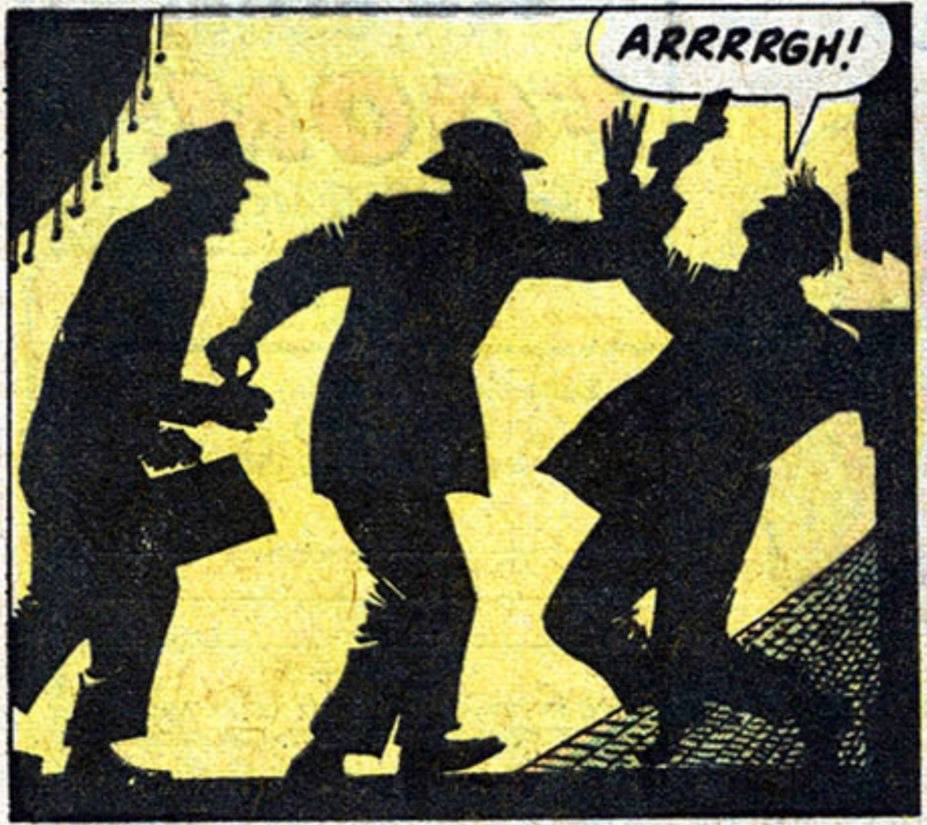
Ever ahead of the curve when it comes to value added to the theatrical experience, Elliot invited Wayne Shellabarger to contribute a slide show of comic book panels to complement the series inbetween screenings and the effect has been stunning. I cornered Shellabarger in a dark alley near the Roxie where, unfortunately, the trash cans were only grey.

* * *

Michael Guillén: Wayne, how did you become interested in comic book panels as a slide show project to accompany Elliot Lavine's "I Wake Up Dreaming: 99 44/100% Noir" series for the Roxie Theater?

Wayne Shellabarger: I had access to a large digital archive of comics and—as I started reading through them—I discovered artists and stories that I had never heard of or read about or seen; most importantly seen reprinted or anthologized. The vibrancy, urgency and energy of certain panels gave me a buzz—whatever you want to call it—and struck me for some reason. I felt the visceral energy of these panels. They hit me. So I began to collect them through screencaps for my personal enjoyment and to look at again for later reference.

I built up quite a library of these and decided to review what I had captured by setting up a slide show to sit back and watch them. What I discovered was that—rather than looking at a series of panels—the slide show created a third form. It wasn't cinema, it wasn't comics, and it wasn't just a slide show. The way that the panels related to each other and were juxtaposed against each other in non-predictable ways created an interesting effect. Watching this slide show for the first time, I felt something new since seeing the panels as I had collected them. I thought, "This would be a really great thing to show before a movie." Especially before a film noir, because what I was collecting was mainly crime comics.

Guillén: In some respects, I consider your slide show project an installation piece.

Shellabarger: Whatever form this slide show has ended up taking at this festival is something I never intended. It unfolded organically and kind of happened as I kept working at it, looking at the panels more, adding to the slide show.

Guillén: Elliot Lavine is a comic book fan? He's been posting several comic book panels on his Facebook timeline. Is that your influence?

Shellabarger: Probably, yeah, though he posted a lot of cool comic book stuff before I started doing this.

Guillén: What caught my eye with your slide show project is that—although the appropriation and recontextualization of comic book panels is readily apparent in American culture through the paintings of Roy Lichtenstein—his project remains essentially a parody. What you're doing is more complementary or supplementary, especially with regard to partnering it with noir films, because you have culled out a collection of panels that are genre-specific.

Shellabarger: I would like to avoid using words like "re-appropriate" or "recontextualize" because there was no brain work that went into this, no intellectual effort at all, the panels just hit me at a gut level.

Guillén: Well, I'd argue that gut reactions fall within the domain of emotional intelligence, which doesn't necessarily have anything to do with intellectuality, and is no less smart for it. As I watched your slide show at the festival, and monitored how well-received it was by your audience, it made me aware of the project's visceral aesthetics: the colors are primary; the frames are succinct, self-explanatory and complete in themselves. Your skill as the compiler of these frames is to single out, for wont of a better term, the focus through light (and darkness)—and, in your case, color—on the essential dramatic moment.

Shellabarger: Yeah! For every one I picked, I saw hundreds that didn't do it for me. It was not like there were gems lying everywhere, for me personally at least, and what I respond to might be different for someone else, but it seems like a lot of people are responding to the selfsame elements that I'm responding to.

Guillén: Do you come from an art history background?

Shellabarger: Well, I've collected comics since I was a kid and then I did art history in college and I draw and illustrate and things like that. Once this slide show started to take shape, then it began to speak to me and dictated what it needed to build itself. Once I had in mind that it might be shown in this form, then it was easier to find a path—"This will work. This goes with this theme or that motif."—which I discovered as I was reviewing my collection. It's not that I'm imposing these themes or motifs. I'm receptive to what's already there.

Guillén: Which is where I would agree with you that this is not recontextualized art. If anything, it's punctuating or emphasizing what's intrinsic to the images.

Shellabarger: Or celebrating them. I'm not trying to make something different out of them.

Guillén: The simple genius of this project is the converging of two popular forms that focus on generic elements.

Shellabarger: One really nice surprise that I noticed was that—if these are noir panels (and I do think there's a hardcore noir sensibility to every single one of them)—they're at the same time the most garish, brightly-hued, and colorful comics, much more so than the comics I grew up reading in the '70s and '80s. For example, there will be a guy walking down a deserted alley and the trash cans will be a bright blue, bright green and bright red. The coloring works perfectly and doesn't take away from the dark attitude of the panel. It's very strange that it works.


Guillén: Even as a child reading comics, I became aware early on of the importance of inking and the individuals responsible for adding color to the stories. I noticed how sometimes the bleeding of color added to the effect, whether intended or not, and that quality especially stood out watching your panels projected onto a large screen.

You mentioned earlier that you were taken by panels unfamiliar to you. I was sitting in the theater with a fellow comics enthusiast and both of us couldn't recognize or source a single frame.

Shellabarger: Yeah, I thought that was another really attractive trait. What attracted me was that I was unfamiliar with a lot of these artists, probably because most of them are anonymous to this day in a lot of cases, except for people like Craig Yoe [official website].

Guillén: So these comics are from the '50s?

Shellabarger: Yeah, they're late '40s and then early '50s before the Comics Code. It seemed like it took the noir sensibility a little longer to inject itself in comics than in film. I noticed that it's in 1948 that it starts in comics more.

Guillén: So did the Comics Code prohibit these kinds of images?

Shellabarger: Exactly. That's what it was designed to do. I mean, look at them! They're terribly harmful. [Laughs.]

Guillén: But then if you look at contemporary comics they're filled with violence.

Shellabarger: Yeah, but it's senseless, not beautiful.

Guillén: So what you're offering in your slide show are significant pre-Code panels that mirror but don't actually time with pre-Code film?

Shellabarger: Right. The same phenomenon happened in comics as happened in film but some 20+ years later.

Guillén: Other than by way of this slide show at the festival, do you intend to further this project in any way?

Shellabarger: A friend of mine compelled me to gather some of the panels together that he'd seen me post to accompany a musical performance that he was doing and that's when I started to gather them with the idea in mind of presenting them publically, rather than just for my personal use. So that's made me aware that I can build different programs to accompany different events, be they music or film. So there might be more slide shows coming. I've also collected a lot of romance panels, and monster panels, and surrealistic panels.

Guillén: About how many images did you use for this slide show?

Shellabarger: Just under 500, about 450, in constant rotation. The randomness of it helps underscore its effect.

Guillén: We're saying "slide show", but are these actually slides?

Shellabarger: No, they're jpegs and they're intended to run in a completely random order. Whatever juxtapositions and connections people make between the panels is what's most interesting about the project. The randomness allows new juxtapositions and connections to be constantly made and I find that stimulating, and—combined with the soundtrack underneath them to glue the images together—I'm surprised how well it works.

Guillén: Did you compile the soundtrack as well?

Shellabarger: I actually got a couple of my buddies—Tom Lynch and Jeremy Wheat, who are as much into music as I am into comics and who share my sensibility on a lot of things—to create the soundtrack. They hooked in to what I was wanting to do and they came up with these great mixes of '40s-'50s jazz and TV crime soundtracks.

Guillén: Thanks, Wayne, for taking the time to talk with me.

Shellabarger: Thanks to Elliot Lavine for creating a forum for this project!

Thursday, 16 May 2013

SFIFF56—FANDOR

It's always such a pleasure to interact with Fandor—specifically Susie Gerhard, editor of Fandor's Keyframe—who requested the transcript of my interview with San Francisco Film Society Executive Director Ted Hope, and invited me to join in on a quick wrap-up of the 56th edition of the San Francisco International Film Festival.

My conversation with Ted Hope can be found here. Shared thoughts with colleagues Michael Fox, Robert Avila, and Glen Helfand, here.

SFIFF56—Michael Hawley Wraps Up Week Two

The 56th International San Francisco International Film Festival (SFIFF) ended last week after screening 158 films from 51 countries, spread out over 15 days and 263 screenings—144 of which were sell outs. Here are some thoughts on what I saw the second week of the festival, in the order I saw them. (Week one can be found here).

Everyday Objects. In Nicolas Wackerbarth's prickly and detached second feature, a German woman arrives at a French Mediterranean resort to meet up with her lover. She soon learns he had to leave town unexpectedly, forcing her to share a roof with his petulant children while waiting. She puts up with the town's hostile dogs and condescending shopkeepers as well. I was fully engaged in this wry vision of alienation until it felt like the director was artificially stacking the deck against his protagonist. I completely lost interest somewhere around the pube-trimming scene. The film's blah ending seemed to scream, "So what, who cares?"

La Sirga. This was one of two Latin American films I saw with a strong female character in an aquatic locale, in this case a mountain lake high in the Colombian Andes. In William Vega's austere and transfixing debut film, a young woman flees from a village massacre to her uncle's ramshackle homestead, a lakefront guesthouse being fixed up for tourists who are unlikely to come given the region's political instability. Vega inserts sexual tension and the possibility of romance into his vision, along with ethnographic details such as talk of mountain elves, a drunken jam session and scorpion-marinated water which the uncle rubs on his body at bedtime. What I'll probably remember most about La Sirga, however, is its infuriatingly vague ending in which an important character appears to have been killed, but without a clue as to why or by whom.

Youth. I had fairly low expectations for this semi-autobiographical film about a girl's transformation during the fatal illness of her famous film director father. But first-time director Justine Malle, daughter of Louis, has produced a memorably bittersweet film that could promise great things ahead. Esther Garrel, daughter of director Philippe and sibling of actor Louis (with whom she shares hangdog eyes and prominent nose), is almost too good as the self-absorbed and overly sensitive college-age teen navigating her way into adulthood.

Computer Chess. Despite walking into this movie totally unnerved—the screening next door was the controversial late-term abortion doc After Tiller and every ticketholder has to pass through airport-like security—I still managed to sleep through much of this new film from mumblecore progenitor Andrew Bujalski. Was it the film's grainy B&W, low-fi look, achieved from a 60's era Portapak videocam, or perhaps the deadpan humor that fell flat as often as not? Should I want to give Computer Chess another chance, and another chance I think it deserves, I can revisit this 1980-set comedy about nerds attending a computer chess convention when Landmark Theatres opens the film locally on July 26.

Inequality for All. SFIFF56's Centerpiece Film was this cogent documentary about our nation's widening economic disparity. The film "stars" and is narrated by charismatic ex-U.S. Secretary of Labor Robert Reich, whose UC Berkeley lectures, accompanied by some of the most inventive and effective graphics I've ever seen in a documentary, are used as a framing device. Both Reich and director Josh Kornbluth were on hand for a Q&A. I enjoyed Kornbluth's response to a question about the film not showing "both sides" of the issue. He replied that sometimes—as with science vs. creationism—facts are facts and there isn't a second side worthy of discussion.

Mai Morire. Enrique Rivero's second feature was one of my top films of the festival and the second Latin American film to feature a strong female protagonist in an aquatic setting, this time the canals of Mexico City's suburb of Xochimilco. Stunning widescreen visuals, ethereal landscapes, disturbing dream sequences, gentle humor, ethnographic details and leisurely pacing are all employed to tell this story of an independent woman who returns home to care for her dying 99-year-old grandmother.

No More Road Trips? Film archivist Rick Prelinger presented a work-in-progress screening of his newest creation, an assemblage of home movies taken of Americans on the open road. The titular question mark derives from Prelinger's supposition that the high cost of gas has put an end to the notion of cross-country road travel. While the film contained much that was memorable—Yellowstone bears, a retracing of JFK's Dallas assassination route, atomic clouds back-dropping a 1958 drive through Las Vegas—there was overall too much generic road footage and not enough moments of human interest. This film was screened silently and audience members were encouraged to provide a "soundtrack." The result was a lot of onomatopoeia and people indentifying makes of cars.

Invasion of the Body Snatchers. The occasion for screening this 1978 sci-fi classic was the festival's handing of 2013's Founder's Directing Award to Bay Area filmmaker Philip Kaufman. Following a clips reel, the director was interviewed by film writer Annette Insdorf (author of a 2012 Contemporary Film Directors edition on Kaufman), who claimed him as her favorite American director because of his non-auteurist approach to movie-making ("He's more interested in telling a good story"). This was my first time seeing a Castro Theatre on-stage interview projected on the big screen and it was a little disconcerting. I admire Kaufman well enough, but I was really there for a Body Snatchers nostalgia trip. The film was shot in San Francisco just two years after I'd moved here and it was a thrill to catch things like Woolworths on the corner of Powell and Market. I hadn't seen the film since its initial release and forgot how incredibly suspenseful it is. I only regret that the fest was unable to rustle up a 35mm print and resorted to a less than optimal Blu-ray projection. Finally, to my great astonishment, I watched as a Castro staff member scolded a director with a film in this year's festival—he was sitting across the aisle from me—for recording Invasion of the Body Snatchers with his cell phone camera. I kid you not.

The Search for Emak Bakia. This was a great year for documentaries at SFIFF and Oskar Alegria's whimsical, free-form search for the reason artist Man Ray named his 1926 experimental film Emak Bakia, was a favorite. A Basque phrase meaning "leave me alone," The Search For Emak Bakia goes down some delightfully screwy paths before arriving at the truth—it was the name of a Biarritz seaside mansion where Ray stayed during filming. That discovery, however, only leads down more byways—one of which involves an old Romanian princess—before reaching the end of this poetic and endlessly fascinating work of non-fiction filmmaking.

Crystal Fairy. My 2013 SFIFF ended on a high note with this screamingly funny and ultimately touching new work from favorite Latin American filmmaker, Sebastián Silva (The Maid, Old Cats). Michael Cera, of all people, stars as an obnoxious American putz who drags three hapless Chilean brothers (played by the director's own siblings) plus an intense American neo-hippie named Crystal Fairy (Gaby Hoffman), on a quest for a hallucinatory cactus plant in the desert region of Northern Chile. Both Silva and Cera were onstage for a rollicking Q&A afterwards, in which it was revealed that: the film is an "85 percent true story" based on Silva's experiences with an actual San Francisco woman named Crystal Fairy, it was conceived in one week of pre-production and shot in 12 days, and yes, they did all ingest the psychedelic cactus pureé we see being cooked in the movie. Best of all, it was announced that Silva will be returning to San Francisco in December for an Artist in Residency program with the SF Film Society.

In addition to the 24 programs I saw during SFIFF56, I squeezed in another three films via DVD screener. Dan Krauss' tragic The Kill Team, tells the story of young military whistleblower Adam Winfield, whose failure to immediately report "scenarios" in which American soldiers got away with killing innocent Afghans, resulted in three years of prison and a bad conduct discharge. The film won the festival's Golden Gate Award for Best Bay Area Feature Documentary. Next, after hearing many terrific reports about Kenji Uchida's Key of Life, I felt compelled to check it out. This meticulously constructed social comedy about a suicidal slacker and Yakuza hitman who inadvertently switch lives is indeed a near-flawless work, although I might argue with the festival's categorization of it as a "screwball comedy." Finally, in Present Tense, Belmin Söylemez' deadly dull drama about living life in state of abeyance, a young Turkish woman works as a café fortune teller while futilely planning a move to the U.S. It's the kind of film that makes me wish the festival didn't devote an entire third of its line-up each year to the works of novice directors. But what the hell do I know? Present Tense ended up winning SFIFF56's New Directors Prize and the $15,000 cash prize that goes with it.

Cross-published on film-415.

SFIFF56—Michael Hawley Wraps Up Week One

A most memorable 56th San Francisco International Film Festival (SFIFF) ended last week after having presented 158 films from 51 countries spread out over 15 days and 263 screenings—144 of which were sell outs. Here are some thoughts on what I saw the first week of the festival, in the order I saw them. (Week two can be found here).

The Artist and the Model. The first regular screening of SFIFF56 was a preview of what would bedevil the festival throughout its first weekend—movies not screening properly because the coded "key" used to "unlock" DCP files for a specific time and theater refused to cooperate, especially when it came to the display of subtitles. Fortunately, my French and Spanish comprehension was adequate enough to enjoy Fernando Trueba's B&W tale of an aging artist (Jean Rochefort) and his young model, which is set against a political backdrop of Nazis and Spanish partisans. Claudia Cardinale plays the artist's wife and original muse, never looking more radiant than she does now at 78. It was also fun to see Spanish character actress Chus Lampreave (the old lady in Almodóvar's movies with the thick glasses) as the meddlesome maid.

Leviathan. In this radically experimental, narration-less documentary from Lucien Castaing-Taylor and Véréna Paravel, the viewer spends one trippy, churning night aboard a North Atlantic fishing trawler. The visuals are grainy and candy-colored, and the hand-held camera work so disorienting there are times you can only guess at what you might be watching. Leviathan inspired more audience walkouts than any other film I saw at the festival. I would be alternately bored and then blasted awake by images of starfish showers, hovering birds illuminated against a black night sky and live skates being hacked in two by machete-wielding boatsmen. Visceral, fantastic, unforgettable.

State of Cinema Address. Steven Soderbergh's delivery of the 10th annual State of Cinema Address was the first SFIFF56 program to sell out. I arrived early and grabbed a front row seat in front of the podium, where I sat captivated for the next 40-minutes. Despite Executive Director Ted Hope's advisory that the address not be recorded, a sound file was leaked to Indiewire, thereby prompting the SF Film Society to post a video of the entire speech originally meant for archival purposes only.

The Pirogue. For some years now, SFIFF has come up short when it comes to programming sub-Saharan African stories that are directed by the region's own filmmakers. I therefore jumped at the chance to catch Senegalese director Moussa Torré's harrowing saga of 30 disparate West Africans journeying to Spain in a wooden boat. The film was effective and engaging, if occasionally stilted, with a storm-at-sea sequence every bit as intense and terrifying as something Hollywood could produce.

Something in the Air. Acclaimed French director Olivier Assayas and I are one year apart in age, which could explain why I was so affected by this wistful, semi-autobiographical look back at radicalized European youth of the early 70's. This may have been my most "perfect" film of the festival and I'll likely see it again when it opens at Landmark's Opera Plaza Cinemas this Friday. Extra points are given for including Captain Beefheart and The Incredible String Band on the soundtrack.

The Act of Killing. Along with Leviathan, this was one of two SFIFF56 entries that appeared on my 20-film wish list for this year's festival. In Joshua Oppenheimer's unclassifiable documentary, Indonesian paramilitary death squad leaders who were responsible for the slaughter of over a million so-called "communists" in the mid-60's, eagerly and shamelessly re-enact their crimes in the style of Hollywood genres, including, of all things, a musical. Had I not seen it with my own eyes, I would never have believed it. You won't want to miss this when it opens at a local Landmark Theatre on August 9.

Downpour. Despite my initial enthusiasm for seeing this 1971 Iranian social comedy recently restored by Martin Scorsese's World Cinema Foundation, lack of sleep plus a warm theater plus a rambling storyline all conspired to ensure that I "watched" a good third of this movie with my eyes closed. Because I had to rush off to my next film, I missed the Q&A with director Bahram Beyzaie, but was later told he gave elusive and unforthcoming answers to the audience's questions.

Twenty Feet from Stardom. It came as little surprise when Morgan Neville's rousing and inspirational look at the world of background singers won the festival's Audience Award for Best Documentary. I admired the artful flourishes which elevated the film above your standard, talking-heads-and-archival-footage doc. One highlight is singer Merry Clayton and Mick Jagger recalling the fateful night in 1969 when a fur coat and hair curler-clad Clayton was tossed into a taxi at 4 a.m. and sent to record her legendary vocals on the Stones' track, "Gimme Shelter." Speaking of Clayton, I regrettably missed the screening two days earlier, when she and Tata Vega performed a live mini-concert in the Kabuki Cinema's House One. I did, however, track her down earlier in the evening and she autographed my vinyl copy of her 1971 self-titled solo LP. Festival memories are made of this.

Museum Hours. SFIFF56 Persistence of Vision Award winner Jeb Cohen's Museum Hours was my favorite of all of the films I previewed prior to the festival (my review is here). I attended this awards program to learn about the rest of his oeuvre, as well as revisit this marvelous film on a big screen with an audience. The 45-minute interview between the equally soft-spoken Cohen and Pacific Film Archive programmer Steve Seid revealed a career spent making films that don't require "taking meetings," meaning that alas, very few are readily available to watch, even on-line. Favorite quote of the evening: "Film festivals? We would be in seriously deep shit without them."

Populaire. This zingy French bonbon with the self-fulfilling title would go on to win SFIFF56's Audience Award for Best Narrative Feature. While I found it wholly enjoyable, I disagree with critics who consider it the Second Coming of Tashlin. Set in the 1950's world of secretarial speed-typing competitions, Populaire's costume design and art direction are upfront and flawless, as is Déborah François' performance as the wannabe secretary from the sticks. Romain Duris, however, is weirdly priggish and unlikable for a period rom-com leading man. First time director Régis Roinsard was on hand for a Q&A, in which he revealed that François did indeed learn to type that fast for her role—no stunt doubles here. Populaire opens at a local Landmark Theatre on September 13, and it will be interesting to see if distributor The Weinstein Company excises a fairly racy sex scene from what is otherwise G-rated fare.

Nights with Theodore. My encounters with eventual festival award winners continued with Sébastien Betbeder's 67-minute made-for-French-TV movie, which took the SFIFF56 FIPRESCI prize. Both wondrous and charming, it combines a fictional narrative about a young couple spending clandestine nights in Paris' Parc des Buttes-Chaumont, along with documentary footage about the park's history and reputation for having mystical powers. Unfortunately, some heavy-handed owl symbolism early on is actuated in the film's clunky final act. Pio Marmaï (Living on Love Alone, SFIFF54) again proves himself one of Europe's most watchable young actors.

Night Across the Street. I sheepishly confess to the personal shortcoming of never having grooved with the complex, playful and enigmatic works of Chilean-born auteur Raúl Ruiz, including his 2010 magnum opus Mysteries of Lisbon. I also failed to embrace this, his final completed film.

Stories We Tell. The reviews for Canadian actress-turned-director Sarah Polley's first foray into documentary filmmaking were so ecstatic, I doubted her film could live up to the hype. It's a pleasure to report that this heartbreaking and humorous inquiry into family secrets and the unreliability of memory, specifically Polley's vivacious mother Diane and the mystery of parentage she left behind, is everything it's been cracked up to be. My only regret is that I missed the SFIFF56 screening at which Polley was present. The film opens at Landmark's Embarcadero Center Cinema on May 17.

Penance. I knew going into Kiyoshi Kurosawa's five-episode, five-hour TV mini-series that I only had time to see half of it, figuring I could catch the rest on DVD screener if I got sufficiently hooked. That didn't happen. But there was a sequence in episode two where a young female teacher uses her kendo skills to subjugate a knife-wielding maniac around a swimming pool of terrified children that was perhaps the most thrillingly directed scene of any film I saw in the festival.

Cross-published on film-415.