 Over the course of attending press screenings and viewing over a dozen screener DVDs, I kept changing my mind about the overall quality of the offerings in the San Francisco International Asian American Film Festival (SFIAAFF), beginning its 30th year of existence this Thursday, March 10. Maybe it's because last year's event was particularly outstanding, at least in the category of documentaries. Or maybe it's my anxiety over regime change after Chi-hui Yang's assured stewardship of more than a decade. At any rate, I'm happy to report that there's plenty to like about this year's bounty, and depending on your choices you will have the film festival experience you hoped for.
 First of all, I want to wish a hearty "Welcome home!" to new Festival and Exhibitions Director Masashi Niwano. It's reassuring to know that, despite his youthful looks (he's 29 like the festival), Masashi actually spent years toiling in different departments of this festival before submitting his own film for screening (Falling Stars, 2006), then moving on to preside over the Austin Asian American Film Festival. He's now returned to the Bay Area where he was born (Campbell) and matriculated (SF State).
Almost Perfect—A moderately entertaining romantic comedy focused on a beleaguered heroine (Kelly Hu) whose troubled family members keep getting in the way of her pursuit of love. Her love object, handsome can't-put-a-foot-wrong Dwayne (Ivan Shaw), is more than patient especially with her resentful little brother (Edison Chen) and recently-retired father (Roger Rees), both of whom crash at her loft. I should have been more absorbed in the family conflicts, but instead I kept wondering how much it cost to heat such a living space in the Manhattan winter, especially with siblings who leave the refrigerator door ajar. (Press Screening)
 Surrogate Valentine—A listless comedy about a semi-successful musician (played by local artist Goh Nakamura) who reluctantly takes on the job of teaching a narcissistic TV star how to play guitar in one week. I kept getting reminded of Steven Okazaki's 1987 Living on Tokyo Time, with its introverted Japanese-American guitarist's pathetic attempts at communication and Bay Area locations. Being a big fan of Dave Boyle's more obviously comic stories of outsize eccentric personalities, Big Dreams Little Tokyo and White on Rice, I was disappointed by this more reserved comedy. (Press Screening)
Clash—A handsome but derivative action film from Vietnam. All it showed me was that Vietnamese filmmaker Le Thanh Son can also do a conventional mixed-martial-arts action film, albeit with Saigon as backdrop. It has its strengths: The constantly pissed-off assassin played by Veronica Ngo is entertaining to watch as she pummels her posse of thugs into submission and gets them to cooperate on the job she needs to complete in order to be reunited with a daughter taken from her years ago. And true to its 1980s Hong Kong roots, we can enjoy the action without the crutch of CGI. (Press Screening)
 Raavanan—Veteran director Mani Ratman's Tamil version of his modern retelling of the Hindu epic the Ramayana is a study in extremes, set in breathtaking natural locations yet heavily daubed with CGI and wire work. Vikram plays a vicious, possibly mentally disturbed, bandit leader who avenges his sister's death by kidnapping the wife (Aishwarya Rai Bachchan) of a police inspector (Prithviraj). As the modern equivalent of the Demon King Ravana, with the demons mostly in his own head, he holds her hostage waiting for virtuous King Rama to come rescue his chaste Queen Sita. While in captivity, she comes to know her captor better and reluctantly falls in love with him. There are a few interesting references to the disenfranchisement of darker-skinned peoples at the hands of the lighter-skinned security forces, but clearly the pleasure lies in watching Aishwarya Rai tied up soaking wet as Vikram flexes his tattooed muscles and makes threatening animal noises while Prithviraj's forces approach his bandit camp for the showdown. (Press Screening)
For me, still thrilled by the final film (Naan Kadavul) in Lalitha Gopalan and Anuj Vaidya's recent series Cruel Cinema on 21st-century independent Tamil film at Pacific Film Archive, Raavanan was an opportunity to see Tamil cinema's higher-budget and more commercial counterpart. I'll take the lower-budget, more politically audacious and iconoclastic Tamil works any day.
 Histeria—This Malaysian thriller about a group of schoolgirls punished by being locked into a school building over the weekend, inadvertently conjuring a spirit they had only been joking about, is an uninspired rehash of countless teen slasher films both Asian and American. (Screener) For a more satisfying horror experience, see the 1999 Thai Nang Nak, based on a traditional ghost story about a pregnant wife who insists on coming back from the dead. I remember seeing it on its initial release and being astonished, and creeped out, at how different Thai ghosts are from other Asian ghosts.
M/F Remix—We seem to be witnessing a spring awakening of Jean-Luc Godard. First the Academy gives him an award (OK, back in November), then two films giving him the intertextual nod show up in this festival: The Imperialists Are Still Alive! and M/F Remix, a playful Asian American riff on Godard's 1966 Masculin Féminin. "We know Coca-Cola, but who the hell is Marx?" (Screener)
 Bi, Don't Be Afraid!—An impressionistic Vietnamese film about an inquisitive and footloose little boy coming upon the secrets of his elders. I don't want to say too much about this film since I wrote the catalogue note. But if you've ever spent time in Hanoi and sat in front of a fan feeling the sweat flying from your brow, it will all come back to you watching this. (Screener)
Bend It Like Beckham—Another encore presentation, this one part of a tribute to director Gurinder Chadha (whose husband Paul Mayeda Berges is a former director of the festival), still holds up from 2002 as a lively cross-cultural comedy about a London girl who idolizes footballer David Beckham and pursues the sport despite opposition by her traditional Sikh parents.
I still think of last year's remarkable program of documentaries and can't help comparing it to this year's less brilliant selection. There are high points though, and even some of the low points are strangely compelling.
One Voice is this year's crowd-pleasing inspirational doc, following high school students competing for the coveted Kamehameha Schools Song Contest in traditional Hawai'ian (better not forget the apostrophe) language. The quieter Amin also celebrates traditional song, but the players are older and not enjoying a resurgence. Widely admired young musician and musicologist Amin Aghaie must search through modern Iran for old practitioners of Qashqai music, recording them before they fade away. (Screener)
 Anna May Wong: In Her Own Words is valuable for using the legendary actress's own letters and articles as its narration for a much-needed career overview. But the use of re-enactment for such a visually spectacular subject, whose film clips we also get to see, is just a bother. (Screener)
Two documentaries about Asian subcultures compel conflicted compassion. Resident Aliens profiles Cambodian "returnees," or young Cambodian-Americans, never made citizens of the United States, who—as a result of being convicted of a crime—have been deported to a country they don't really know. The viewer is torn between pity for these Americans who have had to leave their families behind, and impatience at their poor judgment and self-sabotage in their new and alien home. Tales of the Waria evokes indignation at the treatment of a community of Indonesian men who live openly as women and choose to abide by Islamic doctrine by not undergoing sex reassignment. The idea of anyone sacrificing everything for love is moving, but these people get an especially raw deal in their personal lives. You can imagine which other San Francisco film festival will screen this film a few months hence. (Screener)
 Two of the more sensational documentaries try to understand the motivations behind unspeakable crimes. Open Season explores the 2004 mass murder by a Hmong-American man of six white hunters in Wisconsin, asking if shooter Chai Vang's rampage was an act of self-defense (as he claimed) or of rage against anti-Hmong sentiment, especially in the deer-hunting community. The House of Suh, another film investigating the shooting death of a white man at the hands of an Asian-American man in the Midwest, tries to pry open the deeply locked secrets of a Korean-American immigrant family. The revelations grow more horrifying as the film uncovers the passionate ambitions of parents and children who feel cheated out of their portion of the American dream. (Screener)
Another pair of documentaries take us to Central Asian regions. The melancholy and spectacular Passion is a road movie that traces the history of Mongolian cinema through the works of its most notable filmmakers, including one on tour screening his latest melodrama to a frankly indifferent viewership. (Screener) Far from film culture or any media for that matter, Summer Pasture is a charming and increasingly anachronistic account of a nomadic married couple who herd yaks and make butter in the eastern Tibetan grasslands. He's immature and vain, applying acne ointment to his face. She never stops working and is aware of his infidelity. When they break into giggles, you realize how young they are. Meanwhile, an easier life in the city for their infant daughter is a constant temptation. (Seen at Palm Springs Film Festival, January 2011)
Finally, my choice for best film at the fest so far is the Iranian Gold and Copper. This is the film that singlehandedly changed my evaluation of this year's prescreened offerings. Don't miss this one! It starts out as a mundane story of a sober young theology student who brings his rug weaver wife and two small children to Tehran. Seyyed can't concentrate on his studies when he's constantly disturbed by a neighbor girl who plays music on the radio. Other stresses of city life distract him from noticing his wife's months-long complaints of numbness in her fingers and legs. It isn't until she collapses and has to be hospitalized that they learn she has the symptoms of multiple sclerosis. Her inability to weave, cook or care for the kids forces him to take over these tasks at the expense of his mullah training. What sounds like an Iranian Mr. Mom is much more profound and even transcendent, as the young family faces crippling disease and loss of income while it grows stronger in love and courage. (Screener)
Cross-published on Twitch.
 Last weekend's international symposium on silent cinema—Cinema Across Media: The 1920s—was clearly not oriented towards the average cinephile, nor was it—I think—ever intended to be, though some form of inclusivity in future editions would be welcome. Nevertheless, it provided a keen challenge to keep up with its diverse presentations, which had as much to do with styles of delivery as with complex thematic content. Even amidst the numbing opacity of language tortured beyond necessity, every now and then a term would rise from the podium like Gandalf's wand of light held aloft against the obfuscating legions. One such word was the conference's leitmotif of intermediality. Reams have been written on the subject but for me it arrived as a fresh perspective; such is the wonder of language that certain words reach certain people exactly when appropriate. Intended to suggest that the intermediality of silent cinema in the 1920s comports with contemporary trends in intermedial practice, I regretted that—at least in the presentations I heard—this theme failed to flesh out demonstratively.
Another word—wholly appropriate to any study of silent cinema in the 1920s—first reared its luminescent head in Tom Gunning's introductory lecture "From the Cinema of Attractions to the Montage of Attractions: The Art of Running Film History Backwards": that word being photogénie. It surfaced again and again in subsequent papers until I finally felt compelled to approach Gunning during one of the conference's stimulating coffee breaks to ask if he could please define the term for a layperson such as myself? He graciously complied.
* * *
Tom Gunning: The point of photogénie is entirely visual. It can't be reduced to words. In other words, what you can do is point at it, point it out, but you can't define it. However, to define it by circling around it, the quickest thing is to say that—when something's photographed—one view would be that you just copy it. It's exactly as it looks in real life. The other view would be: no, that's not true; it's transformed. And it's transformed in a way that is both creative and revelatory in the sense that it's not just distorting something but revealing elements to it, you know? That's the idea. It's the way that a photograph or a film transforms what it films or photographs, and transforms it in a way that reveals aspects of it—not just viewpoints of it—but a sense of texture, a sense of form, and so on, which you might not notice if you look at it in real life.
Michael Guillén: So you're saying the term photogénie was a photographic term in existence long before the advent of cinema?
Gunning: Well, it did literally but it didn't necessarily mean what it means for cinema. It basically meant "an image made with light." So it was in reference to photography and some work in printing. But before cinema, it didn't mean what I've just described.
Guillén: I've heard it referenced in several of the presentations I've heard so far. Is it a tapword in current academic research?
Gunning: No. It's a term from the 1920s. From the 19-teens, actually.
Guillén: I'm surprised I've never heard this word before.
Gunning: Well, you have. You've heard its reduced form, the adjective: photogenic. And what does that mean when someone says, "She's photogenic"? She looks good in a photograph. She actually looks better in a photograph than she does in real life. It's not so much the idea of "That's a lie" but it's more, "Oh, the photograph brings out her beauty." Photogenic is the common everyday term; but, it's very much the idea that then gets elaborated to: "Okay, let's not just think of that as 'Oh gee, she looks good in the photograph' but how it adds quality to photography and—if we're going to expand film—how we're going to think of it as an art form.
* * *
Next, having brunch with Thomas Elsaesser, I posed the same query and mentioned how marvelous it was to have a concept like photogénie hiding all these years in its commonplace usage of "photogenic."
Thomas Elsaesser: Photogénie has a special meaning because—like "realism" in the post-war years—it was the term in the 1920s that everybody, at least in France, related to.
Michael Guillén: Can you define it? Can it be defined?
Elsaesser: No. No. [And with considerable mirth in his eye] Go to Google. [Laughter.]
* * *
So accepting Elsaesser's mirthful recommendation that I Google the term, I've reinforced what I've long opined: that to Google is to remember. My research uncovered Paul Coughlin's helpful Senses of Cinema purview entitled "Sublime moments", wherein he examines the distinctive properties of the theories aligned with photogénie.
At her website, photographer Joanne Lee—who has entitled one of her pieces "Photogénie"—traces the term's usage to film-maker Jean Epstein who, in turn, borrowed some of its meaning from Louis Delluc in the 1920s. "He used this word to describe the almost magically transformative power of film/photography," she summarizes. "His photogenic wasn't pretty blonde girls or chocolate box cottages, but a kind of ephemeral intensity, which, once noticed, could only be sustained for a matter of seconds before it subsided. Epstein asserts, however, that this fleeting but concentrated moment can be captured by photography: 'A lens zeroes in on it […] distilling photogénie between its focal planes'."
At this juncture I might mention Sarah Keller's fascinatingly accessible symposium presentation—"Jean Epstein and Intermedial Revelations in the 1920s"—wherein she provided a striking example of what might be considered photogénie in a film clip from Epstein's Finis Terrae (1929); a sequence that captured the hypnotic pulsing of the sun behind drifting smoke.
Wikipedia likewise offers its take on the term's protean meaning within the context of how the narrative avant-garde of the 1920s explored the perception of reality through two main destabilizing concepts: subjectivity and photogénie. Of the latter, they write: "Photogénie occurs at the meeting of the profilmic (what is in front of the camera) and the mechanical and the filmmaker. It is above all a defamiliarization of the spectator with what appears on screen. It is a property that cannot be found in 'reality' itself, a camera that is simply switched on does not record it, and a filmmaker cannot simply point it out. As [Ian] Aitken summarizes, '…fully realized photogénie could only be manifested when its latent power was employed to express the vision of the film-maker, so that the inherent poetry of the cinema could be harnessed, and developed in a revelatory manner by the auteur.' However, the narrative avant-garde lacked a theoretical and philosophical base upon which these notions rest and thus the concept of photogénie is always on the edge of an inexplicable mysticism that many critics cannot accept."
Finally, I recommend Sigrid Merx's application of the filmic concept of photogénie to the theatre [in PDF format].
Cross-published on Twitch.
 This time of year is always tantalizing as the San Francisco Film Society (SFFS) begins to release its press announcements regarding their upcoming "jewel of the crown": the San Francisco International Film Festival (SFIFF), assured and stately in its 54th edition. Their first announcement honors the creative collaboration between renowned French filmmaker Claire Denis and composer Stuart Staples—best known as the primary singer and songwriter for the groundbreaking British chamber rock band Tindersticks—and is an exciting reason to circle May 2, 8:30PM at the Castro Theatre with a big red circle. I know I am. What are you waiting for?
In what will be an unforgettable live performance, Tindersticks will accompany "a meticulously prepared montage of scenes from six Denis films scored by Staples and his band mates. Technicians have scoured archives to collect the original elements and assemble strikingly sensual and alternately meditative and shocking clips from Nénette et Boni, Trouble Every Day, Friday Night, The Intruder, 35 Shots of Rum and White Material."
 "Working with Claire makes us shift our vision," Staples has said. "We come out the other end of it and we always feel kind of changed."
And how much more will this spectacular SFIFF event be appreciated for having earlier indulged the opportunity to watch the Pacific Film Archive (PFA) retrospective "Under the Skin: The Films of Claire Denis", currently running through April 16?
As Juliet Clark has noted for the PFA website: "The work of Claire Denis begins with what she calls 'tactile intuition'. Her films feel their way through charged situations and complex relationships—cultural, familial, sexual—by attending to the textures and rhythms of the physical world and to the ways that people move through it. This is a corporeal cinema: Denis once asserted, 'capturing bodies on film is the only thing that interests me.'
 "Born in Paris in 1948, Denis spent her childhood in various African nations where her father was a French colonial functionary. Several of her most acclaimed films, from her debut feature Chocolat to Beau travail and the recent White Material, are set in Africa, and a concern with colonialism and its aftereffects runs through much of her work. But her approach to this and other subjects is less political or even psychological than emotional and experiential; exposition is pared away, leaving impressions whose full meaning emerges only with the passage of time.
"Denis served a long apprenticeship before directing her own films, beginning as an assistant on Dušan Makavejev's Sweet Movie (1974) and later working as an assistant director to Jim Jarmusch and Wim Wenders. This retrospective includes her films with those two directors, as well as the fruits of her long collaborations with cinematographer Agnès Godard, writer Jean-Pol Fargeau, and actor Alex Descas (whom she has described as her 'muse'). Here is a chance to experience a body of work that both exerts and rewards alert observation."
For ease of reference, I replicate PFA's schedule.
 Friday, March 4
7:00 White Material
Claire Denis (France, 2009)
9:00 Chocolat
Claire Denis (France/W. Germany, 1988)
Saturday, March 5
7:15 Paris, Texas
Wim Wenders (Claire Denis, assistant director) (W. Germany/France, 1984)
Sunday, March 6
3:00 I Can't Sleep (J'ai pas sommeil)
Claire Denis (France/Switzerland, 1994)
Sunday, March 20
3:00 No Fear, No Die (S'en fout la mort)
Claire Denis (France, 1990)
 Friday, March 25
7:00 Nénette and Boni (Nénette et Boni)
Claire Denis (France, 1996)
9:00 Good Work (Beau travail)
Claire Denis (France, 1999)
Beau travail is repeated on Friday, April 1.
Saturday, March 26
8:30 Down by Law
Jim Jarmusch (Claire Denis, assistant director, U.S., 1986)
Friday, April 1
7:00 Good Work (Beau travail)
Claire Denis (France, 1999)
8:50 Trouble Every Day
Claire Denis (France, 2001)
Saturday, April 2
8:30 Wings of Desire (Der Himmel über Berlin)
Wim Wenders (Claire Denis, assistant director, W. Germany, 1988)
Wings of Desire is repeated on April 20 as part of the Film 50: History of Cinema series.
 Friday, April 8
6:30 The Intruder (L'intrus)
Claire Denis (France/S. Korea, 2004)
The Intruder is repeated on Saturday, April 9.
9:00 U.S. Go Home
Claire Denis/Cédric Kahn (France, 1994)
Followed by:
Claire Denis: The Wanderer (Claire Denis: La vagabonde)
Sébastien Lifshitz (France, 1996)
Saturday, April 9
8:30 The Intruder (L'intrus)
Claire Denis (France/S. Korea, 2004)
 Friday, April 15
7:00 Friday Night (Vendredi soir)
Claire Denis (France, 2002)
8:50 Vers Mathilde
Claire Denis (France, 2005)
Preceded by short:
Pour Ushari Ahmed Mahmoud (Claire Denis, France, 1991).
Saturday, April 16
8:40 35 Shots of Rum (35 rhums)
Claire Denis (France, 2008)
Pacific Film Archive
2575 Bancroft Way, Berkeley
For information please call 510-642-1412
Cross-published on Twitch.
 Now that Michael Hawley has provided his helpful overview of the lineup for the 2011 San Francisco International Asian American Film Festival (SFIAAFF), let's hone in on specific films. Last year's edition of SFIAAFF shone a spotlight on the national cinema of the Philippines with a retrospective sampling of the work of Lino Brocka. Not only was this a welcome embrace of the Filipino community into SFIAAFF's Asian American demographic, but afforded opportunity for The Evening Class to collaborate with three of the Philippines' leading young critics: Francis "Oggs" Cruz, Richard Bolisay, and Dodo Dayao. It made for one of my most informed years with SFIAAFF. Following through this year, Francis "Oggs" Cruz has graciously agreed to let me replicate three of his reviews of Philippine films programmed at SFIAAFF 2011. These reviews were previously published at his site Lessons From the School of Inattention and then cross-published at our team site Twitch.
 First up, Chito S. Roño's Emir (2010), whose Variety review—"jaw-dropping in both good ways and bad"—has been recommendation enough for Michael Hawley to scramble for a seat. Myself, I watched Emir on screener and appreciated it for taking me away from my "garlic-scented life" and the dreary monotony of "plaguing rats hiding their tails in the cornfield." Interesting more for its regional inflection of what it self-envisions as a sing-a-long musical than the actual musical numbers themselves (though the "jetsetter nanny" sequence was an amusing guilty pleasure), I appreciated Oggs' review because of its insider's unflinching perspective on what Emir actually means within the context of Philippine film production. His perspective helped me articulate my basic discomfort with the dramatic structure of Emir, despite its seductive escapism into song and dance. Though I have reservations about the political incorrection of the film, Emir's production values are undeniably attractive and will, no doubt, project beautifully on the Castro Theater's large screen.
* * *
"To invest funds and other assets in such activities or undertakings that shall directly and indirectly promote development of the film industry, including the production of films and other terms and conditions as it may deem wise and desirable."—Section 3 (9), Republic Act 9167 entitled "An Act Creating the Film Development Council of the Philippines, Defining its Powers and Functions, Appropriating Funds Therefor, and Other Purposes"
 Chito Roño's Emir, a seventy-million peso endeavor by the Film Development Council of the Philippines, with generous funding from the President's social funds and other government sponsorships or partnerships, looks exactly the part. Set in the most picturesque locations in the Philippines, from the grandiose Banaue Rice Terraces to the rustic Paoay Church, and Morocco, the film is mostly lovely to look at, exactly like moving musical postcards from various touristy destinations. The film also sounds expensive, with the several musical numbers utilizing full orchestrations to sweeping and rousing effect. It seems that every peso of the film's unusually hefty budget was appropriately spent.
 The question remains. Is Emir, a movie that tackles the experiences of Filipino overseas contract workers, deserving of such governmental support? Considering that the mandate of the Council is for the development of the film industry and not the promotion of overseas labor or local and international tourism, is the decision to concentrate such a budget on one expensive production a wise one, when it would be undoubtedly more helpful for the development of the film industry if such immense budget was spread to many filmmakers who have films that are just waiting for a fraction of the seventy million pesos to get made? The reasons and rationales for Emir's existence [are] of course in the arena of discretion; discretion that it is of the greatest import to celebrate the accomplishments of overseas contract workers through a film, an expensive musicale that is half-set in a foreign country. Decisions arising from discretion are sadly a very difficult thing to controvert, and suspicious minds can only entertain—well—suspicions. The film has been made, and the issue of whether or not this decision—based on the discretion of a government whose past discretions or indiscretions have always been questioned but have never been answered—is proper [or] better discussed in other venues.
 Partly based on the true story of a crown prince of an Arab nation who can fluently speak both Tagalog and Ilokano, Emir tells the story of Amelia (Frencheska Farr), the daughter of poor farmers who travels to Yememeni, the fictional oil-rich Arab nation that is on the verge of being invaded by its neighbors, to be able to reverse the fortune of her family. She is employed in the household of a sheik and is assigned to be the nanny of the sheik's only son. True to her job, she rears the child not only to be appreciative of Filipino culture but to treat that culture as his very own, often interrupting his expected English or Arabic with bursts of fluently-spoken Filipino phrases. While not tending to her ward, she either swoons for a half-Arabic half-Filipino man (Sid Lucero) or entangles herself with the issues of her co-workers.
Admittedly, there is something engrossing about telling the stories of these so-called modern heroes, those Filipino men and women who risk parting with their families and endangering their lives to earn enough for their families back home and whose only connection with the motherland is through these Filipino-made microphone-like contraptions that showcase Philippine vistas while displaying the lyrics to all-time favorite karaoke tunes, through song. However, Emir, even with its string of original songs, cannot muster enough sincerity to even approximate a fraction of the overseas experience. The film seems satisfied in approximating its influences, from its opening number, where hyperactive nurses, construction workers and dancers back-flip and gyrate to the incoherent rhythm of a song about the promises of overseas employment, which feels like a ghastly mix of Disney and Demy, to the lone near-lifeless Bollywood number where non-Filipino employees of the sheik suddenly enter the picture and dance to a pseudo-Arabic ditty, in token acknowledgment of their existence.
Save for O, Maliwanag na Buwan (O, Shining Moon), a high-powered duet that resembles the raw emotionality and the unabashed lyricism of Aegis' greatest hits, and is sung sublimely by heartbroken Amelia and Tersing (Kalila Aguilos), who at that given point in the film were both left by their men, all of the songs of this musicale are fleeting and unremarkable.
 Had its uninspiring musicality been its only problem, Emir could still have been a mildly entertaining diversion. However, the film propagates a dangerous fantasy of a reality that gnaws on the very core of what essentially is a national pride. In Hindi Ko Pinangarap (I Never Ambitioned)—the musical number where Ester (powerfully played by veteran singer-actress Dulce), who recently resigned from her job as governess of the house, proceeds to convince Amelia to take the job—she pronounces that the job she reluctantly gave up is the pinnacle of their existences, irresponsibly reinforcing a culture of highly-paid servitude as opposed to self-fulfillment. This is basically the problem with Emir. While it is unwise to blind ourselves to the reality that the Philippines is surviving because it is exporting labor to richer nations, Emir never regards this resignation to this new form of colonization (a near-accurate term especially because this system of economy that relies solely on the fact that other nations are in need of Filipinos' services and have the capacity to pay for Filipinos' services result in the Philippines' being subservient to other countries' superior wealth), as a serious problem, which it is.
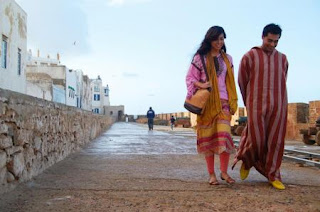 As it is, Emir treats all these, from the very real problems of these immigrant workers to the bigger picture of the country being taken hostage by employer nations, as popcorn entertainment, equivalent to a weekend noon-time variety show and nothing more. The fact that the government, in all its benevolent discretion, decided to go this way in its efforts to improve film production in the country, makes the pain—although forcibly disguised in fancy colors and upbeat tunes—even more resounding.
Cross-published on Twitch.
 Rather than wait until its 30th birthday, the San Francisco International Asian American Film Festival (SFIAAFF) has chosen 29 as the ripe age for a makeover. At a recent press conference announcing 2011's line-up, the fest introduced a new logo, website, tagline ("Stories to light") and most importantly, a new Festival and Exhibitions Director. Masashi Niwano, a 29-year-old Bay Area native, worked his way up the SFIAAFF ranks as volunteer, intern, theater operations manager and even filmmaker. He's come home after a four-year stint running the Austin Asian American Film Festival and now replaces esteemed Chi-hui Yang in helming the largest Asian fest in North America.
 SFIAAFF has also replaced its traditional magazine-format program guide with a classy, but somewhat unwieldy and eye-straining 6" x 9" catalog. Flipping through it at the press conference, I noticed an absence of recognizable international auteurs—indeed, only two of the roughly dozen films I'd hoped for were in the program. Among the M.I.A. are new works by Lee Chang-dong, Tsui Hark, Takashi Miike, Kôji Wakamatsu, Anh Hung Tran, Amir Muhammad, Kim Longinotto and most strangely, SFIAAFF habitué Hong Sang-soo, who released two new films last year. Of course, SFIAAF is more than just a greatest hits collection from the previous year's fest circuit. A closer examination would reveal many programs worthy of anticipation.
 My two wish-list fulfillments are Jia Zheng-ke's I Wish I Knew and Zeina Durra's The Imperialists Are Still Alive! Considered China's most important filmmaker by some, this new work from Jia (Still Life and last year's SFIAAFF entry, 24 City) is a portrait of Shanghai, shot by his extraordinary, longtime cinematographer Yu Likwai. Imperialists is director Durra's narrative feature debut and is set amongst NYC's post-9/11 "émigré intelligentsia." The main character is a bourgeois but politically provocative artist who falls for a Mexican PhD student on the same night she learns that a friend has possibly been abducted under the C.I.A.'s "extraordinary rendition" program. The part is played by one of my favorite French actresses, Élodie Bouchez (André Téchiné's Wild Reeds and Roman Coppola's CQ.) It remains to be seen how the film fits the context of an Asian American film festival, given that the director—as well as Bouchez's character—is of Bosnian-Jordanian-Palestinian descent. Also worth noting is that Imperialists was shot in 16mm and will be screened at the festival in that format. (Speaking of screening formats, you'll need to purchase the catalog to learn what's what—the free mini-guide and website make no mention of them).
 This year's SFIAAFF runs from March 10 to 20 and I've got a big, red circle drawn around Sunday, March 13. I plan on parking myself at the Castro Theater from noon till midnight that day for what promises to be one helluva quadruple-bill. The marathon kicks off with what was originally a distributor-imposed "surprise" screening. Said distributor has changed its mind, however, and now I'm free to tell you that the surprise is Lee Jeong-beom's violent revenge thriller The Man From Nowhere, one of South Korea's biggest 2010 box office hits. Actor Bin Won stars as a taciturn pawnshop owner who's forced to revive his skills as a former government assassin in order to rescue the daughter of his junkie upstairs neighbor from child organ harvesters. Whew! Reviews say the film's occasional hoary genre clichés are outweighed by kick-ass set pieces and a riveting performance by Won, in a role that's polar opposite to the developmentally disabled son he portrayed in Bong Joon-ho's Mother.
 The Castro mood shifts radically at 3:00 with Chito S. Roño's Emir, a campy, 22-song Filipino musical about an OFW (overseas Filipina worker) who becomes nanny to a young Middle Eastern prince. In his review for Variety, Jay Weissberg calls Emir "jaw-dropping in both good ways and bad," which is recommendation enough for me. The Castro's evening programming begins at 6:30 with SFIAAFF's 2011 Centerpiece Film, Le Thanh Son's Clash. This martial arts epic was last year's top box-office smash in Viet Nam and stars that country's very own "Brangelina," couple Johnny Tri Nguyen and Ngo Thanh Van. The trailer is a blast and friends who attended the press screening say it's sexy as all get out. Plus, Nguyen and Van are expected to appear live on-stage at the Castro. How do you top that? Perhaps with Raavanan, the latest spectacle from celebrated Indian director Mani Ratnam (Dil Se, A Peck on the Cheek), which screens at 9:30. This contempo retelling of a tale from the Ramayana stars mono-monikered hunk Vikram as a criminal who conducts a revenge kidnapping of a police chief's wife (Aishwarya Rai). By the way, all four films at SFIAAFF's day-at-the-Castro will be screened in 35mm.
 Each year the festival presents a "ripe for rediscovery" movie from Out of the Vaults—traditionally at the Castro Theater. Unfortunately, this year's selection unspools at Berkeley's Pacific Film Archive at the exact same time as the Castro's Centerpiece Film. I'm probably not the only person who's distressed over having to choose. This year's revival will be 1936's Charlie Chan at the Olympics, said to be "one of the best and most interesting of the 16 films in which Warner Oland played the title character." The event will include a conversation between Stephen Gong, executive director of the Center for Asian American Media (CAAM) and author Yunte Huang, who's just written the book, Charlie Chan: The Untold Story of the Honorable Detective and His Rendezvous with American History.
 Several of the films mentioned thus far hail from the festival's new Cinema Asia sidebar, which is basically their old International Showcase with some foreign documentaries mixed in. Of the 15 selections on offer, I'm especially looking forward to Dooman River, the latest narrative feature about North Koreans in China from director Zhang Lu. His masterful Grain in Ear and its follow-up, Desert Dream, were shown at the festival in 2006 and 2008 respectively. I've also read good things about Jeon Kyu-Hwan's Dance Town, which follows an exiled North Korean table tennis champ as she adapts to life in South Korea. Those who follow the Golden Horse Awards—arguably Asia's most prestigious film accolade—will have the opportunity to catch two big winners from last year. Chang Tso-Chi's When Love Comes won Best Feature Film, Audience Choice Award, Best Cinematography and Best Art Direction, while Chung Mong-Hong's The Fourth Portrait took home prizes for Best Director and Outstanding Taiwanese Film. SFIAAFF's Asian scope extends all the way to Iran, and I've heard nothing but raves for Homayoun Asadian's Gold and Copper from friends who've seen it at other festivals. Praised for how it "illuminates the pressures and pitfalls of traditional roles in Iranian society," the film tells the story of a young mullah-in-training who must assume household and parental duties when his breadwinner wife falls ill to multiple sclerosis. A few other Cinema Asia possibilities include Bi, Don't Be Afraid!, which was Viet Nam's Oscar® submission, and Passion, a documentary about the legacy of filmmaking in Mongolia.
 Eight documentary and eight narrative features will compete in this year's Competition Awards. I've never been clear about the criteria for these awards, but it seems that the filmmaker must be North America-based, while the subject matter or setting can be anywhere in the world. In addition to the previously mentioned The Imperialists are Still Alive!, I'm most looking forward to Eyad Zahra's The Taqwacores, based on the provocative 2003 novel about an imaginary Muslim-American punk scene. Two directors familiar to SFIAAFF audiences return with new projects in competition. From Ian Gamazon (Cavite) comes Living in Seduced Circumstances, a tale of vengeance and torture that "traverses an imaginary border toward the darkened realm of fairy tale." And director Stephane Gauger (Owl and the Sparrow) returns to the streets of Saigon for a look at underground Vietnamese hip-hop youth culture (Saigon Electric). The only narrative feature of significant LGBT interest in the festival is Hossein Keshavarz's Dog Sweat, a clandestinely filmed, multi-character weaving about young people in Iran that includes a gay couple facing the threat of an arranged marriage. Bertha Bay-sa Pan's romantic comedy Almost Perfect is notable for the appearance of Edison Chen—his first film, I believe, since 2008's XXX-photo scandal made him an industry pariah. Rounding out this year’s narrative competition are Jy-ah Min's M/F Remix, which "repurposes" Godard's Masculine/Feminine for a new generation, and Chuck Mitsui's One Kine Day, a skater dude's day-in-the-life saga that's steeped in Oahu working class youth culture.
 Shifting over to the Documentary Competition, I've got an eye on Lynn True and Nelson Walker's critically acclaimed Summer Pasture, a strictly observational doc about a married yak-herding couple being confronted with modernity. News junkies might remember a 2004 item about a Hmong immigrant who killed six white hunters in a Wisconsin forest. Mark Tang and Lu Lippold's Open Season investigates that tragic story. The resurging interest in the life and career of actress Anna May Wong gets furthered with Yunah Hong's Anna May Wong: In Her Own Words. The only LGBT doc in the festival, Kathy Huang's Tales of the Waria, looks into the world of four Indonesian transgenders. Other competition documentaries explore such topics as India's booming trade in "procreative tourism," i.e., Indian women being paid to act as birth surrogates for Western couples (Made in India), a traditional Hawaiian song competition for students (One Voice) and the deportation of U.S. Cambodian refugees with criminal records to a motherland they no longer know (Resident Aliens).
After Masashi Niwano was named Exec Director of the fest, one of his first missions was to curate a horror series for this year. The result is a fun-sounding trio of terror tales called "After Death: Horror Cinema from Southeast Asia." His picks include Thai blockbuster Nang Nak, which was first shown at the festival in 2000; Histeria, from Malaysian indie director James Lee (The Beautiful Washing Machine) which features that country's first on-screen lesbian kiss, and Affliction from the Philippines.
 What else? The SFIAAFF 2011 opening night film is Andy de Emmony's West is West, a sequel to the popular 1999 British comedy East is East. This new adventure follows the multi-ethnic Khan family from Manchester to rural Pakistan, with returning cast members Om Puri, Linda Bassett and Jimi Mistry. (The film was also the sold-out opening nighter at our recent Mostly British Film Festival). After the screening at the Castro, SFIAAFF opening night continues with a party at the SF Asian Art Museum. Closing night's feature is Surrogate Valentine by Dave Boyle (White on Rice), a rock-mockumentary starring local indie singer/songwriter Goh Nakamura. This year also shines a spotlight on director Gurinder Chadha, who will sort of be on hand to introduce her new macabre comedy It's a Wonderful Afterlife—via Skype. Chadha's spotlight also includes revival screenings of her 2002 mega-hit, Bend It Like Beckham. And finally, this year's festival delivers a whopping nine programs of shorts.
In his opening remarks at the press conference, CAAM's Stephen Gong declared 2011's SFIAAFF "the most ambitious festival in our 29-year history." Nowhere is that more evident than in the New Directions section, which includes seven panel discussions (Directions in Dialogue), a night of cutting edge contemporary music at the 111 Minna Street club (Directions in Sound) and the festival's largest event, the all day/all night Festival Forum on Saturday, March 12. This year's forum features live music, spoken word, dance troupes and a Bollywood Under the Stars outdoor screening. Also, as part of Directions in Digital Media, be sure to check out Pixels, Politics and Play, CAAM's first ever independent games exhibition which will happen March 11 to 13 at SUPERFROG Gallery (located in the New People building on Post Street). As someone who couldn't care less about electronic games, whether it's Grand Theft Auto or iPhone Scrabble, I look forward to playing The Cat and the Coup. In this game designed by Peter Brinson and Kurosh ValaNejad, the player becomes the cat of Dr. Mohammed Mossadegh, Iran's first democratically elected Prime Minister who was deposed in a C.I.A.-engineered 1953 coup.
Cross-published on film-415 and Twitch.
 Over the course of attending press screenings and viewing over a dozen screener DVDs, I kept changing my mind about the overall quality of the offerings in the San Francisco International Asian American Film Festival (SFIAAFF), beginning its 30th year of existence this Thursday, March 10. Maybe it's because last year's event was particularly outstanding, at least in the category of documentaries. Or maybe it's my anxiety over regime change after Chi-hui Yang's assured stewardship of more than a decade. At any rate, I'm happy to report that there's plenty to like about this year's bounty, and depending on your choices you will have the film festival experience you hoped for.
 First of all, I want to wish a hearty "Welcome home!" to new Festival and Exhibitions Director Masashi Niwano. It's reassuring to know that, despite his youthful looks (he's 29 like the festival), Masashi actually spent years toiling in different departments of this festival before submitting his own film for screening (Falling Stars, 2006), then moving on to preside over the Austin Asian American Film Festival. He's now returned to the Bay Area where he was born (Campbell) and matriculated (SF State).
 Surrogate Valentine—A listless comedy about a semi-successful musician (played by local artist Goh Nakamura) who reluctantly takes on the job of teaching a narcissistic TV star how to play guitar in one week. I kept getting reminded of Steven Okazaki's 1987 Living on Tokyo Time, with its introverted Japanese-American guitarist's pathetic attempts at communication and Bay Area locations. Being a big fan of Dave Boyle's more obviously comic stories of outsize eccentric personalities, Big Dreams Little Tokyo and White on Rice, I was disappointed by this more reserved comedy. (Press Screening)
 Raavanan—Veteran director Mani Ratman's Tamil version of his modern retelling of the Hindu epic the Ramayana is a study in extremes, set in breathtaking natural locations yet heavily daubed with CGI and wire work. Vikram plays a vicious, possibly mentally disturbed, bandit leader who avenges his sister's death by kidnapping the wife (Aishwarya Rai Bachchan) of a police inspector (Prithviraj). As the modern equivalent of the Demon King Ravana, with the demons mostly in his own head, he holds her hostage waiting for virtuous King Rama to come rescue his chaste Queen Sita. While in captivity, she comes to know her captor better and reluctantly falls in love with him. There are a few interesting references to the disenfranchisement of darker-skinned peoples at the hands of the lighter-skinned security forces, but clearly the pleasure lies in watching Aishwarya Rai tied up soaking wet as Vikram flexes his tattooed muscles and makes threatening animal noises while Prithviraj's forces approach his bandit camp for the showdown. (Press Screening)
 Histeria—This Malaysian thriller about a group of schoolgirls punished by being locked into a school building over the weekend, inadvertently conjuring a spirit they had only been joking about, is an uninspired rehash of countless teen slasher films both Asian and American. (Screener) For a more satisfying horror experience, see the 1999 Thai Nang Nak, based on a traditional ghost story about a pregnant wife who insists on coming back from the dead. I remember seeing it on its initial release and being astonished, and creeped out, at how different Thai ghosts are from other Asian ghosts.
 Bi, Don't Be Afraid!—An impressionistic Vietnamese film about an inquisitive and footloose little boy coming upon the secrets of his elders. I don't want to say too much about this film since I wrote the catalogue note. But if you've ever spent time in Hanoi and sat in front of a fan feeling the sweat flying from your brow, it will all come back to you watching this. (Screener)
 Anna May Wong: In Her Own Words is valuable for using the legendary actress's own letters and articles as its narration for a much-needed career overview. But the use of re-enactment for such a visually spectacular subject, whose film clips we also get to see, is just a bother. (Screener)
 Two of the more sensational documentaries try to understand the motivations behind unspeakable crimes. Open Season explores the 2004 mass murder by a Hmong-American man of six white hunters in Wisconsin, asking if shooter Chai Vang's rampage was an act of self-defense (as he claimed) or of rage against anti-Hmong sentiment, especially in the deer-hunting community. The House of Suh, another film investigating the shooting death of a white man at the hands of an Asian-American man in the Midwest, tries to pry open the deeply locked secrets of a Korean-American immigrant family. The revelations grow more horrifying as the film uncovers the passionate ambitions of parents and children who feel cheated out of their portion of the American dream. (Screener)


