As early as July 2009, Twitch teammate Todd Brown was already anticipating the release of Bay Rong (Clash, 2009), the follow-up to the popular Vietnamese martial arts film The Rebel (2007), produced and written by its male lead Johnny Tri Nguyen, with Thanh Van "Veronica" Ngo as his love interest. As Todd cited, the news that Nguyen and Ngo had become a couple after playing romantic leads in The Rebel probably helped the film's exposure, and it went on to become one of the biggest hits in Vietnamese cinema history.
 Nguyen had already gained notoriety as one of only two men in the world who could claim to have fought both Jet Li and Tony Jaa, plus he was the primary stunt man for the first two Spider-Man films, but his departure from the U.S. to Vietnam to make The Rebel (and its follow-up Clash) exemplifies a new model of American-Vietnamese co-productions (along with Stephane Gauger's Saigon Electric). Reuniting with The Rebel's assistant director Le Thanh Son—Clash marks Son's directorial debut—Nguyen and Ngo play a mystery man who helps a hit woman finish her last job, one ass-kicking at a time. Released in Vietnam around Christmas, Clash was kicking some serious box office butt by January 2010 when Todd posted the trailer.
 Clash then had its U.S. premiere at the Tribeca Film Festival where Jason Bailey at Fourth Row Center described it as "a clever mash-up of John Woo-style gunplay and whiz-bang martial arts, whipped up at top speed with the help of rapid-fire editing and a pounding, pseudo-techno soundtrack." Bailey further described the gunfights as having "a kinetic intensity, while the martial arts scenes that they bleed into, supplemented with knives and swords, are acrobatic and full of scrappy tension." Also at Tribeca, Cinematical's Scott Weinberg praised that Clash treats its audience "to (at least) a half-dozen hyper-kinetic action scenes that—get this—lack CGI, wire-work, or fancy FX of any kind. Better yet, the director actually takes the effort to frame and time some of the more elaborate ass-kicking combos, and the result is some old-school smack-down martial arts lunacy that's quite simply a whole lot of broad, basic fun."
 Josh Hurtado continued the coverage at Twitch when Clash was programmed in the Asian Film Festival of Dallas (AFFD) in late July 2010. His review objected to the obvious references to Reservoir Dogs and how the film's melodramatic elements weakened the action, but he concluded that "overall, Clash is a great time." Clash was then picked up for DVD distribution by Indomina.
Situated as the Centerpiece film at the upcoming 29th edition of the San Francisco International Asian American Film Festival (SFIAAFF), Clash co-stars Nguyen and Ngo will be in attendance and—along with Stephane Gauger (Saigon Electric, 2010)—will participate in a panel discussion "The New Matrix: Casting the Entertainment Mold of the Future." I'm looking forward to seeing Clash's attractive duo in the flesh. Along with its throwback to chopsocky aesthetics, I found Clash irresistibly sexy. Nguyen is a lean machine and Ngo is an angry beauty and when they tango, whoooo-boy! Likewise, when they square off against their French adversaries (who are taken by surprise in their skivvies), I thought for sure the film was going to burn up on the spot.
 Cross-published on Twitch.
 Marilyn Ferdinand (Ferdy on Films) and Farran Smith Nehme (The Self-Styled Siren) are at it again with their second annual film preservation blogathon, drumming up funds this year to benefit San Francisco's Film Noir Foundation (FNF) and Paramount Pictures's restoration of Cy Endfield's The Sound of Fury (aka Try and Get Me, 1950). Donations can be forwarded here. Due to a calendar conflict, this was the first year in many that I was not able to attend FNF's annual Noir City Film Festival; but, in years past I've been so enamored with the festival that I've created an index for my coverage over the years. That's the first item I offer to the For the Love of Film (Noir) Blogathon.
Next, I revisit Eddie Muller's on-stage interview with Argentine curators Paula Félix-Didier and Fernando Martín Peña, responsible for the restored version of Metropolis (1927) that had its North American premiere at last year's first-ever TCM Classic Film Festival in Hollywood and then its Bay Area premiere at last July's San Francisco Silent Film Festival.
* * *
 Eddie Muller is the consummate showman. Aware that his San Francisco Silent Film Festival (SFSFF) audience was restlessly grumbling because Metropolis (1927) was 40 minutes late getting started, he quipped, "When you've waited 83 years, what's another 40 minutes?"
"I don't need to tell you," Muller continued, "but what you are going to see tonight is almost unquestionably the most imaginative, innovative and ambitious silent film ever made and—at the time—the most ambitious, innovative, imaginative movie period that had been made up to that time."
Muller recalled that when he was a callow 15-year-old, he saw Metropolis for the very first time in a high school film literacy course. It was the film that opened his cinematic horizons and helped him appreciate silent film and film history; an experience he's confident he shares with a great many people because of the myth, the legend and the greatness of Metropolis. Admittedly, however, upon his first viewing of the film—despite being blown away by its visual spectacle—he didn't fully comprehend it, which he attributed to his callow youth without fully realizing that it wasn't just him. There were incomprehensible attributes to the film: characters appeared and disappeared without narrative reason, for example. It was only later on with subsequent viewings and study that he learned the reasons why. Metropolis was a film that had been severely edited after its initial release in 1927 and this long saga has been detailed in his essay for the SFSFF program (as well as in Bret Wood's TCM essay).
 Fritz Lang was hurt by this experience and frequently said he never wanted to watch Metropolis again; but, over the years, as every new version of the film appeared—and there have been a few within Muller's lifetime—they were touted as being the most complete version that would ever be seen. Every time he heard these boasts, Muller countered, it had the opposite effect than hoped. It made him feel that the original version of Metropolis—like von Stroheim's Greed—would never actually be found. "Folks," Muller grinned, "we found it!"
Muller then invited to the Castro stage the two individuals responsible for finding the complete Metropolis in a modest film vault in Buenos Aires: Argentine archivists Paula Félix-Didier and Fernando Martín Peña.
First off, Muller wanted to clarify that—when this happened in 2008 and it was reported in the international media—the way it was reported was that the discovery was pretty much "a delightful accident, a fantastic fluke, a feel-good story for the global media." But, apparently, those reports in the media weren't entirely true. "The actual story is something very different, right?" he posed to Peña.
 Yes, Peña confirmed, the discovery was no accident. He had been aware of the existence of the film for some time and had first been denied access to the print 20 years ago. In 1988, Peña was the teenage protégé of Argentine film critic Salvador Sammaritano who founded Argentina's most influential film society. Sammaritano had hired Peña to help him catalog the film collection of the late Manuel Peña-Rodriguez who, in turn, had been Sammaritano's mentor. On that list was Peña-Rodriguez's personal print of Metropolis, which recalled Sammaritano to a screening held in 1959 for a few members of his film society. Sammaritano told Peña that—at that screening—the shrinkage of the original nitrate print caused a gap between the film and the gate, leaving the image to flicker slightly out of focus. To fix the problem, Sammaritano went up to the projection booth and added pressure to the gate with his finger to steady the picture. Sammaritano told Peña that he held his finger in position for two hours and a half. Peña, of course, had studied film and seen the modern version of Metropolis, which didn't last nearly one hour and a half, so he doubted Sammaritano, "Are you sure? Two hours and a half?" Sammaritano responded that he would never forget those two hours and half; his finger was so numb.
 Peña began studying the story of the film in Argentina [read his fascinating Undercurrent account here] and discovered that the version of Metropolis that played in Buenos Aires came directly from Ufa, not Paramount, and that it was bought by an independent Argentine distributor Alolfo Z. Wilson in February 1927—six months before the recut American version replaced all international prints. Peña-Rodriguez—who had begun collecting film in the '30s—bought Wilson's distributor print. When he eventually sold his films to the Argentinean state, they destroyed the dangerous nitrate original and made the 16mm copy. Confirming this research against the 16mm print in the archives was hindered, however, by bureaucratic indifference. When the Peña-Rodriguez print was donated and transferred to the Fondo Nacional de las Artes in 1971, Peña petitioned for access to the print but Sammaritano's anecdote was reduced to interesting hearsay and his request was denied. Peña's repeated requests were denied for the next 20 years as he kept track of the film's transfer among national, state and municipal agencies.
 In April 2008, Peña's ex-wife Paula Félix-Didier was hired as the director of the Museo del Cine in Buenos Aires, the current home of the Peña-Rodriguez collection. Félix-Didier was fully aware of Peña's ongoing struggle to achieve access to the film and so—when they sat down to share a cup of coffee at a Buenos Aires film festival shortly after her appointment—she suggested they work together. Naturally, high on Peña's list was the long-awaited opportunity to go into the vaults to check on the Metropolis print. ("Funny how it works out," Muller quipped.) In May 2008 Peña and Félix-Didier located the print—it took all of 10 minutes; the can was clearly labeled—so the media reports that this was an "accidental" find were totally misleading. The truth was that no one in power had cared enough to confirm the facts. As Félix-Didier relayed to Muller in an earlier interview for the Noir City Sentinel, "Those 10 minutes were the culmination of a whole lifetime spent studying film history." The 16mm print, which had been struck from the 35mm print, was in poor condition and it was difficult for them to determine much holding the film up to the light; but, it didn't take long to confirm that they had indeed found the complete film.
 Muller asked how long it took after they had confirmed their discovery before the international film community believed that they had indeed discovered a full-length print of Metropolis? Peña said it took three to four months. Muller asked them to detail the process.
Félix-Didier explained that she contacted the copyright holders for Metropolis in Germany; Peña contacted Martin Koerber at the Murnau Foundation, who had administered the 2001 restoration. They received no response. They began to realize that, undoubtedly, these agencies had fielded numerous claims of discovered Metropolis footage, and receiving one more email from unknown archivists in Argentina didn't warrant immediate attention. "There's something about Germans and Argentina...." Muller offered by way of explanation.
Peña said it took Europeans to convince the other Europeans. It wasn't well understood that in the '30s and '40s Argentina was one of the first places to screen films from all over the world. They had many foreign expatriates who were collecting films from their home countries. This was somehow hard for Europeans to believe and they took an exclusive Eurocentric view that Argentines weren't aware of the many versions of Metropolis that existed. Peña was swift to assert that he was well aware of the many existing versions of Metropolis but that he was equally confident that he had located an original print.
 Muller asked the on-stage duo to explain some of the economic, political, and ethical issues involved in making such a monumental discovery, especially as the print was located during their employment with a public archive. Félix-Didier admitted that negotiating with the Murnau Foundation was difficult on both sides. She didn't want their discovery to become a repatriation issue—as was recently done with American films in the New Zealand archives—primarily because what Peña uncovered in the vault is a uniquely Argentinean version of Metropolis. Not only did it have Spanish subtitles and intertitles, but those titles had been translated by Leopoldo Torres Ríos who went on to become a well-known filmmaker. He took liberties with his translations and created a free-version "tango" unique to Argentine culture. He also made minor changes to the film. Though these designs might not hold much interest to international scholars of the film with regard to the authenticity of the film, they hold specific interest to Argentine scholars. This remains the version of Metropolis that Argentine audiences watched in 1928 and Félix-Didier wanted to keep that cultural product intact.
She sent the 16mm print to the Murnau Foundation in Germany. They scanned it, made a new print, and a DVD. The Germans only believed her when she physically went to Berlin to the Deutsche Kinemathek and showed them the DVD. Though this was all difficult to achieve, the upside is that the Germans are now helping her preserve a lot of the nitrate films in the Museo del Cine's vaults, currently in progress.
 There were other complications. Félix-Didier received several phone calls from collectors interested in buying their print. The importance of having such a film stored in a public archive is that Félix-Didier hardly needed to waste her breath in reminding interested collectors that the print was not hers to sell. Notwithstanding, one French "pirate" who owned a DVD distribution company, persisted in trying to secure same. At first he didn't even bother to contact her by phone, he sent an email without addressing her by name, and stated he was prepared to offer her a quarter of a million Euros to buy the print. He pleaded with her "not to give the film back to the Nazis"—("So much for forgive and forget," Muller joked)—and argued that he was aware that the Museo del Cine was poor and could use a quarter of a million Euros. Félix-Didier couldn't deny that—she could do a lot of things with so much money—but the point remained that the print was the property of a public archive and not hers to sell. Notwithstanding, he persisted and phoned her every day for two months and a half. Every day she refused his offer. He even phoned her 10 minutes before the premiere at the Berlinale, saying, "I know you are here. I am here too. Let's get together and have a cup of coffee. I want to talk to you because I know that the Murnau Foundation doesn't have the rights to Japan, China and India..." She hung up on him.
 As amazing an experience as this has assuredly been for both of them—particularly for Peña after trying to secure access to the print for 20 years—Muller wanted to know what they were taking away from the experience, what the experience has meant for them, and what this discovery has meant to Argentina? Peña wasn't sure if he could speak for Argentina; but, he hoped that the people in power in government would understand the importance of film preservation and provide funding so that archivists and preservationists can do their necessary work. Since there is no national cinematheque in Argentina, these public archives are dependent upon outside financial assistance and it would be great if some of that came from the government. As for himself, Peña joked: "I know it's going to be all downhill from now on."
Félix-Didier added that they were lucky to have found a complete print of a film that is so well-known because it has drawn a lot of attention—not only to the Museo del Cine, who really needs the attention—but also to film preservation in general everywhere. There's no denying that's a good thing. "I always say that this is our job," Félix-Didier concluded, "This is what we do. We take care of films. We take care of all kinds of films. Sometimes they are famous films and sometimes they are films that are not so famous but equally important."
Peña appended that when a person in a country like Argentina decides to dedicate themselves to film history, they need generosity and encouragement. In his case, he found generosity and encouragement in one man, whose work he has seen and read "since I could read and see." Those grateful for the Buenos Aires "find" of the complete print of Metropolis owe it, Peña suggested, to the work of Kevin Brownlow.
 Muller wrapped up by admitting that—though he knew the SFSFF screening of Metropolis was going to be a special event—he didn't know how special it was going to be until he learned that Fernando Peña had not yet seen the restored print and that he would be seeing it for the first time with the SFSFF audience. Muller was being modest. I feel it important to point out that Fernando Peña's opportunity to finally see the restored version of the film he has championed his entire adult life is directly attributable to Eddie Muller and the Film Noir Foundation, who paid for his airfare to attend SFSFF. Most festivals can only afford to fly one person in for such an event and Paula Félix-Didier, as the director of the Museo del Cine, is the obvious choice; but, realizing that Fernando Peña and his cinephilic passion was being swept aside in the rush of events, Muller wanted to fully credit him for his remarkable achievement. Kudos, Eddie!
07/26/10 UPDATE: At Parallax View, Sean Axmaker has compiled a useful aggregate of all coverage of the Metropolis restoration to date, including his conversation with Fernando Peña at SFSFF regarding the digital projection. As Carl Martin indicated earlier on his Film on Film Foundation blog, though a 35mm print of this recent restoration exists and was shown at the Hong Kong Film Archive in April, 2010, the digital print is seemingly screening everywhere else. Sean asked Peña how his experience of the SFSFF screening matched up to his hopes and expectations. "His response surprised me," Sean reported, "though it shouldn't have: he was disappointed that it was shown in projected digital edition, which he said flattens the image. Personally, I've always disliked the cold, harsh light of digital projection of black and white films, so unnatural compared to the warm light of film projection bulbs (or even better, the burn of old-fashioned carbon arcs, all but gone from projection houses). But Fernando brought another, even more distinctive difference to my attention when he reminded me that the screen image created by light passing through film gives you distinctive texture from light and shadow and gradations between them. It creates sense of space on the screen that video projection of black and white film does not and that texture was missing from the SFSFF screening."
Cross-published on Twitch.
 Bay Area cinephiles have learned to speak up about their love for silent cinema. Not only did MovieMaker magazine recently include the San Francisco Silent Film Festival (SFSFF) as one of the 20 "coolest" film festivals of 2010—and not only did San Franciscans just experience Chaplin's comic antics, Marcel L'Herbier's L'Argent (1928) and King Vidor's La Boheme (1926) at SFSFF's Winter Event—but now the Berkeley Art Museum and Pacific Film Archive (BAM/PFA) proudly partner with UC Berkeley's Department of Film and Media to host an international conference on silent cinema, Cinema Across Media: The 1920s, to be held from February 24 to 26.
As indicated at the BAM/PFA website: "At its core, the conference will examine cinema's institutional consolidation in the twenties, when practitioners were enlisted from many other fields such as architecture, design, painting, music, and vaudeville, resulting in a transformation of established media. Avant-garde cinemas borrowed extensively from a variety of artistic practices, while the 'cinematic' became the new standard for other Modernist aesthetics and popular culture. PFA welcomes film scholars Anne Nesbet, Gertrud Koch, and Paolo Cherchi Usai as well as the talented Judith Rosenberg on piano for these special presentations of films from the height of the silent era."
 The full two-and-a-half-day schedule can be found at the conference's official website, which notes: "Today's multimedia environment brings cinema of the 1920s into new focus as the site of rich intermedial traffic, especially if the term 'media' encompasses not only recording technologies and mass media, such as photography, phonography, radio, and illustrated press, but also the physical materials used for aesthetic expression, such as paint, print, plaster, stone, voice, and bodies.
"Cinema Across Media: The 1920s is a two-and-a-half-day conference that will include five plenary speeches, two plenary roundtables, eight concurrent panels, and a weeklong series of silent film screenings with live musical accompaniment at the Pacific Film Archive. The purpose of the conference is to gather scholars, archivists, and students from a variety of fields in order to assess international cinema from the 1920s as a dynamic center for adjacent media practices. The conference will feature an international group of scholars from a variety of disciplines, including music, architecture, literature, art history, theater, dance, and performance studies, as well as film archivists, curators, and researchers from archives, museums, and institutes worldwide."
 I'm particularly excited to hear Thomas Elsaesser's closing speech on "Cinema Across Media: Expanding the Avant-Garde beyond the Political Divide" and the ensuing plenary roundtable where Elsaesser will be joined by Tom Gunning, Gertrud Koch, Paolo Cherchi Usai, and Anthony Vidler. I'm also looking forward to presentations by Luciana Corrêa de Araújo on movie prologues in Rio de Janeiro (1926-27); Laura Isabel Serna on ethnography, costumbrismo, and Mexican feature film production; and David Wood on performance in 1920s Mexican cinema.
With the exception of film screenings, which are subject to PFA's regular admission rates, all conference events (plenary speeches, roundtables, and panels) are free and open to the public. However, advance registration for the conference is strongly recommended.
Cross-published on Twitch.
Matías Bize's La vida de los Peces (The Life of Fish, 2010) boasted its U.S. premiere at the 2011 Palm Springs International Film Festival (PSIFF). Programmed in the Awards Buzz sidebar as Chile's official submission to the Academy Awards®, the film didn't make the Oscar® shortlist but it did go on to win Best Latin American Feature at the 2011 Goya Awards.
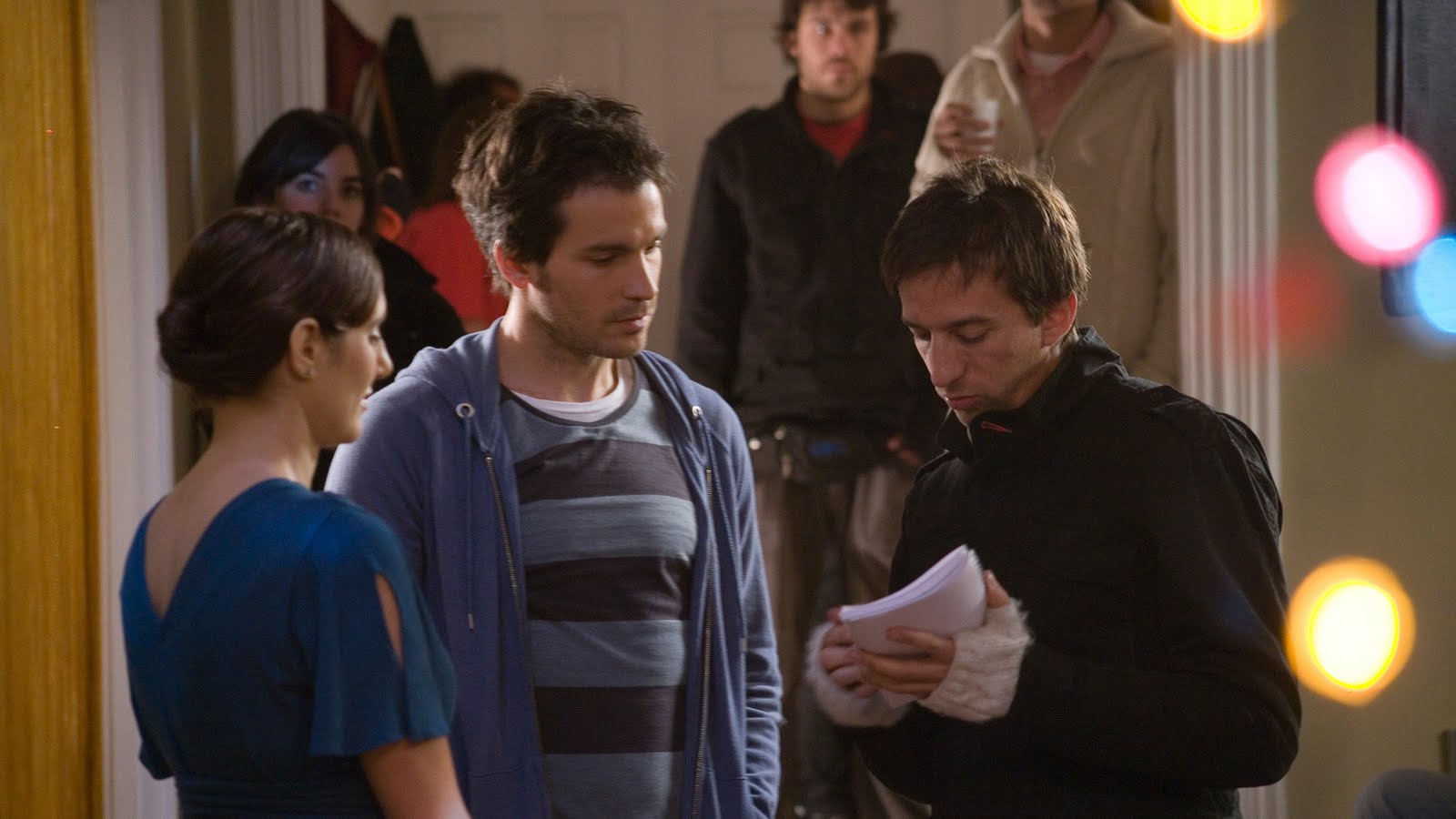
The plot revolves around 33-year-old Andrés (Santiago Cabrera) who has been living for 10 years in Berlin, working as a travel writer. When he returns to his native Chile on holiday, at a friend's birthday party he rediscovers the world he left behind, including his old love, Beatriz (Blanca Lewin). Bize explains: "My idea was to tell the story as simply as possible and follow Andrés through his process. I wanted to tell the story in an emotional way, using the camera to penetrate deeply into the characters. The dialogue is very important in this film, but in some cases, what is not said—the silences and looks—are even more important." Taking that cue, PSIFF synopsized: "It is not what the characters say so much as what they don't say. Their smallest gestures speak volumes. Their collective pain is never fully articulated but is all-pervasive. The weight of missed opportunities leaps off the screen making you question your own."
 At Variety, Boyd von Hoeij appears to have the best handle on why Bize's latest effort is his most accessible. Though he's quick to characterize The Life Of Fish as a "slow-burning yakfest", he nonetheless finds it "loquacious and ultimately poignant" and discerns that it represents "an impressive leap forward" for Bize whose "by now familiar Linklater-esque approach finally feels like a solid fit for the material, with both the mise-en-scène and the screenplay ... less claustrophobic and inward-looking than usual. ...Real-time pacing is thankfully accomplished through artfully edited sequences rather than endlessly long takes, and the naturally acted dialogue is what will keep auds hooked." He concludes, "The strong suit of Fish is that it focuses not on possible things in the future or concrete ones in the past, but the nebulous notion of what might have been."
My thanks to Adrián Solar and Matías Bize for honoring my request for an interview at PSIFF. [This conversation is not for the spoiler-wary!!]
* * *
 Michael Guillén: Matías, congratulations on such a lovely film. I've seen your previous feature En La Cama (In Bed, 2005) and am pleased that La Vida de Los Peces (The Life of Fish, 2010) exhibits your considerable growth as a filmmaker. What's interesting in both films is your fascination with creating the cinematic illusion of real time. Why is that? Where does that fascination come from?
Matías Bize: Because for me that is the most important part of the story. In this case, the story is about what happens to Andrés and Beatriz when they meet each other again. Not only what happens when Andrés reconnects with his old life, but particularly what happens when he reconnects with Beatriz. In that respect, the use of "real time" gets rid of all that is extraneous to the story and concentrates on what is most important. I could have started the story by showing Andrés and his life in Berlin, then his subsequent return to Chile, but that would have added a half an hour or so to the beginning of the film. La Vida de Los Peces cuts all that out and starts when Andrés is getting ready to leave the party. Normally, a film would start with him arriving at the party but mine starts with his saying, "I'm going." The same thing happens in En La Cama. I was interested in what happened between the two characters once they were within the motel room, not with how they got to the motel room, or why they decided to have sex.
 Guillén: I felt you achieved the illusion of real time more effectively in La Vida de Los Peces than En La Cama, primarily through skillful editing. En La Cama seemed to rely more on longer takes to replicate the passage of real time, whereas Peces insinuates the passage of real time through an assemblage of shorter takes.
Bize: Yes, we worked with two cameras and shot a lot of different takes and points of view for each scene. Then we edited a lot. I wanted to be focused on his experience. You notice that we shot a lot of close-ups of his face? As you suggest, the movie was built in the editing room. Of course there was the script and the shooting; but, the editing was very important. We spent every day for six months editing the film trying to capture a sense of the real. I wanted the audience to feel like they were at the party, that it would be a normal experience for them to be at the party, but in another way we told the story poetically, especially towards the end with the use of slow motion and music. So we were trying to do these two things at once: be real and be poetic.
Guillén: Speak to me about the metaphor within the film's title.
Bize: First, the metaphor is spatial. Because the party happens in a close space, it's similar to an aquarium. Watching what happens at this party is like watching fish in an aquarium. Second, I think the title is beautiful. La Vida de los Peces is more poetic than The Party. In fact, the Chilean distributor wanted to change the name because they thought La Vida de Los Peces was too long. They wanted to call it The Party. I protested, "No. Please. I like the title."
 Guillén: The sequence shot through the aquarium with the fish swimming in the foreground is beautiful. In that final sequence when Beatriz agrees to go with Andrés and they begin to leave the party together, they move very much like fish. Was that intentional on your part?
Bize: Yes. Like a school of fish following a current.
Guillén: I understand that you meant the party to be the world in microcosm, but what interested me most about the party was how quiet it was, and how—in your focus on intimate moments—the house seemed at times almost empty except for these two characters. That intriguing choice was then offset by scenes where you'd go into a room with a lot of people and hear music and conversation and laughter.
 Bize: It's true that within the movie you don't hear the music that is at the party. For example, there's the one scene where Andrés walks through the middle of the party and there are a lot of people dancing, but you don't hear the music they are dancing to; you hear the music he is hearing in his head. The party is necessary for the story but it's not the most important part of the story. The party is always a little out of focus as a backdrop behind them.
Guillén: So is it more appropriate to say that the "real time" you're striving for in your films is intimate time, psychological time?
Bize: Yes.
 Guillén: You're trying to conflate real time with psychological time?
Bize: Yes. I'm interested in moments in a life. What happens when two people fall in love in one night, as in En La Cama? What happens when two people have a second opportunity to fall in love, as in this film? This second opportunity is what is most important, most real, to La Vida de Los Peces and my task is to remove all the elements that are not at the specific center of the story.
Guillén: Speaking of the music he hears in his head, your score for the film is evocative. Can you speak about your score?
Bize: It was written by my half-brother Diego Fontecilla. He's worked on the music for all of my movies. He also acted in La Vida de Los Peces as Jorge, the brother of Andrés's dead friend Francisco. We work well together because he knows me so well and knows my taste in music and—in developing the score—we can just talk about emotions. I don't tell him how to do the music, what instruments to use, anything like that, we just talk about emotions. In fact we developed the music and the script at the same time. It helps during the shooting to already have some of the music for the film. Sometimes I don't even say anything to the actors, I just put on the music so they can feel the emotion in the scene.
Guillén: Is the soundtrack available?
Bize: Yes, it's available at the film's website. You can buy it there and download.
 Guillén: This has been a great year for me in terms of Chilean cinema. I've had the opportunity to speak to two of Chile's master filmmakers—Miguel Littin and Patricio Guzmán—and now I'm here speaking with you, one of Chile's youngest filmmakers, acknowledged as its most promising. How does that feel for you to be considered in that way? Is it a burden or a boon? Does it excite you or intimidate you?
Bize: In a way it helps me a lot—at film festivals, in the release of my movie outside my country—but, I'm not interested in being hyped as the new Chilean guy, no. I really like the stories that I tell in my movies and I feel like a student, I feel like I'm always learning a lot with every movie that I make. Just as you mentioned at the beginning of this conversation that you see growth in my work from En La Cama to Vida de Los Peces, I feel the same. I want to continue making movies, continue growing, and it's essential for me to feel that the story is close to me. My movies have to be very personal movies. It can be difficult at first when you make a movie and it gets accepted into a festival and then as a director you start to think, "What kind of movie do I have to make to get into this festival again? To get into Cannes?" For me, it's become different. I have to make the movie I want to make and—if I get an award or something—that's great; but, I remain the first audience. I'm the one who has to love the movie first. I feel good because I do love my movies.
 Guillén: As a filmmaker who admittedly makes personal movies, is there still a national signature to your films? Do your films represent Chile? Does the fact that you were chosen as Chile's official submission to the Foreign Language category of the Academy Awards® indicate there is something specifically Chilean about your personal sensibility? In other words, does your desire to create personal movies inflect a national mood?
Bize: That's a difficult question to answer because in a way my movies don't talk about Chile, especially in the way that most people think about Chile and its political realities. I talk about stories that could happen anywhere. Second opportunities at love happen all over the world. But, in another way, it is a Chilean movie in very specific ways. For example, En La Cama is set in a room that could be in any country—they even made a remake of it in another country—but a Bolivian filmmaker who saw En La Cama told me that it was the story of Chile. He said that through the relationship of the two main characters the audience could feel the sense of political compromise that characterizes the history of Chile. I think it's great that he saw that in the movie but—if I had tried to make the history of Chile set in one bed—it would have been a horrible movie. If I choose to have one point of view in my movie, for sure it could be similar to some point of view in some part of the country; but, it's not my intention to do that. In La Vida de Los Peces, I'm not trying to show Chile to the world but in the end it could happen. So, again, along with it being absolutely important for the story in my film to be personal, it also has to be universal. I've traveled a lot with Peces to many film festivals in different countries speaking different languages and many people have come up to me from the audience to say, "This was my story. This happened to me." For me, that's wonderful.
Guillén: The moment in Peces that I considered—perhaps not a Chilean moment—but possibly a Latino moment was when Andrés was talking to the elderly woman in the kitchen. She recalled serving him cereal with condensed milk, which reminded me of my own childhood. I'm not sure if it's a Latino thing to serve cereal with condensed milk, but it certainly felt like it during that scene.
 I was amused by how long it took Andrés to leave that party. He keeps saying he's going to leave, but then he doesn't leave. I'm aware that the ritual of good-byes is important to you. Can you speak to why?
Bize: Yeah. Two things: first, prolonged good-byes are common among Chileans. You're at a party and you say, "Okay, I'm leaving" and two hours later you're still leaving but always staying. But, second, a good-bye is important because it's the moment when you have the last word and you never know if you will see the person you are leaving again.
 For my story it's important that he be saying good-bye throughout the movie. In a way it shows Andrés as a tourist in his own country. He's Chilean but he lives outside of Chile, and—though he's with his familiar friends—he still feels like a tourist.
Guillén: You've stated this film is somewhat autobiographical. Are you 33, like the character of Andrés?
Bize: No, I'm 31.
Guillén: Are you starting to experience doubts about the decisions you've made in your life? Of the roads you haven't chosen?
Bize: Yes! The film is definitely autobiographical in that sense. I'm always thinking about what could have happened. I end a relationship and I think, "Oh, but she could be the girl of my life. What if we meet 10 years later?" So yes, that's what I've been thinking about. At first I thought I was representing my generation, but now I think that even someone at the age of 15 could relate to this story. Because if you've had even one relationship, and it ends, you think about what could have been. It's important for me that people can identify with that.
Guillén: I've long said that regrets are illuminations come too late and there's a sense of that in your film.
 Bize: Great! When a couple splits up, I don't know why but usually it's the woman who feels the loss while men usually need some time to realize what they have lost. People react differently to loss.
Guillén: Along with your maturation as a filmmaker, Blanca Lewin's performance in La Vida de Los Peces is one of her finest. You've worked with her two or three times now. Why do you like working repeatedly with her?
 Bize: When I have a new project I usually say, "Okay, I'll think about another actress"; but, in the end, I come back to Blanca because she's great to work with. I wrote the script for this movie with her in mind. She's a very hard worker. I'm a very hard worker too so I feel comfortable with her. She loves to rehearse and I usually rehearse a lot. In the beginning we read the script together and then we talk a lot about it. Then we rehearse and I film the rehearsals with a handheld. We talk some more. I usually don't want actors to think too much about their performance because then they become mechanical; but, I want them to have the experience of the scene during rehearsal. When we shoot, we film multiple takes. I usually do very long takes until the actors feel comfortable, which is when they start to work well with each other. It's important for me that my lead actors are friends.
That last scene of the movie, just before Santiago walks out the door, we did 59 takes. Santiago was incredible in each and every one of those 59 takes. He just kept getting better. I think we used the 35th take.
Guillén: Speaking of Santiago, the actors in your movies are uniformly sexy. The women are beautiful and the men are handsome. Is it important for you to cast physically attractive actors to express your intimate stories?
 Bize: For En La Cama it was important because of the physical attraction between the two main characters. For Vida de Los Peces, it wasn't my idea to have a beautiful actor in the lead role, but Santiago is beautiful. I didn't cast the role based on physical type, no. It's important, for sure, because the two main characters in Peces also feel a physical attraction; but, in this movie, they have already been a couple so their attraction to each other is not necessarily a sexual attraction; it's a much more complicated attraction.
What was important was that I needed a good actor for the character. It's a difficult role because the character is in every scene and the movie rests on his shoulders. I had seen Santiago's most recent work in Stephen Soderbergh's Che. He's Chilean but lives in L.A. In fact, he's similar to the character of Andrés because he has lived out of Chile for 10 years.
Guillén: Can we speak about the film's ending? Why Beatriz changed her mind minutes after she had agreed to leave with Andrés?
 Bize: At the moment when they say, "This could be...." it's a moment of feeling, of impulse, it's not intellectual. But as she's intercepted on her way to the door by a friend showing her a photo, the intellect enters back into the picture. They had let themselves go with the moment. They believed their reunion was possible. But that momentum was broken when they tried to leave the party. They also had to confront the social reality of their decision. All their friends were there.
Guillén: What's coming up for you? Are you working on a new movie? Or focusing on seeing this one out into the world?
Bize: I'm trying to be with this movie. I started traveling with it in Venice and have been to a lot of festivals. Right now it's important for me to be with the movie at festivals. I don't have a specific new project I'm working on now but, for sure, it will be some personal story. In a way that's difficult for me because this movie is so personal. I've worked on it for three years, beginning with the script, then the shooting, then the editing and now in its promotion. But as for the next project? It's not like it can be just anything. It still has to be personal and part of a creative process. But I do try to shoot soon after finishing up the previous film, at least within two or three years. I'm 31 and have made four movies. I'm only now just starting to think of some new ideas for the next film.
Guillén: Among your peers in Chile, are there any filmmakers you would recommend to American audiences?
Bize: Hmmmm. I'm not sure who I would recommend. What I like about Chilean filmmaking is that there is no national style. Chilean filmmakers are all very different. Some are making comedies, others are making horror films, and I think all those differences are good. For sure, Chilean filmmaking is an auteurist cinema because a filmmaker is often his own producer and has to do everything. It's not like there's an industry to depend upon. No one comes to you with a script and offers to pay you for directing it. If you want to make movies, you have to do it yourself. Perhaps auteurist isn't the right word. Chilean filmmaking is personal filmmaking, even if you're making horror movies. Friends of mine who make horror movies personally enjoy making them. But if I were to recommend anyone, I would suggest Andrés Wood (Machuca, 2004).
Guillén: If there's no true Chilean film industry, and most Chilean films are independent films, then do you interact much with your peers? With other Chilean filmmakers? Do you party together? Talk shop with each other?
Bize: Yes. Especially when we meet at some festival outside of Chile. Most of us are friends. Some I studied with at film school. Do you know Sebastián Silva (The Maid, 2009)?
Guillén: Yes.Bize: He also was in my school. We all know each other because there are very few Chilean filmmakers. In Chile, we only produce maybe 10 or 12 movies a year so it's a small family.
02/14/11 UPDATE: My colleague from the San Francisco Film Critics Circle Richard von Busack, film critic for the San Jose Metro, has reminded me that La Vida de Los Peces screens three times come March at San Jose's Cinequest Film Festival [tickets can be ordered here].
Cross-published on Twitch.
 The world-renowned San Francisco Silent Film Festival (SFSFF) presents its annual Winter Event at the Castro Theater this Saturday, February 12. After the fabulously exhausting orgy of last summer's four-day, 18-program SFSFF, it's a relief to see Saturday's line-up tapered down to a modestly manageable threesome. On board is a program of classic Chaplin shorts, followed by a Frenchy doublet of Marcel L'Herbier's L'Argent and King Vidor's La Bohème.
 The fun begins at 1:00 P.M. with It's Mutual: Charlie Chaplin Shorts, a trio of comedies Chaplin made for the Mutual Film Corporation. In 1916, Mutual paid Chaplin $670,000 to produce 12 two-reel comedies, establishing him as the highest paid entertainer in the world. Given near complete artistic control, he turned out some of the most inspired comedic moments in cinema history during the course of 18 months. While at Mutual he also assembled an eminent stock company of supporting actors, which included Edna Purviance (with whom he was romantically involved), Harry Bergman, Albert Austin and the unmistakable, bushy-eyebrowed hulk that was Eric Campbell. All four appear in each of these three shorts.
 First up in the program is The Pawn Shop (1916), Chaplin's sixth Mutual film. He plays a shop assistant who battles a fellow employee, waits on customers (with expected disastrous results), flirts with the boss's daughter and captures a burglar. The Pawn Shop has also been noted as one of cinema's earliest renderings of Jewish identity. Also from 1916 comes The Rink, in which Chaplin wreaks havoc in the restaurant where he works and at a roller skating rink. This one does a swell job of demonstrating Chaplin's bewildering physical agility, particularly whilst on wheels. The program finishes up with Chaplin's final film for Mutual, 1917's The Adventurer. Here Charlie is an escaped convict who rescues a rich bathing beauty and her mother from drowning. All's well until the resulting notoriety attracts the attention of the cops, sending him off on the lam once more. This is my personal favorite of the three films, perhaps because it seems to harken back to Chaplin's rough-and-tumble roots at Keystone.
 At 3:30 on Saturday comes the Winter Event program I'm most anticipating, Marcel L'Herbier's 1928 L'Argent. This adaptation of Émile Zola's 1891 novel about financial speculation and the corrupting power of money cost a mind-blowing five million francs to make—an irony that wasn't lost upon critics of the time. They also chastised L'Herbier for transporting Zola's tale to "modern" times, which, ahem, occurred one year before the Great Crash. Reportedly, all of those francs are up on the screen in the form of massive, opulent sets and extreme, soaring camera movements that were unprecedented for 1928. (The camera operator was Jules Kruger, who performed the same duty for Abel Gance's Napoléon.)
The restored 35mm print we'll see on Saturday was struck from the original camera negative and comes from the Archives Françaises du Film, with special permission by Marie-Ange L'Herbier, the director's granddaughter. This is also the original edit, which clocks in at a butt-busting 168 minutes. Accompanying the film will be the incomparable Mont Alto Motion Picture Orchestra. The main theme of their score is the "Herod Overture" by American composer Henry Hadley, who was also the first conductor for the San Francisco Symphony. L'Argent's original French intertitles will be translated and read by Stephen Salmons, the festival's beloved founder and former artistic director.
 Following a two-hour dinner break—during which time patrons might consider attending the festival's Winter Event Celebration Party in the Castro mezzanine—we return to Paris, or at least a Hollywood version of it, with King Vidor's 1926 La Bohème. Based more upon Henri Murger's 1851 "Scènes de la vie de bohème" than Puccini's 1896 opera, the film stars Lillian Gish as Mimi (her first film at MGM) and John Gilbert as Rodolphe. It's said that Gilbert was so infatuated with Gish, he intentionally flubbed their loves scenes in order to necessitate retakes. Legend also claims that Gish did without water for three days before shooting Mimi's infamous death scene. Personally, I'm looking forward to seeing Edward Everett Horton in a supporting role as Rodolphe's roommate Colline, and the (uncredited) costumes designed by Érte. The new 35mm print that will be screened comes courtesy of the Stanford Theatre Foundation and UCLA Film and Television Archive. Dennis James will do that magnificent thing he does on the Castro Theater's Mighty Wurlitzer.
Cross-published at film-415 and Twitch.
 As early as July 2009, Twitch teammate Todd Brown was already anticipating the release of Bay Rong (Clash, 2009), the follow-up to the popular Vietnamese martial arts film The Rebel (2007), produced and written by its male lead Johnny Tri Nguyen, with Thanh Van "Veronica" Ngo as his love interest. As Todd cited, the news that Nguyen and Ngo had become a couple after playing romantic leads in The Rebel probably helped the film's exposure, and it went on to become one of the biggest hits in Vietnamese cinema history.
 Nguyen had already gained notoriety as one of only two men in the world who could claim to have fought both Jet Li and Tony Jaa, plus he was the primary stunt man for the first two Spider-Man films, but his departure from the U.S. to Vietnam to make The Rebel (and its follow-up Clash) exemplifies a new model of American-Vietnamese co-productions (along with Stephane Gauger's Saigon Electric). Reuniting with The Rebel's assistant director Le Thanh Son—Clash marks Son's directorial debut—Nguyen and Ngo play a mystery man who helps a hit woman finish her last job, one ass-kicking at a time. Released in Vietnam around Christmas, Clash was kicking some serious box office butt by January 2010 when Todd posted the trailer.
 Clash then had its U.S. premiere at the Tribeca Film Festival where Jason Bailey at Fourth Row Center described it as "a clever mash-up of John Woo-style gunplay and whiz-bang martial arts, whipped up at top speed with the help of rapid-fire editing and a pounding, pseudo-techno soundtrack." Bailey further described the gunfights as having "a kinetic intensity, while the martial arts scenes that they bleed into, supplemented with knives and swords, are acrobatic and full of scrappy tension." Also at Tribeca, Cinematical's Scott Weinberg praised that Clash treats its audience "to (at least) a half-dozen hyper-kinetic action scenes that—get this—lack CGI, wire-work, or fancy FX of any kind. Better yet, the director actually takes the effort to frame and time some of the more elaborate ass-kicking combos, and the result is some old-school smack-down martial arts lunacy that's quite simply a whole lot of broad, basic fun."
 Josh Hurtado continued the coverage at Twitch when Clash was programmed in the Asian Film Festival of Dallas (AFFD) in late July 2010. His review objected to the obvious references to Reservoir Dogs and how the film's melodramatic elements weakened the action, but he concluded that "overall, Clash is a great time." Clash was then picked up for DVD distribution by Indomina.
 Cross-published on Twitch.