Bay Area cinephiles have learned to speak up about their love for silent cinema. Not only did MovieMaker magazine recently include the San Francisco Silent Film Festival (SFSFF) as one of the 20 "coolest" film festivals of 2010—and not only did San Franciscans just experience Chaplin's comic antics, Marcel L'Herbier's L'Argent (1928) and King Vidor's La Boheme (1926) at SFSFF's Winter Event—but now the Berkeley Art Museum and Pacific Film Archive (BAM/PFA) proudly partner with UC Berkeley's Department of Film and Media to host an international conference on silent cinema, Cinema Across Media: The 1920s, to be held from February 24 to 26.
As indicated at the BAM/PFA website: "At its core, the conference will examine cinema's institutional consolidation in the twenties, when practitioners were enlisted from many other fields such as architecture, design, painting, music, and vaudeville, resulting in a transformation of established media. Avant-garde cinemas borrowed extensively from a variety of artistic practices, while the 'cinematic' became the new standard for other Modernist aesthetics and popular culture. PFA welcomes film scholars Anne Nesbet, Gertrud Koch, and Paolo Cherchi Usai as well as the talented Judith Rosenberg on piano for these special presentations of films from the height of the silent era."
 The full two-and-a-half-day schedule can be found at the conference's official website, which notes: "Today's multimedia environment brings cinema of the 1920s into new focus as the site of rich intermedial traffic, especially if the term 'media' encompasses not only recording technologies and mass media, such as photography, phonography, radio, and illustrated press, but also the physical materials used for aesthetic expression, such as paint, print, plaster, stone, voice, and bodies.
"Cinema Across Media: The 1920s is a two-and-a-half-day conference that will include five plenary speeches, two plenary roundtables, eight concurrent panels, and a weeklong series of silent film screenings with live musical accompaniment at the Pacific Film Archive. The purpose of the conference is to gather scholars, archivists, and students from a variety of fields in order to assess international cinema from the 1920s as a dynamic center for adjacent media practices. The conference will feature an international group of scholars from a variety of disciplines, including music, architecture, literature, art history, theater, dance, and performance studies, as well as film archivists, curators, and researchers from archives, museums, and institutes worldwide."
 I'm particularly excited to hear Thomas Elsaesser's closing speech on "Cinema Across Media: Expanding the Avant-Garde beyond the Political Divide" and the ensuing plenary roundtable where Elsaesser will be joined by Tom Gunning, Gertrud Koch, Paolo Cherchi Usai, and Anthony Vidler. I'm also looking forward to presentations by Luciana Corrêa de Araújo on movie prologues in Rio de Janeiro (1926-27); Laura Isabel Serna on ethnography, costumbrismo, and Mexican feature film production; and David Wood on performance in 1920s Mexican cinema.
With the exception of film screenings, which are subject to PFA's regular admission rates, all conference events (plenary speeches, roundtables, and panels) are free and open to the public. However, advance registration for the conference is strongly recommended.
Cross-published on Twitch.
Matías Bize's La vida de los Peces (The Life of Fish, 2010) boasted its U.S. premiere at the 2011 Palm Springs International Film Festival (PSIFF). Programmed in the Awards Buzz sidebar as Chile's official submission to the Academy Awards®, the film didn't make the Oscar® shortlist but it did go on to win Best Latin American Feature at the 2011 Goya Awards.
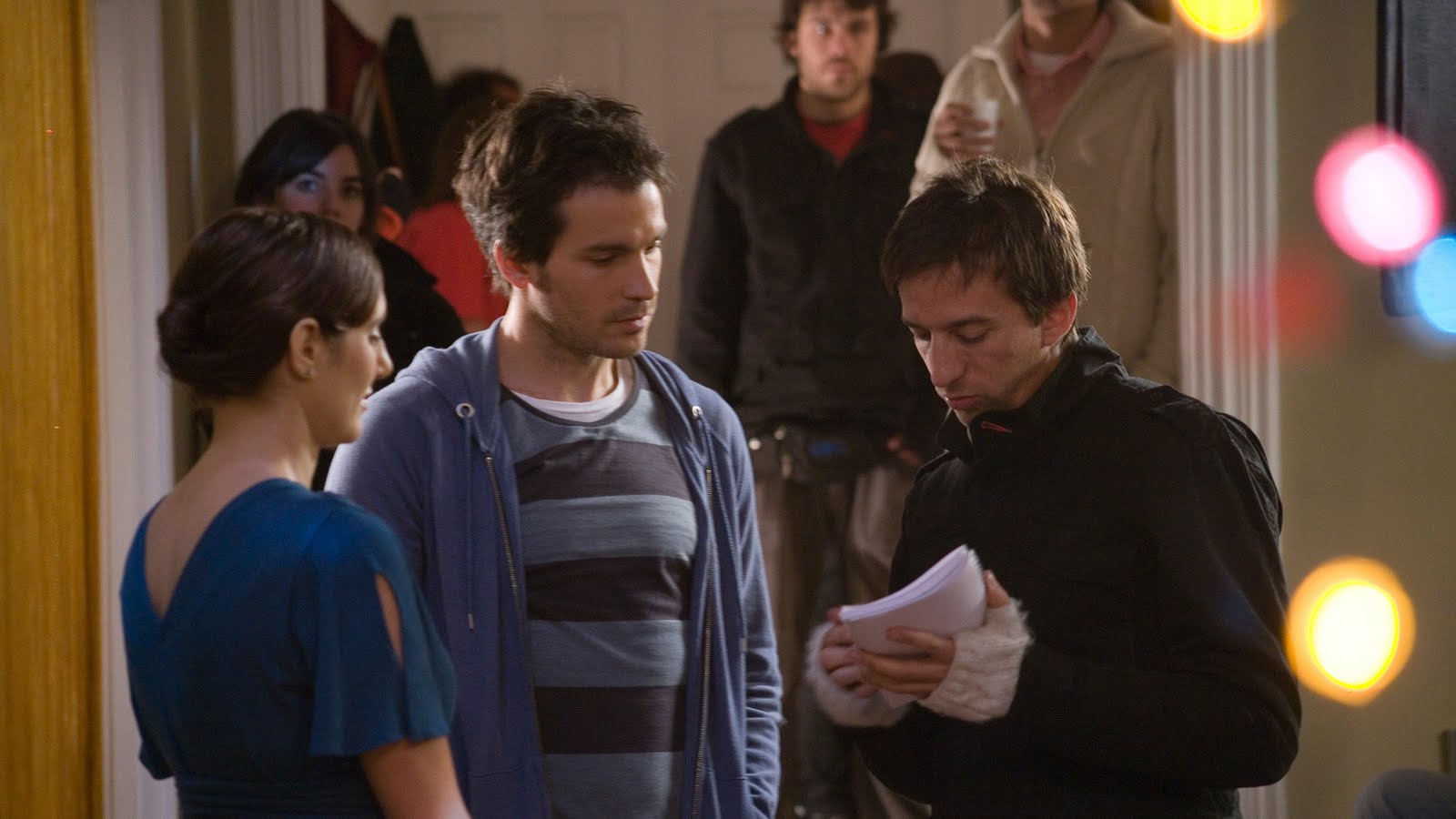
The plot revolves around 33-year-old Andrés (Santiago Cabrera) who has been living for 10 years in Berlin, working as a travel writer. When he returns to his native Chile on holiday, at a friend's birthday party he rediscovers the world he left behind, including his old love, Beatriz (Blanca Lewin). Bize explains: "My idea was to tell the story as simply as possible and follow Andrés through his process. I wanted to tell the story in an emotional way, using the camera to penetrate deeply into the characters. The dialogue is very important in this film, but in some cases, what is not said—the silences and looks—are even more important." Taking that cue, PSIFF synopsized: "It is not what the characters say so much as what they don't say. Their smallest gestures speak volumes. Their collective pain is never fully articulated but is all-pervasive. The weight of missed opportunities leaps off the screen making you question your own."
 At Variety, Boyd von Hoeij appears to have the best handle on why Bize's latest effort is his most accessible. Though he's quick to characterize The Life Of Fish as a "slow-burning yakfest", he nonetheless finds it "loquacious and ultimately poignant" and discerns that it represents "an impressive leap forward" for Bize whose "by now familiar Linklater-esque approach finally feels like a solid fit for the material, with both the mise-en-scène and the screenplay ... less claustrophobic and inward-looking than usual. ...Real-time pacing is thankfully accomplished through artfully edited sequences rather than endlessly long takes, and the naturally acted dialogue is what will keep auds hooked." He concludes, "The strong suit of Fish is that it focuses not on possible things in the future or concrete ones in the past, but the nebulous notion of what might have been."
My thanks to Adrián Solar and Matías Bize for honoring my request for an interview at PSIFF. [This conversation is not for the spoiler-wary!!]
* * *
 Michael Guillén: Matías, congratulations on such a lovely film. I've seen your previous feature En La Cama (In Bed, 2005) and am pleased that La Vida de Los Peces (The Life of Fish, 2010) exhibits your considerable growth as a filmmaker. What's interesting in both films is your fascination with creating the cinematic illusion of real time. Why is that? Where does that fascination come from?
Matías Bize: Because for me that is the most important part of the story. In this case, the story is about what happens to Andrés and Beatriz when they meet each other again. Not only what happens when Andrés reconnects with his old life, but particularly what happens when he reconnects with Beatriz. In that respect, the use of "real time" gets rid of all that is extraneous to the story and concentrates on what is most important. I could have started the story by showing Andrés and his life in Berlin, then his subsequent return to Chile, but that would have added a half an hour or so to the beginning of the film. La Vida de Los Peces cuts all that out and starts when Andrés is getting ready to leave the party. Normally, a film would start with him arriving at the party but mine starts with his saying, "I'm going." The same thing happens in En La Cama. I was interested in what happened between the two characters once they were within the motel room, not with how they got to the motel room, or why they decided to have sex.
 Guillén: I felt you achieved the illusion of real time more effectively in La Vida de Los Peces than En La Cama, primarily through skillful editing. En La Cama seemed to rely more on longer takes to replicate the passage of real time, whereas Peces insinuates the passage of real time through an assemblage of shorter takes.
Bize: Yes, we worked with two cameras and shot a lot of different takes and points of view for each scene. Then we edited a lot. I wanted to be focused on his experience. You notice that we shot a lot of close-ups of his face? As you suggest, the movie was built in the editing room. Of course there was the script and the shooting; but, the editing was very important. We spent every day for six months editing the film trying to capture a sense of the real. I wanted the audience to feel like they were at the party, that it would be a normal experience for them to be at the party, but in another way we told the story poetically, especially towards the end with the use of slow motion and music. So we were trying to do these two things at once: be real and be poetic.
Guillén: Speak to me about the metaphor within the film's title.
Bize: First, the metaphor is spatial. Because the party happens in a close space, it's similar to an aquarium. Watching what happens at this party is like watching fish in an aquarium. Second, I think the title is beautiful. La Vida de los Peces is more poetic than The Party. In fact, the Chilean distributor wanted to change the name because they thought La Vida de Los Peces was too long. They wanted to call it The Party. I protested, "No. Please. I like the title."
 Guillén: The sequence shot through the aquarium with the fish swimming in the foreground is beautiful. In that final sequence when Beatriz agrees to go with Andrés and they begin to leave the party together, they move very much like fish. Was that intentional on your part?
Bize: Yes. Like a school of fish following a current.
Guillén: I understand that you meant the party to be the world in microcosm, but what interested me most about the party was how quiet it was, and how—in your focus on intimate moments—the house seemed at times almost empty except for these two characters. That intriguing choice was then offset by scenes where you'd go into a room with a lot of people and hear music and conversation and laughter.
 Bize: It's true that within the movie you don't hear the music that is at the party. For example, there's the one scene where Andrés walks through the middle of the party and there are a lot of people dancing, but you don't hear the music they are dancing to; you hear the music he is hearing in his head. The party is necessary for the story but it's not the most important part of the story. The party is always a little out of focus as a backdrop behind them.
Guillén: So is it more appropriate to say that the "real time" you're striving for in your films is intimate time, psychological time?
Bize: Yes.
 Guillén: You're trying to conflate real time with psychological time?
Bize: Yes. I'm interested in moments in a life. What happens when two people fall in love in one night, as in En La Cama? What happens when two people have a second opportunity to fall in love, as in this film? This second opportunity is what is most important, most real, to La Vida de Los Peces and my task is to remove all the elements that are not at the specific center of the story.
Guillén: Speaking of the music he hears in his head, your score for the film is evocative. Can you speak about your score?
Bize: It was written by my half-brother Diego Fontecilla. He's worked on the music for all of my movies. He also acted in La Vida de Los Peces as Jorge, the brother of Andrés's dead friend Francisco. We work well together because he knows me so well and knows my taste in music and—in developing the score—we can just talk about emotions. I don't tell him how to do the music, what instruments to use, anything like that, we just talk about emotions. In fact we developed the music and the script at the same time. It helps during the shooting to already have some of the music for the film. Sometimes I don't even say anything to the actors, I just put on the music so they can feel the emotion in the scene.
Guillén: Is the soundtrack available?
Bize: Yes, it's available at the film's website. You can buy it there and download.
 Guillén: This has been a great year for me in terms of Chilean cinema. I've had the opportunity to speak to two of Chile's master filmmakers—Miguel Littin and Patricio Guzmán—and now I'm here speaking with you, one of Chile's youngest filmmakers, acknowledged as its most promising. How does that feel for you to be considered in that way? Is it a burden or a boon? Does it excite you or intimidate you?
Bize: In a way it helps me a lot—at film festivals, in the release of my movie outside my country—but, I'm not interested in being hyped as the new Chilean guy, no. I really like the stories that I tell in my movies and I feel like a student, I feel like I'm always learning a lot with every movie that I make. Just as you mentioned at the beginning of this conversation that you see growth in my work from En La Cama to Vida de Los Peces, I feel the same. I want to continue making movies, continue growing, and it's essential for me to feel that the story is close to me. My movies have to be very personal movies. It can be difficult at first when you make a movie and it gets accepted into a festival and then as a director you start to think, "What kind of movie do I have to make to get into this festival again? To get into Cannes?" For me, it's become different. I have to make the movie I want to make and—if I get an award or something—that's great; but, I remain the first audience. I'm the one who has to love the movie first. I feel good because I do love my movies.
 Guillén: As a filmmaker who admittedly makes personal movies, is there still a national signature to your films? Do your films represent Chile? Does the fact that you were chosen as Chile's official submission to the Foreign Language category of the Academy Awards® indicate there is something specifically Chilean about your personal sensibility? In other words, does your desire to create personal movies inflect a national mood?
Bize: That's a difficult question to answer because in a way my movies don't talk about Chile, especially in the way that most people think about Chile and its political realities. I talk about stories that could happen anywhere. Second opportunities at love happen all over the world. But, in another way, it is a Chilean movie in very specific ways. For example, En La Cama is set in a room that could be in any country—they even made a remake of it in another country—but a Bolivian filmmaker who saw En La Cama told me that it was the story of Chile. He said that through the relationship of the two main characters the audience could feel the sense of political compromise that characterizes the history of Chile. I think it's great that he saw that in the movie but—if I had tried to make the history of Chile set in one bed—it would have been a horrible movie. If I choose to have one point of view in my movie, for sure it could be similar to some point of view in some part of the country; but, it's not my intention to do that. In La Vida de Los Peces, I'm not trying to show Chile to the world but in the end it could happen. So, again, along with it being absolutely important for the story in my film to be personal, it also has to be universal. I've traveled a lot with Peces to many film festivals in different countries speaking different languages and many people have come up to me from the audience to say, "This was my story. This happened to me." For me, that's wonderful.
Guillén: The moment in Peces that I considered—perhaps not a Chilean moment—but possibly a Latino moment was when Andrés was talking to the elderly woman in the kitchen. She recalled serving him cereal with condensed milk, which reminded me of my own childhood. I'm not sure if it's a Latino thing to serve cereal with condensed milk, but it certainly felt like it during that scene.
 I was amused by how long it took Andrés to leave that party. He keeps saying he's going to leave, but then he doesn't leave. I'm aware that the ritual of good-byes is important to you. Can you speak to why?
Bize: Yeah. Two things: first, prolonged good-byes are common among Chileans. You're at a party and you say, "Okay, I'm leaving" and two hours later you're still leaving but always staying. But, second, a good-bye is important because it's the moment when you have the last word and you never know if you will see the person you are leaving again.
 For my story it's important that he be saying good-bye throughout the movie. In a way it shows Andrés as a tourist in his own country. He's Chilean but he lives outside of Chile, and—though he's with his familiar friends—he still feels like a tourist.
Guillén: You've stated this film is somewhat autobiographical. Are you 33, like the character of Andrés?
Bize: No, I'm 31.
Guillén: Are you starting to experience doubts about the decisions you've made in your life? Of the roads you haven't chosen?
Bize: Yes! The film is definitely autobiographical in that sense. I'm always thinking about what could have happened. I end a relationship and I think, "Oh, but she could be the girl of my life. What if we meet 10 years later?" So yes, that's what I've been thinking about. At first I thought I was representing my generation, but now I think that even someone at the age of 15 could relate to this story. Because if you've had even one relationship, and it ends, you think about what could have been. It's important for me that people can identify with that.
Guillén: I've long said that regrets are illuminations come too late and there's a sense of that in your film.
 Bize: Great! When a couple splits up, I don't know why but usually it's the woman who feels the loss while men usually need some time to realize what they have lost. People react differently to loss.
Guillén: Along with your maturation as a filmmaker, Blanca Lewin's performance in La Vida de Los Peces is one of her finest. You've worked with her two or three times now. Why do you like working repeatedly with her?
 Bize: When I have a new project I usually say, "Okay, I'll think about another actress"; but, in the end, I come back to Blanca because she's great to work with. I wrote the script for this movie with her in mind. She's a very hard worker. I'm a very hard worker too so I feel comfortable with her. She loves to rehearse and I usually rehearse a lot. In the beginning we read the script together and then we talk a lot about it. Then we rehearse and I film the rehearsals with a handheld. We talk some more. I usually don't want actors to think too much about their performance because then they become mechanical; but, I want them to have the experience of the scene during rehearsal. When we shoot, we film multiple takes. I usually do very long takes until the actors feel comfortable, which is when they start to work well with each other. It's important for me that my lead actors are friends.
That last scene of the movie, just before Santiago walks out the door, we did 59 takes. Santiago was incredible in each and every one of those 59 takes. He just kept getting better. I think we used the 35th take.
Guillén: Speaking of Santiago, the actors in your movies are uniformly sexy. The women are beautiful and the men are handsome. Is it important for you to cast physically attractive actors to express your intimate stories?
 Bize: For En La Cama it was important because of the physical attraction between the two main characters. For Vida de Los Peces, it wasn't my idea to have a beautiful actor in the lead role, but Santiago is beautiful. I didn't cast the role based on physical type, no. It's important, for sure, because the two main characters in Peces also feel a physical attraction; but, in this movie, they have already been a couple so their attraction to each other is not necessarily a sexual attraction; it's a much more complicated attraction.
What was important was that I needed a good actor for the character. It's a difficult role because the character is in every scene and the movie rests on his shoulders. I had seen Santiago's most recent work in Stephen Soderbergh's Che. He's Chilean but lives in L.A. In fact, he's similar to the character of Andrés because he has lived out of Chile for 10 years.
Guillén: Can we speak about the film's ending? Why Beatriz changed her mind minutes after she had agreed to leave with Andrés?
 Bize: At the moment when they say, "This could be...." it's a moment of feeling, of impulse, it's not intellectual. But as she's intercepted on her way to the door by a friend showing her a photo, the intellect enters back into the picture. They had let themselves go with the moment. They believed their reunion was possible. But that momentum was broken when they tried to leave the party. They also had to confront the social reality of their decision. All their friends were there.
Guillén: What's coming up for you? Are you working on a new movie? Or focusing on seeing this one out into the world?
Bize: I'm trying to be with this movie. I started traveling with it in Venice and have been to a lot of festivals. Right now it's important for me to be with the movie at festivals. I don't have a specific new project I'm working on now but, for sure, it will be some personal story. In a way that's difficult for me because this movie is so personal. I've worked on it for three years, beginning with the script, then the shooting, then the editing and now in its promotion. But as for the next project? It's not like it can be just anything. It still has to be personal and part of a creative process. But I do try to shoot soon after finishing up the previous film, at least within two or three years. I'm 31 and have made four movies. I'm only now just starting to think of some new ideas for the next film.
Guillén: Among your peers in Chile, are there any filmmakers you would recommend to American audiences?
Bize: Hmmmm. I'm not sure who I would recommend. What I like about Chilean filmmaking is that there is no national style. Chilean filmmakers are all very different. Some are making comedies, others are making horror films, and I think all those differences are good. For sure, Chilean filmmaking is an auteurist cinema because a filmmaker is often his own producer and has to do everything. It's not like there's an industry to depend upon. No one comes to you with a script and offers to pay you for directing it. If you want to make movies, you have to do it yourself. Perhaps auteurist isn't the right word. Chilean filmmaking is personal filmmaking, even if you're making horror movies. Friends of mine who make horror movies personally enjoy making them. But if I were to recommend anyone, I would suggest Andrés Wood (Machuca, 2004).
Guillén: If there's no true Chilean film industry, and most Chilean films are independent films, then do you interact much with your peers? With other Chilean filmmakers? Do you party together? Talk shop with each other?
Bize: Yes. Especially when we meet at some festival outside of Chile. Most of us are friends. Some I studied with at film school. Do you know Sebastián Silva (The Maid, 2009)?
Guillén: Yes.Bize: He also was in my school. We all know each other because there are very few Chilean filmmakers. In Chile, we only produce maybe 10 or 12 movies a year so it's a small family.
02/14/11 UPDATE: My colleague from the San Francisco Film Critics Circle Richard von Busack, film critic for the San Jose Metro, has reminded me that La Vida de Los Peces screens three times come March at San Jose's Cinequest Film Festival [tickets can be ordered here].
Cross-published on Twitch.
 The world-renowned San Francisco Silent Film Festival (SFSFF) presents its annual Winter Event at the Castro Theater this Saturday, February 12. After the fabulously exhausting orgy of last summer's four-day, 18-program SFSFF, it's a relief to see Saturday's line-up tapered down to a modestly manageable threesome. On board is a program of classic Chaplin shorts, followed by a Frenchy doublet of Marcel L'Herbier's L'Argent and King Vidor's La Bohème.
 The fun begins at 1:00 P.M. with It's Mutual: Charlie Chaplin Shorts, a trio of comedies Chaplin made for the Mutual Film Corporation. In 1916, Mutual paid Chaplin $670,000 to produce 12 two-reel comedies, establishing him as the highest paid entertainer in the world. Given near complete artistic control, he turned out some of the most inspired comedic moments in cinema history during the course of 18 months. While at Mutual he also assembled an eminent stock company of supporting actors, which included Edna Purviance (with whom he was romantically involved), Harry Bergman, Albert Austin and the unmistakable, bushy-eyebrowed hulk that was Eric Campbell. All four appear in each of these three shorts.
 First up in the program is The Pawn Shop (1916), Chaplin's sixth Mutual film. He plays a shop assistant who battles a fellow employee, waits on customers (with expected disastrous results), flirts with the boss's daughter and captures a burglar. The Pawn Shop has also been noted as one of cinema's earliest renderings of Jewish identity. Also from 1916 comes The Rink, in which Chaplin wreaks havoc in the restaurant where he works and at a roller skating rink. This one does a swell job of demonstrating Chaplin's bewildering physical agility, particularly whilst on wheels. The program finishes up with Chaplin's final film for Mutual, 1917's The Adventurer. Here Charlie is an escaped convict who rescues a rich bathing beauty and her mother from drowning. All's well until the resulting notoriety attracts the attention of the cops, sending him off on the lam once more. This is my personal favorite of the three films, perhaps because it seems to harken back to Chaplin's rough-and-tumble roots at Keystone.
 At 3:30 on Saturday comes the Winter Event program I'm most anticipating, Marcel L'Herbier's 1928 L'Argent. This adaptation of Émile Zola's 1891 novel about financial speculation and the corrupting power of money cost a mind-blowing five million francs to make—an irony that wasn't lost upon critics of the time. They also chastised L'Herbier for transporting Zola's tale to "modern" times, which, ahem, occurred one year before the Great Crash. Reportedly, all of those francs are up on the screen in the form of massive, opulent sets and extreme, soaring camera movements that were unprecedented for 1928. (The camera operator was Jules Kruger, who performed the same duty for Abel Gance's Napoléon.)
The restored 35mm print we'll see on Saturday was struck from the original camera negative and comes from the Archives Françaises du Film, with special permission by Marie-Ange L'Herbier, the director's granddaughter. This is also the original edit, which clocks in at a butt-busting 168 minutes. Accompanying the film will be the incomparable Mont Alto Motion Picture Orchestra. The main theme of their score is the "Herod Overture" by American composer Henry Hadley, who was also the first conductor for the San Francisco Symphony. L'Argent's original French intertitles will be translated and read by Stephen Salmons, the festival's beloved founder and former artistic director.
 Following a two-hour dinner break—during which time patrons might consider attending the festival's Winter Event Celebration Party in the Castro mezzanine—we return to Paris, or at least a Hollywood version of it, with King Vidor's 1926 La Bohème. Based more upon Henri Murger's 1851 "Scènes de la vie de bohème" than Puccini's 1896 opera, the film stars Lillian Gish as Mimi (her first film at MGM) and John Gilbert as Rodolphe. It's said that Gilbert was so infatuated with Gish, he intentionally flubbed their loves scenes in order to necessitate retakes. Legend also claims that Gish did without water for three days before shooting Mimi's infamous death scene. Personally, I'm looking forward to seeing Edward Everett Horton in a supporting role as Rodolphe's roommate Colline, and the (uncredited) costumes designed by Érte. The new 35mm print that will be screened comes courtesy of the Stanford Theatre Foundation and UCLA Film and Television Archive. Dennis James will do that magnificent thing he does on the Castro Theater's Mighty Wurlitzer.
Cross-published at film-415 and Twitch.
 Adam Wingard's A Horrible Way to Die (2010) had its world premiere in the Vanguard sidebar at the 2010 Toronto International Film Festival (TIFF) where—in his official description—Colin Geddes noted: "While the title might imply a degree of exploitation and nastiness, director Adam Wingard triumphs in placing the dramatic narrative ahead of genre conventions." Geddes likewise praised Wingard for having "developed a keen cinematic eye, melding striking imagery with intricately layered soundscapes to create emotionally honest characters and an intimate atmosphere. A Horrible Way to Die marks the arrival of a fresh, dedicated vision in independent American cinema."
 San Franciscans can judge for themselves when A Horrible Way to Die screens twice at SF's IndieFest: first on Saturday, February 5 at 11:30PM and next on Monday, February 7 at 9:15PM. I consider A Horrible Way to Die to be a significant maturation of Wingard's work, creatively angling away from the drug-fueled paranoia of his previous feature Pop Skull (2007) to evoke a cooly unfolding thriller that explores the dark variations of addiction. Having had the pleasure of interviewing Peter and E.L. Katz, the producers of Pop Skull, when that film was programmed at SF IndieFest a few years back, I welcomed the opportunity to finally meet Adam Wingard in Toronto. I had no idea when I arrived for our interview, however, that I would be sitting at a table with the entire creative team behind the film. I've reconstructed the flow of the conversation to focus first on the collaboration between director Adam Wingard and writer Simon Barrett, and then to focus next on the performances of the actors.
[This conversation is not for the spoiler-wary!!]
* * *
 Michael Guillén: Adam, as you know, I've been monitoring your work and am intrigued by your being that rare hybrid of director/editor, which you don't always find in combination. It's your editing style that has caught my attention over the past few years, not only in your short films but in Pop Skull. Every time I think about the time you've taken to achieve your stroboscopic editing effects, I'm simply in awe.
With A Horrible Way to Die you have anchored your already considerable editing skills to a sharp and startling script. Can you speak a bit about your evolution as an editor and how that has informed you as a filmmaker?
 Adam Wingard: With Pop Skull, I was still trying to find what worked for me as a director and that came through just shooting tons and tons and tons of footage. Even though Pop Skull was a small film, I spent a good while on it and I ended up with upwards to 90 hours worth of footage, which is a lot of footage for an 80-minute film. Through that I discovered editing because—when I was shooting—I was shooting anything that came to my head. At the end of it, Pop Skull turned into—not so much a rescue effort—but a discovery of the movie through editing. Through the editing I figured out what I liked and didn't like.
Since then, I've been working at trying to find the decor of the scene in fewer takes, switching it up. I got sick and tired of having to piece together scenes, especially improvisational material. I did that with Pop Skull but it was always hard to split things up. On A Horrible Way to Die, I tried to find the core of it from one perspective and tried to do long takes, with interspersed jump cuts to break it up.
Guillén: Let's address your key visual elements. Several segues from scene to scene were like washes and almost like experimental cinema for me. If it wouldn't have been for the strong narrative, your camera work could easily be categorized as avant-garde cinema. Along with the washes, you used a lot of shallow focus....
Wingard: The visual style was created by the fact that this was the first time I filmed using 35mm lenses. I come from a background of shooting with the DVX and HVX cameras with regular lenses. With those cameras the depth of field is not very shallow at all and if you want to shallow down the field, you have to really zoom it in. So I got used to shooting that way for a while and—when it came to doing A Horrible Way to Die—I loved how 35mm lenses had that shallow depth of field and I wanted to continue those long shots, where in this case the depth of field was now mere centimeters. The shallow depth of field became even more increased. All the fades to blurriness were initially created because I really liked the way that 35mm lenses actually gave me an almost new dimension to play with. I could create what you saw (and didn't see) even more through separating actors from the background and so forth.
 Even other things, like the ending of the film where Amy's hanging upside down for a good portion of it—the last 15 minutes of the film plays upside down in camera—that idea came from the fact that putting a lens adaptor on a camera automatically flips the image upside down. When you go to edit it, you have to flip it rightside up. We got to the point where we were always watching our dailies with our heads turned upside down. But then I started thinking. Watching the dailies upside down, I got used to watching them upside down. I started realizing that was a cool thing. It gives a claustrophobic feel. It interests me how technical elements such as that ended up influencing creative decisions down the line.
Guillén: One of the signature strengths of your work, I would say, is your capacity to use visuals to create anxious, uneasy and uncomfortable states of mind.
 Wingard: I think I live in an anxious state of mind! My girlfriend would probably tell you that. For a long time I was not a social person. Through high school, I never went out to parties and when I did I was always aware, "Is anybody going to notice that I'm not talking to anybody and not drinking?" I guess that plays into my work a little bit. But also, I like movies with large, textural atmospheres to them anyways. A lot of Japanese films have that. Kiyoshi Kurosawa and Shinya Tsukamoto were the two guys who struck me in that phase just before I started film school where I was just starting to think about filmmaking in general. Since then, that kind of work has become more ingrained into what I do.
Guillén: Kiyoshi is my god and texture is the perfect word to describe what you're accomplishing visually. One other visual element that I admired was during the erotic scenes when you fuzzed out what I presume were strings of Christmas lights to create glowing globes of color.
Wingard: Yeah, they were Christmas lights.
Guillén: That fuzzed out effect to create those orbs of color was quite beautiful and contributed to the erotic atmosphere of those scenes.
Wingard: I just really like Christmas lights. [Laughs.] I was going through this period where I was purely obsessed with Christmas lights. I have another movie that will be coming out next year that I shot just before this one—it's very low budget—and it has a similar vibe. Now I'm kind of over it and am trying to move on from the Christmas lights. But the Christmas lights were kind of a trick—hanging them in front of the camera and putting them all over the background—that creates an emotional environment. It's almost as if you're in the characters' brains or something. The colors influence the feeling of the scene. Plus, when you don't have a huge production design budget, you need something to keep it creative. Maybe I overdid it a little bit with the Christmas lights here and there but it was definitely an easy way for me to make the scene look a bit more interesting. "We haven't used the blue Christmas lights? Okay, bring in the blue Christmas lights!"
 Guillén: Simon, you wrote A Horrible Way to Die?
Simon Barrett: Yeah.
Guillén: Where did this story come from?
Barrett: Adam and I had been looking for a project to collaborate on for a while and had been discussing various ideas that I would write and he would direct. He could probably answer this better than me, but he was going through a period where he was researching a lot of serial killers because he was interested in them. He brought the idea to me of developing a serial killer script, which didn't initially excite me but then—when we talked a little more and I approached it from the angle of a young woman who had been in a relationship with a serial killer and had been unaware of it at the time—then I got really excited and went off and wrote it. It was an easy and clever process. I wrote the script and Adam said, "Yeah. I don't know if we'll be able to do that scene but there's no point in cutting it out at this stage." That pretty much became our shooting script.
Guillén: The audience I was in was visibly pleased with the twist in this tale.
Barrett: Oh good! I'm glad.
Guillén: I don't want to go into much detail about it so as not to reveal too much; but, just wanted to express how impressively it worked.
 Barrett: Adam didn't know about that twist when I was writing it. I wanted to surprise him as well. I just handed him the script without explanation and—when he read it—he was pleased too. That twist works much better in the film than it did in the script, mostly because of Joe Swanberg's performance and the way Adam staged those scenes.
Guillén: There was a lot of purposeful misdirection in several of the performances, which—along with the visual texture we discussed earlier—created an intriguing pace to the script.
Wingard: For me the script always had a kind of floaty feeling to it anyways. It jumps around here and there and—from a conventional standpoint—it's almost random; but, as the movie goes along it reveals more of the emotional arc by jumping back and forth and it's not necessarily about revealing events that happened as much as it is creating an emotion you feel—not from watching things in order—but from watching pivotal points to the narrative at just the right time. That was something that Simon and I thought about from the get-go; but, to give Simon credit, it was an idea he initially came up with. At first I wasn't totally sure that I wanted to do something so unconventional. Coming off of Pop Skull, I wanted to do something less experimental; but, then I realized that A Horrible Way to Die was more conventional than Pop Skull because it wasn't as experimental of a story line. Ultimately, it flows so naturally that I don't think it draws any attention to itself, which was a very big concern of mine.
Guillén: Do you act?
Wingard: Me?
Guillén: Yeah.
Wingard: I have recently in one of Joe Swanberg's films. [Laughs.]
Guillén: Do you like shifting between directing and acting registers?
Wingard: I love it. I really like acting. I started acting in my own stuff out of necessity because it was cheaper and easier to schedule myself as one of the characters than to deal with another actor. After two films, I discovered that I really liked acting and friends started casting me in little one-scenes in their movies and I had a good time doing that. I enjoy playing characters close to myself. I don't think I would enjoy burying myself into a character who was different than me and having to do research and that kind of stuff. I don't think that I'm that kind of actor and I don't think I would have a good experience doing that. But if I can sort of play myself, it's one of the things I find most pleasurable in filmmaking, probably more than directing.
 Guillén: Now here's the dreaded question. I wasn't sure if I was going to ask it, but I've decided to ask it anyway: is A Horrible Way to Die "mumblecore horror"? [A baited pause.] Any reaction to that? Do you hate that term "mumblecore"? Do you want to not be associated with it?
Wingard: Early on, when Simon and I were still conceiving the script, we were inspired by "mumblecore" movies in general and it was interesting because—even at that phase—I didn't really know Joe Swanberg and it was just one of those weird things where everything aligned: the money came together, I had just worked with Joe on a film, and—though initially I didn't think of Joe as the character of Kevin—after working with him I realized that Joe has an underlying dark side that you don't usually see and I thought he could play the role of Kevin perfectly. Plus, I just enjoyed putting him in weird sexual situations. His movies are always so wholesome sexually. [Laughs]
Guillén: Well, let me ask you, Joe, about the purposeful misdirection of your performance as Kevin. Actually, you were the only one I truly suspected. I will say that.
 Joe Swanberg: My wife watched the film and my brothers watched it and all of them said that—from the very first scene after the Alcoholics Anonymous meeting where I ask Sarah (Amy Seimetz) in the parking lot to go on a date with me—all of them were like, "Eeeuw, he's creepy. I bet something's wrong with him." And then they said that about 40 minutes later they "un-suspected" me again.
Guillén: That's absolutely right. Plus our hearts went out to you during the sex scene. All the guys in the audience were like, "Oh no!" [Laughter.]
 Swanberg: Exactly. Even my wife said that she thought that I was bad initially and then—after that sex scene—she felt really bad for me and the morning after when I'm trying to make coffee or whatever, she thought, "Aw, this poor guy. He's going to get hurt." Or whatever. Myself, I played the performance the same way the whole time. We had the benefit of being able to shoot most of the scenes chronologically so Amy and I were able to work on that relationship as it was happening and sort of build it. I didn't want to overthink it and try and play like subtlely creepy or anything like that. I mostly let Adam's camerawork and the lighting and things like that make me seem moreorless creepy dependent upon the situation and I sort of just tried to play it the same the whole way; but, I really loved that it went to that place where I could start out really intimidating, have the audience suspect me, and then have the audience come to consider me as a real loser by the middle of the film, not suspecting me of anything other than potentially ruining the relationship with Sarah. Then I was off the hook for the next 30 minutes and actually the good guy for a while who was maybe going to help her. That was kind of fun. But the thing is it was all in the editing. I don't think it was performance choices I was making. Truth is, I'm so limited as an actor. This is the "dark" movie. I only get to do each kind of thing once. I've done dark, I've done this, so that's off the table now.
 Guillén: A.J., let's talk about your performance as the serial killer Garrick, again a misdirection but a different kind of misdirection. When I thought about the movie after seeing it, I decided yours was an extremely tough role. I didn't understand your reactions during the movie until the end of the movie.
A.J. Bowen: I was a little reluctant to play someone that was so gnarly. I had done it before but nothing anywhere remotely close to this territory. We talked a little bit about it and tried to find an approach. It would have been really easy to play Garrick as camp or a caricature of a human being. When people do extreme things in a story, it's really easy to play for the most base, to play the action instead of the pathos, and for us it was really important—we were all on the same page on the book—it was really important to try to humanize these terrible events and this terrible behavior. Otherwise Garrick would have been vilified and then his behavior would mean nothing; it would have no weight and no impact.
We discussed the concept of addiction a lot. You asked if this was "mumblecore horror", if this was a horror film, and I've made a lot of horror films and I never thought that A Horrible Way to Die was a horror film. I still don't think so.
Guillén: I agree. It's really not a standard horror film.
 Bowen: We've talked a lot about it being a love story and a story about addiction in various shapes and forms. We did a lot of reading about different behavioral addiction, chemical addiction, because we thought an interesting angle would be to take a person who does terrible things and who is self-aware that what he does is terrible and who hates that about himself. He thinks that every time it happens, it's going to be the last time that it happens and that he's going to transcend his problem. And every time he doesn't, it's like Sisyphus: you think you're getting out of it, but then you're back down at the bottom. We played around a lot with the idea of this person seemingly getting away with this, but it's still destroying him because he has a conscience. He doesn't want to be doing this. He doesn't want to be a serial killer.
Guillén: What's interesting, however, is that that's not how your character is being read throughout the movie. That's how he's read after the movie is over. The image that lingered in my mind after I walked out of the movie was your facial reaction to seeing the dead woman in the tub. Later, when I realized what had actually happened in that scene, that was the image that immediately came back to my mind for re-evaluation, reassessment. It was like I rewatched and reworked the movie instantly.
 Bowen: Every time there was an act of violence—with the exception of one very specific act of violence and, of course, the climax of the film—for every act of violence we had the moment before where Garrick actually had no idea what he was about to do. He wasn't trying to trick these people into feeling safe. He was more, "What am I going to do? What am I going to do? I'm not going to hurt this person because I'm done with that part of my life. I just got to get out of here." Then we usually shot—not the actual act of violence—but the moment after. We had the moment of thrill kill but then we had the comedown and we played a lot in the world of the comedown. The time after the euphoric moment of the addiction has passed and now you're dealing with the consequence of coming back down to reality and crashing. In that scene specifically, we knew that was what we were going to do.
Guillén: Addiction is the true American horror story. For this film to have approached addiction and presented it so honestly is exactly why it is so terrifying and disturbing. So to wrap up here, I'll turn to you, Amy. I should have been a gentleman and asked you this question first; but, you've been so maltreated by all these guys anyways that what the heck? [Laughter] As the female lead in this film, as a woman, was it difficult for you to be tortured in this movie? What was your process in creating the character of Sarah?
 Amy Seimetz: Initially agreeing to do it was a bit hard. The position I took with her specifically was that I made one decision: she has really bad gut instincts. That means she doesn't get jokes. She doesn't read people well. She's not an idiot. She's not stupid; she's smart. But it might have been that something so horrific happened to her in the past that it's a short fuse in her brain. She doesn't know who to trust but she knows she has to trust people again. So she's not reading signs of when someone's acting strange. She just assumes it's herself. She thinks she's the one being paranoid. Even though someone else is acting strange, she's thinking, "No, it's probably me." Because she has to trust again or she's going to give up on life.
Guillén: Which could be thought of as a victim's strategy.
Seimetz: A victim's strategy, yeah. And she is a little bit of a victim, but she's also trying really hard. She's grappling with alcoholism but I don't necessarily think that's the problem. Her's is a concrete problem that makes sense for her to deal with. The addiction for her is more in the sense of relationship to Garrick. She is addicted to the feeling of being in an intense relationship with someone, which she's unable to replace with anything else. Alcoholism is something she can deal with on the surface. I do think she has a problem with alcohol, but I think she has a deeper addiction problem that alcoholism disguises.
Guillén: As the only survivor of the film's climax—the final image is of Sarah stumbling out of this horrific event—can you project in any way what will happen to Sarah?
Seimetz: Hmmmm. That's a really hard one. We talked about the ending a lot. We shot three different endings; but, we decided it was very important in the end that Sarah leaves. That she says no. The ending is very important for her. It's the moment when she's had enough. Another thing we talked about with regard to AA meetings is how you do them, you talk, and part of it is the repetition of going to the meetings. You don't really believe the words. You don't really believe in the ideas behind AA. Whatever form of rehabilitation you're doing, you just do it and then there comes a moment when suddenly you just get it and you understand what the ideas behind AA mean.
Guillén: By film's end Sarah has been forced into courage and she knows the difference.
Seimetz: I don't like the idea that she's just a victim or, for that matter, that anyone's a victim. You make yourself a victim. Sarah realizes by film's end that it's a choice. She has an active role in this whole thing.
Cross-published on Twitch.
 Bay Area cinephiles have learned to speak up about their love for silent cinema. Not only did MovieMaker magazine recently include the San Francisco Silent Film Festival (SFSFF) as one of the 20 "coolest" film festivals of 2010—and not only did San Franciscans just experience Chaplin's comic antics, Marcel L'Herbier's L'Argent (1928) and King Vidor's La Boheme (1926) at SFSFF's Winter Event—but now the Berkeley Art Museum and Pacific Film Archive (BAM/PFA) proudly partner with UC Berkeley's Department of Film and Media to host an international conference on silent cinema, Cinema Across Media: The 1920s, to be held from February 24 to 26.
 The full two-and-a-half-day schedule can be found at the conference's official website, which notes: "Today's multimedia environment brings cinema of the 1920s into new focus as the site of rich intermedial traffic, especially if the term 'media' encompasses not only recording technologies and mass media, such as photography, phonography, radio, and illustrated press, but also the physical materials used for aesthetic expression, such as paint, print, plaster, stone, voice, and bodies.
 I'm particularly excited to hear Thomas Elsaesser's closing speech on "Cinema Across Media: Expanding the Avant-Garde beyond the Political Divide" and the ensuing plenary roundtable where Elsaesser will be joined by Tom Gunning, Gertrud Koch, Paolo Cherchi Usai, and Anthony Vidler. I'm also looking forward to presentations by Luciana Corrêa de Araújo on movie prologues in Rio de Janeiro (1926-27); Laura Isabel Serna on ethnography, costumbrismo, and Mexican feature film production; and David Wood on performance in 1920s Mexican cinema.