Per TIFF's website: "Colin Geddes selects cutting-edge films for the Toronto International Film Festival's Real to Reel, Vanguard, Visions and Midnight Madness programmes. Since joining TIFF in 1998, he has introduced new talent and programmed many notable world premieres including Miike Takashi's Ichi The Killer; Johnnie To's Full Time Killer; Eli Roth's Cabin Fever and Hostel; Alex Aja's Haute Tension; and Pratchya Pinkaew's Ong Bak: Muay Thai Warrior.
"A specialist in Asian cinema, Geddes' additional programming efforts include the Asian rep theatre Golden Classics Cinema, TIFF Cinematheque, FantAsia Toronto and in May 2010 he was appointed as Festival Director for ActionFest in Asheville, North Carolina. He is on the advisory committee of the Reel Asian Film Festival, The Austin Fantastic Film Fest, and has served on juries for several international film festivals. For more than a decade, Geddes curated the Kung Fu Fridays screening series, which showcased martial arts and cult cinema from Asia.
 "Geddes holds one of North America's largest collections of Hong Kong cinema promotional materials, posters, and lobby cards. In July 2008, La Cinémathèque Québécoise presented an exhibit of fifty posters from the collection. Over the past fifteen years, Geddes has rescued abandoned 35mm prints from Toronto's closed Chinatown cinemas and garbage heaps and in March 2010, he donated 200 feature films originating from Hong Kong and Taiwan to the University of Toronto.
"In 2004 he founded Ultra 8 Pictures, an independent theatrical distribution and booking company, dedicated to bringing offbeat international films to Canadian cinemas. Releases have included Bubba Ho-Tep, A Tale of Two Sisters, Ju-On, and The Human Centipede."
* * *
Michael Guillén: Colin, I was especially impressed with your selections for TIFF's Vanguard Program this year and thank you for taking the time to talk with me regarding same; but, of course, your Midnight Madness program has been a favorite with TIFF audiences for years so why don't we start there? Can you provide some background on the Midnight Madness program, how it got going, and how you became involved?
Colin Geddes: Back in 1988 when TIFF was known as the "Festival of Festivals", they created Midnight Madness as kind of a catch-all for films that didn't quite fit into the perspective of film festivals. At that time, film festivals didn't really have the time for horror films; they were all about the arthouse and international films. Midnight Madness developed after that when they realized that it was almost like an entryway drug for film festival audiences, especially the younger audiences (even though the rating was 18 and you had to be 18 to go). But this was how the Midnight Madness films were described: these are films that don't have any pretensions. We throw out the window all the notions of art house cinema that most festivals love to boast about and focus on plain and simple fun and adrenalin. But at the same time, we realized, "No. We are watching art."
 My personal history with the Midnight Madness program was when I came to Toronto in 1988 from the countryside. My first week in Toronto attending school, I stood in line for the first year of Midnight Madness and I saw Hellraiser 2 and Frank Henenlotter's Brain Damage (1988). Coming from rural Ontario, in that line-up I met these kindred spirits who I could talk to about the nuances of Italian cannibal cinema. To this day I'm friends with those two guys I met in the line-up. Raemo—I've been to his wedding—and Bill and I have driven to New York to go to horror film conventions several times and now Bill's actually a film producer; he produced last year's documentary Examined Life. So I went back to see more films in the film festival each year; but, Midnight Madness was always the anchor.
 TIFF ended up being my film school—I went to school for graphic design; I never went to film school—but, I learned everything about world cinema from seeing 40-60 films every year, as much as I could. Then I wrote a fanzine about Hong Kong cinema around 1992-93, I believe, called Asian Eye. In my first issue I had an interview with John Woo before he went to the American market. In the second issue I had an interview with Jackie Chan. But by doing the zine and writing about a world cinema that no one was really paying much attention to at the time in English, it put me on the film festival's radar. I got a press pass and—once I got a press pass I could see everything!—however, that was also a sad year too because I realized I wasn't seeing the films with the audiences, which was really where my heart was: the audience. So after scoring my press pass, I became more involved in the film festival world and in 1997 Noah Cowan—who is now the Artistic Director of Bell Lightbox but who was running Midnight Madness—brought me on as a co-programmer and that year I brought him Takashi Miike's Fudoh.
Guillén: So you shadow programmed for Noah for a while?
Geddes: Just that one year. The following year he turned around and said, "You have the program."
Guillén: Wow. What a break!
Geddes: 1998 was my first full year as a programmer and I had a lot to learn because it's very difficult going from the perspective of a fan to a programmer; from a fan into the industry side. Being able to negotiate and swim through these shark-infested waters of the industry is a hard skill to acquire, especially when you have such a passion about these films and you see how they're bought and sold. It's not pretty and there's not a lot you can do.
Guillén: On this issue of the earlier perception of genre films not necessarily being considered art, that's changing quite a lot, isn't it? In fact this year's TIFF is juiced up with genre, which had much to do with drawing my attention to these shifting tastes in curatorial programming and to a more general recognition of TIFF as a programmers festival.
Geddes: That's very much what it's about with the festival. I don't think a lot of people understand that because—if you look at other festivals—you don't really follow the programmers. There's no—for lack of a better term—branding of who these people are; who these taste makers are. We've really tried to change that in the past couple of years. This year in the program book, for example, there are all our pictures. So, yeah, it's all about tastes and currents. For example, there was one film Cameron Bailey, Steve Gravestock and I all watched and they didn't like it so much but I did. I realized there was an audience for that film because I knew I shared their taste. But even when my taste is not 100% matched to a movie, I can still realize its potential audience and that's a part of being a programmer. You have to acknowledge, "Okay, there are some problems with this film but I'll overlook that because often times the audience aren't going to have the same problems I'm having with it." As a programmer you have to trust that a film will find a life on its own.
Guillén: Diana Sanchez was telling me that she's given an allotment of 18 films to select for TIFF, is that the same for you?
Geddes: For Midnight Madness, obviously I have 10. I'm always trying to get them to give me an 11th but that would mean the festival would have to go an extra day. Oh wait, they made an extra day!
Guillén: Next year!
Geddes: Truthfully, I don't know if I could handle 11 Midnight Madnesses in a row. So yes, I do have 18 and 10 go to Midnight Madness.
Guillén: You had a strong presence in Vanguard this year.
Geddes: It starts off as a select number; but, then once in a while it's like, okay, we need to find a home for this film. At the end of the day, it's always a bit of a fight because every programmer has around five films that got away just because of space. We just can't fit them all in. It's the same thing with Midnight Madness. There were a number of other films that I saw that were good but, at the end of the day, there were only 10 I could fit in. At the end of the process towards the end of August there's always a give-and-take where it's like, "Okay, we want this film and where can it go?" If we haven't filled all of our slots—there's these kind of "mercy slots" where you have to make a case to Cameron—we'll do all sorts of various things. Jane Schoettle one year offered Cameron a bribe: she left a beautiful baked banana bread on his desk. In order to get one film in myself, or to at least get it into a certain cinema, I think I gave away my secret barbecue rib recipe.
Guillén: Such power broking!! Returning, then, to this issue of personal taste: what determines the placement of the films you favor? How do they end up in respective programs? Specifically, in your case, how did your films end up having such a strong showing in Vanguard? Was it their edginess that found them a home in Vanguard rather than in Midnight Madness?
 Geddes: Yes, it's an edginess to the films. What separates a film from being in Vanguard instead of Midnight Madness is often the pacing and the tone. A perfect example would be Sion Sono's Cold Fish. That is potentially one of the bloodiest and grisliest films in the festival. I Saw the Devil by Kim Jee-woon is the most violent film. There's a difference. There's brutal violence in I Saw the Devil but a grisly grotesqueness in Cold Fish. However, it takes half an hour setting all that up in Cold Fish through the drama and the Midnight Madness audience wants something in the first 15 minutes to keep them jolted. So, for me, it's a pacing thing that separates Midnight Madness from the other programs like Vanguard.
Vanguard was initially brought about because one year we had, I believe, Wassup Rockers and a couple of other films skewed towards a younger surfer audience, for lack of a better word. You know, skinny white kids. They didn't come out and where were they when they were who these films were for? We realized these films were being buried in Contemporary World Cinema so we had to slowly carve out parts of that. Vanguard is traditionally an edgier program, maybe a little more youth-driven—maybe 20s-30s? It's hard to assign an age range to these films—but they're films that are a little more raw. Not in an experimental sense; that would be more for Visions. Films in Vanguard are a little more explosive.
Guillén: I was discussing with Diana that one of the complaints levied against TIFF's line-up this year has been that past practices of programming retrospectives of single filmmakers or particular national cinemas have been more or less eliminated in favor of programming "contemporary" films. I'm trying to gain a sense of why the term "contemporary" should be used to dismiss a film's artfulness outright. Especially because you are so knowledgable in popular trends of genre and monitor—as you mentioned earlier—"tastes and currents", where does that lead to an understanding of the "contemporary"?
Geddes: I'm not well-versed nor do I like using terms like "contemporary." For me cinema is such a personal thing that I can only speak from the gut about it. At first when you said that, I thought, "What? They want more period costume films? What are they saying?" For me, honestly, it's such a random thing. We do not set out as programmers saying, "Okay, this year we're going to address these themes and these trends and this or that nation's cinema." At the end of the day, it depends on the films. There are several established directors whose films I have turned down because they're just not good. My attitude about programming is that—since for 10 years I was in that audience before I started programming—I'm not going to waste their money. I live in this city. I see the audiences. I interact with the audiences. I know them. Some of them I know personally. I'm not going to waste their time with something that is pretentious and indulgent. I'm going to give them honest, serious cinema; but, again, at the end of the day it's how that year plays. Some years, within the Midnight Madness realm, I'll have maybe eight films that I wish I could have selected. Some years there's only two. Some years there's only one. Some years I'm scrambling to find a really good, coherent program. It depends on the year.
As programmers, often times we work in a bubble. We can't talk publically about what we're showing or what we've selected so it's not until September comes and people start looking at the lineup that we realize, "Okay, we did something good."
Guillén: So perhaps the issue is more one of matching audiences to programs? Because the same folks complaining that TIFF's line-up is overloaded with "contemporary" films have no objection, let's say, to the Wavelengths program, which suits their definition of cinema. My sense is that TIFF's programming team is striving to satisfy variant audiences with tailored programs that are sensitive to shifting trends. In your case specifically, it strikes me that the audience for Midnight Madness is—at this juncture—an identified demographic. As you say, you know who your audience is. The audience for Vanguard, by contrast, seems to have an appetite for discovery titles rather than known quantities. As a programmer for such a constituency, when you've found the 18 films that you want to place in the festival, do you then narrow them down and say, "This is a discovery title. This is something that might break out? Where should I place it?"
 Geddes: Yeah. Our marketing department and the press is always trying to get us to boil these things down and compartmentalize them; but, at the same time, we have the difficulty of choosing which is—for example—our favorite child. One of the other children isn't going to like that. For Midnight Madness the first film I invited was The Butcher, The Chef and The Swordsman from a first-time director from mainland China. I've never selected a film from mainland China because, quite frankly, most mainland Chinese films don't speak to me. They're about peasants eating dirt. This one, however, is a game changer regarding how people perceive mainland Chinese cinema. It's vibrant and exciting. It's like a cross between Ashes of Time and, say, God of Cookery and Iron Chef. It's got animation in it. It's got a throw-down rap song in the first 15 minutes. It's a first-time mainland Chinese director, a Polish DoP, Japanese actors: a great, exciting mix. So I look at The Butcher, The Chef and The Swordsman as a breakout title and I've been recommending that film to a lot of people.
 Within the Vanguard line-up, I would recommend Adam Wingard's A Horrible Way To Die.
Guillén: I'm so glad to hear you say that because I'm familiar with and am a fan of Adam's experimental short films, and his first feature Pop Skull, and I was so pleased to see A Horrible Way To Die in your Vanguard line-up. I'm really looking forward to seeing it. What was the quality of that film that you felt suited the Vanguard program?
Geddes: I always felt bad that I didn't select Pop Skull. It was rejected, unfortunately, and rejected is such a terrible word because it doesn't quantify or tell why that happened. The reason Pop Skull wasn't selected—I really liked it!—but, it wasn't for Midnight Madness and at that point in time I was only programming Midnight Madness. There was no other program that could understand and take Pop Skull, unfortunately. So this year by selecting A Horrible Way To Die for Vanguard, I'm kind of making amends to Adam but also, too, because it's much different than Pop Skull. It's a controlled drama. I do believe there is a problem with the title. And I was giving him some tips and advice on how to cut the trailer because it was pushing the film as something that it isn't. The dramatic tone in A Horrible Way To Die is closer to Monster's Ball, more than anything else. It's sharply written by Simon Barrett who wrote Dead Birds, which was a film I scheduled in Midnight Madness several years ago.
One final thing about TIFF's line-up—and this is somewhat from an audience perspective—every year we look at the films and it's always such a large line-up of films. People on the press and industry side complain, "Oh, it's too many films. We can't cover it all. You've got to cut it down." But I'm like, "No! Don't lose a single film." To shorten the line-up would make our job as programmers harder to select films. We offer as much as we do because every audience member's path is different. If you're leafing through the program book and you're thinking, "I like Italian films. I like baseball. And I like food. Oh! And look, here's an Italian film about a pasta maker who has a baseball team!" Each audience member selects their own path and it's the adventurous ones I respect. I give it up more and more to the audience to make those decisions rather than the selections being dominated or determined by industry or press.
Last year I was giving a talk at a private club on the subject of how to program a film festival and one guy in the audience raised his hand and said, "This is how I do the film festival. I go to the Scotiabank or the AMC and I pick a film, simple as that. I just pick a film and I go in. And you know what? Eight times out of ten, I'll like the film. If I don't like the film, I talk to people about it and weigh the pros and cons." For me, that is how to do a film festival. If you have a free block of time, go see this. If you've never seen a film from, say, mainland China, then go see that. If you've never seen a film from Colombia, give it a try. Anyone who's limited by English-language films only are not getting the whole picture. There was a piece in yesterday's L.A. Times about how the American media is really missing out on the full scope of the festival.
Guillén: Chris Fujiwara and I were recently talking about how there is this middle range of films between high brow art fare and fan boy genre films that receive short shrift critically and which, in my opinion, TIFF addresses admirably through the breadth of its programming.
Geddes: There's a term that Travis Stevens has brought up that is being bandied about by programmers: "elevated genre." In the meditations on film section in the program book I brought up that there is now a movement where films are being recognized as having the tropes of genre but that have more of an emotional impact. The two big films one could point to would be Let the Right One In and The Host. Let the Right One In, yes, it's a vampire film but there's a lot more going on there. The Host is a family drama that just happens to star a monster.
Cross-published on Twitch.
 This was the first year—more than any other year I've attended the Toronto International—that its signature as a programmers festival seemed especially pronounced, which drew my attention to how the festival lineup has been selected, shaped and promoted largely through curatorial taste and whether, indeed, it could be accomplished any other way? As Mark Peranson has asserted in his introduction to the current issue of Cinema Scope, the preoccupation by "a certain bored segment of the film world today" with "the relationship between programming and film criticism" enforces his general instincts "that the two are one and the same." I'm inclined to agree and—though perhaps suffering less from ennui than Peranson on this topic, angling in by way of film festival studies rather than film criticism, and largely based on the pleasant conversation I had with Diana Sanchez at last year's TIFF—I decided to structure my own "microfestival" this year by exploring the curatorial instincts of three of TIFF's veteran programmers: Diana Sanchez, Colin Geddes and Kate Lawrie Van de Ven. For myself, this was quite a different approach to the festival—I'm usually chasing auteurs, national cinemas or the annointed darlings from Cannes, Venice and Locarno—and it took a measure of trust to surrender myself to the curatorial (i.e., critical) sensibility of three individuals and to limit my festival experience to their selections; but, it seemed a fair experiment. For me, it was a different way to understand the festival.
TIFF is also one of the few festivals I'm aware of—within my limited festival experience—where the program capsules have been written and signed off by the programmers who have selected the films. Naturally, the purpose of a program capsule has an administrative specificity and TIFF's capsules are no less obsessively promotional and adulatory than any other festival I've ever attended. If I were to believe every word I read, every film boasts a brand new vision and every introduced filmmaker is a brand new auteur, and such has been the Faustian pact with festival marketing for longer than I can remember. Devil be damned, however, James Quandt has conservatively argued with a wry raised eyebrow that there can only be 10 great films a year, if that. So there you have it. Caught between the Devil and an endless blue sea.
Over the years as I've honed the practice of festival attendance, I've learned to maintain a certain resistance to what I've been promised, to nonetheless appreciate how it has been promised to me, and—perhaps most importantly—by whom. As someone who is interested in the art and craft of programming, I enjoy discerning signature elements of personal taste hidden in plain sight between the lines of a program capsule. My festival experience will either chafe against or gladly embrace these paragraphs of curatorial enthusiasm (sleight of hand?), and I set about to further adjust my experience by indulging directorial intent (admittedly, authorial self-promotion) by conversing directly with filmmakers. Finally, over a second cup or twobeer or a shared meal, I mix it all up with the received wisdom and unrestrained opinions of my colleagues wherein taste is either distilled to consensus (call it an uneasy truce) or remains rebelliously idiosyncratic. And of course, it always comes down to my own personal taste: what I do and do not like; that final sober arbiter.
 As extolled at TIFF's website: "Diana Sanchez is an International Programmer for the Toronto International Film Festival, responsible for introducing audiences to the best in Latin American cinema.
"The year after she joined the Festival in 2002, she programmed the Festival's spotlight on Brazil, Vida de Novo. Sanchez subsequently programmed two surveys of Argentine Cinema for TIFF Cinematheque, in 2004 and 2006. Also in 2006, she programmed a week of Cuban cinema at the Royal Ontario Museum.
"Sanchez is currently a programme consultant for the International Film Festival Rotterdam and has been involved in a variety of other festivals and cinematic presentations. In 2010 she programmed Calgary Latin, a selection of eight Latin American films, with the PROA Foundation in Argentina. In 2007 Sanchez was on the Ecuadorian Ministry of Culture Film Fund jury and in 2008 was on the first Premiera Copia jury at the Havana Film Festival. She has also been a jury member for the script development fund at the Colombian Ministry of Culture."
I was delighted to have the opportunity to sit down and catch up with her current selections as inflected through my current interests.
* * *
Michael Guillén: Diana, our conversation last year had an influence on—not only enhancing my appreciation of the films you selected for that edition of the festival—but, my understanding of curatorial taste in general. We spoke some about your method for selecting films for the festival and how you hoped they would represent the best of each country's national cinema(s). After the fact, certain colleagues of mine took objection to that statement. They argued, "How can she know what is the best of any national cinema?" Which provoked me to wonder: at what point does the primacy of personal taste enter into your selection of films?
Diana Sanchez: Personal taste is obviously going to affect a programmer's vision; but, that's not only what's involved because I do show films that aren't really within my personal taste but that I think will work with an audience. I try to balance that with what I think is interesting in cinema: filmmakers who are taking risks or filmmakers who are good storytellers. It's a difficult question. More what I meant by "best" was that I try to find the best 18 films that I can find; but—how to define "best"?—that's a difficult question obviously. As a programmer, I try to find films that are well-told; that are well-made. It's like when you're reading a novel, you can tell which writer has more craftsmanship than another.
Guillén: Do you have a literary preference towards narrative film?
Sanchez: I do not. My big thing now is this new genre that I'm seeing in films like Alamar, Crab Trap, and the films of Lisandro Alonso, José Luis Guerín, Miguel Gomes: this new genre which is a mix of documentary and fiction with a real sense of play between these two forms. I find that hybrid fascinating.
Guillén: So you mentioned you're looking for the best 18 films you can find, is that an allotment you're given as a TIFF programmer?
Sanchez: Yes, I'm given an allotment of 18 films.
Guillén: So your task is to go out and discover 18 films that you think will work for any given year?
Sanchez: That's right.
Guillén: Since "best" is such a nebulous term, let's approach another term which I've heard bandied about lately: "contemporary." Can you speak to what is a "contemporary" Latin American, Spanish or Portuguese film? Do you have a sense of that?
Sanchez: It's an interesting question. I've actually wondered what that is myself. Would an example be this new genre I'm talking about? Sometimes when people talk about contemporary cinema, I wonder if they're talking about subject matter? Or a matter of form?
Guillén: I bring it up because—though I am delighted in what I believe to be one of TIFF's strongest line-ups since I've been coming to the festival—there are, on the other hand, the inevitable detractors who argue, "No, it's not a strong line-up. The program is being padded with too many contemporary films." As valid a criticism as that might be, I still have no sense of what is meant by such a complaint because I'm not sure how the term "contemporary" is being used. I'm forced to question what "contemporary" means when used to describe a film, especially when it's used to dismiss a film, and I'm not sure there's even an answer to that question, let alone any consensual definition of the term.
Sanchez: A lot of people use that term "contemporary" to describe the subject matters that films are dealing with, which—for me, I would have to agree—are sometimes not the most interesting films to see.
Guillén: Another criticism levied against TIFF's program this year—aimed particularly at the City to City program—has been concern over the loss of national cinema retrospectives, which TIFF explored in past editions. But, for me, that's a concern that must necessarily address the changing face of national cinemas, especially factoring in financing and co-production. Within your domain of Latin American programming, let's say, where films exist only through the combined financing of several countries, what for you at this time determines a national cinema? Is it the content? Is it the nationality of the director? Is it the lead financier?
 Sanchez: That's also another question I've asked myself as well. I do go by director. There's two great examples in this year's festival that address this complicated issue. There's Lope, a Spanish film directed by Brazilian director Andrucha Waddington with a Spanish cast about a Spanish playwright Lope de Vega. And then there's Biutiful, which has a mostly Spanish cast shot by Mexican director Alejandro González Iñárritu in Barcelona. I look at Biutiful as a Mexican-Spanish co-production and I look at Lope as a Spanish-Brazilian co-production. So the lines are being crossed. If I were programming a retrospective on Spain, I would include Biutiful. If I were programming a retrospective on Mexico, I would include Biutiful. The film can fit both. They're both very Spanish films but the topics are different.
Guillén: My premise is that the concept of the national cinema is becoming increasingly elastic.
 Sanchez: It is. But then there's films like Marimbas From Hell, which is a Guatemalan-Mexican-French co-production; but, that's a Guatemalan film. It's an absolutely Guatemalan story, a Guatemalan director, and you can feel Central America within that film.
Guillén: So is it safe to say then that a national cinema can be defined by its cultural sensibility, irregardless of external financing?
Sanchez: Yes, a cultural sensibility is important to defining a national cinema.
Guillén: This year I've shaped my festival itinerary to include approximately 10 of the 18 films you've programmed for the festival so I'm hoping we can, perhaps, briefly touch upon those films and then add mention of those I'm not able to catch?
Sanchez: Okay.
Guillén: You've already touched upon the Guatemalan entry Marimbas From Hell. I caught Julio Hernández Cordón's first film Gasolina at the San Francisco International and so I'm curious to see if he has matured as a filmmaker? Do you see a maturation in his work?
Sanchez: Absolutely. Marimbas is a more mature work than Gasolina. It's playful. It's funny. It's melancholic. Cordón has taken characters he's known within Guatemala and meshed them together to create a whole new story that really gives you a sense of the place.
 Guillén: Federico Vieroj's A Useful Life from Uruguay? What will we be seeing there?
Sanchez: It's a black and white film, 67 minutes, in two parts. The first part is about a cinematheque in Uruguay and a man who has been working there daily for 25 years. It's also funny. You can tell that the director has great in-depth knowledge of what it's like to work at a film museum. Lack of funding leads to the closure of the cinematheque and then he finds himself without a job. It's about dealing with life without cinema. A Useful Life is an homage to cinema but also a lament for lesser public investment in important institutions like cinematheques.
 Guillén: Pablo Trapero's Carancho?
Sanchez: Carancho is a mix of genres. It's a noir; but, it's also a social issues story and at its heart it's a love story. So Trapero mixes a lot of genres in there. I saw it at Cannes and really liked it; but, not everyone agrees with me.
Guillén: I'm intrigued that you would characterize Carancho as a noir. What are the elements that you see in it that lead you to characterize it as a noir?
Sanchez: Stylistic elements. It focuses on the underbelly of Argentine life, especially the corrupt economy surrounding traffic accidents.
 Guillén: Julia's Eyes, Guillem Morales's sophomore feature?
Sanchez: It's a horror movie.
Guillén: Is it a true horror movie or more a ghost story?
Sanchez: It's like The Invisible Man.
Guillén: Is it similar to the work of Juan Antonio Bayona?
Sanchez: Yes, it has a similar feel to The Orphanage; but, it has a bit more gore in it. It's by the same production team that made The Orphanage: Guillermo del Toro, etc. It's about a woman who is losing her eyesight and starts to sense an invisible man. The question is whether there really is an invisible man or not. I was terrified.
Guillén: Patricio Guzmán's Nostalgia For the Light? Does this fall within that fictionalized documentary hybrid category you were referencing earlier?
Sanchez: It kind of does; but, it's more a classic essay documentary. It's about astronomers in the Atacama Desert peering into space trying to figure out the mysteries of the universe of the past. At the same desert, you have these women sifting through the sand looking for the remains of the disappeared. Guzmán is asking, "Why, in a country where we can look billions of years into the past, do we turn our backs on and not see what happened 40 years ago?" It's quite impressive.
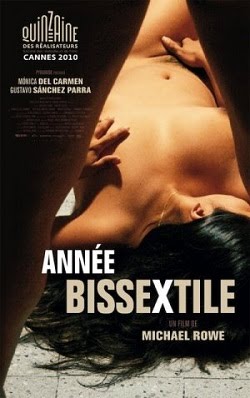
 Guillén: Michael Rowe's Leap Year; a Cannes award winner?
Sanchez: It's crazy. A very dark sadomasochistic love affair. As you say, it won the Camera d'Or at Cannes.
Guillén: This has been a great year for Peruvian cinema and I was pleased to see that you included Daniel and Diego Vega's October among your 18. Can you speak to why you chose that film? I presume they're a brother team?
Sanchez: Y'know, it's funny; but, I try not to include too many Cannes films; but, it was impossible this year. I used to run a program in Miami—and I'm going to be running it again—called Encuentros Projects and I brought one of the brothers there. I met him about five years ago through that project. Then, out of the blue, the first time I heard of him again was at Cannes with this film October. It's a dark, but funny, story about a money lender in Peru who can only relate to other people through money exchanges. His "personal" relationships are all through prostitutes so one day one of them leaves him a baby and he's got to deal with this baby. A woman, one of his clients, steps in to help him out and the film is all about how they try to form a new kind of family.
Guillén: Talk to me a little bit more about this Encuentros Projects you run in Miami. When is that held?
Sanchez: March.
Guillén: Is it a film festival?
Sanchez: No. In 2003 we brought nine projects to Miami either to find co-production or just to get the word out on the projects. That became known as the Encuentros Projects.
Guillén: Is this a public event?
Sanchez: No.
Guillén: So it's more a venture to put filmmakers and their projects in touch with production money?
Sanchez: Exactly.
Guillén: So back to your line-up: Icíar Bollaín's Even the Rain.
Sanchez: She's a Spanish filmmaker and her film is about a crew of Spanish filmmakers who go to Bolivia to make a film about the conquest of America. They arrive during the water crisis in Cochabamba when a lot of demonstrations are happening. So it's a film within a film; but, it's also about past tensions in Latin America as well as these present tensions. It's written by Paul Laverty who is Ken Loach's frequent screenwriter and both Loach and Laverty will be coming to the public screening to introduce the film and conduct a Q&A. I'm very excited about that.
 Guillén: We touched upon Lope, which I'm highly anticipating. I was a fan of Andrucha Waddington's House of Sand and interviewed him when that film made its rounds. Lope has a beautiful look and promises a swashbuckling historical sweep.
Sanchez: It's an epic but it's also a lot of fun with beautiful actors and actresses.
Guillén: Is it a film you can see gaining traction on the circuit?
Sanchez: I wonder. I don't know. I hope so. It's hard with historical dramas.
Guillén: I guess so much is contingent upon whether or not audiences are engaged with any particular history?
Sanchez: Exactly.
Guillén: For me Lope de Vega is a master not known to most and so I'm intrigued by this biopic.
Sanchez: It's just such a wonderful story about an artist coming into his own. I think for Andrucha it's a parallel story to becoming a filmmaker. That's one of the things that's interesting about it. Andrucha will be here, straight from Venice.
Guillén: What about What I Most Want?
Sanchez: That is the first feature film by Delfina Castagnino, who was previously the editor for Lisandro Alonso's Los Muertos and Fantasma. She's young and this debut is a very small personal film from Patagonia about two female friends that are going through difficult times of loss in their lives—one of them has lost her father and the other is going through a break-up of a relationship—and it's incredibly acted. I love it when films are this personal and you can feel the director's anxieties, which I find fascinating.
 Guillén: And how about the titularly similar Anything You Want?
Sanchez: That film is by Achero Mañas who a few years back did a film called November, which won the FIPRESCI Award that year. This is his first film in eight years. I really like it but I'm wondering how the audience is going to react? It might be an audience favorite. It's a weird story about a little girl who loses her mother. Her father—played by Juan Diego Botto, who I consider one of Spain's best actors—in order to help the little girl go through her grieving process, approaches a drag queen to help him dress up as a woman so at night he can pretend to be her mother. But then—because she always wants her mother—he starts to lose his identity. [We both laugh.] It's kind of morally nebulous because you're thinking, "Ay, is that good for the kid?" So we'll see how that one works out.
Guillén: So of the ones remaining on your slate that I'm not going to be able to catch at official TIFF screenings, which would you recommend I keep an eye on?
Sanchez: Daniel Hendler's comedy Norberto's Deadline, which played in Locarno. Also, you must see José Luis Guerín's Guest; it's wonderful and special. His film definitely falls into that hybrid genre we were talking about earlier and he's a master at it. He goes to all these film festivals and you think the film's going to go one way; but, then he leaves the festivals behind and he gets into the street life of each place he visits. He explores little neighborhoods in Colombia that I didn't even know existed! In hardly any time at all, he achieves an intimacy with the people he meets.
Guillén: Balada Triste is yours?
Sanchez: Ah yes, Álex de la Iglesia's latest film about the Spanish Civil War. I know that we have seen many but this one is from the gut.
 Guillén: Manuel Martín Cuenca's Half Of Oscar?
Sanchez: Another nice film from Spain. Cuenca has made two films before but neither have shown in North America and Half Of Oscar is a truly different look at Spain set in the mountains of Almeria. The landscape becomes a vital part of the film and was one of the elements I found most fascinating about it. I would strongly recommend it. And you have to see Nicolás Pereda's Summer of Goliath.
Guillén: Why are you so enthused about that film?
Sanchez: It's another documentary-fiction hybrid; but visually, it's experimental, unexpected and visceral. Like Crab Trap last year, Summer of Goliath really achieves a sense of place, of this small town in Mexico.
Guillén: So we touched upon this when we were talking about the contemporary, but you seem to have programmed several of these hybrid films that blend documentary, fiction and essay. Is this a particular development you're seeing in the films of Latin America?
Sanchez: Again, this is a question I've asked myself because these films mostly seem to be coming from Latin America, Spain and Portugal. Is it particular to those cultures? I know that Lisandro Alonso is beloved by many of these filmmakers. They watch his films faithfully. No doubt the new Argentine cinema in general affected the region so, yes, I suspect there must be some Latin American sensibility that is related to the development of the genre. Then again, it's not just being expressed in Latin America. Apichatpong, for example, would speak to its presence in Thailand.
Guillén: When I tell people that I mainly focus on Latin American cinema, I often hear the complaint that Latin American films rely too much on the genre of melodrama, emulating telenovelas to achieve popular success. Can you speak to that?
Sanchez: Well, many of them are overtly melodramatic; but, I try not to select those for the festival.
Guillén: One or two are fine for their broad humor but they tend to wear me out. Well, Diana, thanks again for the preview and your insights into how you developed this year's Latin American, Spanish and Portuguese program and congratulations again on the success of some of your films from last year, namely Alamar and Crab Trap. I look forward to comparing impressions after the festival.
Cross-published on Twitch.
 Singular pleasures. When I was invited by the publicists of The Housemaid (Hanyo, 2010)—the highly anticipated remake of Kim Ki-Young's 1960 Korean classic—to interview director Im Sang-soo, I agreed to do so if they would pull me a ticket to TIFF's North American gala premiere at Roy Thompson Hall. Little did I expect that—not only would they pull me a ticket—but they would seat me in the director's box with Im Sang-soo and The Housemaid's two lead actors Jeon Do-yeon (Cannes winner for Secret Sunshine) and Lee Jung-jae. At film's end when the spotlight angled up to our section during the applause, I had to resist rising and flexing my bicep. No sense in stealing Lee Jung-jae's thunder.
It was a grounding shift from that evening's spectacular spotlight to my relaxed conversation with the convivial Im Sang-soo and his disappointingly laconic actors the following day at the Four Seasons (especially Jeon Do-yeon who deferred to her director on every count, such that I finally gave up addressing her directly). While waiting for my interview to begin, I was afforded the added pleasure of overhearing Marion Cotillard pointing to the poster for Little White Lies to advise her rapt friends exactly who among that film's male cast was gay. (Don't worry, boys, your secrets are safe with me!)
 As synopsized for TIFF: "In this erotic thriller, the housemaid of an upper-class family becomes entangled in a dangerous tryst. A satirical look at class structure, reminiscent of the work of Claude Chabrol, this sexy soap opera is a story of revenge and retribution." At MUBI, David Hudson rounded up the multiple reviews from The Housemaid's international premiere at Cannes. For those who didn't catch Kim Ki-Young's original version at any one of a number of revival screenings this past year (including its appearance in the San Francisco International Asian American Film Festival's "Out of the Vault" selection), MUBI has continued to offer Kim Ki-Young's original on free streaming video.
A reminder to Bay Area audiences that Im Sang-soo's The Housemaid will be screening in the World Cinema sidebar at the upcoming 33rd edition of the Mill Valley Film Festival.
Im Sang-soo was born in Seoul. He studied history at Yonsei University before enrolling at the Korean Academy of Film Arts. As a writer and director, his feature films include Girls' Night Out (1998), Tears (2001), A Good Lawyer's Wife (2003), The President's Last Bang (2005), and The Old Garden (2007). [This conversation is not for the spoiler-wary!!]
* * *
 Michael Guillén: Recently, I had the opportunity to catch a revival screening of Kim Ki-Young's original version of The Housemaid at our Asian film festival in San Francisco and—now having seen your version of the story at last night's North American premiere at Roy Thompson Hall—I can express my admiration that your version is so different, that it's not really a remake at all, and that it's a true revisioning of the narrative. I commend you on that achievement.
I would, however, seek to explore those differences and why you decided to take the story in such a separate direction than the original and why you infused it with such an altogether distinct tone? What was the challenge for you in taking on Kim Ki-Young's much-beloved original?
Im Sang-soo: Kim Ki-Young's movie was made in 1960. The background of that film was its accurate description of the socio-economic environment at the time. The film emerged when Korea was just beginning to develop its middle class and many young women from the countryside would move to the city to work as housemaids for these burgeoning middle class families. I made my film different than the original because Korea's socio-economic environment has changed since then. These days, due to globalization, there is much more separation between the poor and the rich and the definition of the middle class has actually started to break down. Many Koreans who once thought of themselves as middle class—like Eun-yi (Jeon Do-yeon) in my film—have started to self-destruct as the separation between rich and poor has increased, such that now there is a super-rich class, like the family where Eun-yi is employed. So, as you say, Kim Ki-Young's film is legendary and I wanted to challenge myself remaking it.
Guillén: But what specifically was it that you found challenging in readdressing the socio-economic issues first described by Kim Ki-Young?
 Sang-soo: The challenge was exactly in describing how the socio-economic situation is changing in Korea. As throughout Asia, there is now an emergence of the super rich, which is offset against the fact that in the past 20 years those who are poor are becoming even poorer and having even more of a hard time of it. I wanted to challenge myself by showing this social problem.
Guillén: When Noah Cowan introduced the film at last night's gala, he dedicated it to Claude Chabrol who passed away yesterday. Cowan likened your film to Chabrol's "chilly thrillers"; however, you have likened your film to Alfred Hitchcock's style of suspense. Can you speak to what you feel you have borrowed from Hitchcock and brought into your film?
Sang-soo: In François Truffaut's interview with Alfred Hitchcock, Hitchcock talked about what he felt were the true elements of suspense. For example, when his characters are having a sexual relationship, they think no one knows; but, Hitchcock makes sure the audience knows. The suspense arises from the tension between what is believed to be unknown by the characters but is known by the audience.
 Guillén: Speaking of sexual tension, The Housemaid heats up the auditorium. How do you direct such intimate scenes with your actors? How do you create that erotic environment on set? Do you work on a closed set?
Sang-soo: I worked with the sexual relationship between Eun-yi and her employer Hoon (Lee Jung-jae) so that it would be secretive and express the danger of their lust. I'm wondering, did you feel that?
Guillén: Definitely! My question, however, is more technical. I'm wondering how you contain the eroticism on set? Did this require a closed set so that the actors could indulge the intensity of the scenes?
Sang-soo: Usually, yes, it was a closed set but also it must be said that my actors are very professional. They could joke around with each before shooting; but, once the cameras started rolling, they took their direction quite seriously.
Guillén: The film's tag-line that "sometimes innocence becomes a menace" distinguishes the difference in character and tone that I noted between Kim Ki-Young's film and yours. In the original, I felt the maid was bad from the beginning but Jeon Do-yeon's performance is admirably multi-faceted and her character arc painfully enunciated. Why did you choose to focus on the—for lack of a better term—deflowering of her innocence?
 Sang-soo: I actually don't think it's a "deflowering" of innocence because there is no person in the world who is innocent, per se. Eun-yi understood what was going on, she knew what was at stake in the situation and what the dynamics were within the house, but she went ahead and built up her hopes and enflamed her desires. Her revenge at film's end was a way to maintain her dignity in the face of her own choices.
Guillén: Jung-jae Lee, your character Hoon has to hold his own among a pride of lionesses, in effect; strong, beautiful, cruel women. How did you pull out of yourself the necessary strength to match these women?
Jung-jae Lee: Through unexpected behavior.
Guillén: How do you mean "unexpected"?
Jung-jae Lee: That the character himself would even think of having sexual relations with the housemaid in the presence of his family indicates that he possesses this strength.
 Guillén: A strength which could probably be more accurately characterized as arrogant privilege. My favorite nuance in your characterization of Hoon was—when discovering that his wife and his mother-in-law have had Eun-yi's baby aborted—rather than being concerned with her welfare, he is indignant that this action was taken without his knowledge or compliance. For a moment you almost feel compassion for him, for his loss, and yet you realize it's mainly pride on his part and no sense of genuine care for Eun-yi.
Jung-jae Lee: I think every human being is capable of such selfishness and duplicity, pretending to put someone else's interests first but thinking only of themselves.
Guillén: With that arrogant privilege in mind, let's turn to how it has been represented in the film's production design. If your challenge to yourself, Im Sang-soo, was to depict the increasing divide between the poor and the super-rich, you have staged it excellently in this house where Eun-yi comes to work as a maid. The house is amazingly designed, not the least of which is its collection of paintings scattered throughout. They telegraph a sense of unbridled acquisition true to Hoon's privileged character. Clearly this was your intention? Can you speak to how you came up with the vision of the house?
 Sang-soo: Just as in all the super-rich homes in Europe, Korea and Asia, what these people try to do is to copy the traditional European lifestyle: drinking good wines, collecting paintings, listening to opera. Myself, I find it questionable that this would be a life they genuinely enjoy or if it's not more for show.
Guillén: I don't want to give away the film's shocking and spectacular set piece ending; however, I am interested in the rhyme between the film's introductory scene where the young woman jumps off the high building to her death and Eun-yi's suicide. What are you trying to say by that framing rhyme?
Sang-soo: People don't know why the young woman in the first scene has committed suicide. These people witness the suicide and then they forget about it. It's possible that at film's end when Eun-yi commits suicide that people in the neighborhood heard about the housemaid committing suicide but then—just as easily as in the first instance—they will forget about it. The point is that—even though throughout the movie it is never explained why the young woman in the first scene committed suicide—she has a story. We just don't know about it like we know about Eun-yi's story. Suicide has become much more frequent in Korea as the economy has become unstable.
Guillén: My final question, then. The coda to the film is a nearly surreal and extremely stylized set piece that proves unsettling for being so ambivalent. Can you offer a bit of insight as to what you wanted the audience to take away from that scene?
Sang-soo: There has been a lot of controversy surrounding that last scene. Even one of the producers wanted it deleted. Many people complain about it. But without that scene, I think the movie would have been just so-so. I went with my gut feeling and included it. It's a simple set-up: they're giving a birthday party to a little girl who just witnessed something terrible and trying to cover up her trauma with expensive gifts. I wanted audiences to wonder if she could truly heal from such an event?
Cross-published on Twitch.
 At the press conference announcing the 33rd Mill Valley Film Festival (MFFF) line-up, Founder/Executive Director Mark Fishkin referred to a "programming sensibility" that has evolved at MVFF over the course of three decades. That sensibility has become an extremely successful formula—one that inspired indieWIRE to name it one of the world's 50 leading film festivals. There's little arguing with success, and as evidenced by the 143 films and programs in this year's selection, MVFF33 will be adhering to the tried and true.
 The bedrock of the festival's success is its position as THE post-Venice / Toronto / Telluride launching pad for autumn prestige films expected to figure prominently during Awards Season. If you want to see tomorrow's big movies today, as well as ogle the stars that come with them, MVFF is the Bay Area's place to be as amenable celebs make the trek to Marin County. Among this year's attendees will be Annette Bening, currently riding a 10-year career high with The Kids Are All Right. She won't be plugging a film, but will instead be feted with a clips, conversation and Q&A tribute. Also getting the MVFF tribute treatment this year is Edward Norton. He'll be there with Stone, playing a convicted arsonist who uses his wife (Milla Jovovich) to manipulate an early prison release from an about-to-retire parole officer (Robert De Niro). Bay Area native Sam Rockwell will be at the fest on Opening Night. He's accompanying Conviction, in which he plays a convict whose sister (Hilary Swank) is hellbent on proving his innocence. Last but not least, we'll get a gander at fellow Bay Area boy James Franco, who's getting raves for his portrayal of extreme mountain-climber Aron Ralston in Danny Boyle's Slumdog Millionaire follow-up, 127 Hours.
 If famous directors are more your thing, MVFF33 features several prominent ones live and in person. In 2006 the fest did a Spotlight on Alejandro González Iñarritu with Babel. That Spotlight is turned back on in 2010 as the noted Mexican director returns with Biutiful, for which Javier Bardem won a Best Actor prize at Cannes. Meanwhile, artist/filmmaker Julian Schnabel occupies MVFF33's Centerpiece slot with his latest work, Miral. This drama set in the middle-East is based on the semi-autobiographical novel by Rula Jebreal (also expected to attend) and stars Hiam Abbass (Lemon Tree, The Visitor) and Slumdog Millionaire heroine Freida Pinto. Closing out MVFF33 on October 17 will be The Debt, to be attended by its director, John Madden (Shakespeare in Love). The Debt stars Helen Mirren as an Israeli Mossad agent being forced out of retirement.
 Among the other upcoming fall releases appearing at Mill Valley we have—yes, Helen Mirren again—this time starring as Prospera in Julie Taymor's (Frida, Across the Universe) sure-to-be strange adaptation of Shakespeare's The Tempest. Sharing the Opening Night duties with the aforementioned Conviction is Tom Hooper's The King's Speech. Fresh from its Audience Award win at Toronto, the film stars Colin Firth as a stammering King George VI who's aided by an unorthodox speech therapist played by Geoffrey Rush. For those who can't wait for the October 29 release of The Girl Who Kicked the Hornet's Nest, the third filmed installment of Stieg Larsson's "Millennium Trilogy" will be shown once at the festival on October 13. Marin-ite Sean Penn is represented at MVFF33 by Doug Liman's Fair Game, in which he plays the husband of outed undercover CIA operative Valerie Plame (Naomi Watts). Finally, in what is sure to be a huge crowd pleaser, Sally Hawkins leads a strike of women auto-factory workers in Nigel Cole's Made in Dagenham. (Personally, the thought of watching the actress who played Happy Go Lucky's obnoxious optimist Poppy, channeling Norma Rae in a film by the guy who directed Calendar Girls is the very stuff of nightmares.)
 Another area in which MFFF stakes its reputation is the Valley of the Docs section. I probably watch over 50 documentary features each year and I'm always impressed how many of the best come from MVFF. There are exactly two dozen in this year's line-up, and here's a handful that are of interest to me. At the top of the list is The Two Horses of Genghis Khan, another Mongolian docu-fiction hybrid from the director of The Story of the Weeping Camel and The Cave of the Yellow Dog. I have high hopes for Queen of the Sun, a doc about the frightening phenomenon of honeybee CCD (Colony Collapse Disorder), which has got to be better than the pointless film Colony that screened at this year' SF International Film Festival. Every film enthusiast should want to see Cameraman: The Life and Work of Jack Cardiff, a study of the enormous talent who shot The Red Shoes and The African Queen (and who only passed away last year). Docs about the counterculture are a MVFF mainstay, and this year I'm eyeing Ed Hardy 'Tattoo the World' and Space, Land and Time: Underground Adventures with Ant Farm. Most Valuable Players sounds like fun, as it takes a peek at the Freddy Awards (the Tonys of local high school musical productions). Finally, at the press conference Fishkin highly recommended Stefan Jarl's Submission, in which the acclaimed Swedish documentarian has his blood analyzed and discovers it contains several hundred types of industrial chemicals.
The festival frequently pairs a music documentary with a live performance event. Following the October 15 screening of Everyday Sunshine: The Story of Fishbone—a Laurence Fishburne-narrated doc about the influential L.A. based ska-punk band—Fishbone itself will perform live at The Woods Music Hall in Mill Valley. (The previous evening, Everyday Sunshine opens SF DocFest and Fishbone will play that fest's Opening Night Bash at the DNA Lounge).
 The biggest part of MVFF is always the World Cinema section, which clocks in with 40 films this year. As usual, the Mill Valley programmers have marched to their own drummer in assembling 2010's international line-up. So if you're hoping to catch the more acclaimed/discussed films from this year's major film festivals, MVFF might disappoint—perhaps this year more than in the past. I'm pretty obsessive about tracking these things and at first glance I drew a blank on all but a handful of titles. Apart from some films I mentioned earlier, only three rang a bell. Im Sang-soo's The Housemaid is a slick re-imagining of Kim Ki-young's 1960 cult shocker, in which a man's extramarital affair has horrific repercussions for his family. (The SF International Asian American Film Fest screened the original version last spring.) In an admitted attempt to entice a younger demographic to MVFF, they've programmed French-Canadian wunderkind Xavier Dolan's Heartbeats, a follow-up to last year's wildly acclaimed I Killed My Mother. Dolan once again directs himself, this time as a guy competing with his female best friend for the attentions of a dim Adonis. Then in Sam Taylor-wood's Nowhere Boy, Aaron Johnson (Kick-Ass) serves up a portrait of the teen-aged John Lennon. October 9 will be Lennon's 70th birthday and to celebrate (albeit one day early) MVFF will have a live music event featuring vintage Fab Four video clips and a performance by cover band Rubber Souldiers. Nowhere Boy opens in theaters on October 15.
 Closer scrutiny of the World Cinema section revealed some familiar names. MVFF-regular Jan Hrebejk is currently the Czech Republic's most prominent director, and his latest film Kawasaki's Rose is about a revered political dissident with a shameful secret. The film was just named that country's 2010 Best Foreign Language Film Oscar submission. A new film from director/political activist Raoul Peck (Lumumba) is always welcome. His satirical Moloch Tropical follows the final 24 hours of a Haitian autocrat's presidency. Peck should know from whence he speaks, having once served as Haiti's Minister of Culture. Veteran French director Alain Corneau (who died one month ago) is in MVFF33 with Love Crime, a tale of corporate intrigue starring Kristin Scott Thomas and Ludvine Sagnier. Also from France we have none other than Gerard Dépardieu having a go at "The Three Musketeers" writer Alexandre Dumas, in Safy Nebbou's Dumas. Another veteran director in the line-up is Japan's Yôji Yamada, best known for his Tora-San comedies. I adored his recent samurai trilogy (The Twilight Samurai, The Hidden Blade, Love and Honor), but scathing reviews have put me off his latest, About Her Brother.
 There are more intriguing possibilities in World Cinema. Feo Aladag's When We Leave won the top prize at Tribeca and was just named Germany's 2010 Oscar submission. It stars Sibel Kekilli (Fatih Akin's Head On) as a mother fleeing an abusive husband in Istanbul. Another German-language film, Switzerland's Julia's Disappearance, features the estimable Bruno Ganz. These two movies will respectively serve as Centerpiece and Closing Night films during October's revamped Berlin & Beyond festival at the Castro Theater. From the SF-based Global Film Initiative's 2010 Global Lens series, MVFF has programmed Adrift from Vietnam and Becloud from Mexico. The entire 10-film 2010 GFI series will play the Rafael Film Center following the festival, from October 18 to 28. From Argentina I'm reading good things about Puzzle, which stars The Headless Woman's Maria Onetto. Set in 1963, Italy's Cosmonauta is about a teen-aged girl's obsession with the Soviet space program. It received two small prizes at last year's Venice Film Festival. Desert Flower is the true story of Somali supermodel Waris Dirie and recreates her "transformation from starving runaway to fashion icon to human rights activist and U.N. Special Ambassador dedicated to the fight against Female Genital Mutilation." Set in the Transylvanian countryside, Katalin Varga follows a woman's quest to avenge a rape that occurred in her past. Then in Black Field, a 17th century Turkish janissary joins forces with a Greek nun who possesses a "little something extra" (hint, hint—the film is co-presented by Frameline). Finally, who can resist a title like The Most Important Thing in Life is Not Being Dead?
 MVFF33 also has several American indies of note. Lena Dunham's Tiny Furniture won the jury award for Best Narrative Feature at SXSW, and what would MVFF be without a new film from prolific local director Rob Nilsson (Sand)? In addition to 127 Hours, James Franco stars in Jay Anania's existentialist neo-noir William Vincent. The October 17 screening of William Vincent begins a half hour before Franco's Spotlight tribute at the Rafael, so it's not unthinkable to hope he'll drop by to do a personal intro. Elsewhere in MVFF33 you'll find the 5@5 Shorts Programs (five programs of five shorts each screening weekdays at 5:00), a Children's FilmFest (now in its 17th year), special panels and lastly, a 30th anniversary screening of The Empire Strikes Back. It can all be found on the festival's website, along with many more narrative features and documentaries I wasn't able to mention here.
Cross-published on film-415 and Twitch.
 Per TIFF's website: "Colin Geddes selects cutting-edge films for the Toronto International Film Festival's Real to Reel, Vanguard, Visions and Midnight Madness programmes. Since joining TIFF in 1998, he has introduced new talent and programmed many notable world premieres including Miike Takashi's Ichi The Killer; Johnnie To's Full Time Killer; Eli Roth's Cabin Fever and Hostel; Alex Aja's Haute Tension; and Pratchya Pinkaew's Ong Bak: Muay Thai Warrior.
 "Geddes holds one of North America's largest collections of Hong Kong cinema promotional materials, posters, and lobby cards. In July 2008, La Cinémathèque Québécoise presented an exhibit of fifty posters from the collection. Over the past fifteen years, Geddes has rescued abandoned 35mm prints from Toronto's closed Chinatown cinemas and garbage heaps and in March 2010, he donated 200 feature films originating from Hong Kong and Taiwan to the University of Toronto.
 My personal history with the Midnight Madness program was when I came to Toronto in 1988 from the countryside. My first week in Toronto attending school, I stood in line for the first year of Midnight Madness and I saw Hellraiser 2 and Frank Henenlotter's Brain Damage (1988). Coming from rural Ontario, in that line-up I met these kindred spirits who I could talk to about the nuances of Italian cannibal cinema. To this day I'm friends with those two guys I met in the line-up. Raemo—I've been to his wedding—and Bill and I have driven to New York to go to horror film conventions several times and now Bill's actually a film producer; he produced last year's documentary Examined Life. So I went back to see more films in the film festival each year; but, Midnight Madness was always the anchor.
 TIFF ended up being my film school—I went to school for graphic design; I never went to film school—but, I learned everything about world cinema from seeing 40-60 films every year, as much as I could. Then I wrote a fanzine about Hong Kong cinema around 1992-93, I believe, called Asian Eye. In my first issue I had an interview with John Woo before he went to the American market. In the second issue I had an interview with Jackie Chan. But by doing the zine and writing about a world cinema that no one was really paying much attention to at the time in English, it put me on the film festival's radar. I got a press pass and—once I got a press pass I could see everything!—however, that was also a sad year too because I realized I wasn't seeing the films with the audiences, which was really where my heart was: the audience. So after scoring my press pass, I became more involved in the film festival world and in 1997 Noah Cowan—who is now the Artistic Director of Bell Lightbox but who was running Midnight Madness—brought me on as a co-programmer and that year I brought him Takashi Miike's Fudoh.
 Geddes: Yes, it's an edginess to the films. What separates a film from being in Vanguard instead of Midnight Madness is often the pacing and the tone. A perfect example would be Sion Sono's Cold Fish. That is potentially one of the bloodiest and grisliest films in the festival. I Saw the Devil by Kim Jee-woon is the most violent film. There's a difference. There's brutal violence in I Saw the Devil but a grisly grotesqueness in Cold Fish. However, it takes half an hour setting all that up in Cold Fish through the drama and the Midnight Madness audience wants something in the first 15 minutes to keep them jolted. So, for me, it's a pacing thing that separates Midnight Madness from the other programs like Vanguard.
 Geddes: Yeah. Our marketing department and the press is always trying to get us to boil these things down and compartmentalize them; but, at the same time, we have the difficulty of choosing which is—for example—our favorite child. One of the other children isn't going to like that. For Midnight Madness the first film I invited was The Butcher, The Chef and The Swordsman from a first-time director from mainland China. I've never selected a film from mainland China because, quite frankly, most mainland Chinese films don't speak to me. They're about peasants eating dirt. This one, however, is a game changer regarding how people perceive mainland Chinese cinema. It's vibrant and exciting. It's like a cross between Ashes of Time and, say, God of Cookery and Iron Chef. It's got animation in it. It's got a throw-down rap song in the first 15 minutes. It's a first-time mainland Chinese director, a Polish DoP, Japanese actors: a great, exciting mix. So I look at The Butcher, The Chef and The Swordsman as a breakout title and I've been recommending that film to a lot of people.
 Within the Vanguard line-up, I would recommend Adam Wingard's A Horrible Way To Die.