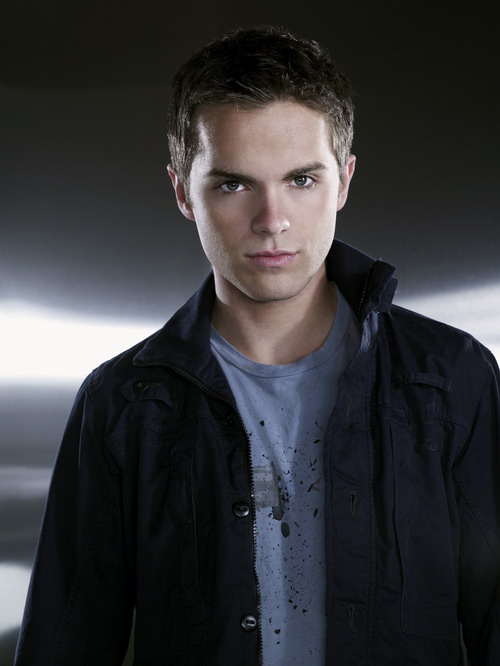
At the time that I interviewed Thomas Dekker on the set of Joshua Grannell's All About Evil, the decision was still pending as to whether or not his TV series Terminator: The Sarah Connor Chronicles would be picked up for another season. Fox elected to cancel the series; but—livewire that he is—there are no flies on Thomas Dekker. No sooner did he return home to Los Angeles from the All About Evil shoot than he was cast as Jesse Braun in Samuel Bayer's remake of A Nightmare On Elm Street, which he recently promoted at WonderCon.
During down time on one of All About Evil's infamous night shoots, Dekker and I sat down to discuss his career to date, his involvement with Evil, and his plans to shift from acting to directing.
* * *
Michael Guillén: I was just reading an interview where you were complaining about night shoots on the set of Laid to Rest, and here you are going at it again!
Thomas Dekker: I know! It's difficult, but I don't actually dislike it. A lot of the other actors hated it; but, for me, it was just strange to adjust to. I'm a night person anyway. I would much rather shoot overnight than to have to be up early every day, that's for sure.
Guillén: I wanted to make sure to tell you, Thomas, that as one of core group of extras working here last weekend, I was impressed with your friendliness and kindness to the extras, coming over to talk to us while we were waiting to be called on set.
Dekker: We couldn't make the movie without you guys.
Guillén: I especially liked how you treated Annie. She's such a fan of yours and you made her feel like a million bucks.
Dekker: I love Annie; she's sweet. And she's a great supporter. She's been at every single thing I've done and I'm thankful. There are actors who are rude to the extras and rude to the crew but what the fuck's the point of that?
Guillén: I've been noticing you're a bit of a live wire on this set.
Dekker: Yeah. I tend to become the jokester on set. I mean, it feels like I'm making a movie with my friends, like I felt on Laid to Rest where I was friends with so many of the creative people and the actors in the cast. I don't feel I have to be "professional"—though I am professional about the performance—but, it's been great to be crazy and silly and have fun. It took me a while to get there on Terminator: The Sarah Connor Chronicles because I was being precise at first; but, both Lena Headey and I became terrible jokesters on that set. But there have been movies where—if I have a lot of emotion to play—I've needed to keep a lid on it; but, this is way more fun.
Guillén: How did you become involved in All About Evil? Did you know Joshua beforehand?
Dekker: This is how it went down: I knew the producer Darren Stein for years. I'd heard him talk about Peaches Christ but I didn't really know who Peaches was. We had just started filming the second season of Terminator: The Sarah Connor Chronicles when Darren called me and said, "I have this friend Joshua; he's the one who does Peaches Christ and he's in town and wants to meet you." I said, "Okay, well come to the set." Joshua (not in Peaches drag) came to the set—which, comically, was made up to be a military academy that day of all things—and I spent about 20 minutes talking to him and really liked him immediately. I thought he was smart and cool. He told me, "I'm directing this movie All About Evil and Darren's producing it and I think there's a role I'd like you to do." He sent me the script but I had actually agreed to do it before even reading it because I really liked these two guys. Joshua didn't really know anything about me personally. I think he thought I was just another actor; but, when he was talking to me in my trailer on set, he noticed it was filled with John Waters films and horror films. Since then, he and I have talked at length about being major horror geeks—very close to the character Steven I'm playing in All About Evil—and cult geeks. Joshua's thing for cult and horror is totally my thing. That sealed the bond for sure.
Guillén: Tell me about your character Steven in All About Evil.
Dekker: Steven is a big ol' horror geek, which was the easy part for me, and he's also a visual artist, which I've also done my whole life. So I have a lot in common with the character of Steven. But he's been fun to play because he's naïve. In a way he has to be. Even though all this stuff is going on around him and even though he figures it out, being as close to it as he is you'd think he'd get a whiff of something being wrong. But, he's naïve, aloof, and I'm playing him very young. I knew a kid who was a big horror geek and he used to blink all the time so I've put that into the character. He has all these twitches and blinks and a funny slurred speech. It's been fun because I've been playing John Connor now since June of last year so finally getting to play someone else has been really liberating.
Dekker: No, I'd never worked with either of them before and I only got to meet Mink briefly because I didn't have any scenes with her. Cassandra is such a lovely woman. The only two people I knew from this cast previously were Anthony Fitzgerald who I worked with on Laid to Rest (he was the head that was cut off in the fridge) and he was in Whore, is a friend of mine, and helped me out a lot with getting that movie made. The problem was that I shot Whore while I was doing Terminator that first season so Anthony was the person who made everything happen because I couldn't get stuff ready. My time off was simply to shoot. And I've known Noah Segan for a long time.
Guillén: I was going to ask you what it was like to be directed by someone in drag; but, you've done so much genre work that you're probably used to collaborators in costume around you?
Dekker: Yeah, but, I've never had a director in drag, which has been interesting. It's funny, but I miss seeing Joshua sometimes when he's directing as Peaches. What's interesting, though, is that—even in drag—he's still on top of everything. He's a great director, no matter if he's in a dress or jeans.
Guillén: I was impressed reviewing your career last night in preparation for our talk today. I had first seen you as Claire's friend Zach on Heroes and was somewhat disappointed that your character in that series wasn't really developed past the first season; but, then you got the gig as the young John Connor in Terminator: The Sarah Connor Chronicles, which I watched in its entirety this last weekend.
Dekker: All of them?!
Guillén: Yeah, I did a marathon catch-up.
Dekker: Oh my God!
Guillén: It was fun.
Dekker: You liked them, though?
Guillén: Absolutely. Is the series going to be continued?
Dekker: We won't know until May 15. That's when all the shows, the up fronts, happen.
Guillén: Annie will be devastated if the show isn't renewed. Is there anything your fans can do to make sure it happens?
Dekker: Yeah, well, the fans of the show have been working their asses off. They're not the issue. They write to Fox every week; but, you can write all the letters you want and, unfortunately, it's an issue of having greater numbers overseas than here, which doesn't really please Fox. Who knows? I'd love it to come back and do another season; but, if it doesn't, we did a good show that I don't feel ever compromised its intelligence to be successful.
Dekker: IQ-145 is one of the strangest gigs of my career because I did it long before Heroes and Terminator. I didn't know what it was for. It was all green screen. I just auditioned and went and did this thing for a month. I didn't know if it was a pilot or an internet thing and then I never heard anything else about it, but then when I was working on Terminator suddenly it was out. It felt kind of odd because everyone thought it was this new thing I'd done but it had actually been sitting for a while, mainly because it took them so long to do the computer animation.
Guillén: Though you're a young actor, you began as a child actor and—in some ways—have more experience than most of the actors on this set.
Dekker: Look at you! Paying me compliments. Keep them coming.
Guillén: Which leads me to ask: by comparison, what is the atmosphere of this set like for you?
Dekker: It's a blast! One of my favorite moments was when Peaches—just in his makeup and regular clothes—walked past Martiny and went, "Third time to the cake table, Martiny?" We all get along and we all know each other and I've never worked on anything with quite this much blood. I came up to San Francisco wanting to do something fun with my friends, that was the feeling, and after the read through, even after a couple of days of filming, I realized, "Wow, this is going to be an amazing movie." It wasn't that I didn't believe in the film before I got here; but, once I was here, I really began to believe in it. But, honestly, that wasn't the reason I first came here. I just wanted to have fun. But All About Evil is blowing my mind. Joshua is directing like a pro. I was saying to Darren the other day that it has everything you want—which makes it difficult to describe—because if you want your tits, you've got your tits; if you want your murders, you got 'em; if you want culty stuff or comedy, you got 'em. Everything is in this movie. That's why when people ask me what the movie's about, I don't know whether to tell them it's a horror movie, a cult movie, or a black comedy, which is great.
Guillén: As a director yourself now, having directed Whore….
Dekker: And a couple of other things out there on the Internet….
Guillén: …are you having any issues switching back to being an actor?
Dekker: The only time I have issues is when I get nervous for the director and nervous for the production and the movie that's being made because—when you're just an actor—you're oblivious to those concerns and you're focusing on your own performance. Sometimes I wish I could go back to that "innocence" again; but, I can't. Once you've directed, you see what's going wrong with a production and it becomes frustrating. You see the director running out of time, running out of money, which—when you're making an indie movie—you learn are both scarce. Then I get nervous.
Guillén: So tell me about these directorial efforts out on the Internet.
Dekker: You make them sound so scandalous talking about them like that. The very first I directed was when I was 16, almost 17, and it was a feature-length hand-held dogme '95 movie. This is the first time I've ever spoken about it in an interview. It was called Cotton Wool and it was an improvised piece. I did it mainly to learn. I funded it but it was majorly cheap. It's kind of funny when you don't watch something for a long time and then you go back to it? Whenever I thought of Cotton Wool I dismissed it as that piece of shit thing I did as a kid; but, I watched it again recently and it wasn't that bad. Then I did a 30-minute short called Arcane and that was my first time working with a crew. Arcane is what helped me get the money to make Whore.
Guillén: Is Whore going to be theatrically released?
Dekker: No. We took a long time to get it ready because I kept going back and re-editing and added greasy coloring to it, so it took a long time. The finished cut is on DVD and we're trying for the festival thing. It's a culty movie so it needs to find its niche. Some people love it. Some people hate it.
Guillén: With Megan Fox, Lena Headey and Ron Jeremy, it has a promising cast.
Dekker: Here's the thing. I might as well just come clean now and we'll call this the first interview. The main point of Whore—among the many points it's trying to make—is a hokey idea: about kids who come to L.A. who want to be actors, fail, and become prostitutes and drug addicts. I get that's been done a million times before; but, the reason for Whore is specific. You never see these young kids attempting to be actors; it's implied. It's more about the mental state these kids are in while in Los Angeles. Kids all over the world desperately want to be actors; but, actors—by the public—are often treated like whores, sometimes like shit. It wasn't until I got my own TV show and started going online and reading what people were saying, not just about me, but about the show in general that I realized that some person in Wisconsin was writing the most vile shit about people that they don't know for no reason other than that they're actors. That fascinated me. Why is there this need to rip apart people you don't even know?
The main reason Megan Fox and Rumer Willis—who are friends of mine—are in the film is a game with the audience. They don't even have dialogue. They're on screen for a total of 25 seconds to two minutes. They offered to play roles, but, the reason I did it like that was because I wanted to play with the fact that everybody—and this is exactly what has happened—is concerned with whether Megan shows her tits and "that Rumer girl is so ugly that I wonder what she does in it." I knew that would happen and my hope was that these idiots who would go to the movie to see Megan's tits and make fun of Rumer will find out neither of them are really in the movie. If you want to see the movie for the movie, you're not going to miss them; but, if you're coming to ogle over celebrity, I'm not going to give them to you.
Guillén: Do you want to direct more than act?
Dekker: Yes. I love acting and I've done it now for 16 years. Darren asked me the other day if I'd ever quit and I said, "Of course!" And then I went, "I dunno." I may do both.
Guillén: Well, there's nothing wrong with taking a hiatus, perhaps; but, I hope you don't quit acting altogether because—in reviewing your work this week—I'm struck by its promise. I'd like to see you older in more mature roles. I see you owning your craft at such a young age, that I'm curious to see what you'll give us with even more experience. It's interesting to watch you be such a livewire on the set because when it's time for you to play your scenes, you're actually much more subdued. Some of your roles call for you to be quite serious and emotional.
Dekker: And those are the roles I normally tend to get. I never get comedy or anything like that. I usually get dark, brooding roles, which is probably why I do a lot of horror. The greatest compliment I receive is when someone says, "Oh, you're nothing like your character." To me that's the whole point about creating a character: you have to find a voice and a walk and mannerisms.
Guillén: You're on the crest of a pop cultural wave with Heroes and Terminator: The Sarah Connor Chronicles, but talk to me about some of your upcoming projects, like From Within.
Dekker: From Within will come out in about a month. It's funny because people are asking me now if I'm choosing to do horror and science fiction films and I'm actually not. It just seems to keep happening that way. I did From Within, Heroes is sci-fi, Terminator is sci-fi, Laid to Rest is horror, this is horror, and the next film I'm doing is sort of horror.
Guillén: One of your early roles was as Picard's son in Star Trek: Generations, for God sake.
Dekker: I was, baby!
Guillén: And weren't you one of those damned children in John Carpenter's Village of the Damned?
Dekker: Which we shot here in San Fran. Yeah, so I've had a long line of that kind of stuff. From Within is actually a good film; I like it. Phedon Papamichael did a great job. It was, again, another exhausting night shoot in Maryland. And the next film I'm doing is a werewolf film.
Guillén: What about Laid to Rest, which made this month's cover of Fangoria?
Dekker: Laid to Rest was kind of like All About Evil in that I thought, "Oh, let me help my friend Robert Hall out. We'll all pitch in and do our thing." But, again, it turned out great.
Guillén: When I was talking to Aurora Bergere about her career, I told her she was reminding me of Robert Hall's Lightning Bug, which she didn't know anything about, and which you actually turned me onto in the Fangoria piece on Laid to Rest.
Dekker: I hope I turned a lot of people on to Lightning Bug.
Guillén: I understand you're a fan of Fangoria?
Dekker: I first started reading Fangoria because when I was 8 or 9 years old I saw an issue that covered the film Species and Natasha Henstridge's tits were on it as she was coming out of the cocoon and I had to have the magazine. I had watched Species about a thousand times a day. My mother had to take the magazine away from me because was I so fucking in love with Natasha Henstridge.
Guillén: Though it's not a genre piece, tell me about My Sister's Keeper.
Dekker: I just saw the finished cut of it actually not too long ago and I was impressed. It's a story that could so easily be a Lifetime / Hallmark film; but, it isn't because Nick Cassavetes is a pretty tough guy and so—when you have a tough guy doing sensitive material—it works well. I got to shave my head and my eyebrows off for it, which was really fun.
Guillén: But they didn't touch your eyelashes.
Dekker: No! They're my meal ticket. But as an actor you rarely get to be paid to do something as drastic as shaving your head and eyebrows. It was awesome. It was right after the first season of Terminator had aired where I had emo hair and everyone was like, "Where did you hair go?!" It was a big hoopla.
Guillén: In that first season of Terminator, I was wondering if you got to work with Jesse Garcia, who is one of my favorite young Chicano actors?
Dekker: No. I never even got to meet him. We weren't in any scenes together; but, Lena loved him. She thought he was amazing. There were a lot of people that first season I never got to meet. I barely even saw Richard T. Jones. Everyone had their own shooting schedules.
Cross-published on Twitch. Here's a little Evening Class extra: Thomas Dekker's colorful music video for title track "Psyanotic."
I caught up with the mesmerizing Jack Donner on his last day of shooting Joshua Grannell's All About Evil. As the maleficent Mr. Twigs he exudes charming menace with his craggy countenance, raspy voice and piercing eyes and—with scarce a trace of effort—has nearly stolen the show, according to co-star Cassandra Peterson. He strikes me as one of the great character actors of his generation, as accomplished as Vincent Price or Peter Cushing if not as well-known by name. His face is eerily familiar on an almost unconscious level. As a child in the '50s, I often caught episodes of As the World Turns and The Guiding Light, soap operas my mother, aunts and female cousins watched faithfully and which—now and again—I watched with them. Perhaps I first saw him there? Or perhaps it was during the '60s when he guest-starred on many of my favorite television programs: Mission Impossible, The Man From U.N.C.L.E., The Streets of San Francisco, Mannix, Kojak? Or perhaps when he appeared as a Romulan in Star Trek? Or later as a Vulcan priest in Star Trek: Enterprise? All I know is I couldn't take my eyes off him from the moment I first saw him. I was curious with the sense of knowing him and was especially pleased to have a chance to get to know him. [This conversation is not for the spoiler-wary!!]
* * *
Michael Guillén: Jack, as one of the core group of extras, I was lucky enough to be seated in the front row of the Victoria Theatre watching you perform multiple takes of your final monologue and fell in love with you.
Jack Donner: Really?
Guillén: You've got a good chance of stealing this show with your wonderfully wicked performance as Mr. Twigs. You've been performing for quite a while?
Donner: Oh yes.
Guillén: How did you come to be associated with this film All About Evil?
Donner: The standard way. My manager submitted my resume to the casting people, they called me in, I read for it and they hired me. [We're temporarily interrupted as craft services delivers some hot tea and cookies.] This company's been so caring and lovely.
Guillén: It seems that way.
Donner: It is! It's the first company in the 50 years that I've been working that I'm really feeling sad about leaving because—as you know—today I wrap. The people have been a considerate, professional, smart and talented group. This set is heads above many of the indie film sets I've been on.
Guillén: So you had never met Joshua before or knew nothing about Peaches?
Donner: Not at all. This was all brand new for me. But they liked my audition, said it was fantastic, and I agreed with them. [Laughs.]
Guillén: Has it been odd to be directed by someone in half-drag?
Donner: I guess it was. Once I saw him a few times, I got used to it. I just related to him as my director. I've been directed by some oddballs who—though they have been dressed in a typical way—were screwy as hell.
Guillén: Tell me about your character Mr. Twigs.
Donner: I liked him when I read him. I had to give him some dimension for being a killer; but, he's spent his life in the projection room and became introverted and angry, shut down and isolated, so when Deborah's step-mother Tammy threatens to sell the movie theater, Twigs goes a little unhinged and haywire. Not only out of anger and rage, but fear. When he sees—not only Deborah killing her step-mother on the security camera; but, the fact that she enjoys it—he realizes, yes, murder and revenge is the thing to do, this is how to get his anger out. So as an actor, that was my job: to give him dimension through the tics in his eyes and the fiddling with his hair and the rumbly laughter. All of that seemed to express his psychosis.
Guillén: You've done a lot of genre films?
Donner: I've done a lot, yeah. This is probably about my eighth, ninth or tenth horror film. I've worked for about five decades except for a long hiatus between 1976 and 1991 when I got very ill and couldn't work. When I became ambulatory, I was still too weak to work so I decided to go to the university and—10 years later, or whatever it was—I came out a licensed psychotherapist. In 1970 I was diagnosed with adult onset asthma, which the doctors prognosticated would become emphysema, and they gave me about three years to live. They wanted to keep me comfortable with heavy medication. I had already fallen in with a group of people practicing a theory of emotional release listening, deep listening and questioning, so I told the doctors that I didn't want the heavy medication; I only wanted whatever it took to keep my bronchioles open so that I could breathe and I would take care of the rest. So for the next three years I had an emotional release session at least five times a week, which was all connected to early family trauma. It took me about three to four years to heal this thing and I'm still here.
Guillén: Excellent! If I were to go to the video store, which of your early performances would you want me to check out?
Donner: Everything. [Laughs.] I'd like you to look up the videos that have my performances from the Mission Impossible television series. I did 11 of those. They loved me on that show.
Guillén: Did you play the same character?
Donner: No. Different characters. Always bad guys, except for one. But they loved the way I died, so…. I'd also like you to look up a short 45-minute film called Cool Air based on the H.P. Lovecraft story. I loved that role because the emphasis was on his emotional psychology more than the horror of it. You might remember, perhaps, that the story is about this doctor from Spain who had to live in a refrigerated room when he came to America. That, plus certain chemicals, kept him alive. He had actually died and his doctor friend brought him back to life with this cold environment. That was one of my favorites. And then there's a fun little movie called Retro Puppet Master. I think it was the last of the Puppet Master series. Those are the performances I would love for you to take a look at.
Guillén: What's it been like working with Natasha Lyonne?
Donner: Fun! She's professional and truly interested in—not just her performance—but the timing, and the chronological development of her character. It's very difficult, you know, to keep hold of a character in a movie when you don't shoot in sequence. You have to keep your eye on the development of the character and figure out where a character is at any given point so that you can keep artistic control over the development of the character. She was great to work with in that regard. We chopped off heads, sliced off breasts, and—in terms of gore—this reminded me of another film I've done Farmhouse, which I'm not sure has been released yet.
Guillén: Talking with others on the set, it's become clear you are well-loved on this shoot.
Donner: Really? That's great to hear.
Guillén: I know that the budget for this film has been stretched thin over every aspect of this shoot. What has been most challenging for you?
Donner: The night shoots have been hard and demanding. About 10 days ago we had several days in a row where it was not just nighttime shooting but daytime too. We were in overtime working 12-15 hour days. And then the weather here in San Francisco is cold! And this building, the Victoria Theatre, is frigid! It's a warmish kind of day outside today but you wouldn't know it, it's so cold in here, and my fingers are always rigid. But that's not really a complaint, just a statement of fact.
Guillén: As someone who has worked with many directors over the years, how has Joshua's done as a first time director?
Donner: Superbly! It was as if he was well-experienced with directing. He knows his story very well and he knows what he wants, yet he's very flexible. He listens to the actors, accepts their ideas, and he'll adapt his approach while keeping the integrity of the story intact. He's done a great job.
* * *
I didn't ask idly, and followed through seeking out Donner's recommended performances from his long and established career. As Dr. Muñoz in Bryan Moore's 1999 black and white short film Cool Air, based on the eponymous Lovecraft tale, Donner inflects the film's structuring monologue with an understated yet riveting charisma, commanding a mastery of the countenance and elocution requisite to the narrative atmospheres of H.P. Lovecraft and Edgar Allen Poe. For those able to access Netflix Instant Watch, this title is currently available.
Mink Stole's mindblowing scenes in Joshua Grannell's All About Evil had already been shot by the time I arrived on the set so I didn't have the chance to speak with her during the production; but—ever generous in spirit—Mink recently phoned me to share her thoughts about working on Joshua's first film. [This conversation is not for the spoiler-wary!!]
* * *
Michael Guillén: Mink, it's wonderful to talk with you again. Thanks for taking the time to help me promote Joshua Grannell's All About Evil.
Mink Stole: Absolutely! I'm a huge fan and good friend of Joshua Grannell's and would do anything for him.
Guillén: When we first spoke back in 2007 when you were at Frameline with Out At the Wedding, you mentioned to me that Joshua had approached you with the role of Evelyn in All About Evil and—as we had been joking—it was yet another role where you get killed off in a wonderful way.
Stole: I do, don't I?!
Guillén: Tell me a little bit about your character Evelyn.
Stole: Evelyn is a nice person. She really cares about Deborah, Natasha Lyonne's character. She's worried about Deborah's obsession with this completely dilapidated movie theater that will possibly bankrupt her and she counsels Deborah with genuine affection and concern to get rid of the place. Deborah does not like that.
Guillén: You've had the honor of being the first live guest at Peaches Christ's Midnight Mass and have—in effect—grown up with Joshua's alter-ego Peaches and the midnight scene he's created here in San Francisco over the past decade. What was it like for you to graduate with Joshua to his first feature?
Stole: I have to tell you that everything I have ever done with Peaches has been done professionally; he's extremely professional. I've always been very well taken care of. In all of my dealings with him—from my first appearance at Midnight Mass and our various appearances together around the country (we've appeared together in Seattle and a few times in San Francisco; I've done Midnight Mass several times)—it's always been stress-free for me and a pleasure to do anything with him. So I knew that if Peaches was doing a movie, he would have it together.
Guillén: So for his first stint as director, you felt he did a good job?
Stole: Yes, he did an excellent job as a director but I also thought he did a very good job as a producer.
Guillén: In your scenes in All About Evil, you primarily interact with Natasha Lyonne, who you've worked with before?
Stole: It was lovely. It was really nice because I hadn't seen her in that entire 10-year period so it was wonderful to see her healthy, well, working and happy.
Guillén: As you know, the world premiere of All About Evil is coming up in a few weeks and I understand that you're going to be here to help launch it off?
Stole: I will be there.
Guillén: And rumor has it that you and Peaches will be performing the theme song from Female Trouble.
Stole: That's correct.
Guillén: That delighted me because the last time we spoke you mentioned that someday you hoped to perform on the Castro stage.
Stole: One of these days I'd like to have my whole band there with me and do my whole one-woman show. That's something that I would love to do, but that's a fairly big undertaking.
Guillén: One of the most interesting aspects of the production of All About Evil is Joshua's plan to roll the film out across the country with a pre-show "spooktacular." Will you be helping him with that in a few cities?
Stole: I will do as many of them as I can because, first of all, they're fun; second of all, I love traveling to different cities to do shows; I enjoy that very much. And I love Joshua. We're friends. We get to spend time together when we're traveling and that's always pleasant so, yes, I will do as much of it as I can depending on my schedule and whether the venues want me.
Guillén: Without giving too much away, your particular shock gag in All About Evil was created by up-and-coming effects artist Aurora Bergere. Can you talk a little bit about interacting with her to achieve that shot?
Stole: She was great. The hard part of that shock gag for me was when I had to have a face cast made. They put this stuff on your face and then they wrap it in bandages so you can't see and it's a little bit claustrophobic. The traumatic difficult part of that was done here by somebody else whose name I can't remember and wouldn't tell you if I did because I didn't like him. [Laughs.] But anyway, what Aurora had to do was create the actual prosthetic that fit on my face and she did an excellent job. I've seen just a tiny clip of the sequence and it's very realistic.
Guillén: It's one of the most amazing shocks in the film.
Stole: And the nights that we filmed that scene were long and grueling night shoots, which are always hard. We were working against the sun and had to get everything done before the sun came up. We were also working in a library so we had to get out of there before the library opened. I was put in a position of perpetuating that shock gag for hours while scenes were being shot around it. It was hard for me, I have to admit.
Guillén: Did you get to work in the Victoria Theatre?
Stole: Yes, I did, though my only shots at the Victoria were outside the theater. There are scenes in the film where I'm allegedly in the attic of the Victoria; but, they were shot in a different location, at the Armory.
Guillén: Since the last time I talked to you when you were in San Francisco with Out At the Wedding, you've worked on several projects. I was pretty sure you had told me you were not in Adam Shankman's Hairspray, yet IMDb lists you as an uncredited cameo?
Stole: IMDb is notoriously wrong. I was not in that movie and, also, John Waters' Fruitcake has never been made; it's not even in pre-production. There's a script but there is no film.
Guillén: As you know, I'm writing a feature for Fangoria magazine, which has long been one of Joshua's favorite magazines and a dream of his to be featured within its pages. Are you a fan of Fangoria?
Stole: I'm not a fan of horror movies. Fake blood scares me.
Guillén: Really? So is your role in All About Evil your first horror credit?
Stole: It's my biggest; but, I have done others. I just actually worked on a short in Los Angeles called Bug Baby where I am killed by a bug baby; a bug that was born to human parents and you get a nice shot of the pincers getting ready to take off my head.
Guillén: [Laughs.] Oh my God! You continue to have an absolutely fascinating and unique career!
Stole: That was such a fun gig. So I get to say, "Yes, I've been eaten by a bug."
Guillén: Have you gotten around yet to drafting your memoirs?
Stole: No.
Guillén: You know I'm going to be on your case about that every single time I talk to you?
Stole: Good! Fine. Somebody needs to push me into it because it's something that I would like to do, but is torture for me: writing is very hard. And I'm not going to have someone else write it for me.
Guillén: Well, Mink, thank you so much for taking the time to give me a few quotes for the Fangoria article and I really look forward to visiting with you when you're in San Francisco for the world premiere of All About Evil.
Stole: Thank you. I'm looking forward to it as well. First of all, I love San Francisco; it's one of my favorite places. I love the Castro Theatre and the premiere should be a spectacular event.
Known to her legions of fans as horror hostess Elvira: Mistress of the Dark, actress Cassandra Peterson has set aside her revealing goth lingerie to "play it straight" in Joshua Grannell's All About Evil. The shift in persona is revelatory. During one of Evil's exhausting night shoots, Cassandra and I sat down between takes to talk about her participation in the film.
* * *
Michael Guillén: Cassandra, I consider you—not only iconic—but probably one of the most intelligent and talented artists of my generation. You've had such a profound effect. As I was surveying your career, I was shocked how many places you pop up. A classic example is you as a strip tease performer on the cover of Tom Waits' album Small Change.
Cassandra Peterson: People are talking about that so much lately and the very bizarre thing about that is that I don't know if that's me! I don't know. People say it is, it looks like me, but I don't have any recollection of ever doing that. But it was the '70s, so I don't have a recollection of a whole lot that I did then.
Guillén: I'm very pleased to talk with you as Cassandra Peterson. Not to disrespect Elvira or anything; but, her accomplishments are well-documented, so I wanted to focus instead on the fact that—within All About Evil—you actually get to play a role, to act. How does that differ from playing an icon like Elvira?
Peterson: Well, it's a lot different because I don't know what I'm doing as an actor in All About Evil. I feel pretty comfortable as Elvira. As myself, I act so rarely that my biggest challenge is not to act like Elvira, y'know? People go, "What are you thinking of while you're acting?" and what I'm thinking is, "Don't roll your eyes and mug."
Guillén: I respect your humility but I wouldn't deminimize your chops as an actor. The other night I was watching you do multiple takes on a scene, over and over and over, and I was genuinely impressed with your concentration. I knew you were exhausted, it was something like 3:00 in the morning, it was stop and go with the scene, but you kept going back to the same space, in character, focused.
Peterson: Thank you. I guess I've been around for so damned long that I've finally picked up on it, whether I'm trying or not.
Guillén: You've had a longstanding friendship with Joshua Grannell and his alter-ego Peaches Christ for at least the last few years, how did you get pulled into this project?
Peterson: It was obviously through Peaches. She told me she was doing this movie and wanted me to be part of it. I really didn't know if I could act in a role. She had seen this other short film I did called Tomoko's Kitchen (2006) that was apparently screened at the Sundance Film Festival. I had a small role in it (and I don't know how I got dragged into that one either). I never watched it because I didn't want to see what I looked like in it; but, Joshua had seen it and he said, "I thought your acting was really great." I was like, "You're kidding?" Then I actually watched it and I wasn't as bad as I thought. So I thought, "Hmmmm, okay, maybe I can act in All About Evil, I don't know." It had been so long.
Guillén: Have you grown as an actor as a consequence of committing yourself to performing in Evil?
Peterson: I guess I have. The hard part about being an actor is not being self-conscious. From being Elvira for so many years I have absolutely no shame or self-consciousness—that's all gone—so I feel very relaxed.
Guillén: That must feel fabulous to be so confident and centered?
Peterson: It does feel a little bit like, "Oh well, I can do whatever now."
Guillén: What has it felt to be directed by Joshua, or I guess I should say "Peachua"—Joshua, half in drag?
Peterson: Peachua's a great name! It's been great because Joshua is just so damn sweet and nice and any suggestions you make, he thinks they're great. He's such an easygoing guy. I love being around him. He's funny and we work great together. I love doing stuff with him.
Guillén: This moviemaking environment and this experience of late night shoots, multiple takes, how does that differ from your TV experience where you have set skits?
Peterson: The hardest part for me is not having a teleprompter. Oh no! I'm a teleprompter queen. To actually have to remember lines is stressful because—with TV—I never have to remember any lines ever. So that's the hardest part for me, plus staying up all night. I know I'm "Mistress of the Dark"; but, y'know….
Guillén: And I imagine that—even after working all night—it's hard to decompress and get to sleep? I did three nights of extras work while recovering from an appendectomy and was doing pretty good until the third night, when I finally had to beg off and go home to sleep and recuperate. I was so exhausted, I thought for sure I was just going to go home and die. But, instead, I couldn't go to sleep. I was so wound up. It took nearly three hours to calm down enough to sleep.
Peterson: That happens to me too. I go home after filming on set; but, I'm so beyond exhausted that I'm still wired, y'know?
Guillén: Do you want to do more acting gigs beyond your Elvira persona?
Peterson: Maybe. But I don't want to start the whole thing of getting an agent and going back out on the calls; I'm too lazy. I've been doing this too long. The thought of going out on interviews is more than I can stand.
Guillén: All About Evil is more a labor of love, then?
Peterson: It is. When friends call me and ask me to do something, then I love to be there. But the practical thing of looking for work? That's just too hard.
Guillén: Tell me about your character Linda. What was it about the role that you felt you could move into?
Peterson: Well, she's a mom with a teenager and I am a mom with a teenager. Every line that is written in this script for the character of Linda is something I have repeatedly said before to my own kid.
Guillén: I was observing with interest the manner in which you handle your co-star Thomas Dekker, who plays your son Steven. Dekker is something of a live wire on the set.
Peterson: Yeah! "Get over here! Where's your coat? Stop smoking!" Face it, being cast in the role of Linda was typecasting.
Guillén: And you haven't had to do any of the gore effects in the film?
Peterson: Not really, no. Just what I have on now: a little blood. I get to kill a bad person. That was fun. I never get to kill anyone. I did get to threaten Pee Wee Herman once in Pee Wee's Big Adventure; that was good. That was a dream job for any gal: getting to threaten Pee Wee.
Guillén: You'd worked with Paul Reubens earlier, however?
Guillén: I haven't heard much about Paul Reubens lately.
Peterson: He's around. He's been doing quite a bit of acting and working on a whole bunch of TV projects that he's trying to get out there; but, he does quite a bit of acting as himself.
Guillén: When I first interviewed Joshua a few years back, you hadn't yet made it up to Peaches Christ's Midnight Mass; but, you were scheduled to make your first appearance and I remember Joshua being all excited about it. How difficult is it to have such a strong alter-ego; Joshua has Peaches and you have Elvira? You mentioned a little earlier that you had trouble getting rid of Elvira acting the role of Linda.
Peterson: Well, when I see a camera in front of me, like I said I just start mugging, rolling my eyes and stuff, automatically. I play it pretty straight here in All About Evil, I'm Mom, I'm not making jokes or anything and the hardest part for me is, "Don't be Elvira, don't be Elvira." That's all I'm thinking. "Be normal for once for God's sake, woman!"
Guillén: And how would you describe working with the ensemble on the All About Evil set?
Peterson: It's great! I love all these actors. Everybody here is just so great. Oh my God, Jack Donner—who plays Mr. Twigs—I think he's stealing the show, dammit! He's such a pro.
Guillén: You say that with complete love?
Peterson: I do! I love it! He's such a great actor and such a nice guy; but, everyone in the cast—I feel like they're all little kids; they're all adorable—we've been getting along great. I've been swapping music with them and they've been showing me how to do things on the computer because I'm so computer illiterate. We've been having a lot of fun. Even on our day off we all got together and had dinner. That was nice.
Guillén: Your involvement in this project is something of a gift to San Francisco. It certainly has been to the extras involved in the film. They bemoaned the fact that they missed Mink Stole—she shot her scenes before the extras came on board—but, they've been excited to interact with you and delighted to watch you in action.
Peterson: That's cool! The extras have told me they're very excited and I've been out sitting in the audience with them, talking with them. They seem like real fans. They're great.
Guillén: Have you always loved genre films?
Peterson: I have. Ever since I was a kid, I've loved that kind of thing. I've always been into it. For me, All About Evil is a cross between Herschel Gordon Lewis and John Waters. They've melded together. It's a dream job for me.
Guillén: I was recently watching the YouTube clip of you and Peaches on stage at Midnight Mass. Peaches acknowledged that she was influenced by you and you credited the creation of Elvira to a drag queen…
Peterson: Oh yeah, definitely! Lots of drag queens.
Guillén: I'm intrigued by that sense of continuity.
Peterson: Isn't it weird? I really do feel that I learned everything—how to walk, talk, dress—from drag queens and now I'm influencing drag queens. It's come full circle. Isn't that weird? I can't tell you how many drag queens have come up to me and said, "Oh, you were my idol growing up." And I'm like, "Well great, I see I've rubbed off on you."
Guillén: I'm aware that you're holding auditions to find a second Elvira to make appearances that—as I think you've said it—don't pay you enough?
Peterson: [Laughs.] That's exactly right. Gimme that money! No, actually it was a low budget attempt at doing what I would eventually like to do, which is to franchise the character of Elvira. Not quit Elvira right now—as someday I'm going to have to—but, sort of doing what Bozo the Clown did. I love basing my entire career on a clown. Bozo—for anyone old enough to remember him—was wearing tons of make-up too so that he could go out and get a lot of other actors to play Bozo to make various appearances and do TV shows across the country. I started thinking, "Hmmmmm. Bozo. That sounds like a good gig. Maybe I could do that too."
Guillén: This is why earlier I was praising your intelligence. You market better than almost anyone I know. Elvira has been a successful "product" for you.
Peterson: Thanks. Well, I have a lot of help. I get good people and I'm still working on that, believe me. I'd like to say it's much bigger than it is; but, it's been going along pretty well for 28 years.
Guillén: So your hope is to continue the Elvira franchise but to be behind the scenes?
Peterson: Exactly! Yes. So I don't have to be schlepping around in this outfit when I'm 85.
Guillén: As I mentioned earlier, It's been a true pleasure to watch you perform as an actor in a non-Elvira role.
Peterson: Thank you. It's been fun for me. A nice break.
Guillén: And I trust that—even though you may not want to go out and actively solicit roles—that when people see your performance in All About Evil it will open a window on a whole new facet of your personality and earn you invitations to act in other films.
Peterson: It would be nice to be given an opportunity to do something without having to work too hard to get it. [Laughs.]
I had a few conversations with Noah Segan during the shoot of All About Evil, wherein he plays the demented Adrian. At the time, Noah had produced and starred in Someone's Knocking At the Door and shared a screener. We talked about his performance in that film, along with one of my favorites—Deadgirl. Here are some thoughts Noah shared regarding his experience with All About Evil. [Not for the spoiler-wary!!]
* * *
Michael Guillén: How did you get pulled into All About Evil? Did you know Peaches beforehand?
Noah Segan: I'm very good friends with Darren Stein, who is All About Evil's producer. He's also the director of Jawbreaker. As Darren and I were becoming pals—we met through mutual friends—we realized quickly that we'd like to work together. We'd been talking, running through various projects, and when this came on his radar and Peaches/Joshua started the casting process, it was an opportunity for Darren and I to work together and for Darren to help Peaches find his appropriate Adrian. The three of us got together and later I introduced Peaches to Tom Richmond, the cinematographer, who's an old friend of my family. Natasha Lyonne, of course, accepted the lead and the family just kept growing. It was originally through Darren but now at this point it just feels like one big family.
Guillén: How does it feel to be directed by someone who's in half-drag part of the time and full drag the rest of the time?
Segan: It feels great. It feels at home. This is a wild flick. This is an out there movie. My character Adrian particularly is an out there guy. Actually at the end of the film I end up in drag. There's a little bit of Mark David Chapman in my character. I want to kill to become. That's how I end up in drag because my character Adrian is so enamored with Deborah, Natasha's character, that I eventually want to be her. There's a lot of that even in my regular get-up. I have these fucked-up teeth and I'm this disgusting deviant guy. The same with Jack Donner who plays Mr. Twigs. The Twins. Everybody's wild and has their own style. So it's nice to have a director who has an aesthetic style. Know what I mean? Obviously, Joshua's only in drag when he's Peaches. He doesn't do it just for fun on set. But it is fun. It feels like it's an aesthetic collaboration. You're not just talking to somebody. You're thinking, "Well, that person's on the same team as me!" We're all a bunch of wild weirdos.
Guillén: I saw you dressed up in your drag and, pardon me, but you walked around like a drag queen looking for his horse. [Laughs.]
Segan: It's just my love of the western shining through, man. I'm a big fan of the western. But I have a newfound respect for women in high heels, I'll tell you what. It's been a challenge. I've done a lot of physical stuff in films ranging from getting my butt kicked to getting killed, being dismembered, but walking in high heels was a physical challenge! I've also gained a lot of respect for what women have to wear. I believe now that women are mostly cold all the time. I was freezing when I was wearing that dress! That's why I had the robe around me. It wasn't that I was bashful; I was freezing my ass off.
Guillén: I know you've been on the set of many genre films. By comparison to the many sets you've worked on, what is the set of All About Evil like?
Segan: The set? You mean the environment?
Guillén: Yes.
Segan: This is very much on the level of beyond the professionalism, competency and logistics of anything I've worked on. These people have it together. The mood on the set reflects the mood in the film. It's sardonic, absurd, and there's a lot of sarcasm, humor and irony floating around the set, even within the crew. Our production assistants, grips and electricians are all people who want to be here. We all understand that—though we're making a film that slots into the horror genre—it's a little deeper than your average horror movie, as well as silly and out there.
 At the time that I interviewed Thomas Dekker on the set of Joshua Grannell's All About Evil, the decision was still pending as to whether or not his TV series Terminator: The Sarah Connor Chronicles would be picked up for another season. Fox elected to cancel the series; but—livewire that he is—there are no flies on Thomas Dekker. No sooner did he return home to Los Angeles from the All About Evil shoot than he was cast as Jesse Braun in Samuel Bayer's remake of A Nightmare On Elm Street, which he recently promoted at WonderCon.
 Michael Guillén: I was just reading an interview where you were complaining about night shoots on the set of Laid to Rest, and here you are going at it again!
 Guillén: I especially liked how you treated Annie. She's such a fan of yours and you made her feel like a million bucks.
 Dekker: This is how it went down: I knew the producer Darren Stein for years. I'd heard him talk about Peaches Christ but I didn't really know who Peaches was. We had just started filming the second season of Terminator: The Sarah Connor Chronicles when Darren called me and said, "I have this friend Joshua; he's the one who does Peaches Christ and he's in town and wants to meet you." I said, "Okay, well come to the set." Joshua (not in Peaches drag) came to the set—which, comically, was made up to be a military academy that day of all things—and I spent about 20 minutes talking to him and really liked him immediately. I thought he was smart and cool. He told me, "I'm directing this movie All About Evil and Darren's producing it and I think there's a role I'd like you to do." He sent me the script but I had actually agreed to do it before even reading it because I really liked these two guys. Joshua didn't really know anything about me personally. I think he thought I was just another actor; but, when he was talking to me in my trailer on set, he noticed it was filled with John Waters films and horror films. Since then, he and I have talked at length about being major horror geeks—very close to the character Steven I'm playing in All About Evil—and cult geeks. Joshua's thing for cult and horror is totally my thing. That sealed the bond for sure.
 Dekker: Steven is a big ol' horror geek, which was the easy part for me, and he's also a visual artist, which I've also done my whole life. So I have a lot in common with the character of Steven. But he's been fun to play because he's naïve. In a way he has to be. Even though all this stuff is going on around him and even though he figures it out, being as close to it as he is you'd think he'd get a whiff of something being wrong. But, he's naïve, aloof, and I'm playing him very young. I knew a kid who was a big horror geek and he used to blink all the time so I've put that into the character. He has all these twitches and blinks and a funny slurred speech. It's been fun because I've been playing John Connor now since June of last year so finally getting to play someone else has been really liberating.
 Dekker: No, I'd never worked with either of them before and I only got to meet Mink briefly because I didn't have any scenes with her. Cassandra is such a lovely woman. The only two people I knew from this cast previously were Anthony Fitzgerald who I worked with on Laid to Rest (he was the head that was cut off in the fridge) and he was in Whore, is a friend of mine, and helped me out a lot with getting that movie made. The problem was that I shot Whore while I was doing Terminator that first season so Anthony was the person who made everything happen because I couldn't get stuff ready. My time off was simply to shoot. And I've known Noah Segan for a long time.
 Dekker: All of them?!
 Guillén: Speaking of intelligence, IQ-145.
 Dekker: It's a blast! One of my favorite moments was when Peaches—just in his makeup and regular clothes—walked past Martiny and went, "Third time to the cake table, Martiny?" We all get along and we all know each other and I've never worked on anything with quite this much blood. I came up to San Francisco wanting to do something fun with my friends, that was the feeling, and after the read through, even after a couple of days of filming, I realized, "Wow, this is going to be an amazing movie." It wasn't that I didn't believe in the film before I got here; but, once I was here, I really began to believe in it. But, honestly, that wasn't the reason I first came here. I just wanted to have fun. But All About Evil is blowing my mind. Joshua is directing like a pro. I was saying to Darren the other day that it has everything you want—which makes it difficult to describe—because if you want your tits, you've got your tits; if you want your murders, you got 'em; if you want culty stuff or comedy, you got 'em. Everything is in this movie. That's why when people ask me what the movie's about, I don't know whether to tell them it's a horror movie, a cult movie, or a black comedy, which is great.
 Dekker: The only time I have issues is when I get nervous for the director and nervous for the production and the movie that's being made because—when you're just an actor—you're oblivious to those concerns and you're focusing on your own performance. Sometimes I wish I could go back to that "innocence" again; but, I can't. Once you've directed, you see what's going wrong with a production and it becomes frustrating. You see the director running out of time, running out of money, which—when you're making an indie movie—you learn are both scarce. Then I get nervous.
 Guillén: Is Whore going to be theatrically released?
 Guillén: You're on the crest of a pop cultural wave with Heroes and Terminator: The Sarah Connor Chronicles, but talk to me about some of your upcoming projects, like From Within.
 Guillén: One of your early roles was as Picard's son in Star Trek: Generations, for God sake.
 Guillén: What about Laid to Rest, which made this month's cover of Fangoria?
 Guillén: Though it's not a genre piece, tell me about My Sister's Keeper.


