 Like ships passing in the night, Brecht Andersch and I literally met on the BART train on our way home from a PFA screening, introduced by our mutual friend Brian Darr. His essay "Venus In and Out of Furs: Joseph Losey's Eve and Accident" for SFMOMA's Open Space convinced me to catch those two films in PFA's retrospective Joseph Losey: Pictures of Provocation, currently running through April 16.
Though a Bay Area native, Andersch—a filmmaker and on-call AV Technician at SFMOMA—co-founded the Austin Film Society in 1986 with Richard Linklater, Lee Daniel, and George Morris, gaining a great deal of his film education from Morris, who had spent 10-or-so years as an Auteurist film critic in New York (roughly covering the 70's), before returning to Texas. Already an Auteurist before meeting Morris, Andersch's understanding of film history, aesthetics, and ethics advanced under Morris's guidance. Morris died of AIDS in 1989, but his presence continues to inform both Andersch's film sensibility, and his writing style when—as he puts it—"I write well."
 Currently serving as Board Chair of the Bay Area-based Film on Film Foundation—whose mission is to encourage the appreciation of projected celluloid motion picture film as central to the cinematic experience—Andersch has curated the on-going FOFF series "Radical Strategies" since May 2007, including rare screenings of Jean-Isidore Isou's Traité de Bave et d'Èternité (Venom and Eternity, 1951), Yoshishige Yoshida's Eros Plus Massacre (1969), and Joseph Losey's Accident (1967). He also spent much of 2009 writing the weekly column "Highly Recommended!", focusing on the Bay Area repertory film scene, for the Film on Film website.
Further credits include his role as the "Dostoyevsky wannabee" in Richard Linklater's Slacker (1991). His interview with Stan Brakhage will appear in A History of the Avant Garde Moving Image in the San Francisco Bay Area, 1945-2005, to be published by University of California Press later this year. Andersch is currently editing two films: a low-budget feature, and a lyrical experimental work in the Brakhage/Baillie mode, both photographed in 16mm black & white. I'm grateful for the time Brecht has taken to generously respond to my inquiries.
* * *
 Michael Guillén: How did you come to appreciate the work of Joseph Losey?
Brecht Andersch: I saw my first Losey film, The Servant (1963), as a 15-year-old. I'd recently purchased my first issue of Film Comment (Nov/Dec '81), which had an article by Raymond Durgnat entitled "Skin Games", dealing with The Servant briefly, along with other films. Although I found it mystifying, I was very taken with it, and Losey's been on my radar ever since. Over the years, I've been able to see almost all his films, whether in the form of fantastic 35mm prints or poor, bootlegged videos. The ones I especially like, I've been diligent in watching repeatedly.
 I'm deeply interested in many filmmakers, but I certainly consider Losey in the top echelon. Until the mid 80's, when he died, he was generally considered one of the world's major directors. Since then, there's been a reversal of fortune in critical opinion, and his Hollywood films have been getting much more attention than his later European Art-House output. I love films from throughout his body of work, don't value one period over another (although his late period definitely wasn't the best), and find the arc of his career highly exciting—there have been European filmmakers widely seen as artists who've gone to Hollywood and had successful careers; but, as far as I know, Losey's the only Hollywood filmmaker to reach the heights of European Art Film culture, where he was widely seen as a major figure.
Guillén: In my earlier conversation with Peter Conheim on the PFA Losey retrospective, though recognizing "recurrent themes" that run throughout Losey's work, Conheim appeared reluctant to categorize him as an "auteur". Do you see Losey as an auteur?
 Andersch: Peter's definition of the term is very American, coming from an underground, experimental film, and Punk DIY sensibility. But "auteur" is a French word and concept, and I think you have to understand it from its original Cahiers du Cinéma context. The idea was cognizant of, and held up as an ideal, the total mastery and control of a Hitchcock (who to a large extent embodied the practice of Alexandre Astruc's "camera-stylo"—camera pen—conceptualization), but really was applied to all directors who were able to impress their personalities on a film (or—to think of this process as more gentle and humane—to imbue their films with their sensibilities).
 One of, perhaps the defining auteur was Nicholas Ray, of whom Godard famously said "Nicholas Ray is cinema". Ray, to some extent, chose his projects, had a hand in writing their scripts (certainly influencing them, or having them re-written by others if he couldn't get what he needed from the original scriptwriter, or re-writing them himself, all this often amidst production), and did the usual work of a director: all the aesthetical production decisions, creating shots, guiding actors in their performances, planning how cuts would work in the editing, and influencing how they actually came out. He never had complete control over his work or career, however, and lasted as a creative artist in full control of his abilities for only roughly a dozen years. By the standard of Ray, Losey was very much the auteur. His films are every bit as impressed with his personality as Ray's, and he was able to get much more control over both individual films (or at least many of them), and his career. Roughly the same age (and of course coming from the same town, LaCrosse, Wisconsin, where they knew each other, having gone to the same high school, and then were later friends and associates in the New York leftist theater scene), they started filmmaking pretty much at the same time. Losey's career lasted much longer, however—over 30 years. He had his best decade, the 60's (winning big prizes at Cannes, etc.), at a point when Ray was dropping out (he stayed out for a decade before resurrecting as a semi-underground icon). So in my opinion, Losey was about as "auteur" as you can get.
 To the culture which developed the auteur concept, that is, French cinephilia, Losey was definitely the auteur, or at least he was to a major segment from at least the early 60's. He was a key figure to the MacMahonites, who were also rabid fans of Robert Aldrich, among others. A lot of why he has become ignored in English-speaking cinema culture is wrapped up in his becoming the key figure for 10 or more years in English cinema. The English have a unique talent for lopping off the heads of those who let their brilliance shine all-too-clearly. Look at Michael Powell.
There's also a distrust in Anglo-Saxon culture (obviously including us) to emotionalism, especially by men. The French, on the other hand, love this kind of stuff. Think about New Wave films like Pierrot le Fou, Shoot the Piano Player, or all of Jacques Demy, for example. If these had been made by Americans or Britons, they would have been skewered by the English-language press (not that they were too popular as it was, but I think you get what I'm saying).
 This relates to, as Losey might have put it himself, the whole hetero/homo/bi-sexual issue. There's a whole lot to say about this, but let me cut to the chase and say that Losey, who presented himself as a heterosexual who acknowledged homosexual feelings, has never been a figure who's made broad swathes of Anglo-American cinephiles and critics comfortable. You can imagine all the eye-rolling greeting Stanley Baker's exit from the bar in the opening scene in Eve, for example.
At any rate, Losey saw himself as very much the auteur. He was both biting and generous with credit towards his collaborators, but he never saw himself as a hired hand or cog, and constantly sought to exert himself as an artist, and someone who was seen as an artist (another factor which made him few friends in the non-French world).
Guillén: Your comment about cultural attitudes towards masculine self-laceration is fascinating. Since you seem to know a lot about Losey, is there some reason why this theme (which you insinuate as auteurial) is so important to him? I've heard some indication that he had mother issues? Is this vision of women as toxic six degrees away from being misogynistic?
 Andersch: I discussed the issues re. his mother and father in the last section of my article, and think this dynamic, as explored in David Caute's biography Joseph Losey: A Revenge On Life (which, by the way, I have very mixed feelings about), pretty much provided the template for his relations with, and feelings towards women. He deals frequently—and especially in both Eve and Accident—with an area not often explored in narrative art: masochistic feelings by heterosexual men towards women. Some great filmmakers and writers have dealt with this, but not often. Josef von Sternberg is the most obvious major figure to delve into this extensively, and maybe his The Devil Is A Woman (1935) is the great masterpiece along these lines. Von Sternberg's film is adapted from a terrific Pierre Louÿs 1898 novel, La Femme et le pantin (The Woman and The Puppet), later adapted as Luis Buñuel's last film, That Obscure Object of Desire (1977).
 Both films treat the man's feelings satirically, ritualistically. There is clear masochistic pleasure taken in the ironies of his situation. Both, however, hint at a feeling plunged into by Losey in Eve and Accident: resentment at women for the power they have within the man's internal psychology. I don't know of any culture which has any love to spare for the straight male who abdicates, or can't inhabit sexual self-assurance, or is prone to open emotionalism (although maybe the French go the furthest). This just really isn't in the normal paradigm of what's considered sexy, so unless you're an out-and-out masochist, as a heterosexual male artist you aren't going to deal with this stuff openly. Of course, large numbers of straight men (no doubt probably the vast majority) want a heterosexual version of what some gay men get to have: much sex with many partners. Few get this opportunity, and usually only by those of great fame and wealth. This is a natural source of resentment.
 I don't think Losey saw women as toxic, so much as tantalizing. Being tantalized without satisfaction for those not so masochistic is torturous. The issue of misogyny is often brought up in connection to these kinds of feelings when they're revealed. Personally, I've never understood this label. Is having an emotional issue of some kind with women equivalent to hatred? There are very few men and women who don't have issues with the opposite sex, and perhaps just as few who don't have related issues to their own. I think the world Losey portrays—in my opinion quite accurately—is a sexual battleground in which men and women are in natural conflict with each other for what they desire, and are at the same time in conflict with members of their own sex in achieving their ends.
 Towards the beginning of his oeuvre, Losey blames hierarchical, Capitalist society for this situation, and indicates false consciousness as the root of the problem, the factor which keeps us enslaved. This take is best exemplified by The Prowler. As he goes along, Losey observes class dynamics at play, but is less fixed on the idea that they can be addressed via individual or collective enlightenment. By Eve and Accident, he seems to arrive at the sex war situation being archetypal, ingrained into the structures of our psyches. Eve begins and ends with references to Adam and Eve's expulsion from paradise (there are numerous citations of this throughout the film, actually)—since eating from the tree of knowledge, man and woman are condemned to pain, struggle, disharmony. By Accident, Losey seems to no longer be protesting this situation, but merely observing it, as indicated by Sassard's departure with the Kali figurine. She's played her innocent role, leaving the lives of all involved in disarray (or in York's case, brought to an end). Bogarde rejoins his family in their home as the sound of the accident plays on the soundtrack. It will be a lingering reminder of a irrevocably disordered world for a long time to come.
 I believe you've an interest in Jungian psychology? I don't know of Losey ever mentioning Jung, but I'm sure he would have read him. He kept up with the intellectual developments of his time. Whether he liked him, I can't say, but, as a Jungian myself, I apply ideas from Jung in thinking about Losey. The male artist with obvious resentment towards women has an overpowering anima which seeks expression via his work. Losey tried to present himself as highly rationalistic, but he seeped (mostly understandable) bitterness and resentment from his pores. He tried for many years to ascribe his emotional issues to problems in the set-up of society, but I think the reality is he had a highly feminine aspect to his nature which he tried to suppress but couldn't, leading to the leakage. The heterosexual male artist must deal with this issue—must come to terms with his feminine, feeling aspect—or he'll come apart at the seams. The anima will lead you to where you need to go, you just have to follow, pursue. Losey did follow, and by his fifties or so reached a certain emotional equilibrium after The Servant and its success, but it was a rough ride. As shown by Eve, he had a giant-sized anima; an anima to rule the world.
 In Losey's actual relations with woman (as well as non-sexual ones with men), he always tried to dominate. If he could, he would, so I'm not saying anything simplistic regarding his psychology, like he was a simple sexual masochist; although maybe he was, I don't know.
Losey made it very clear in his interview book with Michel Ciment (Conversations With Losey, 1985) that he found Eve's feminine wiles (and those of his other female characters) an adaptive way of gaining power, and he thought them right to employ these. As his work proceeded, however, there was less and less internal evidence that he thought there was a way out of this paradigm. He's relatively harsh in his judgment of Tyvian (as opposed to Eve), but this strikes me as a little reflexively PC, less connected to his direct feelings as a man than his utopian yearnings. He tried to incorporate a Feminist critical sensibility into his work, but was often criticized as being a chauvinist himself.
 Guillén: Associated with the Hollywood Left and forced into exile in Britain to flee the HUAC inquisition, how valid do you think the HUAC's concerns of Losey's leftist leanings were? It might seem like a moot point today, but how much do you think his politics influenced his art? Was there any tell-tale evidence? Especially with regard to his examination of the power structures inifluencing gender and class?
Andersch: I think HUAC could have had reasons to be concerned, because—if some of the info in Caute's biography is correct—Losey could have served as a courier for the CPUSA; a role which could even be described as a low-level spy. (I want to make it clear, however, I'm—retroactively—totally against HUAC, nor would I condemn any of Losey's political actions, or blame him for his unfortunate delusions regarding Stalin, the Soviet Union, etc. Perhaps I can add more to this topic later.) I think his American film, and to a certain extent all of his films are informed by his Marxism, especially by a Marxian analysis of class and false consciousness. I don't think HUAC had any reason to be concerned regarding the content of Losey's films. Losey was too much of an artist to be in any way a propagandist, and—while he tried to enlighten people, or at least to raise their consciousnesses regarding their social conditions (or, as in The Lawless, that of minorities)—his films weren't going to drive anybody out into the streets to search out Molotov cocktails.
 Losey is a fascinating case study of an American Stalinist who lived in a state of self-willed delusion. Through the Ciment book, he left a pretty detailed record of his intellectual development and the evolution of his world-view. By this book you can see how he really believed, and was able to force from consciousness all doubts regarding Stalin, and the mass-murder Stalin was perpetrating in the Soviet Union. Losey was a man of deep perception in any environment he actually was immersed in, but he could invest faith in the Soviet Union because of its distance. This is an interesting inversion to the paradigm we, as Americans, encounter more frequently: those who are able to ignore, or force from consciouness, or excuse injustices right under their noses (or which are caused in other countries directly by the actions of our own) because they've heard that it's much worse elsewhere. However Losey deluded himself about the "elsewhere", he was pretty clear about the insanity of the society right in front of him.
 Losey, as an outsider in Britain, was very psychically impacted by the British class system, and this registered very deeply within his work, which dealt with this theme very incisively and much more frankly on a regular basis than just about any British filmmaker has ever done. I think this contributed to the resentment against him, much of which was unconscious. His brazen foregrounding of style was another. It was very un-English, especially at that time. Even many of the best English critics didn't get him. Unless I'm much mistaken, he wasn't very popular amongst the MOVIE critics, for example (certainly the greatest collective of film critics in the English language of that generational cohort). V.F. Perkins for example, in his largely brilliant book Film As Film extols the virtues of Richard Brooks, while using examples from Losey as how one shouldn't make a film! Losey's manner was just too jaunty, too overt, too aesthetically oriented towards the exquisite and, simultaneously, too Brechtian.
Cross-published on Twitch.
 As any gamer or blockbuster fanboy will tell you, adapting a video game for a film is often not the best decision for either medium. Yet the guns at the big studios remain convinced they can offer gaming's immersive and interactive experience within the frame of cinematic narratives on the big screen. Hopes run high for Disney's Prince of Persia: Sands of Time, whose WonderCon panel was moderated by L.A. Times writer Geoff Boucher and introduced by producer Jerry Bruckheimer (at his first-ever comics convention), with director Mike Newell, game creator / story consultant Jordan Mechner, and the Prince himself Jake Gyllenhaal on hand to field questions.
 As synopsized at IMDb: Set in medieval Persia, Prince of Persia: The Sands of Time is the story of an adventurous prince who teams up with a rival princess to stop an angry ruler from unleashing a sandstorm that could destroy the world. Which is why after the prince is tricked by a dying Vizier to unleash the Sands of Time that turns out to destroy a kingdom and transforms its populace into ferocious demons, he makes efforts to save his own kingdom and redeem his fatal mistake. It's up to the prince and the princess to return the sands to the hourglass by using the Dagger of Time, which also gives him a limited control over the flow of time.
 Starting off their WonderCon presentation with an action-packed sizzler reel of the siege of a 6th Century walled city, director Mike Newell complained that the scene was a huge undertaking that took forever to shoot. Shot on three separate tracks—one for character interaction; a second unit for Gyllenhaal's stunts (Newell felt it important to point out that this was made much easier by Jake doing a tremendous number of his own stunts); and the third for the computer graphics—each track was equally complicated within the particular scene. To create shots of the city—because, of course, the city didn't exist—they sent people to India to photograph Indian cities so that they could get the detail absolutely right. Although the wide shots were created with CGI, the big castle in this sequence actually existed, situated on one of the most colossal stages of the world: the Bond stage at England's Pinewood Studios.
As to how they determined the tone of the film, Newell relayed that he and Bruckheimer felt it was very important that they both feel good about their vision of the project, and they agreed that the film should not have a postmodern tone, by which Newell meant that the characters would not do something heroic and then turn to the camera to wink. They didn't want that at all. They wanted the story to be absolutely for real from the ground up and that the audience would sense the peril, the emotions, the love, and find themselves right in the middle of the action throughout the whole movie, without being constantly yanked out by the movie commenting on itself.
 Bruckheimer's priority of tone was to realistically capture the period, to express the film's humor, and its romance. In effect, he felt the key was to tell a great story. Crediting Jordan Bechner with having created great characters while adding a Shakespearean element to the character drama, and then bringing a fantastic director like Mike Newell on board to guide the actors along the way, created something special; but, ultimately, it was always about the story. No matter how good Mechner's original game was, Bruckheimer knew that if he gave audiences a bad story, they would be bored. They shot in Morocco where—though it doesn't show on screen—it was nearly 120° every day. It was brutal on location for Mike Newell and his cast. Again, it shows in their performances, you can feel the heat, feel the tension and yet Mike is wonderful with the humor. It's a shame, Newell inserted, that they didn't have a clip that offered a sampling of the comic genius of Alfred Molina who plays the wonderfully untrustworthy Sheik Amar.
 Gyllenhaal was impressed with the "ocean of people" packing WonderCon's Esplanade Ballroom and the thunderous applause, catcalls and whistles let him know how much he was adored by his fans. Boucher asked him if—with a character like Prince Dastan—he prepared for the role by starting with the inside or the outside? Gyllenhaal responded: "I started from the outside first. I'm a physical person and I'm athletic so I started training early, knowing that—if I wanted to make a movie like this—I wanted to pull off the stunts and do the functional action. If I was going to run on walls, I really wanted to run on walls. I tried to figure out how to do that and not get hurt." How could it not be fun to get paid to get in shape and work on a tan?
 Every character requires different things and Prince Dastan required working out. With all of the stunts that he had to perform, Jake trained in free running. "We worked very closely with a guy named David Belle who invented parkour. It took a long time to find him because he has no email address or phone number. So we went over the streets of France in a helicopter looking for someone jumping off of buildings and snagged him and brought him over to Morocco. [Gyllenhaal laughs.] No. But at first I worked with a lot of gymnasts. Free running is based a lot on acrobatics and I started working in a gym jumping off of things that were padded and learning how to do the running up to stuff. Then slowly we started working on harder and harder surfaces, very carefully. Then David just started saying eventually at certain points, 'We're going to go from here to here' and then I'd say, 'Okay, I'm going to try it' and then he'd go, 'Oh God, don't please!' and then I would and then I'd get a little bit farther and earn a little respect and David would let me go a little longer, a little farther, a little higher, and we just kept going like that."
Boucher asked if this action hero role was a new sector Gyllenhaal was moving into as an actor. "Yes," Gyllenhaal quipped, "the Jerry Bruckheimer sector. It's a little louder, a little bigger, and a little more fun."
 Boucher turned to Jordan Mechner and asked—having created the game and watched it evolve over the years—how this moment of the game becoming a blockbuster film felt? "Considering that it started with a character on the Apple 2 computer that was three pixels high, moving from that to Jake is pretty incredible," Mechner answered. The video game of Prince of Persia became something of a phenomenon on its own. Mechner was fresh out of college, home for the summer, and inspired by such swashbuckling Hollywood films of the 1940s as Thief of Bagdad. He had his brother put on a pair of baggy pajamas and they went to the high school parking lot where Mechner had his brother run and jump and do all sorts of actions, which he videotaped. He put the videotape through the computer and the game was born. Gyllenhaal inserted: "That's how I trained for the movie too! It was just me and a baggy pair of pajamas."
 Newell attested to being familiar with the video game because of his 14-year-old son who—though he has played the game—finds it a little too early historically to be of interest. Currently his son prefers fighting the Reichstag in the second world war. Privvy to the new version of Prince of Persia that's about to come out, Newell played the game as much as he was able, though he was "absolutely hopeless" and fell into revolving knives every game.
Bruckheimer is not an avid gamer, admittedly busy developing TV shows and movies all over the world; but, thanks to Jordan Mechner he became familiar with the game, loved its devices and characters, and the Shakespearean touches Newell brought to the drama throughout.
 Gyllenhaal stated he played the original sidescrolling videogame that Mechner invented. "Who knew how our fates would meet so many years later?" He admitted there was definite pressure in adapting the game to film because he knows how important the game is to so many people and how much fun people have had playing the game for decades. There have been so many incarnations of the game. "It's been reborn and reborn and reborn again, which is a testament to Mechner's brother's pajamas, y'know? So definitely there's pressure there. But it's exciting too to try and reinvent the character in a new way for a different genre of entertainment. It's great fun, y'know? And my boots, by the way, speaking literally, took 20 minutes every day to put on so they were hard boots to get on and to fill."
 They next showed a sizzler reel wherein Jake's character discovers the power of the dagger: it can turn back time. Newell wanted to give the impression that—by doing that—the body of whoever is handling the dagger is dissolved to its constitutent atoms, and then built back up again a little earlier in time.
Newell described some of the other characters in the film. British actress Gemma Arterton plays Tamina, the princess of the great cult that guards the Sands of Time, which are a natural force of destruction. Should the Sands of Time get out of their imprisoning glass container, they could potentially destroy the world. It's her business to make sure that doesn't happen. The only thing that can ward off the destructive onslaught of the Sands of Time is the dagger itself. Of course, Tamina falls in love with Prince Dastan, which Newell admitted is what he would have done if he'd been in the same place.
 Reluctant to say too much about Nizam, Ben Kingsley's character, for fear that it would spoil too much, Newell characterized him cautiously as "a serpentine character." Newell always said to Kingsley, "Ben, we have to make two movies with you. We have to make a movie they think they're seeing and we have to make a movie that you know you're making"; but, Newell advised his audience that they wouldn't be able to really disentangle that until they see the film.
"One of the great comic turns of our times is Alfred Molina who plays Sheik Amar," Newell went on. "He's on the side of the angels at the end, but if he can see his way to a little profit as he goes, he will. So he's a rogue with a good heart." Then, of course, there is a "whole range of wonderful characters" including princes, and a marvelous villain, an Icelandic actor named Gísli Örn Garðarsson who plays the Vizier, the chief Hassansin.
 Describing his character Prince Dastan, Gyllenhaal stated Dystan had "the difficult challenge of being able to take the situation at hand as seriously as it is possible to be taken when you have a dagger that turns back time, you have magic snakes that come out of your arms chasing you, and at the same time have fun while he's doing it. He has a wry sense of humor, which I appreciate about him. In the first draft of the script I read, he was a strong fighter who would face each challenge in front of him with a sense of fun. He also likes to jump off of things. He likes to fight with his fists and his swords. And he also likes princesses."
Having played a few roles related to time travel, Gyllenhaal was asked if time travel was of personal interest to him? He responded affirmatively: "Whether it's conscious or unconscious, I have a real issue with time. I might not be alone in that. And I'm fascinated with how it works in telling stories. There are so many opportunities when you can move forward and backward and when characters are unaware that they're moving forward or backward. That's fascinating. And anyone who knows anything about time continuums knows that we probably don't necessarily only move forward." As to where he would travel back in time if he could, Gyllenhaal said he would be interested in traveling back to his birth. "I'd love to see what that was like." Boucher remarked, "That's weird, Jake. I'd like to travel back in time before you said that."
 Asked what convinced him to shift from his more usual dramatic roles to choose an action role, Gyllenhaal answered, "Well, all of my peers seem to be getting into it so I thought maybe it's time. I love big action adventure movies, I really do, Indiana Jones is one of my favorite movies. Jordan was influenced by movies like that, and it felt somehow great to mix all of these interests and all of these movies that I love so much."
Mechner was the first to admit that not every video game should become a movie; but, Prince of Persia leant itself well to the enterprise for many reasons. First, it's set in a fantastical world of the One Thousand and One Nights that hasn't been brought to the screen in a long time and certainly not on the scale undertaken by Bruckheimer and Newell. Second, to have a dagger that turns back time, who wouldn't want to turn back time? And that's the heart of the story.
 Newell related that he came to adore Mechner while filming Prince of Persia. Mechner would wander around the set with a notebook. He didn't write a diary, he drew a diary of what was happening each day, which Newell thought was wonderful. But what he loved most about him was that he was an absolute research freak. Everything in the game and everything in the film script—for which he wrote the first draft—was researched on the basis of what it was actually like in 6th century Persia, what was around, what the technologies were, what the belief systems were, all that wonderful research.
Despite its rich visuals, Bruckheimer did not film Prince of Persia in 3D and—when asked why—admitted it was because James Cameron's Avatar hadn't yet come out. Until then, most 3D films were animated films. They considered re-editing it in 3D but it was too costly. Further, the cameras that were available at the time were not as advanced as those of today to take out into the desert. Had they decided to shoot the film in 3D, they would probably still be shooting today.
Cross-published on Twitch.
 The poster for the reboot of the Nightmare On Elm Street franchise welcomes us to a new nightmare, and the cast of that new nightmare—Jackie Earle Haley (in his highly-anticipated incarnation of Freddy Krueger), Katie Cassidy, Kyle Gallner, Rooney Mara, and Thomas Dekker—were welcomed by Geoff Boucher of the L.A. Times to their WonderCon 2010 panel.
Of course, the obvious question hovering in the air was what it's been like for Haley to become Freddy, a recognized cinema icon lovingly created by Robert Englund over 20 years ago? "It's a scary process," Haley admitted. "It's tough to take on a character that one guy has played. Robert Englund has done an incredible job. Wes Craven created this character and Englund is the only actor who has played him over the decades. So, yes, it's a bit scary and daunting; but, these guys were going to re-envision the film and start over so they were looking for a new Freddy. I can't tell you how exciting it was to be offered the role. The first thing I heard was that you guys were suggesting me for the part"—Haley gestured to his audience—"I guess some of you must think I'm a little creepy or something? I don't know what's up with that; but, it was a trip and an honor to play such an iconic character, especially after playing such an iconic character as Rorschach in Watchmen."
 Englund's original interpretation of Freddy Kreuger was a mixture of menace and wicked black humor and Haley was asked if his interpretation would retain that sense of humor? "We're a little darker and a little bit more serious," Haley responded. "There's a bit of humor but not as much." Boucher noted that as the various chapters of the Nightmare franchise evolved, more and more comic elements came into Englund's performance of Freddy as time went along and opined that it would be difficult to reboot a franchise starting off with such a comic take.
 As for what elements of the original he incorporated into his performance, Haley said, "I actually saw the original in the theater in the early '80s. I remember seeing the trailers and the film at the time. I rewatched it, but I made a point of not watching them all because I knew that the first one—from my recollection—was a bit different than the others, it was more serious. I watched the original to take a look at the tone and what went on there, what Robert had done, and it wasn't so much like, 'Let me see how I can incorporate that into what I'm doing' as it was to re-see and re-apprise myself of what the film was. I felt it was important for me to play this character where there was still something familiar about him—because he has so many fans of, obviously, the hat, the glove, the sweater—but, to do it in such a way that I could still be able to own it, to make it my own." Aware of just how much the Nightmare franchise is a part of American pop culture—"a sick part of our culture but a fun part nonetheless"—Haley likens it unto the campfire story that's been in circulation 100+ years. "Nightmare on Elm Street is a special one of that ilk, and Freddy Kreuger is a special character, and I for one am really excited to introduce him to existing fans but also to a whole new generation."
 Having now played an admittedly creepy sex offender in Little Children, and the morally ambiguous Rorschach in Watchmen, and now a slasher villain in Nightmare, Haley discerns that—though a commonality of creepiness can be ascribed to his characters—for him, they require diverse approaches. "I like them all in different ways. Ronnie [from Little Children] is the most real of the group. They're all satisfying in different kinds of ways. Watchmen was such an incredible comic book. For me it was fascinating because I had never been a comics fan and that book was what introduced me to that world. It was cool just to become a fan of it. Getting to play that character was tough in a whole different kind of way because I was isolated a bunch and would run everything through a filter in my head and I came out of that experience a little bit cynical. But it was such a different energy.
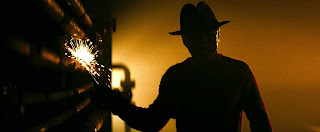 "Working on Nightmare, I started down this road when Sam [Bayer, the film's director] sent me the script and—not with anything specific in mind—we were looking together for a way for me to access the part. He sent me this big book on serial killers and so I started to go through that and get into the minds of these guys. I focused on Ed Kemper. By the way, this actor's work on studying the mind of a serial killer is not fun work. The mind of a serial killer is a messed-up mind. But while I was doing this I noticed there was a movie on Ed Kemper so I thought, 'Let's go check this out' so I brought it up on YouTube and it was a slasher movie. It pissed me off; but, it was at that moment that I realized I was playing a bogeyman and that I really needed to embrace playing this mythical bogeyman, this character from a campfire story. I still wanted to embrace his human side and define what made him tick and go after him in that way; but, it was neat to discover early on that this wasn't an exercise about getting into the mind of a serial killer. It was an exercise in embracing this monster, this bogeyman."
The make-up was particularly challenging for Haley. "Once all the artistic decisions were made for the day's shoot, then the process of putting on make-up was a mere 3½ hours and an hour to get out of it, and that was even before stepping onto the set."
 Curious if Haley had to put in a lot of practice to master his glove, he described that it took only a little bit of time to put it on. First it snapped on and then the screws were secured with a screwdriver and, basically, he kept it on for long periods of time and had plenty of opportunity to work with it. "Luckily, I never stabbed anybody and never cut my face or anything." Kyle Gallner—who plays Quentin—interrupted Haley to remind him that during one of their sequences Haley actually sliced him on his stomach a bit. "Oh yeah, I forgot about that," Haley grinned, "Sorry."
Rooney Mara—who has taken over the role of Nancy Thompson (originally portrayed by Heather Langenkamp)—revealed: "Our Nancy's slighter darker than the original Nancy. She's a tortured, lonely soul trying to figure out what's happening to her."
 Thomas Dekker said the role of Jesse was offered to him no less than a day or two after he finished shooting All About Evil here in San Francisco when he returned home to Los Angeles. Familiar with the original, he didn't even bother reading the script. He saw the title and knew he wanted to do it. As for what he felt about the hazards of doing a remake of such a classic film, he countered, "Remakes and reboots are very tricky subjects and they're very hard to do because you don't want to piss off the people who loved the original and yet you want to give birth to something that new people are going to love, and they're always going to be in opposition. However, when the script is written well and you have great actors—all these folks are incredible—I feel confident and do believe that all of you who are here because you love this franchise will not be disappointed. I'm adverse to remakes and yet this one is great. We have a great product and I think that all we cared about was keeping the faith of all of you."
 Kyle Gallner concurred: "It's a franchise that's been loved by so many people for so long that—when you take it on your shoulders—you don't want to screw things up. You want to pay homage to the original but you also want to have the balls to make it your own and not do a frame-for-frame remake. We want to show you something you haven't seen, technology's different, visual effects are different."
Cross-published on Twitch.
 WonderCon—San Francisco's sibling response to San Diego's ComicCon—roused thousands of fans to the George Moscone Convention Center this Easter weekend on the hunt for more than chocolate eggs. My favorite is always Movies Saturday where thousands pour into the Esplanade Ballroom to get their first glimpse of upcoming blockbusters while listening to creative talent pitch their films panel after panel. I park myself in my front row seat at about 10:30 in the morning and don't leave until the early evening because—once you leave the Ballroom—good luck getting back in!
WonderCon's Kick-Ass panel included comic book creator John Romita, Jr., screenwriter Jane Goldman, and cast members Nicolas Cage, Aaron Johnson, Chloë Moretz, Christopher Mintz-Plasse, and Clark Duke, moderated by HitFix.
 The HitFix moderator noted that—in contrast to Dave Gibbon's reaction to having his graphic novel The Watchmen transposed to cinema after the fact—John Romita, Jr. and Mark Millar had a nearly opposite experience; their comic book wasn't even completed before they began working with Matthew Vaughn, effecting a cross-pollination between the book and the movie. He wondered how Vaughn got his hands on the story and what it was like for Romita and Millar to go through the experience with Vaughn simultaneously?
 Romita quipped that—being Sicilian—"bribery and threats" worked well for him. Vaughn was in need of a project and Millar—who ran into him at a party—mentioned to Vaughn that he and Romita had successfully worked together remounting Wolverine and were working on another interesting project. Up for the gamble, Romita joined Millar in publishing their comic Kick-Ass under Marvel's Icon imprint, even as they began developing Vaughn's film. Romita praised Vaughn for having "good taste in comics" and for recognizing a quality story when he read it. By directing an animated flashback sequence in the film, Romita earned his directorial debut alongside his scribal credits.
 In a world where most people get bullied upon and get their asses kicked, Romita was asked how he felt about delivering a fantasy that turns that situation on its head? "I can tell you what Mark Millar initially said," Romita answered, "that's exactly what he did when he was a kid: exercised, took martial arts classes, and planned to get a costume because he wanted to fight crime. He claims that's what he wanted to do. I think everybody in this room probably fantasized about that." When Millar first approached Romita with the project, he admitted it was a risk but offered a 12-year-old bottle of scotch if Romita could finish the script on time. Romita didn't, so he didn't get the scotch, but from the moment Millar sent him the first synopsis—and, at that time, the character of Kick-Ass wasn't even involved; it was just Big Daddy and Hit Girl—Romita enjoyed it. "Mark is out of his mind and that's the fun of it. It morphed into what it is. So it's working with Mark and working with that story that was just amazing."
 When screenwriter Jane Goldman and Vaughn decided to go with Romita and Millar's unfinished comic book, it was a huge act of faith on their part because they had no way of knowing how the comic book—thereby, their movie—would end. Irregardless, Goldman was attracted to the idea of superheroes without superpowers, which—much to her surprise—hadn't been fully explored. The fact that the movie industry has been plundering the comic book characters that have been around for quite a long time encouraged her and Matthew to work from the angle of a completely fresh character.
 Of course, the character of Hit Girl—the child assassin who has elicited some controversy for her colorful language—was a special challenge for Goldman, who is no stranger to controversy. The mother of two daughters, Goldman felt the character of Mindy McReady (aka Hit Girl) was a strong female role, precisely because she was pre-teen and a nonsexualized female character. That combination is almost unheard of in contemporary cinema where a sexy woman with a gun is considered to be a strong female role, which Goldman doesn't believe it is at all. It was that combination of youth and vigilante activism that struck her first, rather than the idea that people might be outraged. Further, audiences are used to seeing women and children as the victims of violence. Surely it's less offensive to see them kick off violence? As much as people might complain about linking a pre-teen girl with so much violence, anyone who sees the film and situates the character in its context, in its humor, never seems to complain.
As for whether or not she felt there was any place that went "too far" in the writing, something she felt she needed to pull back from, or whether she felt inclined to push all the tropes of the superhero as far as she could, Goldman offered that she always knew the film was intended for an adult audience; but, that being said, she never wanted to push further than the spirit of the comic, she wanted to be true to it, and tell the story as it had been told.
 The readily identifiable and "delicious touchstones" Nicolas Cage has built into his portrayal of Damon Macready (aka Big Daddy), are character-driven, including Big Daddy's mask, and especially his belt. Cage remembered that when Matthew Vaughn first showed him his character's yellow belt, he instantly sourced it to the 1960s Batman TV series as the belt Adam West wore. Vaughn confirmed that's exactly what it was and asked Cage if he thought they could pull it off? Not only did Cage think they could pull it off, he felt the belt was one of the coolest things about Big Daddy's character. Not only did he decide he was going to wear it, but he decided Big Daddy should talk like Adam West in the TV series. West delivered his lines in staccato rhythm in odd inflections that didn't quite go together.
 Cage added that everyone loves comic books because they're like the myths of our times; they give people power. There are people that go out and wear Batman t-shirts underneath their cop uniforms or Superman t-shirts underneath their paramedic uniforms because that's what gives them the guts to go in and get the job done. Cage figured that it was somewhat the same for Big Daddy: mimicing Adam West's portrayal of Batman gave him the guts to fight crime. Cage also remembered dating a girl many years ago whose father was a cop and he always wore these sunglasses and had that moustache that a lot of cops wear and he always called his daughter "child", which Cage thought was strange. He thought of Damon Macready as being like that guy.
 Cage recalled that he learned to read at the age of four-six with comic books. "I would read Stan Lee's stories and the words were so interesting. I learned words like 'opaque' and 'inexorable' when I was six. So I've always had a soft spot in my heart for comic books. I don't want to mislead you. I don't want you to think that's all I read or that I'm on a steady diet of comics as I speak here today, but I think my interest in comic book characters is when they fall within the realm of the supernatural. I like characters that are supernatural like City of Angels [1998, based on Wim Wenders' Wings of Desire (1987)] or Ghost Rider [2007], because when you play a supernatural character, the possibilities are limitless. We're talking about infinity, imagination, you can do anything almost, you're not stuck in a context of reality, whatever that is. So comic books lend themselves to that. That's what it is. They have a big impact. People respond to myths. Comic books give us that power." Asked which superhero he would like to be, Cage responded, "I'd be the Silver Surfer so I could fly through the universe and beat up Superman" to which Mintz-Plasse quipped: "I'd be Galactus, so the Silver Surfer could feed me planets."
 Asked what made him go for the role of Big Daddy, Cage responded that as an actor he feels he has the mind of a student, he's always learning. "I can't always sing the songs that I love because it's too easy," he said. "Sometimes I have to sing songs that make me uncomfortable, that take me out of my comfort zone, so I can learn something, right? I wanted to do Macready because I didn't know how I was going to get around shooting a 12-year-old girl in the chest. It made me a little uncomfortable so I figured I'd better do it." As challenging as he found the role, it ended up being a joy for him because he got to work with Aaron Johnson and Chloë Moretz "and these guys are as good as it gets," he praised. Since he's been around for over 30 years now, Cage tries to learn when he works with different generations of actors. Working with the current generation of actors keeps him relevant. The minute he met Chloë and began working with her, he knew she was destined to become a star because of her charisma and confidence. Immediately they began riffing off each other and there was no question in his mind that the chemistry would work.
 As for his favorite scene in the film? Cage didn't miss a beat: "My favorite scene in the movie, hands down, is when Aaron takes on the three hoodlums and he says something like 'I'm the guy who will take on three guys who are picking on one guy.' He said it with such conviction that I realized at that moment that was his superpower, it was as simple as that. When you see the movie, you're going to ask yourself, 'Would you do it? Would you have that level of guts?' I think a lot of us have been in that situation and wondered whether to jump in or not. That moment inspired me."
 When asked about how he'd trained for his role of Dave Lizewski (aka Kick-Ass), British newcomer Aaron Johnson admitted he mainly just ran around in circles waving his arms. Both he and Christopher Mintz-Plasse (as Red Mist) basically sat back and watched Chloë Moretz do all the action. Both of them got their asses kicked more than kicking any ass. Mintz-Plasse added that—when he first read the script—it was bloody and violent and funny, "and that's everything that I want to see in a movie." He auditioned and read for the role of Kick-Ass, and Matthew Vaughn hated him right off, but offered him the role of Red Mist on the spot. As for Red Mist's look: "They were going for David Bowie. I thought it was more Rihanna, really. I got Christopher Lambert once but I refused to agree with that!"
 Because she dropped the "F-bomb" in the film, let alone talked about giant cocks in the sky, Chloë Moretz was asked how her parents reacted to her performance in this role? Her mother read the script before Chloë and thought the role was awesome and unique and synched to how young kids play. She handed the script to Chloë, fully aware: "Who wouldn't want to play Hit Girl?" Chloë's favorite scene in the film is the one time you see Hit Girl become an 11-year-old girl. You enjoy seeing her kick ass and kill and root for her to do so; but, when she sees her dad in trouble, she realizes it's not a game they're playing anymore, it's real-life, and you see her become a little girl worried about her dad.
Clark Duke—who plays Dave's best friend Marty in the film—helped Aaron a bit with his American accent; but joked: "I'm Aaron's life coach, actually, I focus on health and nutrition." Duke, incidentally, has been receiving great reviews for his comic role as Jacob in Hot Tub Time Machine and his comic talent was readily apparent onstage as he shamelessly pitched for a costume of his own in the Kick-Ass sequel, which—rumor has it—Mark Millar has confirmed.
 I'll be the first to admit that Nicolas Cage is not one of my favorite actors. Along with some admirable work, he's done a lot of big budget dreck. But I never wish him ill will, and am glad that Kick-Ass and The Sorcerer's Apprentice have helped him back into the limelight. He's genuinely funny as Big Daddy in Kick-Ass. He came off quite gracious on both the Kick-Ass and Sorcerer's Apprentice WonderCon panels, despite sounding like Howlin' Wolf (he had laryngitis from an allergic reaction to location shooting in Louisiana). Clearly the big draw of this weekend's WonderCon, I respected how Cage deferred to the performances of his co-workers in both films, in contrast to the grandstanding of some of the younger actors who one might criticize haven't learned to share the stage yet. Case in point would be Aaron Johnson who seemed visibly petulant that he didn't have a name card, and grumbled that his presence didn't "fucking matter." He grabbed Nicolas Cage's name card and said he would be Nicolas Cage. Cage opened his mouth to say something, thought better of it, and stayed silent, which amused his audience. It takes a touch of class, and years of experience, to know that each young actor has to learn how to carry themselves in public. Johnson's next project will be the upcoming thriller Chatroom, directed by Japanese filmmaker Hideo Nakata (Ringu, Dark Water).
Cross-published on Twitch.
 My first conscious exposure to the films of Joseph Losey was with regard to the Film Noir Foundation's successful efforts to strike a restored print of Losey's 1951 eerie noir The Prowler. I say "conscious" because—though I had seen The Boy With Green Hair (1948), M (1951), The Servant (1963), and Boom! (1968)—I didn't connect the author to his work. And isn't that an oddity? That a director's auteurial legibility evades ready identification? That grievous oversight is currently being corrected by Joseph Losey: Pictures of Provocation, co-curated by Steve Seid and Peter Conheim, screening at the Pacific Film Archive through April 16 (when the series ends with The Prowler). As different as Losey's films are from each other, this series has intelligently culled out their connective tissue and common concerns.
 Reinvigorated commentary on The Prowler has surfaced in association, no doubt, with its recent Film Forum revival. At The L Magazine, Matt Zoller Seitz offers a video essay on The Prowler (transcript here) and Justin Stewart reviews same. At The Auteurs, Daniel Kasman identifies The Prowler's ill-fated lovers—Susan Gilvray (Evelyn Keyes) and Webb Gardner (Van Heflin)—as "ciphers" ("you can't call them characters"). While at The Village Voice, J. Hoberman credits Losey's "sordid nocturne" as "the creepiest of film noirs."
Also of note is Brecht Andersch's analysis for SFMOMA's Open Space of Losey's Eve (1962) and Accident (1967), which proved instrumental in my catching both films at their PFA screenings, if only to honor the goddess Venus in and out of furs. Pre-empted by covering the San Francisco International Asian American Film Festival, I'm only now joining the Losey retrospective in process, with hopes of catching the bulk of the program's second half in the next couple of weeks.
 The PFA screening for Eve was introduced by co-curator Peter Conheim who—along with Steve Seid—organized the 15 films plus for the Losey retrospective, as well as writing the program capsules for The Big Night (1951), The Sleeping Tiger (1954), Time Without Pity (1957), Blind Date (1959), King and Country (1966) and The Prowler (1951). Long-time friends Seid and Conheim collaborated earlier on Value-Added Cinema—their scathing indictment of product placement in film—a sampling of which can be found here. Conheim is also a member of the experimental music group Negativland. He is also the co-founder of the band Mono Pause and has played in other groups such as Wet Gate and Neung Phak, as well as in his solo project under the alias The Jet Black Hair People.
Peter was kind enough to respond to a few email questions.
* * *
 Michael Guillén: To start with, let's get some background. Could you tell me a little bit about yourself and your education and how you came to collaborate on PFA's Losey retrospective? How did you and Steve work together to shape this program? Did you divvy up films and, thereby, the research? Was this program affiliated in any way with the recent Film Forum Losey retrospective? In other words, is this a traveling program you and Steve expanded upon? Or did the two of you work from scratch?
Peter Conheim: I'm pretty much a life-long film buff who used to write capsule reviews—complete with one-to-four-star ratings, a system I now despise—when I was about eight years old. My film education has come mainly from mentors at the shops and institutions I worked at in my youth, mostly independent video stores, now deceased.
From 2004-2009 I co-owned and operated a small cinema in Albuquerque, New Mexico, the Guild Cinema. My former business partner has continued to run it. And when I left the theater, I began looking in earnest for ways to apply the various arcane knowledge I've been storing up, and those ways have generally been as an independent curator and film collector, and ersatz preservationist. I'm currently working mostly in the latter arena and hope to produce some restoration projects over the next few years.
 I've worked on and off at PFA since 1997 on a clerical level, though not on a formal curatorial level by any means, and my friendship with Steve Seid goes back to my early video store days in the early 1990s. He's brought me on board several times to work on screenings; we co-curated several outdoor shows in the PFA sculpture garden, and he's consulted with me now and again on his regular shows.
I had been hoping to at least co-curate a Joseph Losey retrospective for several years, and was heartened by the 2008 series at Harvard Film Archive, which was actually 100% complete. Once I knew they had had success with it, and had located some of the trickier prints, I decided to push harder for such a series at PFA. I dropped enough hints that eventually the idea was put forward, though I can't really be credited with instigating it—they probably would have gotten around to it ... Losey has been sort of "in the air" of late.
 We began by drawing up a complete filmography, and once Steve presented me with the various restrictions we had to work with, I pretty much did the first go-round of red-lining titles, passing over certain things in order to be able to show something else (i.e., being able to import Mr. Klein, which is costly, and so only showing one of the two Elizabeth Taylor collaborations—Boom! instead of Secret Ceremony, or choosing Time Without Pity over The Criminal, etc.). We simply weren't able to do it all for many entirely expected reasons. The major omission which was not our doing is The Go-Between, which we were unable to secure a print of. There is only one apparently un-faded color print in existence in the U.S., and it was not available to us for some frustrating reasons best not to go into. So, rather than show a basically worthless print which had faded entirely to red, we chose to omit it. We hope that down the road, Sony—which is the U.S. rights holder—will see fit to do a preservation on this wonderful film, which isn't even available on DVD in the U.S.
 Steve did the majority of the research of the prints, and several are from my own collection: Blind Date and King and Country. In those cases, the distributors no longer had any prints and, indeed, Blind Date is arguably the rarest film in the series in terms of availability. I am aware of two extant prints, both 16mm—and that is literally it.
I've begun making inquiries to see if some other venues around the country might want to pick up on the series. The issue for venues is, and will continue to be, the importation of prints from Europe, Assassination of Trotsky, La Truite, Roads to the South, Stranger on the Prowl and nearly all the British films among them. We've not located prints in the U.S. of any of those titles. And Losey's final film, Steaming, apparently does not exist in print form at all—only Betacam video. Which seems crazy, given that it was only made in 1985, but there you are.
 Guillén: In your introduction to the Losey doublebill of Eve and Time Without Pity, you made a point of emphasizing how different these films were from each other. And they were. And these two, in turn, differ very much from other films of Losey's I've seen. Can Losey be read, then, for his auteurial legibility? Do you consider him an "auteur" and—if so—can you describe what you perceive to be his creative signature?
 Conheim: I would argue that Time Without Pity fits very well alongside his other noir-ish titles, such as The Big Night in particular, as well as The Prowler and Blind Date. I would also argue that Eve fits nicely alongside The Servant and Accident, to a certain degree, but I think it can also be viewed as an anomaly because he was consciously in the grip of Antonioni, Resnais, et al., admittedly so, and I think it's safe to say he was positing himself as making a "serious art film" with Eve. If you read interviews with him, he admits to a certain amount of self-consciousness and excess with the film, and indeed, it's almost hard to believe something as economical as King and Country was made by the same person.
 I find the whole auteur concept to be slippery. When you are a filmmaker working with the "system", the products which emerge were and are inevitably born of collaboration (and compromise), so I think there are genuinely few true auteurs in the real sense of the word; I think of Russ Meyer when I think of the word, not Losey. I think of someone completely on the fringes, in total control of their product, who every once in a while pulled the wool down over the eyes of studio execs and accomplished something truly auteurial, such as Beyond the Valley of the Dolls. Whereas Losey took the jobs that were offered to him for the majority of his life. Some of his best pictures he came onto after they had already been originated, sometimes with other directors in mind—Godard was initially slated to direct Eve, for instance.
 But Steve did, I think, nail the recurrent themes which run through Losey's work which, I suppose, could be considered the marks of an auteur: characters up against an unfair system, or deeply flawed, being forced to reckon with their flaws. Certainly he filtered his 1950s work through his experiences as an exile—it's pretty hard to separate the work from his life during that period.
There are certainly different ways to approach an overview of a director with as varied a resumé as Losey; from the standpoint of an easily digestible evening at the cinema, we could have put The Big Night and Time Without Pity together, or The Servant and Accident together, but I think Steve was wise in mixing them up, effectively discarding an easy definition of "auteur" for Losey.
Because I am a sick and cruel person, I would have put Boy With Green Hair and King and Country together, myself. On Easter!
* * *
 As stated earlier, Joseph Losey: Pictures of Provocation continues through April 16 at Berkeley's Pacific Film Archive, with screenings on Friday, April 2, of Blind Date (1959) and Modesty Blaise (1966); on Sunday, April 4, of King and Country (1966), with an encore screening on Thursday, April 8; Boom! (1968) on Friday, April 9; Mr. Klein (1976) on Saturday, April 10; wrapping up on Friday, April 16, with the restored archival print of The Prowler (1951), preceded by Losey's short A Gun In His Hand (1945).
Cross-published on Twitch.
 Like ships passing in the night, Brecht Andersch and I literally met on the BART train on our way home from a PFA screening, introduced by our mutual friend Brian Darr. His essay "Venus In and Out of Furs: Joseph Losey's Eve and Accident" for SFMOMA's Open Space convinced me to catch those two films in PFA's retrospective Joseph Losey: Pictures of Provocation, currently running through April 16.
 Currently serving as Board Chair of the Bay Area-based Film on Film Foundation—whose mission is to encourage the appreciation of projected celluloid motion picture film as central to the cinematic experience—Andersch has curated the on-going FOFF series "Radical Strategies" since May 2007, including rare screenings of Jean-Isidore Isou's Traité de Bave et d'Èternité (Venom and Eternity, 1951), Yoshishige Yoshida's Eros Plus Massacre (1969), and Joseph Losey's Accident (1967). He also spent much of 2009 writing the weekly column "Highly Recommended!", focusing on the Bay Area repertory film scene, for the Film on Film website.
 Michael Guillén: How did you come to appreciate the work of Joseph Losey?
 I'm deeply interested in many filmmakers, but I certainly consider Losey in the top echelon. Until the mid 80's, when he died, he was generally considered one of the world's major directors. Since then, there's been a reversal of fortune in critical opinion, and his Hollywood films have been getting much more attention than his later European Art-House output. I love films from throughout his body of work, don't value one period over another (although his late period definitely wasn't the best), and find the arc of his career highly exciting—there have been European filmmakers widely seen as artists who've gone to Hollywood and had successful careers; but, as far as I know, Losey's the only Hollywood filmmaker to reach the heights of European Art Film culture, where he was widely seen as a major figure.
 Andersch: Peter's definition of the term is very American, coming from an underground, experimental film, and Punk DIY sensibility. But "auteur" is a French word and concept, and I think you have to understand it from its original Cahiers du Cinéma context. The idea was cognizant of, and held up as an ideal, the total mastery and control of a Hitchcock (who to a large extent embodied the practice of Alexandre Astruc's "camera-stylo"—camera pen—conceptualization), but really was applied to all directors who were able to impress their personalities on a film (or—to think of this process as more gentle and humane—to imbue their films with their sensibilities).
 One of, perhaps the defining auteur was Nicholas Ray, of whom Godard famously said "Nicholas Ray is cinema". Ray, to some extent, chose his projects, had a hand in writing their scripts (certainly influencing them, or having them re-written by others if he couldn't get what he needed from the original scriptwriter, or re-writing them himself, all this often amidst production), and did the usual work of a director: all the aesthetical production decisions, creating shots, guiding actors in their performances, planning how cuts would work in the editing, and influencing how they actually came out. He never had complete control over his work or career, however, and lasted as a creative artist in full control of his abilities for only roughly a dozen years. By the standard of Ray, Losey was very much the auteur. His films are every bit as impressed with his personality as Ray's, and he was able to get much more control over both individual films (or at least many of them), and his career. Roughly the same age (and of course coming from the same town, LaCrosse, Wisconsin, where they knew each other, having gone to the same high school, and then were later friends and associates in the New York leftist theater scene), they started filmmaking pretty much at the same time. Losey's career lasted much longer, however—over 30 years. He had his best decade, the 60's (winning big prizes at Cannes, etc.), at a point when Ray was dropping out (he stayed out for a decade before resurrecting as a semi-underground icon). So in my opinion, Losey was about as "auteur" as you can get.
 To the culture which developed the auteur concept, that is, French cinephilia, Losey was definitely the auteur, or at least he was to a major segment from at least the early 60's. He was a key figure to the MacMahonites, who were also rabid fans of Robert Aldrich, among others. A lot of why he has become ignored in English-speaking cinema culture is wrapped up in his becoming the key figure for 10 or more years in English cinema. The English have a unique talent for lopping off the heads of those who let their brilliance shine all-too-clearly. Look at Michael Powell.
 This relates to, as Losey might have put it himself, the whole hetero/homo/bi-sexual issue. There's a whole lot to say about this, but let me cut to the chase and say that Losey, who presented himself as a heterosexual who acknowledged homosexual feelings, has never been a figure who's made broad swathes of Anglo-American cinephiles and critics comfortable. You can imagine all the eye-rolling greeting Stanley Baker's exit from the bar in the opening scene in Eve, for example.
 Andersch: I discussed the issues re. his mother and father in the last section of my article, and think this dynamic, as explored in David Caute's biography Joseph Losey: A Revenge On Life (which, by the way, I have very mixed feelings about), pretty much provided the template for his relations with, and feelings towards women. He deals frequently—and especially in both Eve and Accident—with an area not often explored in narrative art: masochistic feelings by heterosexual men towards women. Some great filmmakers and writers have dealt with this, but not often. Josef von Sternberg is the most obvious major figure to delve into this extensively, and maybe his The Devil Is A Woman (1935) is the great masterpiece along these lines. Von Sternberg's film is adapted from a terrific Pierre Louÿs 1898 novel, La Femme et le pantin (The Woman and The Puppet), later adapted as Luis Buñuel's last film, That Obscure Object of Desire (1977).
 Both films treat the man's feelings satirically, ritualistically. There is clear masochistic pleasure taken in the ironies of his situation. Both, however, hint at a feeling plunged into by Losey in Eve and Accident: resentment at women for the power they have within the man's internal psychology. I don't know of any culture which has any love to spare for the straight male who abdicates, or can't inhabit sexual self-assurance, or is prone to open emotionalism (although maybe the French go the furthest). This just really isn't in the normal paradigm of what's considered sexy, so unless you're an out-and-out masochist, as a heterosexual male artist you aren't going to deal with this stuff openly. Of course, large numbers of straight men (no doubt probably the vast majority) want a heterosexual version of what some gay men get to have: much sex with many partners. Few get this opportunity, and usually only by those of great fame and wealth. This is a natural source of resentment.
 I don't think Losey saw women as toxic, so much as tantalizing. Being tantalized without satisfaction for those not so masochistic is torturous. The issue of misogyny is often brought up in connection to these kinds of feelings when they're revealed. Personally, I've never understood this label. Is having an emotional issue of some kind with women equivalent to hatred? There are very few men and women who don't have issues with the opposite sex, and perhaps just as few who don't have related issues to their own. I think the world Losey portrays—in my opinion quite accurately—is a sexual battleground in which men and women are in natural conflict with each other for what they desire, and are at the same time in conflict with members of their own sex in achieving their ends.
 Towards the beginning of his oeuvre, Losey blames hierarchical, Capitalist society for this situation, and indicates false consciousness as the root of the problem, the factor which keeps us enslaved. This take is best exemplified by The Prowler. As he goes along, Losey observes class dynamics at play, but is less fixed on the idea that they can be addressed via individual or collective enlightenment. By Eve and Accident, he seems to arrive at the sex war situation being archetypal, ingrained into the structures of our psyches. Eve begins and ends with references to Adam and Eve's expulsion from paradise (there are numerous citations of this throughout the film, actually)—since eating from the tree of knowledge, man and woman are condemned to pain, struggle, disharmony. By Accident, Losey seems to no longer be protesting this situation, but merely observing it, as indicated by Sassard's departure with the Kali figurine. She's played her innocent role, leaving the lives of all involved in disarray (or in York's case, brought to an end). Bogarde rejoins his family in their home as the sound of the accident plays on the soundtrack. It will be a lingering reminder of a irrevocably disordered world for a long time to come.
 I believe you've an interest in Jungian psychology? I don't know of Losey ever mentioning Jung, but I'm sure he would have read him. He kept up with the intellectual developments of his time. Whether he liked him, I can't say, but, as a Jungian myself, I apply ideas from Jung in thinking about Losey. The male artist with obvious resentment towards women has an overpowering anima which seeks expression via his work. Losey tried to present himself as highly rationalistic, but he seeped (mostly understandable) bitterness and resentment from his pores. He tried for many years to ascribe his emotional issues to problems in the set-up of society, but I think the reality is he had a highly feminine aspect to his nature which he tried to suppress but couldn't, leading to the leakage. The heterosexual male artist must deal with this issue—must come to terms with his feminine, feeling aspect—or he'll come apart at the seams. The anima will lead you to where you need to go, you just have to follow, pursue. Losey did follow, and by his fifties or so reached a certain emotional equilibrium after The Servant and its success, but it was a rough ride. As shown by Eve, he had a giant-sized anima; an anima to rule the world.
 In Losey's actual relations with woman (as well as non-sexual ones with men), he always tried to dominate. If he could, he would, so I'm not saying anything simplistic regarding his psychology, like he was a simple sexual masochist; although maybe he was, I don't know.
 Guillén: Associated with the Hollywood Left and forced into exile in Britain to flee the HUAC inquisition, how valid do you think the HUAC's concerns of Losey's leftist leanings were? It might seem like a moot point today, but how much do you think his politics influenced his art? Was there any tell-tale evidence? Especially with regard to his examination of the power structures inifluencing gender and class?
 Losey is a fascinating case study of an American Stalinist who lived in a state of self-willed delusion. Through the Ciment book, he left a pretty detailed record of his intellectual development and the evolution of his world-view. By this book you can see how he really believed, and was able to force from consciousness all doubts regarding Stalin, and the mass-murder Stalin was perpetrating in the Soviet Union. Losey was a man of deep perception in any environment he actually was immersed in, but he could invest faith in the Soviet Union because of its distance. This is an interesting inversion to the paradigm we, as Americans, encounter more frequently: those who are able to ignore, or force from consciouness, or excuse injustices right under their noses (or which are caused in other countries directly by the actions of our own) because they've heard that it's much worse elsewhere. However Losey deluded himself about the "elsewhere", he was pretty clear about the insanity of the society right in front of him.
 Losey, as an outsider in Britain, was very psychically impacted by the British class system, and this registered very deeply within his work, which dealt with this theme very incisively and much more frankly on a regular basis than just about any British filmmaker has ever done. I think this contributed to the resentment against him, much of which was unconscious. His brazen foregrounding of style was another. It was very un-English, especially at that time. Even many of the best English critics didn't get him. Unless I'm much mistaken, he wasn't very popular amongst the MOVIE critics, for example (certainly the greatest collective of film critics in the English language of that generational cohort). V.F. Perkins for example, in his largely brilliant book Film As Film extols the virtues of Richard Brooks, while using examples from Losey as how one shouldn't make a film! Losey's manner was just too jaunty, too overt, too aesthetically oriented towards the exquisite and, simultaneously, too Brechtian.


